HVAC Marketing Strategies That Actually Work for a 5-20 Tech Shop

The conventional HVAC marketing advice is wrong for most shops
The typical HVAC marketing guideline is to put more money into Google Ads and Facebook until your calendar is full. That isn't the case for most businesses with fewer than 20 technicians, which is why many residential contractors we speak to say they have lost five figures' worth of leads because they weren't able to service them quickly enough.
In our experience, the shops that outgrew their competitors during the cooling season didn't hire a new agency. They bridged the gap between the lead arriving and the technician showing up. After 14 years of customer conversations and data collection, we've seen a consistent pattern: marketing spend only goes so far if the dispatcher board, mobile application, and invoice cycle that follows aren't tightly connected. If a homeowner fills out a form at 9:47 a.m., they're expecting a call before lunch. If that doesn't happen, you've paid full price for a lead that has just contacted your competitor.
The Bureau of Labor Statistics projects HVAC/R installer employment growing 8% from 2024 to 2034 with about 40,100 openings a year. In our customer base, the shops absorbing that demand without adding office coordinators are the ones running tight ops, not the biggest ad budgets.
What follows is the playbook I'd hand an owner running a 5 to 20 tech HVAC business. Where standard advice is wrong for a small-to-mid shop, I'll say so.

A pattern across HVAC operators: the marketing multiplier that lives in the field
We've observed a pattern across HVAC operators over the past several cooling seasons: businesses that outperform their competitors in Google reviews and referral share are typically the same companies that solved a common fieldwork problem a few seasons earlier. Consider an owner-operator of a home-based HVAC business with fewer than 10 technicians in the Carolinas.
Across the HVAC operators we've worked with since 2018, sub-10-tech shops in the Southeast typically skip structured onboarding and instead rely on shadowing and ride-alongs during spring tune-ups. The result is that callbacks tend to cluster around technicians who weren't taught to measure subcooling, because that was what they were taught on their first day.
In the course of one cooling season, this owner watched technicians leave to join larger companies that advertised paid training. The newer techs ignored subcooling inspections and misinterpreted low-charge calls as airflow problems. There was no way to determine which techs were not following the process. Callbacks were reported only after customers complained, not through the diagnostic process.
Beginning the following spring, he spent one Friday morning each month riding with one technician and noting what was skipped. After a month, the team was recording static pressure, subcooling, and capacitor microfarad readings against the nameplate. The initial version was too long, and the technicians didn't follow it. He shortened it twice before it finally stuck.
During the busy summer months, retention remained steady. Callbacks for missed diagnoses dropped by around one-third by the end of the summer. Fewer callbacks meant fewer unhappy reviews, which improved the company's Google star rating and increased organic referrals. In the end, each ride-along took about half a day of billable work. The senior installation technician adopted the checklist immediately. One mid-tenure technician, however, interpreted the instruction as criticism and left.
Composite cases are based on the pattern we observe across HVAC providers in the Carolinas. Each marketing channel below builds on the same premise: what happens in the field will appear later in reviews, referrals, and paid-lead economics.
1. Your website is a lead engine or it's dead weight

Most HVAC websites in 2026 are just brochures. That's fine if your business relies solely on referrals. It's a mistake to pay for advertising or SEO because you're sending paid traffic to a website that doesn't generate bookings.
The test is simple: can a homeowner use your website on a phone and complete the task in less than 90 seconds without calling the number? In most shops, the answer is no. The form has 12 fields. Submitting it doesn't provide any confirmation. The lead goes into an inbox that isn't checked after 5 p.m. The dispatcher uses another tool, and the owner notices the missed lead two days later.
The fix is a lead-capture form that feeds directly into your scheduling system. An HVAC contractor reviewing Field Promax on the QuickBooks App Store described this working: web leads route straight to the dispatch board and techs get assigned same-day. In our customer base, shops that wire these two systems together consistently report meaningfully more bookings without adding office staff. That's not a website story. It's the plumbing between your website and your HVAC scheduling and dispatch software. If those two systems aren't wired, redesigning the homepage won't help.
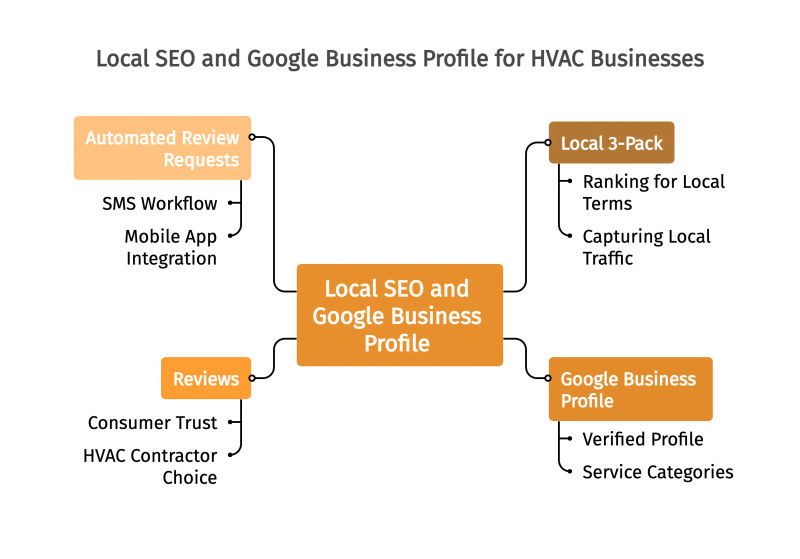
2. Local SEO and Google Business Profile beat generic SEO
Ranking nationally for "HVAC repair" is an ambitious five-year project that can cost six figures, with little return on investment for a 12-tech shop. Ranking for "furnace repair [your town]" in the local 3-pack is a 90-day effort that can significantly increase phone calls.
The local 3-pack captures the largest share of clicks from local search results. Without a verified, well-reviewed Google Business Profile, nearby intent traffic is directed to the three competitors who have claimed and optimized theirs. According to our experience, the businesses that close this gap most quickly pair a complete Google Business Profile (with all 12 relevant service categories) with automated review requests after each job. No extra blog posts. No backlinks.
BrightLocal's 2024 Local Consumer Review Survey reports 75% of consumers always or regularly read reviews for local businesses, and a Clear Seas Research study found 91% of homeowners rate online reviews as important when choosing an HVAC contractor. Our data shows the shops leaning on a handful of stale 4-star ratings lose head-to-head against competitors collecting fresh reviews after every job. Automating that ask through your field service software (we handle it via automated Google review management) reliably lifts booked calls within a quarter. Mechanically: when a tech marks a job complete on the mobile app, an SMS goes out within 15 minutes with a one-tap link to your review page.
3. Local Services Ads pay off, but only if your dispatch can keep pace

Google Local Services Ads are the highest-intent HVAC lead channel in 2026. SearchLight Digital's LSA benchmark shows HVAC LSA leads booking at roughly 44%. In our customer base, shops hitting anywhere near that book rate are the ones whose dispatchers see the LSA call in the same tool they use to schedule techs. Standard Google Ads for the same searches convert at 7-8%, per First Page Sage's 2026 CPL report, with blended HVAC CPL around $92 and non-branded closer to $149. The pattern we watch: shops that turn on paid before fixing dispatch pay premium rates for leads their competitors close.
The issue is that LSA leads come in as phone calls. Google evaluates your business based on your response rate and response time. If you don't answer promptly, you still pay for the lead, and slower response times can reduce the number of impressions your ads receive. Owners on the r/HVAC forum often discuss turning on LSAs, spending several thousand dollars in a single week, only to find that a quarter of their leads are misrouted or answered after the caller has already hired another contractor. It's a dispatch problem disguised as an advertising problem.
Based on what we've observed over time, referrals continue to outperform LSAs in close rates, while LSAs generate significantly higher lead volume. Shared marketplace leads from platforms like Angi and HomeAdvisor typically have the lowest close rates. The goal isn't to choose between referrals and LSAs. You need both. You also need intelligent call routing that directs LSA calls to the nearest available technician rather than someone sitting in the office.
4. Reviews are your cheapest acquisition channel; email is your cheapest retention channel
The economics of reviews are asymmetric. A 5-star Google review typically costs nothing more than a 30-second SMS automation, while the average Google Ads lead costs between $92 and $149. Yet most shops we onboard have fewer than 40 lifetime reviews and no consistent process for requesting reviews after every completed job.
Automating the review request is more important than the exact wording of the message. When a technician closes a job in the mobile app, an SMS should be sent immediately, before the homeowner gets back to their routine and forgets about the experience. Based on feedback from our customer base, shops that automate review requests often see a measurable increase in monthly reviews within the first billing cycle, with improvements in local pack rankings typically following over the next two quarters. One plumbing shop owner reviewing Field Promax on G2 noted that automated post-service SMS follow-ups allow customers to respond and schedule their next job within minutes, saving dispatchers hours of follow-up work. The same automation principle applies to customer retention, not just review generation.
Email is the retention counterpart, and it's underused. FieldEdge's HVAC email benchmarks put industry-standard performance around a 23% open rate and 3% CTR - modest looking on paper, but the list is warm and send cost is negligible. From 14 years of customer conversations, small plumbing and HVAC shops that actually send seasonal tune-up reminders and post-service follow-ups tell us email is the cheapest repeat-revenue channel they run. A single Q1 spring tune-up campaign to your existing list often outperforms a full month of Facebook ads on cost per booked job. The bottleneck isn't strategy. It's whether your customer database is clean enough to send from, which is downstream of whether invoicing and job history live in one system or five spreadsheets.

5. Mobile-first execution is the multiplier for every other tactic

Mobile isn't just a website design topic. It's the entire chain of operations between a homeowner making a call and cash landing in your account.
Every strategy described in this article depends on mobile app execution: routing Local Services Ads (LSA) calls to the nearest technician, triggering an automated post-job SMS review request the moment a ticket is closed, and sending invoices from the truck before the technician even leaves the customer's driveway. Mobile app adoption by field technicians is one of the strongest indicators of a successful field service management (FSM) rollout. If your technicians aren't updating job status from the field, your marketing investment will leak away through slow, disconnected operations.

The number that matters isn't mobile traffic share. It's how long it takes for the job to be completed and the invoice sent. Across our customer base, shops running same-day mobile invoicing compress cash cycles from over a week to same-day. That compressed cycle funds next quarter's marketing budget. Give techs a mobile app for HVAC technicians that handles job status, signatures, photos, and invoicing in one flow, and the review, referral, and email machinery downstream has something to work with.
The pattern I keep watching is shops spending $3,000 a month on Google Ads while their dispatch board runs on paper. Wrong order. In our experience, cold Google leads for residential HVAC installs close at much higher rates when the shop calls back within an hour, and drop toward single digits by the next morning. Marketing spend is a multiplier on operational speed.
If techs aren't updating job status from the field, if your dispatcher can't see who's closest to a new inquiry, if invoices go out three days later, you're paying premium ad rates to fill a leaky bucket. Owners who fixed dispatch first, then turned on paid acquisition, tell me they meaningfully cut cost per booked job without changing their ad budget.
- Joy Gomez, Founder of Field Promax
Where to start, in order

The five plays should be executed in sequence. First, build a dispatch-ready website. Next, put local SEO, review generation, and other organic marketing efforts on autopilot. Third, layer Google Local Services Ads (LSAs) on top of a disciplined dispatch process. Fourth, send post-service SMS messages and email follow-ups to your existing customer list. Finally, tie everything together with seamless mobile execution.
If you manage between 5 and 20 technicians and don't have your mobile app, dispatch, and invoicing fully integrated, don't increase your ad spend yet. Fix the operational plumbing first. Field Promax was built for shops that don't have the budget for enterprise-grade marketing suites and don't need the added complexity.
Keep the marketing engine running
Conclusion
Fix the operational plumbing between your website, mobile app, dispatch, and invoicing before increasing your advertising budget. Once those systems are working together, you can confidently scale your marketing spend.
Frequently Asked Questions

Content Creator
Bhargavi Halthore is a content writer at Field Promax, a field service management platform serving trades businesses across the USA and Canada. With over a decade of experience writing for business owners, she brings detailed, ground-level insight to every topic she covers. Her research goes beyond search results - she digs into LinkedIn groups, Facebook communities, and Reddit forums to understand what field service business owners are actually dealing with on the ground. She speaks directly with industry professionals, understands their day-to-day challenges, and translates that into content that is practical and actionable. What you read in her articles reflects real industry patterns, not theory.