Preventive Maintenance Checklist for Commercial Buildings: A Field Service Owner's Guide

Imagine the owner of a commercial maintenance shop in a mid-sized Midwest metro with around 14 techs and two dispatchers, a mix of plumbing and HVAC teams, and contracts for around forty office buildings as well as light industrial locations. Monday morning, the board for PM inspections is twelve inspections deep. This isn't because the work wasn't done. However, three filter changes completed last week never made it back to the office as fully completed tickets. The tech completed the work. The paperwork was left on a truck console. The customer's portal still shows the unit as due, but finance is unable to invoice the quarterly PM line until someone digs out the completed commercial building maintenance checklist.
This is the workflow that breaks first in a commercial PM program. Not the checklist. The handoff.
Ready to get started with Field Promax?
Sign Up FreeOwners on Quora describe the same problem: paper work orders moving between the office, technicians, and dispatch, where transfers are lost and there is no visibility into who is holding the ticket. The bottleneck is rarely writing better checklists. It's routing the completed maintenance checklist for commercial building operations back to invoice fast enough to keep the PM contract profitable.
The remainder of this article is built around the 14-tech scenario. There's a no-cost template at the end of the guide.
Why does preventive maintenance break down in a 14-tech commercial shop?
Preventive maintenance is the scheduled work, such as inspections, filter changes, calibration, lubrication, and valve checks, that catches a failure before it becomes a billable emergency callout. BOMA-aligned commercial building benchmarks put repair and maintenance at roughly 15% of total operating expenses, and IFMA analysis suggests well-run PM programs return multiples on cost. Operators who treat PM as a billable contract line, not a cost center, are the ones who actually fund the program instead of gutting it when summer emergency calls spike.
The failure mode we see most often is a dispatcher running PM schedules in a spreadsheet, work orders printed on paper, and a tech whose ticket lives in a glove box for three days. ASHRAE Standard 180-2018 sets minimum inspection frequencies for commercial HVAC. The spreadsheet shop can technically meet those frequencies. What it cannot meet is the documentation requirement. Shops fail tenant PM audits not because they skipped work but because they cannot prove they did it.
The U.S. Department of Energy's Better Buildings program estimates effective PM of commercial HVAC delivers 5 to 20% energy savings versus poorly maintained systems. The spread inside that range maps almost perfectly to whether the shop has mobile checklists in the field. The high end goes to shops that catch a drifting refrigerant charge in month three instead of month nine.
A functional commercial building maintenance checklist addresses two issues in one go. The checklist defines precisely what needs to be checked and creates the evidence that proves the work was actually completed. Without both, you're left with a schedule, but no proof that the work was completed.
OUR STANCE: Most field service businesses treat their maintenance checklist like a homework assignment - something to fill out after the job is done, not a system that drives the job in the first place. That's backwards. Your checklist should trigger the work order, assign the tech, capture the completion proof, and flag anything that needs follow-up. Without that loop, you don't have a PM program. You have a paperwork problem.
What does a working PM checklist actually look like in the field?
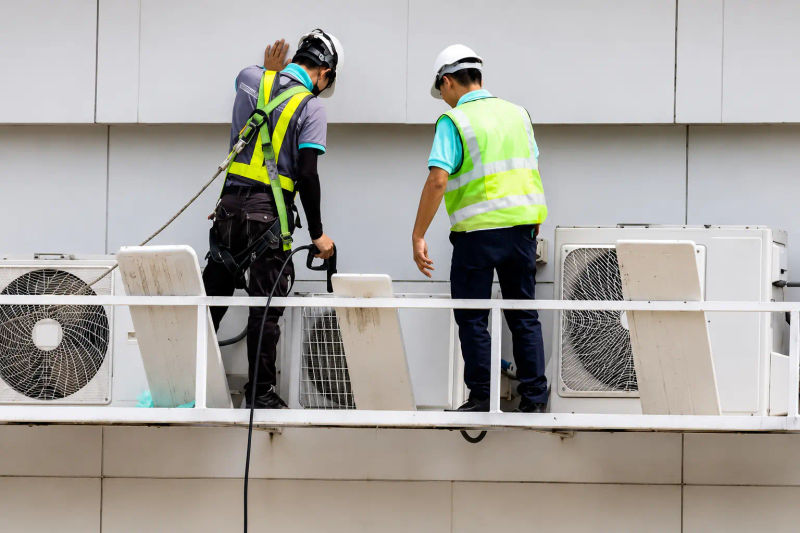
A PM checklist is the structured task list a tech runs at a site visit. For commercial buildings it covers HVAC inspections, plumbing assessments, electrical checks under OSHA 1910.147 lockout/tagout procedures, fire and life-safety verifications under NFPA 25 and NFPA 72, structural exams, and exterior maintenance. OSHA 1910.147 specifically requires written, equipment-specific energy-control procedures and annual periodic inspections by an authorized employee other than the one using them. Shops that pass audits keep those procedures in the mobile app where techs reference them at the truck.
Good checklists are scoped per asset, not per building. A chiller has its own task list distinct from an air handler. NFPA 25 sprinkler inspection frequencies run from weekly through 50-year depending on component and sprinkler type. The 14-tech shop running PM on a single generic commercial building maintenance checklist will miss component-level frequencies every time.

What separates a working maintenance checklist for commercial buildings from a standard paper checklist is its mobile accessibility. Mobile accessibility means a tech can pull up the asset-specific checklist at the unit itself, rather than working from a generic printed sheet. Without mobile checklists, steps can be missed because there is no evidence that they were actually completed.
Aberdeen Group research pegs the industry-average first-time fix rate at 75%, while top-quartile field service teams exceed 88%. The difference is mobile access to service asset history, service records, and standard checklists, with adoption rates of 82% among leaders compared to 48% among laggards. Shops that shift from troubleshooting based on tribal knowledge to mobile PM checklists regularly see callback rates drop within one quarter.
A pattern across multi-trade operators we've worked with
With multi-trade firms we've worked with since 2018, the reason for frequent failures is not software. The dispatcher is running the HVAC board in one application and the plumbing board in another, then focusing on the overlap. The scenario closest to the owner-operator involves running HVAC and plumbing teams with one dispatcher and about 14 technicians in an average-sized Midwest metro area, which becomes especially challenging during a busy spring season.
The shop was double-booking techs whose licenses covered both trades, as the dispatcher maintained two separate calendars and reconciled them from memory. Estimate disclaimers compounded the problem: HVAC estimates carried weather and equipment-availability language, while plumbing estimates carried material-assumption language. If a scope crossed both trades, customers could choose whichever disclaimer was more favorable to them. By midweek, no one trusted either calendar.
The owner's solution was to reorganize the two boards into one calendar that the dispatcher could work from exclusively and then force all bookings through that system, regardless of whether the senior plumbing technician pushed back. Parallel to that, he changed the disclaimer to a single template that covered all trades' exclusions, scope-of-work limits, assumptions, access requirements, and weather conditions.
Double-bookings were essentially eliminated after a rough start to the month, when the calendar unification brought out issues that had previously been concealed. The disclaimer required two revisions after a client protested a water-damage exclusion that appeared to be overly broad in the unified template. The plumbing foreman remained the one who resisted calendar adoption beyond the second month.
This is a composite, with the specifics tied to the most commonly used variation of this pattern among multiple-trade operators we've had the pleasure of working with.
Where does the real ROI on a PM checklist actually show up?
The biggest benefit for owners is faster invoice processing. In a typical shop with 5-20 techs, handling paper work orders for PMs can burn 8-10 hours per week searching for lost tickets, re-keying notes, and matching invoices to paperwork. Shops that switch to electronic work orders can reduce that time to under an hour because tickets are automatically routed from the office to the technician and then to invoicing when the work is completed.
Another benefit is the reduction of ticket leakage. People who manage paper tickets in shops with 5-20 techs estimate that around 15% of tickets are lost or duplicated. Some never return in a form that can be invoiced. Digital work orders reduce that 15% leakage to essentially zero. For a property maintenance contract that includes quarterly PM visits at $850 per visit across forty buildings, a 15% leakage rate can amount to roughly $20,000 in annual revenue that the shop earned but never billed.
The third is unplanned downtime. Aberdeen and ABB benchmarks show real-time digital asset tracking paired with proactive maintenance cuts unplanned downtime by roughly 30-50%, against the U.S. manufacturing baseline of 800 downtime hours per facility per year. Shops that move equipment service history out of glove-box folders into digital asset records catch failing units before they fail. This is where equipment tracking with full service history earns its keep.
Other benefits include longer equipment lifespan, regulatory compliance with ASHRAE 180 and NFPA 25/72, a more secure environment for occupants, and higher tenant retention. These benefits stem from the same three factors.
How do you build a PM checklist that techs will actually use?
The most common feature request I hear from commercial maintenance shops is not a better checklist. It is faster dispatch-to-invoice. The checklist itself - HVAC filter changes, sprinkler valve checks under NFPA 25, lockout/tagout under OSHA 1910.147 - all of that is well-trodden ground. What kills the PM contract margin is the three-day lag between a tech finishing the work and finance having a billable record.
Industry conventional wisdom treats PM software as a scheduling problem. From 15 years of customer conversations I would push back: it's a documentation problem. The shops that fund a thriving PM program are the ones where the completed mobile checklist becomes a billable invoice the same afternoon. Build the documentation loop first. The schedule follows.
- Joy Gomez, Founder of Field Promax
The build sequence we recommend:
- Inventory assets first, not buildings. Visit every site and record each asset with its make, model, installation date, and OEM service intervals. The asset register, not the building location, serves as the primary unit for PM planning.
- Set frequency from regulation, OEM spec, and run hours. OSHA 1910.147's annual inspection requirement (covered above) applies here too. NFPA 25 establishes sprinkler inspection intervals that range from weekly to every 50 years. NFPA 72 covers fire alarm inspection intervals ranging from weekly to annually. Use these as baseline requirements, then tighten the intervals based on equipment age, environmental conditions, and operating hours.
- Customize task lists per asset class. A monthly HVAC checklist includes filter changes, belt tension and wear tests, condenser coil cleaning, refrigerant charge confirmation under EPA Section 608, and a condensate drain-pan flush. A quarterly life-safety and fire-safety checklist includes main drain tests, control valve inspections, and appliance notification tests. Do not use a single generic checklist across all asset classes.
- Build the mobile field flow before the office flow. Mobile-app adoption by techs is the single biggest predictor of a successful PM rollout. If the tech does not open the checklist on their phone at the truck, the program fails. A field service mobile app that techs will actually open beats a desktop checklist only the dispatcher ever sees. The right preventative maintenance tools are the ones your techs actually use at the site, not the ones that live on the dispatcher's desktop.
- Wire dispatch to invoice. Treat the handoff from a completed checklist to invoicing as a primary element of the rollout, not as an afterthought.
- Train, then iterate. Use the checklist for one quarter, collect completion-rate and callback data, and then make revisions. The first version usually reveals tasks that existed only in a senior technician's knowledge and were never formally documented.
What's in the free PM checklist template, and where should you start?
Below is a downloadable starting template for electrical, HVAC, plumbing, life-safety, exterior, and structural tasks at daily, weekly, monthly, quarterly, and annual intervals. It can be customized because each commercial building has a unique asset mix, and each contract includes different SLA requirements.
One long-time Field Promax user on the QuickBooks App Store described the platform as one of the best work order software solutions they had used, praising its user interface and responsive support. Ensuring the work order is structured correctly before allowing invoices to flow from it is a sound approach for commercial PM rollouts.
If you are a property maintenance, HVAC, plumbing, or electrical shop running PM on spreadsheets or paper today, the move that pays for itself fastest is digitizing the work order itself, then layering the checklist on top once the dispatch-to-invoice loop is closed. The platform is built for that migration: property maintenance PM scheduling, asset-level service history, and mobile field workflows.
The Complete Commercial Building Maintenance Checklist by System
The dispatcher at this 14-tech shop isn't merely managing filter changes. Forty buildings means eight distinct systems in each location - HVAC, electrical, plumbing, roofing, elevators, fire safety, pest control, and security. Each one has different failure modes and inspection frequencies. Using a uniform checklist for all of them is the fastest way to miss component-level maintenance needs and the reason tenant audits can go wrong.
The table below outlines the primary tasks, required frequency, and licensing requirements for each system. Use it as a scaffold for your asset-specific checklists - and then adjust according to the equipment age, building type, and local regulations.
One case that illustrates what a missed quarterly cycle costs: a 14-story office building in Phoenix had a rooftop HVAC cooling tower losing 18% capacity over nine months - completely undetected until tenants on floors 12-14 filed temperature complaints in July. Emergency chiller replacement ran $127,000 plus three weeks of tenant credits. A quarterly work order capturing that cooling tower's condition in month three would have flagged it for roughly $4,200 in corrective work. That's the math on quarterly frequency (OxMaint Commercial Building Benchmarks, 2026).
| System | Monthly Tasks | Quarterly Tasks | Annual Tasks | Licensed Trade Required |
| HVAC | Air filter inspection/change; drain pan check; thermostat calibration | Coil cleaning; refrigerant charge verification (EPA Sec. 608); belt and pulley check; condensate drain flush | Full system tune-up; duct inspection; safety controls test; ASHRAE 180 documentation | EPA 608 certified; licensed HVAC contractor |
| Electrical | GFCI outlet and breaker test; emergency lighting test; panel cover visual | Distribution panel inspection; generator and UPS test; outdoor lighting check | Thermographic scan of panels; licensed wiring review; NFPA 70B compliance check | Licensed electrician (state/provincial) |
| Plumbing | Leak inspection; water pressure zone check; floor drain flush | Backflow prevention test; sump pump check; water heater anode inspection | Drain camera on buildings 15+ years old; sprinkler supply line pressure test; Legionella risk review | Licensed plumber (backflow certification required) |
| Roofing | N/A | Drain and scupper clearing; flashing and membrane inspection; sealant check at penetrations | Full roof certification per NRCA guidelines; waterproofing review | Certified roofing contractor; post-storm trigger regardless of schedule |
| Fire Safety | Pull station test; sprinkler head clearance check; extinguisher pressure and tag; exit lighting test | Flow and tamper switch test; fire door closure and latch check | NFPA 72 full alarm test; NFPA 25 sprinkler certification; fire pump annual test; generator load test | Certified fire contractor (NFPA 25/72 mandatory) |
| Elevators | Emergency comms test; cab interior check; door alignment | N/A | State/provincial licensed inspection; lubrication; safety device verification | Licensed elevator contractor (no exceptions) |
| Pest Control | Perimeter entry-point inspection; exterior lighting check; storm drain grates | Licensed IPM treatment; parking lot trip-hazard check; signage and lighting bracket inspection | Pavement sealing/restriping; landscaping drainage inspection; exterior caulk replacement | Licensed pest control contractor (IPM program) |
| Security | Access control reader test; camera coverage and lens clean; alarm battery backup confirm | Full intrusion detection system test; access log review; panic button and duress alarm test | Full security audit; firmware updates on all devices; access authorization list review | Licensed security contractor for system audit |
Building an Industrial Preventive Maintenance Checklist by Frequency
The 14-tech shop in our scenario runs contracts for "light-industrial sites" alongside office buildings. That distinction matters. A standard office building and a light-industrial facility do not present the same preventive maintenance challenges. Industrial equipment - compressors, production equipment, overhead cranes, conveyors, and hydraulic systems - operates under constant high-stress loads, with production uptime serving as the primary performance metric. A failed drive in an assembly line may cost more per hour than the entire preventive maintenance budget for a 200,000 sqft office building.
A proper industrial preventive maintenance checklist for industrial facilities requires more frequent daily and weekly inspections, unlike a standard commercial maintenance checklist.
- Daily (operator-level): Visual inspections of all production-critical equipment for unusual heat, vibration, or noise; fluid level checks on compressors and hydraulic systems; safety interlock verification; and equipment run-hour logging in the CMMS
- Weekly: Maintenance of all rotating machinery according to OEM specifications; filter checks for compressed air systems and dryer performance testing; safety equipment testing, including pressure relief valves, emergency stops, and safety sensors.
- Monthly: Vibration analysis on pumps and motors; electrical panel load assessment against design capacity; dust filter replacement for collection systems according to air quality standards.
- Quarterly: Full inspection of drive components, including gearboxes, couplings, and shaft alignments; thermographic scanning of motor control centers, boilers, and pressure vessels; inspections performed according to ASME standards.
- Annual: A full reliability audit comparing asset uptime data against manufacturer MTBF benchmarks; inspection and certification of cranes and hoists according to OSHA 1910.179 requirements; and an environmental compliance audit.
The dispatch implications are real. Industrial PM tasks can't wait for the weekly route. A daily equipment check that flags an anomaly should generate a corrective work order the same morning, not sit in a paper log until the dispatcher sees it on Friday. Scheduling and dispatch tied to digital checklists means a flagged item at 7am becomes a work order at 7:05am - not a truck-console note that shows up Thursday.
The majority of shops that run industrial PM alongside commercial accounts use the same platform. The difference lies in the task frequency and the asset criticality settings. The industrial preventive maintenance checklist lives in the same system as the commercial one; it just fires more often and flags more aggressively.
When to Move to a Predictive Maintenance Checklist
The FAQ in this guide clarifies the fundamental difference between preventive and predictive maintenance. Preventive maintenance is calendar-based, while predictive maintenance is condition-based. The real issue for a 14-tech shop is knowing when to make the transition - and most shops make that decision too early, before they have enough PM data to make analysis worthwhile.
A working predictive maintenance checklist is built around equipment condition indicators, such as a motor drawing 3 amps more than it did six months ago, a shift in refrigerant pressure between PM service intervals, or a cooling tower performance metric that declines quarter by quarter. These signals do not exist until you have reliable PM records with detailed condition notes. Predictive maintenance can reduce costs by as much as 25% and improve uptime by 10-20% (according to Deloitte facility management research), but only if the underlying data is accurate and organized.
This is what prevents most small trade businesses from reaching that point: poor condition reporting. A technician who records “belt tension - OK” gives you no trend data. A technician who records “belt tension - showing early cracking on outer edge, tension at 85% of spec” provides one useful data point. Track twelve of those observations over quarterly inspections, and you will know exactly when to schedule replacement before the belt fails. The behavioral shift that teaches technicians to record equipment condition rather than simply completing checklists is what unlocks predictive maintenance. The sensors and AI tools come later.
OUR STANCE: Here's what nobody tells small FSBs about predictive maintenance - you're probably already doing it informally. Your best tech knows which HVAC unit at that office complex always starts showing refrigerant symptoms in August. That knowledge lives in their head instead of your system. The real unlock isn't buying sensors. It's capturing the condition data your techs already have, turning it into structured work order history, and letting the patterns tell you when to act. That's how a 5-person crew starts doing what enterprise facilities teams pay consultants to build.
| Dimension | Preventive Maintenance | Predictive Maintenance |
| Task trigger | Calendar interval (time or usage) | Equipment condition signal (vibration, temp, amperage drift) |
| Data required | Manufacturer schedule + service history | Trended condition data from repeated PM visits |
| Cost savings vs. reactive | ~40% reduction (ServiceChannel/MaintainX) | 25% additional reduction on top of preventive (Deloitte) |
| Unnecessary task rate | ~30% of PM tasks are premature (IBM) | Minimal - tasks triggered by actual need |
| Uptime improvement | Significant vs. reactive-only | Additional 10-20% improvement (Deloitte) |
| Right fit | Most commercial properties, shops under 50 techs | High-criticality industrial assets, large portfolios |
Preventative Maintenance Tools That Work in the Field
There is a huge difference between a "tool that can hold a PM schedule" and "a tool that closes the dispatch-to-invoice loop". Excel can store the schedule, but it cannot auto-generate a work order when a task becomes due, assign it to the right technician based on trade or work location, record completion with photos and timestamps, and send the completed ticket directly to invoicing. This complete workflow is what the 14-tech shop in our scenario lacks - not the checklist template itself.
The right preventive maintenance tools for a commercial maintenance shop fall into three tiers:
- Digital mobile checklists (minimum viable): The tech opens the asset checklist on their mobile device at the truck. Every task is completed with notes and photos before leaving the location. Everything is timestamped. No paper involved. This eliminates the proof-of-completion gap that often leads to failed tenant audits.
- Work order management with automated scheduling: You set a PM schedule for each asset - filter changes every 90 days, backflow testing quarterly, roof inspections every six months - and the system automatically generates work orders when they are due. The dispatcher no longer needs to manually track due dates because the system triggers tasks automatically. Research from OxMaint shows that buildings using digital maintenance systems complete 91% of scheduled PM tasks compared to 43% under paper-based processes. That 48-point gap comes from system execution, not technical skill.
- Maintenance reporting and asset history: When work orders are digital, you can analyze maintenance data over time. Which assets generate the most corrective service calls despite regular PM visits? Which buildings have the highest emergency call frequency? CMMS systems built around preventive maintenance scheduling reduce maintenance costs by 15-25%, with positive first-year ROI for most commercial portfolios (IFMA/OxMaint benchmarks, 2025-2026).
The preventive maintenance tools conversation usually comes down to one key point. Field Promax is built specifically for small to mid-sized service shops where dispatchers are often the primary operational bottleneck. It combines PM scheduling, work order management, mobile checklists, and invoicing into one seamless workflow, allowing a technician’s completed checklist to be invoiced the same day.
Common Mistakes Commercial Maintenance Shops Make with PM Programs
They are common across multi-trade businesses that operate commercial PM contracts. These are not checklist issues. They are workflow issues.
- No named owner per task. A work order without an assigned technician creates unnecessary risk. Every PM task requires a name, a deadline, and a clear completion requirement. Vague shared responsibility is how quarterly tasks end up pushed to month eight without anyone noticing.
- Treating the checklist as static. The PM schedule you created two years ago may no longer reflect current operational requirements. Equipment replacements, tenant improvements, and lease renewals can all change the maintenance scope. Review and update the checklist at least every 12 months, and immediately after any major system upgrade.
- Completing without condition notes. A technician who writes "checked - OK" without specific details provides no useful trend data. A note like "Belt showing early surface cracking, tension at 82% of spec" becomes the first step toward building a predictive maintenance program. Make sure every technician records actual conditions, not just completion status.
- Skipping post-storm inspections. Scheduled PM programs are built around normal operating conditions. After any major storm, hail event, or ice event, a rooftop and exterior walkthrough should become an automatic inspection trigger, not a judgment call made only after interior water damage appears.
- Using cost-per-square-foot as the primary PM metric It looks effective until multiple HVAC units fail within the same month. Teams that successfully reduce maintenance costs over time typically maintain a planned-to-reactive maintenance ratio above 65% and use asset history to justify capital expenditures before failures occur. Cost-per-sqft can measure the strategy, but it is not the strategy itself.

Regional Considerations for USA and Canada
Commercial building PM does not follow a single standard. Climate, state and provincial licensing requirements, and differences in local codes all affect what goes into the checklist, when maintenance is performed, and who is legally required to complete it.
- Climate-driven frequency adjustments. In northern states and Canadian provinces such as Minnesota, Ontario, Quebec, and Alberta, freeze-thaw cycles place greater stress on roof membranes, exterior caulking, and parking structures. Fall pre-winterization and post-thaw spring inspections are not optional extensions to the baseline national schedule. In regions such as Florida, Texas, and Southern California, cooling system reliability requirements and hurricane or high-wind preparedness protocols require heavier maintenance prioritization.
- State and provincial licensing requirements. Backflow testing, elevator inspections, fire suppression certifications, and boiler inspections all have licensing requirements that vary by jurisdiction. In Canada, boiler and pressure vessel inspections are overseen by the Technical Standards and Safety Authority (TSSA) in Ontario and by similar regulatory organizations across other provinces. Build your PM schedule around the inspection cycles required within your specific region.
- Utility rebate programs. BC Hydro, Hydro-Québec, Xcel Energy, and Pacific Gas and Electric all offer commercial rebate programs tied to documented HVAC preventive maintenance. These rebates require service records for claims, creating another direct financial benefit tied to maintaining complete PM documentation.
- Wildfire and smoke season (western states and BC). Properties in California, Oregon, Washington, and British Columbia require a wildfire-season maintenance schedule. This often includes upgrading HVAC filters to MERV-13 or higher before fire season begins, sealing air intakes, and testing air quality monitoring systems. Standard national maintenance templates typically do not include this. Regional PM programs do.
KPI Benchmarks: Commercial Building Preventive Maintenance
| KPI | Reactive-Only | Industry Target (PM Program) | Best-in-Class |
| PM task completion rate | 43% (informal/paper systems) | 75-85% | 91%+ (digital CMMS) |
| Planned-to-reactive maintenance ratio | Below 40% planned | 65% planned or higher | 80%+ planned |
| Annual maintenance cost per sqft (office) | $3.50-$5.00+ (emergency premium) | $1.80-$2.80 | $1.40-$1.80 |
| Emergency repair as % of total maintenance budget | 45-60% | 15-25% | Under 15% |
| Annual maintenance budget variance | 18-30% over projection | 5-10% variance | 3-5% variance |
| Tenant/occupant retention rate | 74% | 85-90% | 92%+ |
| Dispatch-to-invoice cycle time (paper PM) | 3-5 days | Same day to 24 hours | Same afternoon |
| Annual ticket leakage rate (paper-based) | ~15% of PM tickets unbilled | Under 3% | Near zero (digital work orders) |
| ROI on PM program investment | N/A | 400%+ over 3 years (IFMA) | 545% (IFMA 2025) |
An important note about the dispatch-to-invoice row: this metric doesn't appear on the majority of PM KPI lists; however, for the smaller commercial shop for maintenance, it's a difference between a PM program that funds itself, and one that slowly sinks under in terms of margin. The 14-tech shop model in the first section of this article had a loss of revenue due to completed work, not because of poor execution of the PM program, but rather from billing loops that required five days to complete. Maintenance reporting dashboards that track completion-to-invoice time make that invisible leak visible.
Year-by-Year Growth: Preventive Maintenance Adoption in Commercial Buildings
PM adoption has climbed steadily since 2021, and the jump toward a $175B+ smart building market by 2026 signals it's becoming a competitive necessity rather than a nice-to-have.
| Year | PM as Top Strategy (% of facilities) | Smart Building Market Size | Predictive Maintenance Adoption | Key Driver |
| 2021 | ~60% | $60B global | ~18% | Post-COVID HVAC scrutiny accelerates PM adoption |
| 2022 | 65% | $80B | 22% | Energy cost spikes make PM ROI measurable priority |
| 2023 | 68% | $100B | 26% | IoT sensor costs decline; mid-market adoption grows |
| 2024 | 70% | $120B | 30% | Mobile-first FSM tools close the field adoption gap |
| 2025 | 71% (Plant Engineering 2025) | $143B (Visitt 2026) | 27% (slight dip from workforce skills gap) | AI-assisted scheduling enters commercial property market |
| 2026 (projected) | 73%+ | $175B+ | 30%+ | Regulatory documentation pressure drives PM formalization |
| 2032 (projected) | N/A | $548.5B (Visitt 2026) | N/A | Smart building infrastructure becomes standard in new commercial construction |
The commercial building maintenance checklist is not the hard part. The hard part is the accountability loop - who owns each task, what they found, and what gets done with that information the same afternoon. Without that loop, the checklist is just paper.
Conclusion
A checklist of PMs is only as effective as the process that is used to create it. The shops that are able to see the real ROI from preventive maintenance aren't those that have the prettiest task templates. These are the ones where the tech opens the checklist using a smartphone in the truck, the office can see the completion of the task in real-time and the invoice goes out that same afternoon. Field Promax is designed for the small to mid-sized commercial maintenance shop, which allows for the migration of paperwork and spreadsheets.
Frequently Asked Questions

Content Creator
Bhargavi Halthore is a content writer at Field Promax, a field service management platform serving trades businesses across the USA and Canada. With over a decade of experience writing for business owners, she brings detailed, ground-level insight to every topic she covers. Her research goes beyond search results - she digs into LinkedIn groups, Facebook communities, and Reddit forums to understand what field service business owners are actually dealing with on the ground. She speaks directly with industry professionals, understands their day-to-day challenges, and translates that into content that is practical and actionable. What you read in her articles reflects real industry patterns, not theory.