Inventory and Equipment Tracking for Field Service Businesses

You run a tight crew. Your techs are skilled. But somewhere between the shelves of your warehouse and the customer's invoice, tools go missing, parts disappear, and trucks arrive on site without the equipment they need. It is not a people problem - it is a system problem. For most HVAC, plumbing, electrical, cleaning, and pest control companies across the United States and Canada, the cost of this is far higher than most owners realize.
This guide covers 12 proven practices for equipment tracking for service businesses and inventory control - methods that actually stick when you are managing multiple crews working on multiple projects each day. Instead of following generic guidelines, let's look at what truly impacts the numbers.
Why Inventory and Equipment Chaos Costs More Than You Think
Review your numbers at quarter-end, and something always seems off. The parts were ordered. The jobs were completed and invoiced. Yet the margins are lower than expected, and it is difficult to pinpoint where the profit disappeared. In many cases, the answer is poor inventory management.
The cost of poor inventory management shows up in three areas at once. The first is shrinkage - parts and materials that disappear between the warehouse and the job site. According to SmartService field service benchmarking data, the average service business loses between 2% and 5% of its inventory value to shrinkage each year. For a company carrying $200,000 in inventory, that translates to $4,000-$10,000 disappearing annually without ever appearing on an incident report.
Ready to get started with Field Promax?
Sign Up FreeThe second cost is duplicate ordering. If dispatch does not know what inventory is already stocked in each truck, replacement orders are often placed for items that are already available in the field. On its own, this may seem like a minor mistake. Across multiple vehicles and hundreds of jobs, however, the cost adds up quickly. According to the IHL Group's 2025 Inventory Distortion Report, inventory distortion - the combined cost of stockouts and overstocks - costs businesses an estimated $1.7 trillion globally each year. Field service operations account for a meaningful share of that loss.
The third, and often most expensive, cost is callbacks. When a technician arrives without the correct part, the results in another truck roll, a frustrated customer, and a lower first-time fix rate. According to fieldservicesoftware.io's 2025 industry analysis, the average first-time fix rate in field service is 76%. Best-in-class operations reach 88%, according to PTC benchmarks. Much of that 12-point gap comes down to inventory management and having the right parts available when technicians arrive on site.
OUR STANCE: Most field service owners treat inventory as overhead to minimize. We think of it differently. Inventory is the variable that controls your first-time fix rate, your technician utilization, and your true margin on every job. If you're not tracking it job by job, you're not running a business - you're running a guess.
For owners looking to improve service business profitability, inventory is one of the highest-ROI operational levers available. It is often more effective than adopting new technology, faster than launching a new service line, and easier than renegotiating supplier contracts. Inventory control is not about creating new revenue - it is about preventing the revenue you have already earned from slipping through your fingers.
| Cost Vector | Impact on a $200K Parts Inventory Business | Source |
| Annual shrinkage (2-5%) | $4,000 - $10,000 lost per year | SmartService Field Service Benchmarks |
| Inventory distortion (global) | $1.7 trillion combined cost of overstocks and stockouts | IHL Group, 2025 |
| Callback cost per failed first visit | $150-$400 per callback in labor and fuel | fieldservicesoftware.io, 2025 |
| First-time fix rate - industry avg vs. best-in-class | 76% vs. 88% - 12-point gap | fieldservicesoftware.io / PTC, 2025 |
| Job completion rate boost with real-time inventory | +28% improvement | fieldservicesoftware.io, 2025 |
The Two Inventories Every Field Service Business Actually Runs
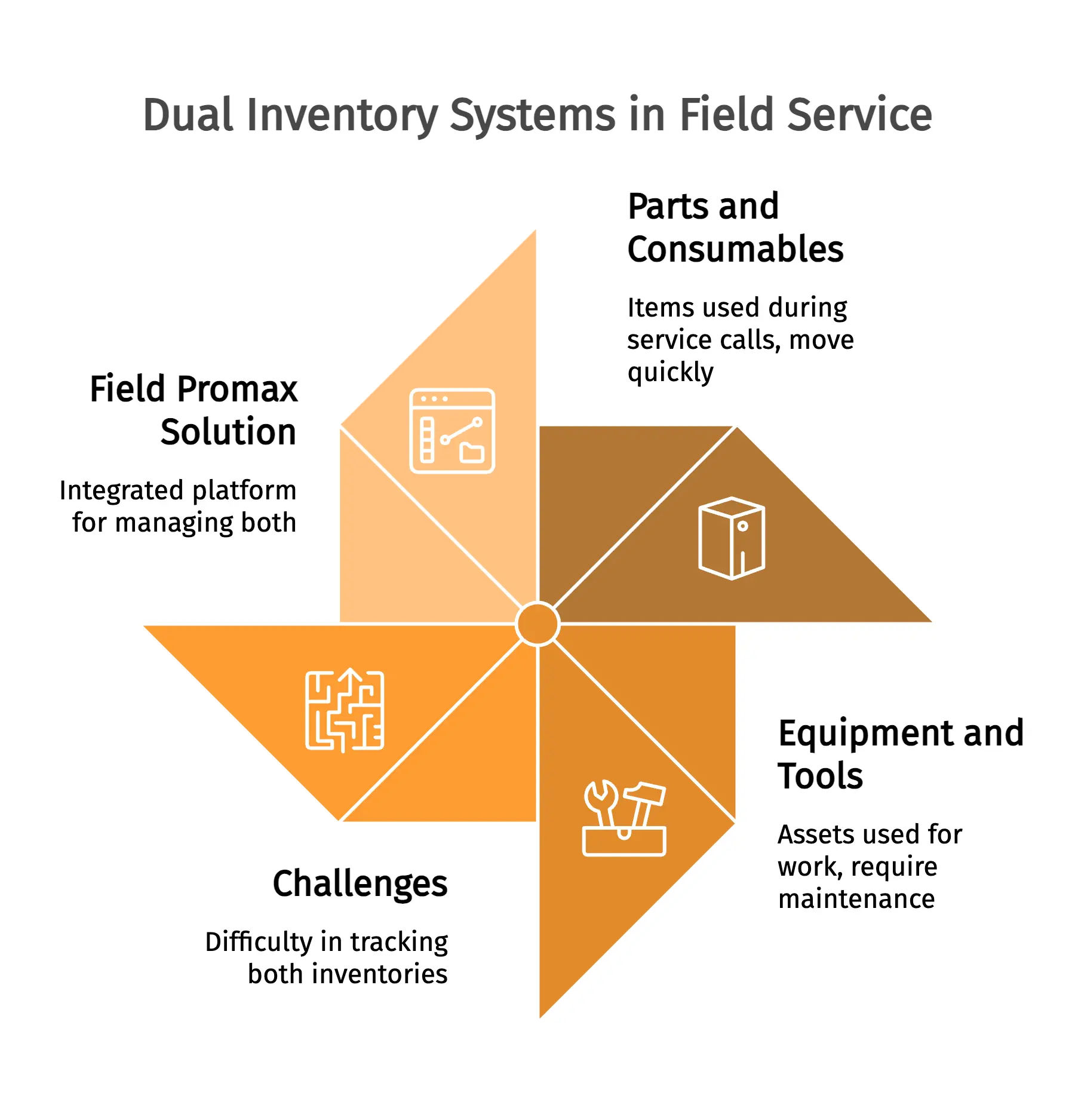
This is something most general inventory guides do not cover. Field service companies do not operate a single inventory system - they operate two, and they are fundamentally different. That is why inventory tracking becomes challenging.
The first inventory category consists of parts and consumables, such as capacitors, fittings, filters, refrigerant, wire nuts, and other materials technicians use during service calls. These items move quickly, vary by trade, and must be tracked against specific work orders to control costs and ensure accurate invoicing.
The second inventory category is equipment and tool inventory. This includes tools, gauges, vacuum pumps, drills, test instruments, ladders, and other assets technicians use to perform their work but do not consume. These items are considered assets. They are often serialized, require maintenance, and carry significant replacement costs.
Many small service businesses do not effectively track either inventory category. Instead, they rely on rough estimates of what is stocked in each truck and occasional physical counts that frequently uncover unexpected discrepancies. They then wonder why inventory records and financial reconciliations do not match.
ATRI's recent cargo theft survey of carriers running roughly 90,000 trucks recorded over $16 million in stolen cargo value, with theft incidents up 36% in Q1 2025 ATRI is the trucking industry's research affiliate within the American Trucking Associations. That's freight, not service trucks, but the exposure carries over: a parked service truck loaded with copper, refrigerant, and panels is a target. Shops that can answer "what was on Truck 7 at 6 p.m. Friday" recover from a break-in faster than the shops that can't.
Field Promax's Equipment tracking software manages both categories from one platform - connecting asset records to job histories, tracking warranty periods, logging service histories, and flagging maintenance schedules before equipment fails mid-job.
12 Best Practices for Equipment Tracking for Service Businesses
1. Build a Two-Tier Inventory System: Truck Stock vs. Warehouse Stock
Warehouse stock and truck stock are not the same thing. Treating them as a single inventory pool creates blind spots that cost money. Truck stock consists of the parts and materials technicians carry every day and use on most service calls. Warehouse stock serves as a deeper reserve, holding higher-value equipment and parts with longer lead times.
Keep these inventory tiers separate and establish par levels for each. When truck stock falls below a minimum threshold, it should trigger a transfer from the warehouse - not an urgent supplier order. This single workflow change reduces panic buying, lowers parts costs, and keeps inventory spending predictable week after week.
2. Tie Every Part Used to a Work Order - No Exceptions
The fastest path to improving service business profitability before inventory-to-invoice tracking, the mechanism most businesses skip. Every part that leaves a truck should be recorded against a specific work order. Not as a batch entry at the end of the day. Not as an estimate based on memory. The exact job, the exact part, and the exact quantity.
This closes two leaks at once: it prevents parts from being used but not billed, and it builds the data trail that shows you which job types are actually profitable. When your inventory ties into your Fire and Security Management Software, this becomes automatic - parts consumed on the job populate directly on the invoice, with no manual step in between.
3. Run Weekly Truck Audits, Not Quarterly Counts
Quarterly physical inventory counts are largely reactive. By the time discrepancies are discovered, the damage has already been done. The parts are gone, and the jobs that used them may have been completed three months earlier. At that point, you have an audit trail, but little opportunity to recover the missing costs or correct the billing.
Weekly truck audits, on the other hand, typically take only 15-20 minutes per vehicle and can identify discrepancies while the related work is still recent. An electrical contractor on the Mike Holt electrician’s forum summarized the concept well: the goal is to balance "the cost of monitoring, the cost of losses, and the cost of not having a needed item on the truck." A weekly audit strikes that balance - not so frequent that it becomes a burden, but frequent enough to prevent small problems from developing into expensive patterns.
4. Set Reorder Points by Trade Season, Not by Gut Feel
An HVAC company that stocks the same quantity of refrigerant in January and July will either run short during the summer season or carry excess inventory throughout the winter. The same principle applies to plumbing companies stocking pipe insulation and electrical contractors managing breaker inventory during periods of active construction. Inventory levels should reflect seasonal demand and workload patterns. Businesses that fail to adjust stocking levels throughout the year often experience either costly stockouts or unnecessary carrying costs.
Use 12 months of historical parts data to set seasonal reorder thresholds. This is one of the core answers to how to reduce inventory costs in HVAC and other seasonal trades - buy ahead of demand, not in response to it. Supplier price increases and seasonal surcharges during peak demand periods are common. By placing orders before the season begins, businesses can avoid those additional costs while ensuring inventory is available when demand rises.
5. Track Serialized Equipment Separately from Consumables
A capacitor is a consumable item. An HVAC condenser unit installed at a customer site is a trackable asset. A drill bit is a consumable tool that will eventually be replaced. A vacuum pump, on the other hand, is a long-term asset. The most valuable equipment should be tracked using serial numbers, maintenance logs, and assignment records that identify exactly which technician is responsible for it at any given time.
Serialized asset tracking provides two benefits that many service businesses lack: a reliable audit trail for warranty claims and a clear record of equipment ownership, location, and maintenance history. This becomes more important than most owners realize when trying to locate a $1,200 diagnostic tool that "someone had last week." With serial number tracking, the answer can often be found in seconds instead of spending days calling technicians and searching through trucks.
6. Connect Technician Location Data to Equipment Records
GPS tracking does more than show the location of your trucks. When it is connected to job records and parts usage data, it creates a time-stamped record of who was on a job, when they were there, and which parts were used. This becomes an important layer of accountability. Instead of relying on assumptions or memory, managers can verify technician activity, inventory usage, and job completion details using documented records. It removes much of the uncertainty from inventory discrepancy investigations and helps resolve issues quickly.
Field Promax's contractor inventory best-practices guide connects location data to work records in real time. Dispatch knows not just who has which tool but when it was used and where. That connection is the foundation for legitimate accountability that doesn't require treating your team like suspects.
7. Assign Accountability to Technicians, Not Just to Jobs
If a component goes missing, saying that "someone on that job used it" isn't accountability. It is simply the starting point for a conversation that rarely leads to a clear answer. Real accountability means every technician has a documented record of the inventory, tools, and equipment assigned to them. Assets should not be assigned to a truck in general - they should be assigned to a specific technician within the system. When ownership is clearly recorded, discrepancies can be identified quickly and resolved without guesswork.
This is particularly true for high-value equipment. Technicians who know that equipment assignments are clearly documented tend to take greater care of those assets than technicians working in informal systems where ownership and accountability are unclear. We'll cover how to improve field team accountability in detail in a dedicated section below. The short version is that accountability starts with assignment. If a tool is not assigned to a specific technician, no one is truly responsible for it.
8. Build Minimum Truck Stock Templates Per Trade
Every HVAC truck should carry a standardized stock kit that includes commonly used contactors, capacitors, fuse holders, and refrigerants. Every plumbing truck should be stocked with common O-rings, fittings, and shutoff valves. Every electrical truck should carry standard breakers and the wire types most frequently required for service calls.
A member of the Mike Holt electricians' forum explained the rule of thumb in simple terms: "If you ever have to leave a job to go get a part, you're not stocked properly." Creating minimum stock templates by trade, rather than allowing each technician to stock a truck based on personal preference, helps standardize par levels, simplifies inventory management, and reduces routine supply-house trips. Those unnecessary trips can easily cost 45 minutes or more of billable time per vehicle.
9. Apply Construction Crew Material Management Principles to Multi-Truck Operations
The construction crew material management best practices refined over decades on large-scale projects translate directly to field service. This includes documenting every material movement between the warehouse and service vehicles, performing foreman-style verification when parts are delivered to a job site, and comparing actual material usage against estimated material requirements to identify cost overruns. An HVAC company operating 15 service trucks across a service territory is managing a distributed inventory system with a level of complexity similar to that of a mid-sized specialty contractor. The accountability systems used in construction projects can be highly effective in field service as well, provided they are adapted to the faster pace and more dynamic nature of service operations.
10. Connect Inventory to Invoicing to Capture Every Billable Part
One of the most common causes of margin loss in field service is unbilled parts. A tech uses a component but fails to record it on the work order, which means it never appears on the customer invoice. This is rarely a result of dishonesty. More often, it happens because the system makes it easier to skip the entry than to record it at the time the work is performed.
When inventory management is integrated with invoicing, parts recorded on the work order automatically flow through to the invoice. Techs cannot close a job without documenting the materials used, and the office does not need to manually reconcile truck inventory usage against invoices at the end of each week. Field Promax's field service mobile app builds this connection into the standard job workflow, so the loop from parts used to invoice sent closes without any additional steps.
11. Use the Mobile App for Tool Check-In and Check-Out
Your techs already have their phones. A mobile check-in/check-out workflow for high-value tools takes accountability to zero friction. A tech picks up a diagnostic tool before leaving the shop, logs it in their BLS reports 83,540 security and fire alarm systems installers employed nationally, and it's assigned to them. When they return it, the same process is reversed. Thirty seconds each way.
This goes beyond simply tracking tool locations. It creates a formal check-out process, where tools are assigned and recorded rather than simply taken. It also creates a time-stamped usage record that can be used for maintenance scheduling, warranty documentation, and asset management. If a tool goes missing, the investigation becomes much simpler. Managers can check the assignment log to see who last had the equipment and when, instead of guessing.
12. Review Inventory KPIs Weekly from Your Reports Dashboard
Effective tracking methods can be useless if there is no one reviewing the information. Inventory KPIs monitored weekly - including parts usage by job, truck variance reports, reorder alerts, and equipment utilization rates - can provide early warning of problems before they become costly.
Field Promax's pegs the industry-average first-time fix rate at roughly 75% surface these metrics in one view. That weekly 10-minute review is where you catch the truck that consistently returns with more parts than it should. It's where a tech whose job close-out rate doesn't match their parts consumption shows up as an anomaly. It's where a supply cost trend appears three weeks before it becomes an emergency purchase. The data is only useful if someone's looking at it. Build the review into the week the same way you build in dispatch.
Construction Crew Material Management Best Practices Every Field Service Business Should Steal
Most field service guides treat construction operations and service operations as separate disciplines. In reality, they have more in common than many people realize. If you are managing three or more service vehicles, maintaining inventory in a shop or warehouse, and dispatching technicians to multiple locations each day, you are effectively managing a distributed material system with a level of complexity similar to that of a specialty subcontractor on a mid-sized commercial construction project.The construction crew material management best practices refined over decades on large-scale projects translate directly to field service. This includes documenting every material movement between the warehouse and service vehicles, performing foreman-style verification when parts are delivered to a job site, and comparing actual material usage against estimated material requirements to identify cost overruns.
The construction crew material management best practices that work on a job site also work in a service fleet - with the appropriate adjustments for faster job cycles and higher vehicle count.
1. Document Every Materials Transfer
In the construction industry, whenever materials move between a central warehouse and a job site, a transfer record is created. The person receiving the materials verifies the delivery, signs off on it, and the inventory system is updated accordingly. Field service businesses should follow the same process for daily truck restocking. Which truck was loaded, what materials were transferred, who approved the transfer, and when it occurred should all be documented. In a digital system, this process can take just a few minutes while creating the traceability needed to maintain accurate inventory records.
Without a transfer history, truck inventory is little more than an estimate. With a documented transfer record, inventory becomes a known quantity with a clearly identified owner and audit trail.
2. Compare Actual vs. Estimated Materials per Job Type
NetSuite's inventory management research for the construction industry highlights a practice that many field service companies still do not adopt: comparing actual material usage on a job against the original estimate. When a particular job type consistently requires 30% more materials than estimated, it is a sign that either the estimate is inaccurate or there is an operational issue in the field that deserves further investigation. Identifying these patterns helps businesses improve estimating accuracy, control costs, and reduce recurring margin leakage.
This comparison should be run monthly by service category. It reveals the types of jobs that are eroding parts margins and provides the data needed to adjust pricing or investigate field-level usage patterns. HVAC tune-ups should not cost three times more than the parts estimate. If they do, you need to understand why.
3. Apply a Verification Step When Parts Arrive at a Job
On a construction site, the foreman signs off when materials are delivered. This verification step is built into the workflow rather than treated as an additional task. In field service, the equivalent process is requiring technicians to verify the parts they receive before starting a job, with that confirmation recorded in the job management system.
At first glance, this may seem like unnecessary friction. In practice, it takes less than a minute and eliminates the common "I never received that part" dispute that can take hours to investigate after the work has been completed.
| Construction Best Practice | Field Service Equivalent | Time Required |
| Documented warehouse-to-site transfers | Digital truck restocking records per vehicle | 3-5 minutes/day/truck |
| Actual vs. estimated materials per project | Parts used vs. estimated by job type - monthly comparison | 30-min monthly review |
| Foreman verification of deliveries | Tech confirmation of parts received at job start | 60 seconds per job |
| Cycle counts at defined intervals | Weekly truck audits + monthly full count | 15-20 min/truck/week |
| GPS tracking on heavy equipment | Serialized tracking + GPS on high-value field tools | One-time setup |
How to Improve Field Team Accountability Through Inventory Systems
Responsibility in field service is not just about monitoring. It is about transparency. When technicians clearly understand what they are accountable for, and when that accountability is visible both to them and to management through the system, accountability happens naturally. The problem is that many field service businesses try to enforce accountability through conversations rather than systems. Conversations can be ignored. Systems cannot.
Here's how to improve field team accountability using your inventory and equipment tracking infrastructure as the backbone.
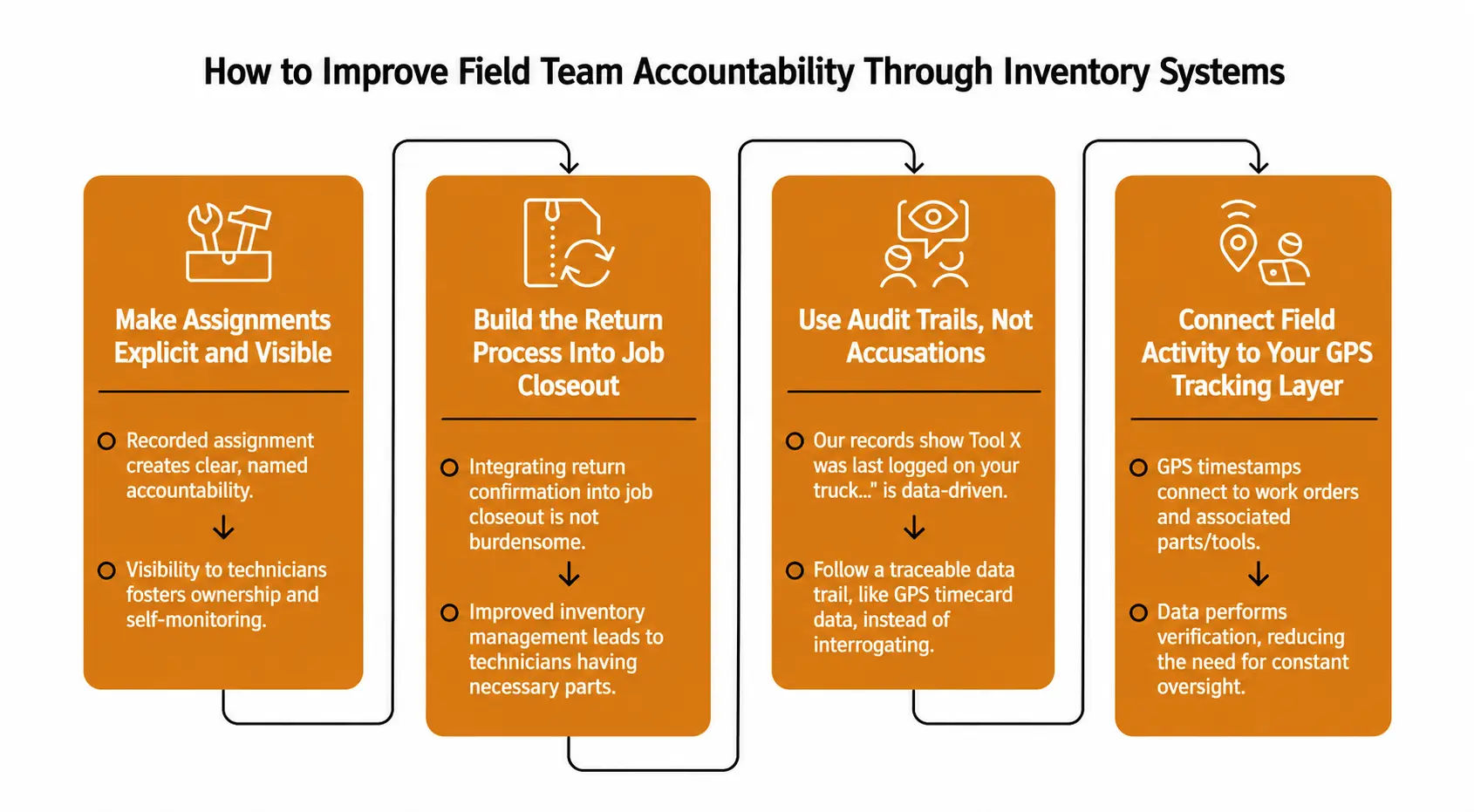
1. Make Assignments Explicit and Visible
Each high-value tool must be assigned to a specific technician in the system - not simply recorded as "in the truck," but clearly assigned to [name] as of [date]. A recorded assignment creates clear, named accountability. Without it, "I don't know who had it last" becomes an impossible question to resolve. With documented assignments, discrepancy conversations are based on data, not assumptions or accusations.
The key point is that assignments should be visible to technicians, not just management. When technicians can see their own assigned tools and self-monitor, they take ownership of them. They do not want discrepancies in their records, just as managers do not. Visibility of accountability is often more effective than any policy.
2. Build the Return Process Into Job Closeout
The accountability gap doesn't start when tools go missing. It starts when they're returned without being logged. Tools leave the shop without being properly logged, and they are often returned without being recorded because logging the return takes longer than simply placing them back in the van.
The solution is to make tool return confirmation a required step when closing out a job. When a technician closes a work order on their mobile device, the final step should be confirming that tools have been returned to stock. This is already part of their workflow - adding a return confirmation step is not burdensome, and it automatically generates a proper audit log.
One reviewer on Capterra, describing their experience with field service tracking software used in their HVAC and plumbing business, noted that once the inventory management and reordering processes were implemented, technicians no longer had to worry about arriving at jobs without the necessary parts. The accountability system helped build trust between technicians and management, improving confidence on both sides.
3. Use Audit Trails, Not Accusations
If a discrepancy is discovered, base the conversation on facts. "Our records show Tool X was last logged on your truck on Tuesday at Job A - do you recall where it went from there?" is a very different discussion compared to "Did you lose the tool?" The first is grounded in data. The second creates resentment and solves nothing.
GPS timecard data supports this approach. If a technician was recorded at Job A on Tuesday and Tool X was used at the same job site, you have a reliable starting point. Instead of interrogating individuals, you are following a traceable data trail.
OUR STANCE: The real accountability problem in most field service businesses isn't dishonest technicians - it's systems that make it easier to bypass the process than to follow it. Fix the friction and most techs will do the right thing automatically. You don't build a culture of accountability by assuming the worst. You build it by making the right behavior the easiest behavior.
4. Connect Field Activity to Your GPS Tracking Layer
Field Promax's digital work orders and dispatch pairs location data with technician records and work order activity. When a tech checks in at a job site, the GPS timestamp connects to the work order - and through it, to every part and tool logged on that job. That connected record is the accountability infrastructure that makes field teams function with less oversight, not more. The data does the verification, so you don't have to.
Want a personalized demo?
See how Field Promax can transform your field operations
How to Reduce Inventory Costs in HVAC and Every Other Trade
HVAC companies are faced with a particular inventory issue: the cost of making a mistake can be high in both directions. Excess refrigerant inventory in January ties up funds in your warehouse for the entire slow season. In July, being understocked means a technician arrives at a cooling emergency without the refrigerant needed to complete the repair - which means a lost job, an unnecessary callback, and possibly a lost customer.
The same tension exists in plumbing around water heater parts, in electrical around breaker inventory, and in pest control around chemical stock. Every seasonal trade has its version of this issue. Here's how to solve it using specific levers, not vague guidance.
1. Time Your Orders to the Season, Not to the Stockout
The most direct answer to how to reduce inventory costs in HVAC is pre-season purchasing. Supplier surcharges during peak cooling demand (May-August) are predictable - and they hit hardest when everyone else in the market is buying at the same time. HVAC contractors who build their summer stock in April pay consistently less per unit than those who order in June because a tech ran out on a call.
Run a usage analysis of last year's summer season. Establish a pre-season order quantity for your top 20 fastest-moving parts. Begin placing orders by early spring. The cost difference is typically 8 to 15% per unit, and the fill rate through peak season increases substantially.
2. Separate Fast-Movers from Slow-Movers
The top 20% of your SKUs by usage volume usually account for around 80% of service demand. Know what those SKUs are, keep them well-stocked on every truck, and stop tying up working capital in slow-moving parts ordered "just in case." Usage reports by part number will reveal the list clearly after the first full reporting cycle.
Slow-moving overstock is especially common during the transition from paper-based to digital inventory. When inventory management previously relied on a technician's memory and manual inspection of truck bins, every part seemed necessary. When data shows that a particular fitting hasn't moved in six months, the decision to reduce its par level becomes straightforward.
3. Connect Inventory to QuickBooks for True Cost Visibility
Reducing inventory costs requires knowing what inventory actually costs - not just the supplier invoice price, but total cost including carrying cost, shrinkage, emergency orders, and parts that expire or become obsolete. When your inventory flows through to your accounting via Job costing, you get that full picture in a format you can act on by job type, by truck, and by technician.
Businesses using real-time inventory management systems boost job completion rates by 28%, according to fieldservicesoftware.io's 2025 industry analysis. This improvement in completion rate is the result of having the right parts in stock - which is the result of managing inventory costs well. Lower costs and higher completion rates are not competing goals in this case. Both are the same objective.
| Cost Reduction Strategy | Expected Savings Impact | Best Applied To |
| Pre-season bulk ordering | 8-15% reduction in per-unit parts cost | HVAC, plumbing (seasonal parts) |
| Fast-mover vs. slow-mover stratification | 10-20% reduction in total inventory carrying cost | All trades |
| Weekly truck audits replacing quarterly counts | Reduces shrinkage from the 2-5% industry baseline to under 1.5% | All multi-truck operations |
| Closed-loop work order billing for parts | 3-8% margin improvement per job | All billable service businesses |
| QuickBooks integration for true cost visibility | 4-6 hours/week admin savings + full job-cost clarity | All trades, 5+ employees |
Common Mistakes Field Service Businesses Make with Inventory and Equipment Tracking
These aren't just hypothetical failures. They come up frequently on contractor forums, in G2 and Capterra reviews, and in the pain points companies describe when they're searching for a better solution. The majority of these issues are not visible until they have been quietly costing money for months.
- Treating truck stock as free inventory. Everything in a truck comes with a cost. The practice of "just throwing stuff in the truck" without recording it as an assignment creates the shrinkage gap that shows up at year-end in a number that's hard to explain. Truck stock isn't discretionary inventory - it's committed capital with an assigned location and a cost that should be recoverable through job billing.
- Combining equipment and parts tracking into one undifferentiated list. A vacuum pump and a box of capacitors are not in the same category of asset. Incorporating them in one inventory list makes both harder to manage. Serialized equipment requires its own records and maintenance log. Consumable parts require par-level management and reorder tracking. Trying to manage both with the same approach creates confusion on both sides.
- Only auditing when something goes missing. Reactive auditing uncovers problems only after they've already caused financial loss. Weekly proactive audits reveal discrepancies early - while the job is still fresh in the technician's memory and there is still time to ask the right questions. The longer the delay, the less traceable the discrepancy becomes.
- Relying on technician memory for parts logging. "I'll add the parts when I do the invoice" is how materials disappear from billing. The gap between part use and invoice recording is where items fall through the cracks. Same-day, work-order-attached logging is the only method that reliably captures every part used on every job.
- Not tracking equipment maintenance schedules alongside inventory. A vacuum pump that hasn't been serviced in 18 months will fail during a job. Field service businesses typically manage maintenance schedules separately from inventory records - if they track them at all. When equipment records include maintenance schedules and service history, your team arrives on site equipped with tools that actually perform.
- Using spreadsheets for multi-truck operations. Spreadsheets work for a single truck. For two or more, they break down quickly - updates lag, versions conflict, there's no mobile access in the field, and there's no real-time visibility. The data is always one step behind the reality on the road.
- Skipping the exit process when a technician leaves. When a technician departs - particularly in high-turnover metro markets - tool and parts accountability should be a standard part of offboarding. Without a formal return and reconciliation step, equipment leaves with the person and shows up as an unexplained discrepancy months later.
Regional Inventory Considerations for Field Service Businesses Across the USA and Canada
The location you operate in determines how you stock your vehicles, set your par levels, and build your auditing schedule. These are the regional factors that matter.
1. Climate-Driven Seasonal Demand
HVAC companies in Sun Belt regions - Texas, Florida, Arizona, and Southern California - experience peak cooling demand from April to October, with almost no heating demand during that period. Northern states and Canadian provinces experience the opposite, with heavy heating demand from October through March, along with shoulder-season overlap at both ends of the year. Reorder points, minimum truck stock levels, and bulk purchasing schedules should be based on regional climate patterns rather than national averages. A Texas HVAC company and a Minnesota HVAC company will have fundamentally different inventory calendars, even if they use the same parts.
2. Refrigerant Compliance Documentation
Canadian provinces have distinct HVAC refrigerant certification requirements under the Environmental Protection Act that differ from US EPA Section 608 guidelines. In several US states - California, New York, and Washington - additional environmental reporting requirements for refrigerant tracking apply to commercial service contractors. Your inventory management system must maintain refrigerant receipt and disposal records in an audit-ready format, not just for operational tracking purposes.
Compliance: EPA, NFPA, and What Your Records Have to Show
For HVAC and refrigeration, EPA Section 608 recordkeeping requires service records on appliances containing 50 lb or more of ozone-depleting refrigerant: date, type of service, quantity added, and leak inspection records, kept for at least three years. The AIM Act and 40 CFR Part 84 lowered leak-tracking to systems holding 15 lb or more of regulated HFCs, with 10% annualized leak-rate triggers for comfort cooling and 30-day repair deadlines.
For fire and security, NFPA 25 Section 4.3 requires documentation of every inspection, test, and maintenance activity on water-based fire protection systems, with retention from 13 months for monthly ITM up to 11 years for 10-year tests. NFPA 72 adds annual functional testing and reacceptance testing after any modification. Shops that pass inspection without a scramble keep this documentation in the mobile app where techs complete it at the panel, not in a binder at the office.
3. Supply Chain Distance for Rural Operations
Field service companies operating in rural markets - the Great Plains, Northern Ontario, the Mountain West, and Atlantic Canada - face longer supply timelines than metro-based competitors. A compressor shipped within 24 hours to Dallas could take up to 4-5 days to reach a rural Saskatchewan contractor. These businesses must maintain higher levels of safety stock, which increases carrying costs but also protects service delivery. Rural business par levels should be determined with supplier distance as a core factor rather than as a last-minute consideration.
4. Labor Market Turnover and Equipment Recovery
Major metro markets across the USA and Canada - especially in the HVAC and electrical trades - experience higher technician turnover rates compared to rural markets, largely driven by wage competition and contractor demand. High turnover can increase the risk of assignment discrepancies. A formal equipment return process and inventory reconciliation should be part of every offboarding process. This is an accounting control as much as it is an HR process.
Future Trends in Field Service Equipment and Inventory Tracking
The technology curve for tracking in field service is moving faster than most owners realize. Here's what the next 3-5 years may look like and which developments are close enough to influence decisions today.
1. RFID Tags That Survive the Field
The global RFID market is expected to grow by $18.77 billion between 2025 and 2029, at a 14.6% annual growth rate, according to CYBRA's RFID market analysis for 2026. For field service, this means RFID tags becoming cheaper, tougher, and capable of surviving job site conditions. Next-generation truck inventory tracking will incorporate passive RFID tags placed on storage bins that automatically scan when a technician unlocks the van door - with no manual counting and no human intervention.
2. AI-Powered Demand Forecasting
AI-driven supply chain planning can reduce forecasting errors by 20% to 50%, according to research from McKinsey & Company. In field service inventory management, this means systems that can predict what parts you'll need next week based on job schedules, seasonal demand patterns, and service contract schedules, while automatically triggering reorder alerts when stock runs low. This technology already exists at the enterprise level and is now moving into SMB-accessible FSM tools in the current product cycle.
3. Individual GPS Tags on High-Value Tools
The GPS tracking device market is projected to grow from $4.17 billion in 2025 to exceed $12 billion by 2034, according to Roots Analysis. The technology is now small and affordable enough that individual high-value tools can carry GPS trackers roughly the size of a quarter. The "where's the vacuum pump" problem becomes a quick app check instead of a lengthy investigation.
4. IoT-Connected Equipment Health Monitoring
IoT-connected tools and equipment are beginning to report their own operational status directly to FSM platforms. Test instruments that detect their own calibration errors before a service call - instead of failing during a customer repair - bring predictive maintenance into the first-time fix process. According to research conducted by Inmarsat in 2023, 84% of businesses reported significant cost savings and efficiency improvements through the use of IoT technology to track and monitor assets.
5. Mobile Camera-Based Scanning as Standard
Phone cameras with scanning apps are replacing specialized barcode scanners. The inconvenience of carrying an additional device, keeping it charged, and connecting it to a separate system is disappearing. Scanning a tool or part is becoming as simple as taking a photo. For teams that have traditionally avoided inventory tracking because it adds extra steps to daily routines, this is the first major adoption barrier coming down.
| Technology | Current Adoption Status | Market Signal | Timeline to Widespread FSM Use |
| RFID auto-scanning for truck stock | Low (large enterprise only) | +$18.77B market growth 2025-2029 (CYBRA) | 2-4 years |
| AI demand forecasting for parts | Early adopter (SMB tools) | 20-50% error reduction - McKinsey | 2-3 years |
| Individual GPS tags on tools | Low - growing | $4.17B to $12.38B by 2034 (Roots Analysis) | 1-3 years |
| IoT equipment health monitoring | Medium (enterprise) | 84% of businesses could benefit (Inmarsat 2023) | 3-5 years |
| Phone-camera QR/barcode scanning | High and growing | Tied to $2.8B FSM software market (IBISWorld 2025) | Now |
Financing Your Inventory Management and Equipment Tracking System
The upfront cost discussion can stop some small businesses from getting started. However, the math usually makes the decision fairly straightforward.
Field Promax's Standard plan costs $159 per month for five users. It covers dispatch, scheduling, and work order management. It also includes equipment tracking, GPS-linked timecards, and reporting in one platform. For a business operating 3-5 technicians, that is under $2,000 per year. Consider that the low end of annual inventory shrinkage on parts worth $100,000 is $2,000-$5,000, and the system can pay for itself before the next quarterly review.
For companies that want to spread their investment over a longer period, there are several financing options available. The SBA 7(a) working capital program includes technology and software investments as qualified uses of funds. Trade association financing is also available through ACCA (Air Conditioning Contractors of America), PHCC (Plumbing-Heating-Cooling Contractors), and IEC (Independent Electrical Contractors), each of which offers member programs or vendor discount structures for operations software. Some service business lenders also provide specific 12-24 month lines of credit for technology investments, with repayment terms linked to proven cost savings.
If you're starting out, Field Promax's Light plan starts at $99 per month - an ideal entry point for a 1-2 person operation building proper systems before scaling. And every plan unlocks a 14-day free trial after a demo, so you can verify the fit before committing.
Field Service Inventory and Equipment Tracking KPI Benchmarks
These are the figures that distinguish well-planned inventory operations from ones that quietly absorb unexplained expenses. Consider them targets - not aspirational, but operational.
| KPI | Underperforming | Industry Average | Best-in-Class | Source |
| First-time fix rate | Below 65% | 76% | 88% | fieldservicesoftware.io / PTC, 2025 |
| Annual parts inventory shrinkage | Over 5% | 2-5% | Under 1.5% | SmartService Field Service Benchmarks |
| Job completion rate boost with real-time inventory | No system (baseline) | N/A | +28% with real-time inventory system | fieldservicesoftware.io, 2025 |
| Parts billing capture rate (billed vs. used) | Under 85% | 88-92% | 97%+ | IHL Group Inventory Distortion Report, 2025 |
| Truck stock audit frequency | Quarterly or ad hoc | Monthly | Weekly | SmartService Benchmarks |
| Technician dispatch response speed (automated vs. manual) | Manual baseline | N/A | 2.8x faster with automated notifications | fieldservicesoftware.io, 2025 |
Field Service Management Software Market Growth by Year
| Year | US FSM Software Market Size | YoY Growth | Key Driver | Source |
| 2020 | ~$1.5B | Baseline | Pandemic-driven field operations digitization push | IBISWorld |
| 2021 | ~$1.7B | ~13.3% | Post-pandemic operations recovery and mobile adoption | IBISWorld |
| 2022 | ~$2.0B | ~17.6% | Trade labor shortage driving efficiency tool adoption | IBISWorld |
| 2023 | ~$2.3B | ~15.0% | Mobile-first FSM expansion into SMB market | IBISWorld |
| 2024 | $2.6B | 13.4% | Real-time inventory and AI scheduling integration | IBISWorld |
| 2025 | $2.8B | 7.7% | IoT and GPS convergence, SMB segment acceleration | IBISWorld |
Inventory tracking is where the discipline shows. The businesses that run it well don't just have fewer missing parts - they have fewer callbacks, cleaner invoices, and techs who trust the system because the system trusts them back.
- Joy Gomez, Founder of Field Promax
Book a Demo to Unlock Your 14-Day Free Trial
Your trucks are loaded with parts and equipment right now. Do you know exactly what's on each truck, which job each part was invoiced to last week, and whether everything used has been accurately billed?
If those questions make you uncomfortable, Field Promax can fix it. From work-order-linked parts tracking to GPS-connected technician accountability to QuickBooks-integrated cost visibility, Field Promax gives HVAC, plumbing, electrical, cleaning, and pest control businesses across the USA and Canada the systems for real equipment and inventory tracking, without the complexity that slows small teams down.
For more information, contact Field Promax
We're here to help you get started
Conclusion
Inventory work is unglamorous, but in a 5-20 tech shop it is one of the largest controllable margin levers after labor. Get the count out of paper, attach the parts deduction to the job ticket, and train the field crew to live in the mobile app.
Frequently Asked Questions

Content Creator
Bhargavi Halthore is a content writer at Field Promax, a field service management platform serving trades businesses across the USA and Canada. With over a decade of experience writing for business owners, she brings detailed, ground-level insight to every topic she covers. Her research goes beyond search results - she digs into LinkedIn groups, Facebook communities, and Reddit forums to understand what field service business owners are actually dealing with on the ground. She speaks directly with industry professionals, understands their day-to-day challenges, and translates that into content that is practical and actionable. What you read in her articles reflects real industry patterns, not theory.
Reviewed by

Founder and CEO
Joy Gomez is an engineer, process automation expert, and the Founder of Field Promax. Known for his technical expertise and commitment to field service innovation, Joy writes about transforming traditional business models into paperless, efficient operations. He is a Lean Six Sigma Black Belt based in Rochester, MN, dedicated to helping field professionals work smarter through better technology.