HVAC Issues Technicians Miss That Customers Catch First
.webp?tr=f-auto,q-80,w-1200,pr-true)
How could an HVAC shop make five figures in a month from service calls when every job ticket states ‘unit running at time of departure’? The reality is that the errors in the system are not always fully resolved when the truck leaves, and the rest of the visit is often spent uncovering what was not properly fixed.
The same pattern repeats: The technician arrives, checks the machine, confirms it is operating, and then leaves. Three days later, the client calls back. One room is too hot. The air smells musty. The costs increase. The same technician returns, costing you more money.
These are not breakdowns. They are callbacks on jobs marked complete. ACCA puts a typical two-hour callback at roughly $650 once you fold in tech time, truck cost, and the paying job that slot displaces. Install callbacks run closer to $850 because the visit runs longer. A shop running 500 jobs a month at a 10% callback rate is losing nearly $32,000 - a large portion of it triggered by one question: "Is the machine running?" instead of "Does the building feel right?"
The following is a list of 10 issues that commonly appear when HVAC businesses move away from spreadsheets, paper, or accounting-only systems to properly organized work orders. They do not require the purchase of any new equipment to address. Most of them require changes to what the technician must verify before completing the job.
1. Tunnel Vision on the Obvious Fault
| The fix is a structured work order with a mandatory post-fix system check. The tech can't close the ticket until airflow, temperature split, and a 60-second walk-through of the affected zone are logged. |
The best HVAC contractors refer to it as tunnel vision. A technician arrives on site, identifies the obvious problem, such as a tripped breaker, an unresponsive capacitor, or a blockage in the drain pan, fixes it, and closes the job. The system may continue to function. However, other underlying issues remain unaddressed until the customer calls back.
A long-time HVAC technician explained it clearly in a trade forum: when you let the machine run without thinking about the system, often just to fill gaps in the schedule, critical issues can be missed.
The customer didn't call because the unit wouldn't start. They called because the building was uncomfortable. If the discomfort is still there after the truck leaves, the job is technically done and practically failed. That's the visit that earns a one-star review two weeks later when the secondary issue surfaces.
Research by ACHR News on common technician troubleshooting issues highlights the ‘pre-diagnosis trap’ - arriving at a job with assumptions already formed before fully hearing the client - as one of the most costly practices in field service. Technicians who stop listening after identifying the obvious flaw often overlook secondary issues that fall outside that initial assumption.
What actually happens in practice: A technician arrives on a no-cool call. The capacitor is damaged and the condenser fan is not operating. A new capacitor is installed and the system is running, and temperatures at the unit appear normal. What the technician did not check was that the evaporator had not been cleaned in two years. The condensate drain is blocked, and the supply duct running through the attic is missing a flex connection. All three issues will lead to customer complaints after 30 days. All three were present at this visit.

2. Uneven Airflow That Looks Fine on the Unit
Hot & cold spots make up the majority of post-service complaints. Customers notice them when they return to their space. Technicians are often unaware of these issues because the equipment has passed inspection when supply temperatures fall within an acceptable range and the system appears to be running normally. The job is considered complete, but the underlying issue remains. By 2 p.m., the conference room can feel like a sauna.
A widely cited ACEEE field study found 70% of tested residential systems running at 350 CFM per ton or less, with 39% falling under 300 CFM per ton against a 400 CFM per ton design standard. The National Comfort Institute reaches similar conclusions on commercial systems. The takeaway: most systems are out of spec on airflow, and most technicians are not measuring it.
The equipment isn’t always the cause. The delivery system is often the problem. A typical air delivery failure looks like this:
- Dirty filters block airflow before it can reach the duct system.
- Leaks in ducts can release conditioned air into unconditioned spaces. Lawrence Berkeley National Laboratory found that duct systems lose around 10% of supply air and 12% of return air due to leakage.
- Dampers are shut or not set correctly for the season.
- Blower wheels loaded with dust reduce CFM output without triggering a fault code.
It is estimated by the U.S. Department of Energy that the average home loses around 30% of its energy due to inefficiencies in heating and cooling, with duct leakage being a major cause. SMACNA warns that unsealed duct systems can experience leakage of over 30% of airflow. One HVAC contractor in the r/HVACadvice community observed that unbalanced room temperatures are usually caused by airflow or duct issues, rather than refrigerant problems. However, most service calls are designed to address a specific issue, and ductwork is often not included in the scope.
A technician who only inspects the unit won’t notice any of these. A technician who checks static pressure, duct conditions, and register flow can resolve the problem in a single visit.
3. Thermostat Readings Versus Occupant Comfort
Comfort is not measured solely by temperature. It is measured by where people are seated. The thermostat shows 72. The system has been running throughout the night. The person sitting at a south-facing desk is sweating. Two cubicles away, someone is wearing a sweater. The customer calls the shop and says the space is still uncomfortable, and trust in the service begins to decline.
The technician returns to check the thermostat, confirms it is correct, and leaves. Trust has been lost, and the next service call goes to a competitor.
What is actually happening
- Thermostat placement - it is located in a comfortable area, not in the area where discomfort is actually occurring
- Heat stratification - warm air gathers near the ceiling, while the occupied zone remains cool
- Internal heat loads - such as server racks, west-facing glass, commercial kitchen equipment, and electronics concentrate heat in specific areas
- Short cycling - the system shuts off before the space reaches balance
What separates a tech from a parts-replacer
Check the temperature in occupied areas across all zones, not just at the control point. A spot-check of three to five locations using a calibrated probe will take less than five minutes. If one location is consistently cold or hot, it indicates a diagnostic issue. The work order must include these tests before the work order is closed.
4. Humidity and Ventilation Gaps Without an Error Code
If a building feels damp or smells unpleasant, visitors notice it within 10 minutes of arriving, even before any error message appears. Since nothing is technically incorrect, technicians often overlook that.
In commercial and light industrial spaces, this matters more than it looks. The EPA notes that indoor pollutant concentrations are commonly two to five times higher than outdoor levels, and HVAC systems not pulling adequate outside air simply recirculate that load. The U.S. indoor air quality market was valued at $10.5 billion in 2024 and is projected to reach $12.9 billion by 2029 (BCC Research) - driven directly by growing customer awareness of what is circulating through their space.
What customers actually report
- The air feels heavy regardless of the temperature.
- Condensation appears on supply registers or window frames.
- A musty or stale odor that won’t go away.
- The thermostat is adjusted between settings, but there is no noticeable change in temperature.
These symptoms usually trace back to humidity control or outside air balance. If the system uses makeup air, an economizer, or duct heaters, checking whether they are staged and controlled correctly often resolves the issue in a single visit.
What to check
- Airflow rates are based on both return and supply airflow.
- They also depend on the volume of outside intake air and the position of the economizer.
- Indoor humidity is ideally maintained between 30% and 60-80%, depending on conditions.
- Ventilation response must be evaluated under occupied load conditions.
These extra 20 minutes generally prevent a callback and the awkward exchange of emails that follows.
5. Noises and Smells Logged but Not Resolved
Customers report changes in smell and sound within hours of entering the space. Technicians note them in job reports, then move on. ‘Slight vibration detected’ fixes nothing. ‘Musty return’ reassures nobody. These are warning signs that should be heeded. If they are ignored, you will almost always be back the following week.
What these signals typically mean
- Vibration or rattle - missing panels, loose fan mounts, or failed duct hangers. Usually a 10-minute on-site fix.
- Squeal or grind - worn or damaged bearings, or a slipping belt, typically indicating failure within weeks.
- Burning or dusty smell on startup - dirty heat exchanger or airflow restriction around heat strips.
- Musty smell - dirty evaporator coil, blocked condensate drain, or biofilm buildup in ductwork. This indicates an untreated mold condition that can become costly.
Each has a clear cause and a same-visit fix. A tech who closes the issue prevents a callback. A tech who logs it without acting almost always creates one.
In the case of a cracked heat exchanger, a persistent burning smell directly linked to furnace operation, especially in northern climates where systems run for long periods from October to April - is a safety warning. Cracked heat exchangers can allow combustion gases to mix with circulated air.
Checking the heat exchanger is one of the most often neglected steps in furnace maintenance, as it can add 15–20 minutes to a service visit. If you live in cold-climate regions such as Minnesota, Michigan, Ontario, or Alberta, this inspection should be a required and documented step at every furnace tune-up.
6. Efficiency Drift on Operating Systems
Facility managers track utility costs in the same way shop owners track their earnings. If costs increase after a service visit or trend upward quarter to quarter, the issue is noted.
The system may still be operating with no alarm. It can run longer and draw more energy, and the user only sees the increased bill. Loss of efficiency is as much of a problem as a mechanical failure, but it cannot signal it through an error code.
HVAC accounts for roughly 39% of energy use in U.S. commercial buildings. The EPA's ENERGY STAR program estimates improper installation alone can drag system efficiency down by up to 30%. A 2002 California field study analyzed for the state energy commission found 57% of residential systems had incorrect refrigerant charge, with 65% needing charge or airflow corrections. A system 10 to 15% off peak adds hundreds to the monthly bill with no visible fault to flag it.
Service businesses that use Field Promax frequently report that adding photos of coil condition and static pressure readings to a work order provides a documented baseline, making efficiency declines visible throughout the process - not only after a customer contacts the company about an invoice.

Common causes
- Dirty coils hinder heat transfer, leading to longer runtime.
- Duct leakage: the DOE estimates that 25-40% of conditioned air is lost in typical buildings.
- Refrigerant charge loss can exceed 10% compared to original design specifications.
- Poor blower performance reduces delivered CFM.
- Older components draw more amps for the same output.
- Firing control stages operate out of sequence or at incorrect settings.
What to check
- Running duration and cycling: should reflect sustained operation (not short cycling of 5 minutes)
- Coil temperature differential
- Fan static pressure and performance against design specifications
- Refrigerant superheat or subcooling compared to manufacturer specifications
The ability to detect efficiency drift during a service call prevents the bill from surprising the customer in the first place and creates a legitimate reason to avoid pushing unnecessary repairs. This is how businesses earn consistent revenue without appearing to be selling.
7. Aging Equipment and the Replacement Conversation
This is where technicians struggle the most, and it can slowly erode customer relationships over time.
A roof unit that is 12 years old doesn’t perform as well as a three-year-old model. Compressor amps increase. Refrigerant lines develop pinhole leaks. Capacitors weaken. The chance of failure during each cooling season rises. Most technicians don’t mention the issue unless the client asks first.
If the unit eventually fails on the hottest day in July, the customer is often shocked and asks why they were not warned. ACCA also highlights a contractor-side issue: a significant portion of HVAC technicians are approaching retirement age, and knowledge of systems nearing end-of-life is often held by walks out with the senior tech. If this information is not recorded in a structured process and carried forward across service visits, it is easily lost.
What happens when you say nothing
- The customer typically does not allocate a budget for replacement.
- Failure occurs at the most inconvenient time, during high temperatures, peak occupancy, or a holiday weekend.
- The customer blames the shop rather than the age of the equipment and then leaves an online review.
What to do instead
For any unit that is eight years old or more, enter the age and condition into a work order in clear English:
The unit is 9 years old. Compressor amps are trending upward. We suggest planning for a replacement within the next 24 to 36 months.
That note takes 30 seconds. It sets the right expectation and gives the customer a reason to plan, not panic. An equipment tracking system that carries that note forward across visits means the next technician sees it before the truck rolls.
8. Verification Versus Visual Confirmation in PM Visits
The majority of maintenance visits don’t fail because something was left unfinished. They fail because there is no verification.
The technician arrives, replaces the filter, inspects the unit, then runs it briefly before leaving. The visit is over. Whether the system is operating within its designed parameters is not verified. Callbacks are the next step.
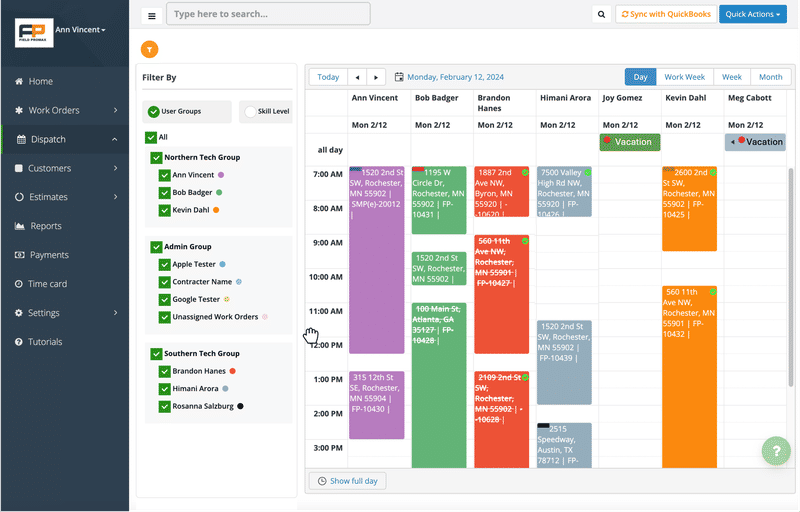
Preventive maintenance is performance verification, not component-touching. If airflow, temperature split, and load response are not measured, the visit is built on assumption. Shops that schedule PM through a system - not a wall calendar - are also the shops where dispatchers can see capacity gaps and overbooked days before they turn into rushed visits.
What goes wrong on a rushed PM
- Filter has been changed; however, pressure drop has not been measured.
- The coils appear clean; however, heat transfer has not been confirmed.
- The unit runs, but it was not logged for runtime.
- Air is released from the vent; however, CFM has not been analyzed.
Everything appears done. There is no evidence it was.
What proper PM looks like
A quality maintenance visit is based on the measurement of data points rather than visual confirmation:
- Verification of airflow relative to the 300 CFM/ton design limit.
- Temperature split between supply and return air.
- Monitoring of cycles: runtime, off-time, and short cycling.
- Load response: how the system reacts as demand increases.
- Fan performance is checked across all floors and zones.
Why this matters
If PM is reduced to a routine checklist level, performance decreases. Small inefficiencies can add up. Customers notice a decline in comfort and increased costs. If PM is based on verification, issues are detected in the early stages. This is the only difference between a maintenance visit and a future callback.
%20(5).webp?tr=f-auto,q-80,w-800,pr-true)
9. Incomplete Job Documentation
This problem is invisible and gradually damages the business.
If a technician fails to note down what they observed, what they did and what they recommended - the next visit begins with a blank slate. The next technician does not have any background. The office is unable to answer questions from customers without confidence. If a warranty issue arises, but there is no record.
Incomplete documentation is the most frequent reason that small issues end up costing you expensive. A long-time commercial customer who reviewed Field Promax on the QuickBooks App Store, credited the software for removing the majority of their paperwork issues - noting that paper is the place where even the small details are lost before they make it into an invoice.
What good job documentation includes
- Initial condition upon arrival
- Repairs are made and parts are replaced along with the reason behind each
- System readings include temperatures, pressures, airflow, amperage and humidity
- Recommendations and the timing for the next visit
- What was the information provided to the customer prior to departure?
Five extra minutes here ensures subsequent visits. It also gives the office reliable answers when customers make calls about charges.
.webp?updatedAt=1747733768755&tr=f-auto,q-80,w-800,pr-true)
Why documentation matters
Good documentation builds trust, reduces disputes, and keeps the team aligned. A field service mobile app that makes documentation part of the work order - not an optional step at the end of the day - is the difference between a standard your techs follow consistently and one they forget under pressure. Mobile app adoption inside the shop is the single biggest predictor of whether documentation actually happens.
10. The Missing Customer Debrief
It is the most expensive item on this list since what it is costing you is the customer relationship, not just a single phone call.
The technician identifies the issue is packed up, says "you're all set," and leaves. The customer doesn't know what was the issue or what they should be looking for. Two weeks later, whenever something is off again, they do not contact the shop. They go to the next service.
What appears in HVAC reviews on Google over and over?
- "The tech fixed something but they couldn't tell me what it was"
- "He was in and out in 20 minutes, but the building still isn't right"
- "No one told me how to prevent this from happening again"
The solution isn't an offer. It's a conversation lasting 90 seconds prior to the tech leaving to find out what caused the issue, what could be the solution, and what the next maintenance appointment will be. This conversation is what turns the phone call into a lasting account.
A 2025 FieldBoss survey of 1,000 U.S. homeowners found that the top frustration in HVAC service was not price - it was communication. Customers do not always know whether the fix was correct. They always know whether the tech explained it.
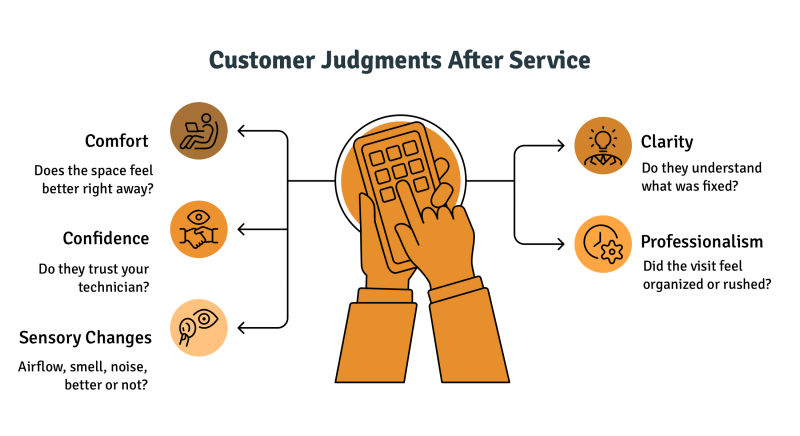
| Field service software that tracks per-customer service history can give the tech full context before they arrive: past issues, notes from the last visit, equipment age, recommendations from the previous tech. That changes the quality of every conversation at the door. |
Operational Fixes That Cut Callbacks Before They Happen
The pattern that runs through each issue above follows the exact same pattern. The technicians are trained to correct what's broken, not to determine the performance of the system. If there is no consistent process. The gap between the best technician and the least skilled one shows up directly in your callback frequency.
Three operational fixes carry the most weight:
- Standardized job-type checklists, so every tech covers the same ground regardless of experience
- Documented service history for every asset, so patterns can be seen across visits - not only on the day of the call.
- Customer history and pre-job context - techs arrive with a clear understanding of what was previously flagged and what must be confirmed before closing the job
This is the operational backbone HVAC field service software provides: structured work orders, recurring PM scheduling, equipment-level service history, QuickBooks integration so prior complaints carry forward into the next invoice, and a scheduling and dispatch system that puts the right tech at the right job with the right context. The shops where techs use the mobile app on every job are the same shops whose customers stop catching issues first.
.png?updatedAt=1747763704661&tr=f-auto,q-80,w-800,pr-true)
<-- CEO commentary -->
I've spoken with thousands of HVAC shop proprietors, and I've noticed that the frequent pattern isn't caused by a technical skill issue. It's a gap in the process. The technician who didn't perform the airflow inspection during the Tuesday incident is also that technician who would have noticed that the work order needed CFM reading prior to making the decision to close the job.
The most frequently requested feature I receive from HVAC users in Field Promax is better dispatch-to-invoice automation. What they really want is an automated system that will not allow a job to close until all visible items to customers are recorded: photos, readings, line items and suggestions.
Shops running five to ten technicians do not need the most feature-heavy platform in the market. They need fewer, better tools that techs can actually use on the truck. Mobile app adoption is the primary indicator of whether callback rates decrease - and that is what we are focused on building.
Mobile app adoption is the primary indicator of whether the rate of callbacks decreases or not, and that's what we're developing.
Data Tables
Common Customer Symptoms and the HVAC Issue They Signal
| Customer Report | Most Likely HVAC Issue | Typically Missed Because |
| Musty smell from vents | Dirty evaporator coil / condensate drain clog | Access panel not opened on standard call |
| One room always hot or cold | Duct leak or airflow restriction | Static pressure test not in scope |
| Energy bill increase, no behavior change | Dirty coil, duct leakage, efficiency drift | Not visible without runtime and pressure data |
| System sounds labored on startup | Degraded capacitor / worn bearings | No capacitor load test on maintenance calls |
| Short cycling on hot afternoons | Oversized unit, high-pressure cutout, dirty coil | Symptom absent during mild-day diagnostic visit |
| Burning smell with the heat on | Cracked heat exchanger / heat strip restriction | Heat exchanger check adds time, often skipped |
| Water pooling near air handler | Condensate drain clog | Drain flush skipped on rushed PM calls |
| "Air feels heavy" despite correct temperature | Humidity imbalance or ventilation gap | No humidity or outside air check in standard scope |
KPI Benchmark Table: HVAC Service Quality Metrics
| Metric | Benchmark | Source |
| Acceptable callback rate | Below 5% of total service calls | O'Connor University HVAC Training |
| Cost of a typical 2-hour callback | ~$650 (labor, truck, displaced job) | ACCA |
| Cost of an install callback | ~$850 | ACCA |
| Duct leakage - average residential | 10-12% supply, 12% return air | Lawrence Berkeley National Laboratory |
| Energy waste from HVAC inefficiency | ~30% of total home energy use | U.S. Department of Energy |
| Economizer fault rate - commercial rooftop | ~65% of examined units | New Building Institute |
| Residential systems with incorrect refrigerant charge | 57% | ACEEE / CA Energy Commission |
| Systems at 350 CFM/ton or less vs. 400 design | 70% of tested residential systems | ACEEE field study |
Year-by-Year Growth: U.S. HVAC Repair Revenue Share
| Year | Repair Revenue Share | Key Driver |
| 2021 | 21.6% | Post-pandemic demand; normalized replacement cycle |
| 2022 | Growing | Supply chain delays pushed repair-over-replace decisions |
| 2023 | Peaked on cost | Equipment costs up ~7%; customers opted to repair |
| 2024 | Normalizing at ~31% | IAQ awareness growing; aging install base expanding |
| 2025 | 31.3% | Repair costs down 26% from 2023 peak; volume rising |
| 2026 (projected) | Growing | Heat pump retrofit transition; 15+ year systems failing |
Sources: Housecall Pro HVAC Industry Trends Report 2026, Statista, Grand View Research
Closing the Gap Between "Unit Runs" and "Building Feels Right"
The above 10 issues are common technical problems. There are patterns that appear when technicians are overwhelmed with their work, there are no checklists, and each visit is evaluated by the time the unit is running with a bang, not by how the building feels right.
Each one of these calls is possible to avoid. It's not with better equipment but with a better procedure in work order, which means that the next technician comes into the room knowing what was flagged during the previous visit, and the technician on today's call can't close the job without verifying the checks that matter.
If you manage your own HVAC shop and want to reduce calls backs, fewer reviews with one star or customers who sign up for their service agreements, start by looking at how your jobs are organized before the truck departs.
Field Promax keeps PM consistent, the visible asset history, the documentation for technicians completely and clear - meaning that your building is correct when the truck is away and your client will not be the only one to find out that it's not.
Further reading
Deep dives in this guide
- The Commercial HVAC Preventive Maintenance Checklist for Owner-Run Shops - the structured PM workflow that catches the issues this pillar describes before they generate callbacks
- HVAC Safety: Regulations, PPE, and Field Workflows for Small Shops - OSHA, EPA 608, AIM Act, and LOTO rules a rushed tech is most likely to skip
- HVAC Talent Retention and Recruitment: An Owner's Playbook - why losing tenured techs is what drives most of the missed-issue pattern in the first place
- HVAC License Reciprocity by State: A Working Guide for Contractors Crossing the Line - keeping quality and documentation intact when crews cross state lines
Conclusion
Each of these callbacks are possible to avoid. Not by using more tools, but by having an improved process that is documented on the work order, that way, the next technician walks in knowing exactly what was reported before that, and the current tech can't complete the job without verifying what actually matters.
Frequently Asked Questions

Founder and CEO
Joy Gomez is an engineer, process automation expert, and the Founder of Field Promax. Known for his technical expertise and commitment to field service innovation, Joy writes about transforming traditional business models into paperless, efficient operations. He is a Lean Six Sigma Black Belt based in Rochester, MN, dedicated to helping field professionals work smarter through better technology.
Reviewed by

Content Creator
Bhargavi Halthore is a content writer at Field Promax, a field service management platform serving trades businesses across the USA and Canada. With over a decade of experience writing for business owners, she brings detailed, ground-level insight to every topic she covers. Her research goes beyond search results - she digs into LinkedIn groups, Facebook communities, and Reddit forums to understand what field service business owners are actually dealing with on the ground. She speaks directly with industry professionals, understands their day-to-day challenges, and translates that into content that is practical and actionable. What you read in her articles reflects real industry patterns, not theory.