How to Get Clients for a Cleaning Business: The First-25 Playbook
Imagine a three-person cleaning company with six months in business and 11 recurring clients, managing everything through a spreadsheet and QuickBooks. The owner handles sales from the truck while driving between jobs. New inquiries come from the company's Facebook page and Yelp listing. Many people call, but they don't book or call back.
In owner discussions on Quora over the past 12 months, one of the most common complaints from new cleaning business owners isn't a lack of traffic. People are visiting the website or Google Business Profile but leaving without submitting a form. Low trust signals and messaging that doesn't match search intent often create doubt, but owners can't see where the funnel breaks between the initial inquiry and a booked job.
This article explains the factors that help cleaning businesses win their first 25 clients, which marketing channels convert into recurring contracts, how commercial and residential customers differ, and what happens when inquiries are followed up faster than a paper calendar can support.
Marketing guides for established brands assume you already have assets that a new business doesn't. You may lack an email list, a strong review base, historical customer acquisition cost (CAC) data, and a clearly defined ideal customer profile (ICP). A three-person cleaning company may have only a truck with magnetic signage, a phone that rings twice a week, and a small team ready to take on more work.
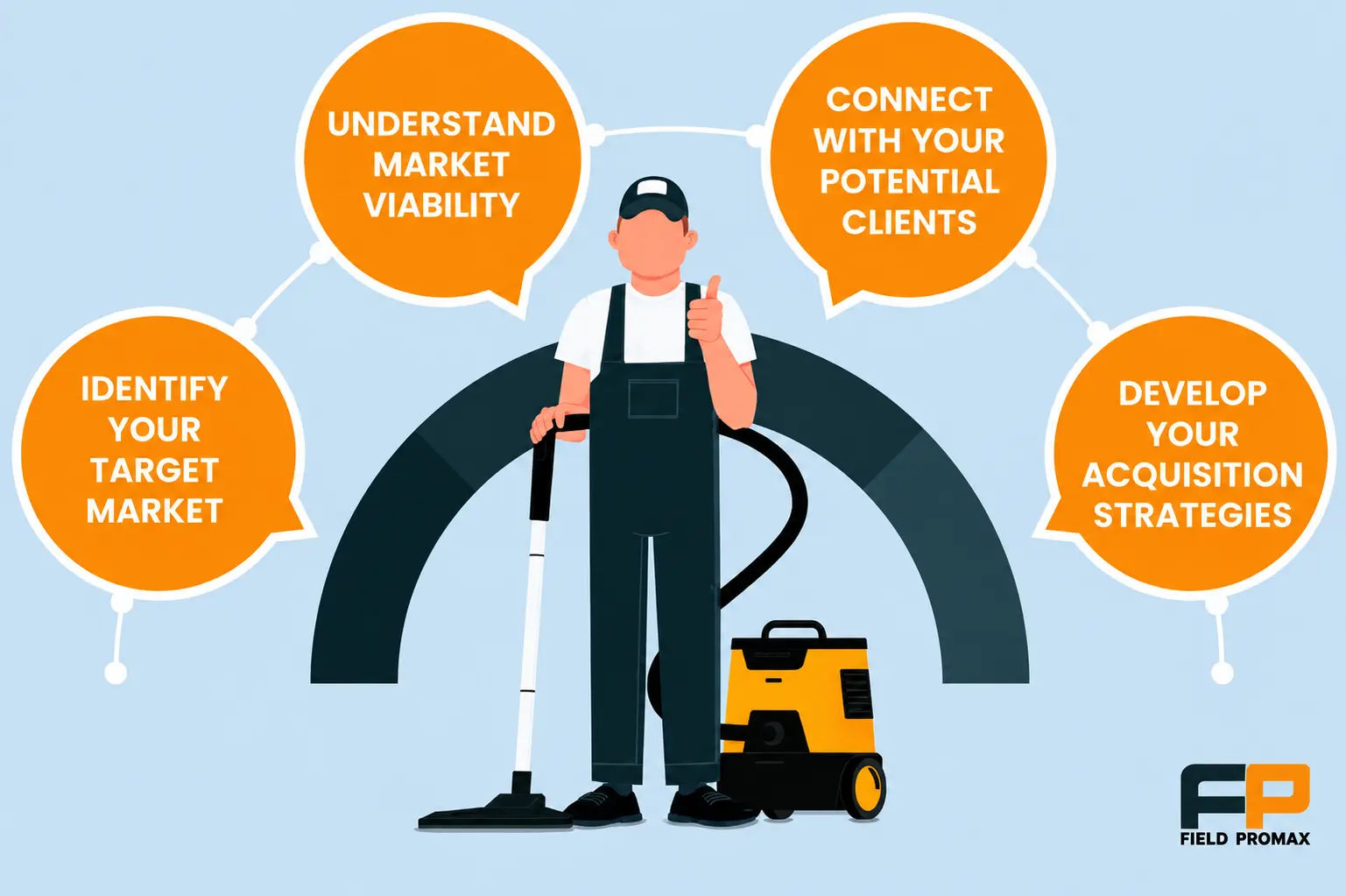
Cleaning is also crowded. Per IBISWorld's residential cleaning services benchmark, roughly 357,000 businesses operate in the U.S. residential segment, a USD 18.8 billion market in 2024. The shops that break past their first 25 clients aren't the ones with the flashiest branding. They pick two or three channels, work them hard, and get operations tight enough that every booked job stays booked.
Why do the first 25 clients decide whether your cleaning shop survives?
Customer acquisition is the process of turning someone who isn't a customer into one. For a cleaning service, the customer typically searches for "house cleaning near me" or "office cleaners [city]" and clicks on three or four results before making a decision. Everything you do to appear among those results and earn the call is part of customer acquisition.
New shops can't afford to lose leads to slow response or shaky follow-through, because they don't have a base of recurring accounts to smooth the gaps. The first 25 clients pay the bills, prove the model, and generate the referrals that fund the next 100. Per BLS 2024 data on janitors and building cleaners, the occupation employs 2.45 million workers at a median wage of $35,930, meaning your labor cost is fixed enough that every unbooked slot has a real dollar consequence.
An HVAC contractor reviewing Field Promax on the QuickBooks App Store described the same pattern: since lead-capture forms started feeding directly into dispatch, they book roughly 30% more jobs without adding office staff. The mechanism is identical for cleaning. Every hour a lead goes unanswered is an hour a competitor spends quoting the same prospect.
What does this pattern look like in the field?
Across roughly 40-50 small trade operators we've worked with since 2018, we've seen a similar failure pattern once a shop grows beyond its first two dozen clients. Consider an owner-operator of a multi-trade business running HVAC and plumbing teams, with one dispatcher and around two dozen technicians in a mid-sized Midwest metro. The problem wasn't marketing. The dispatcher was managing one schedule in one tool and another in a different tool, trying to find the overlap. One Tuesday morning, a technician was dispatched for an HVAC tune-up while the same technician had already been scheduled for a plumbing rough-in on the other board.
During a busy spring season, the shop had to double-book technicians licensed in both trades. Estimate disclaimers made the situation worse. HVAC estimates used equipment and weather-related language, while plumbing estimates relied on material-assumption language. When a job involved both trades, customers pointed to whichever disclaimer best supported their position.
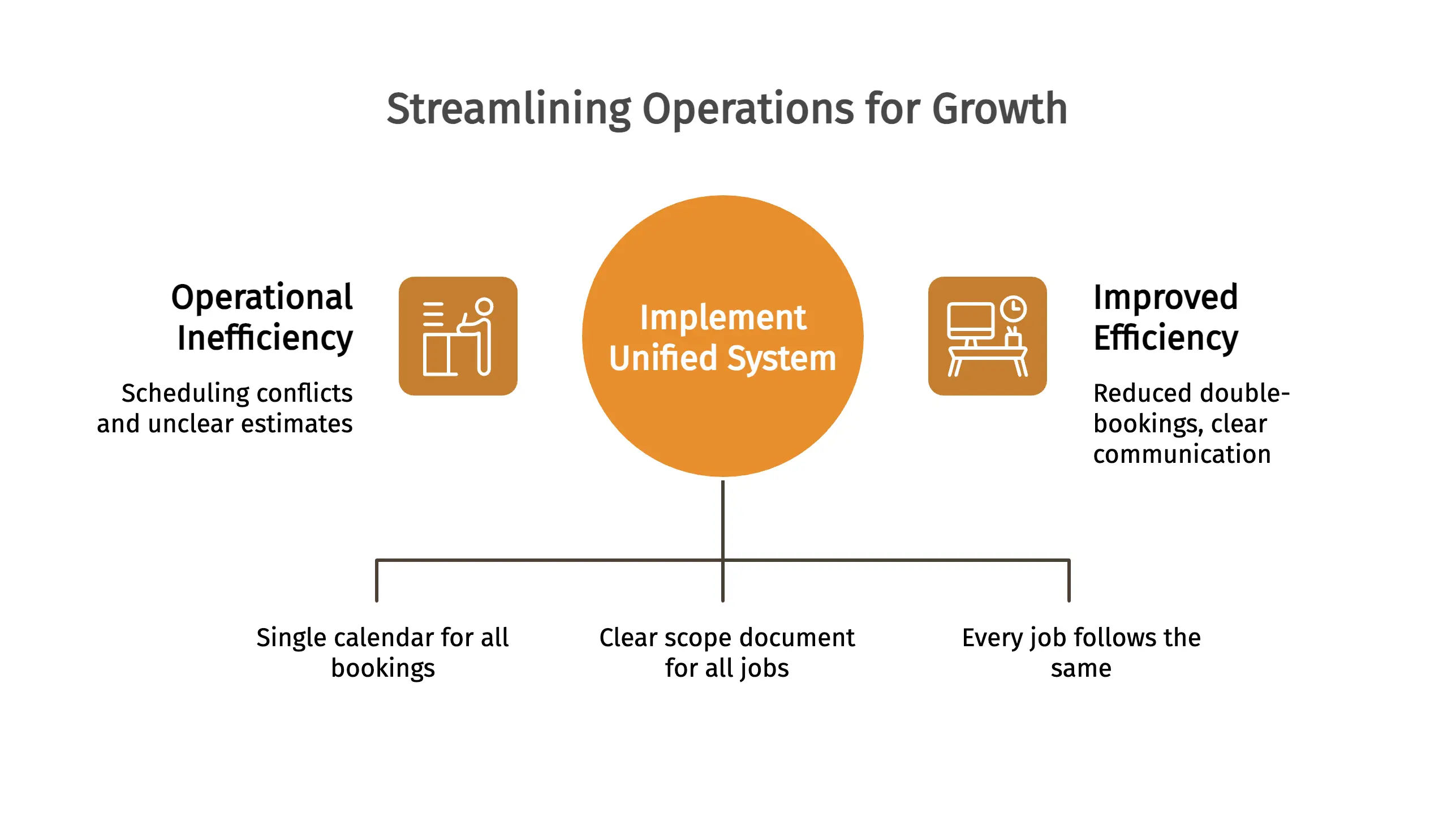
The change was operational. The owner consolidated the two scheduling boards into a single calendar used exclusively by the dispatcher, requiring every booking to go through one platform, even when technicians resisted the change. The estimate disclaimer was also standardized into a single template that covered the common exclusions for both trades in plain English, including scope boundaries, material assumptions, weather, and access contingencies.
Double-bookings largely disappeared after the first month, when the unified calendar exposed scheduling conflicts that had previously gone unnoticed. The disclaimer required two revisions after a customer disputed a water damage exclusion. One plumbing technician was the last to adopt the new scheduling process. This is a composite case based on the most common version of the pattern seen in multi-trade businesses. The lesson for any shop with more than 20 clients is the same: use a single system for scheduling, maintain a clear scope document, and ensure every job follows the same process.
Where should you actually spend your first 90 days?
The channels below are ranked by the payoff for the owner's time, not by what looks best in a presentation.
Claim and fill your Google Business Profile. Google's Local 3-Pack receives some of the highest click-through rates for local searches, which means businesses without a complete, well-reviewed profile risk losing a significant share of nearby search traffic to competitors. Include every service, every service area, and high-quality photos in your profile. Publish updates every week. It costs nothing and offers one of the fastest returns on this list.
Ask for referrals systematically. Industry benchmarks show referral leads close at roughly 45% for home services contractors, paid Google Ads leads around 18%, and shared marketplace leads (Angi, HomeAdvisor) closer to 12%. A referral is roughly 3x more likely to book. Shops that build a referral ask into every closeout, tied to a $25 credit or a free add-on, run at referral rates two or three times higher than shops that "just tell everyone." Automate the ask.
Post in three local Facebook groups and Nextdoor. Write a brief, human introduction explaining what you do, the neighborhoods you serve, and your discount for the first five bookings. Owners report that the first booking from a helpful community post often comes within 72 hours.
Respond in under 15 minutes. Housecall Pro's 2025 Customer Service Report shows homeowners overwhelmingly hire the first qualified company to respond, and 27% of homeowner calls to contractors go unanswered. Cleaning shops running the mobile app on every cleaner's phone answer inquiries between jobs, not from a desk at 6 p.m.
Automate a review request after every job. BrightLocal's 2024 Local Consumer Review Survey found 92% of consumers read reviews of local businesses before their first visit. A cleaning shop with three stale reviews is filtered out before the first conversation.
What actually convinces a customer to pick you over the shop across town?
Three things convince them: trust, evidence, and follow-through. Trust comes from your review count, the quality of the photos on your Google Business Profile, and the fact that someone returns the customer's call. Evidence comes from a room-by-room walkthrough during the estimate, an itemized quote, and before-and-after photos. Follow-through means arriving on time, doing exactly what you promised, and asking for a review while you're still with the customer.
A plumbing business review on Capterra described how automated follow-up improved repeat business. SMS follow-ups sent immediately after each service call encouraged customers to schedule their next service within minutes. The same principle applies to cleaning businesses. A one-time cleaning can become a bi-weekly service, a bi-weekly service can become a monthly contract, and satisfied customers often refer you to friends, neighbors, or office managers.
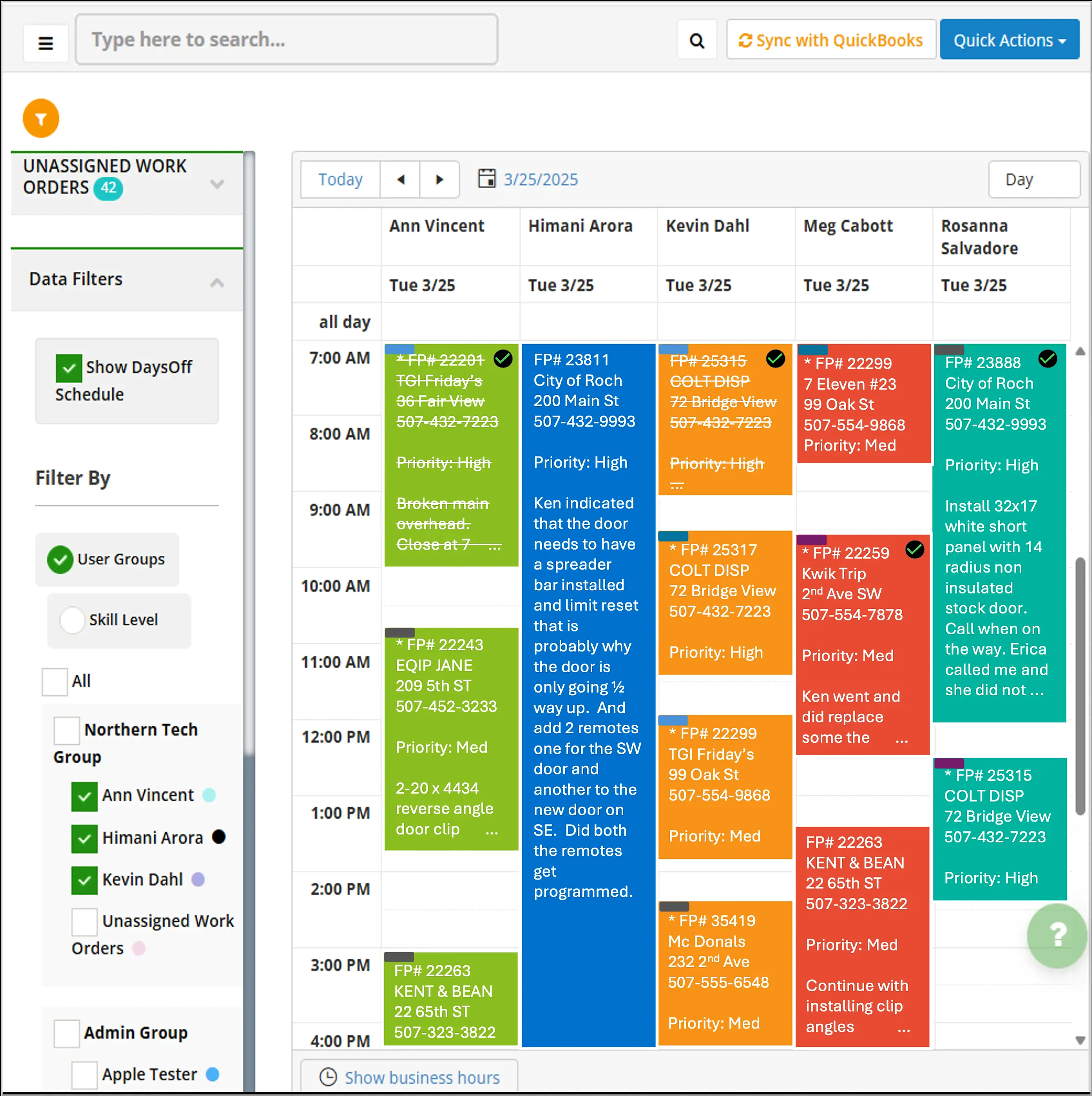
The starting-stack failure mode we see most often is running all of this on paper, a spreadsheet, and QuickBooks alone. That stack gets you to 10 to 15 recurring accounts. Past that, admin time between finishing a job and getting paid becomes the largest hidden cost of the business, ahead of any marketing spend. The fix in cleaning: scheduling and dispatch that holds every booking, a mobile app the cleaners actually open at the door, and automated review requests tied to job closeout.
How do you land your first office cleaning contract?
Commercial is a different game and pays back accordingly. Per IBISWorld's commercial cleaning benchmark, the U.S. commercial cleaning market sits around USD 75.3 billion in 2024, roughly four times the residential segment. BSCAI-referenced Pricing referenced by BSCAI puts a typical Class B office at $0.10 to $0.20 per square foot per month, meaning a 10,000 sq ft office pays $1,500 to $3,000 monthly. One of those replaces several residential accounts.
-
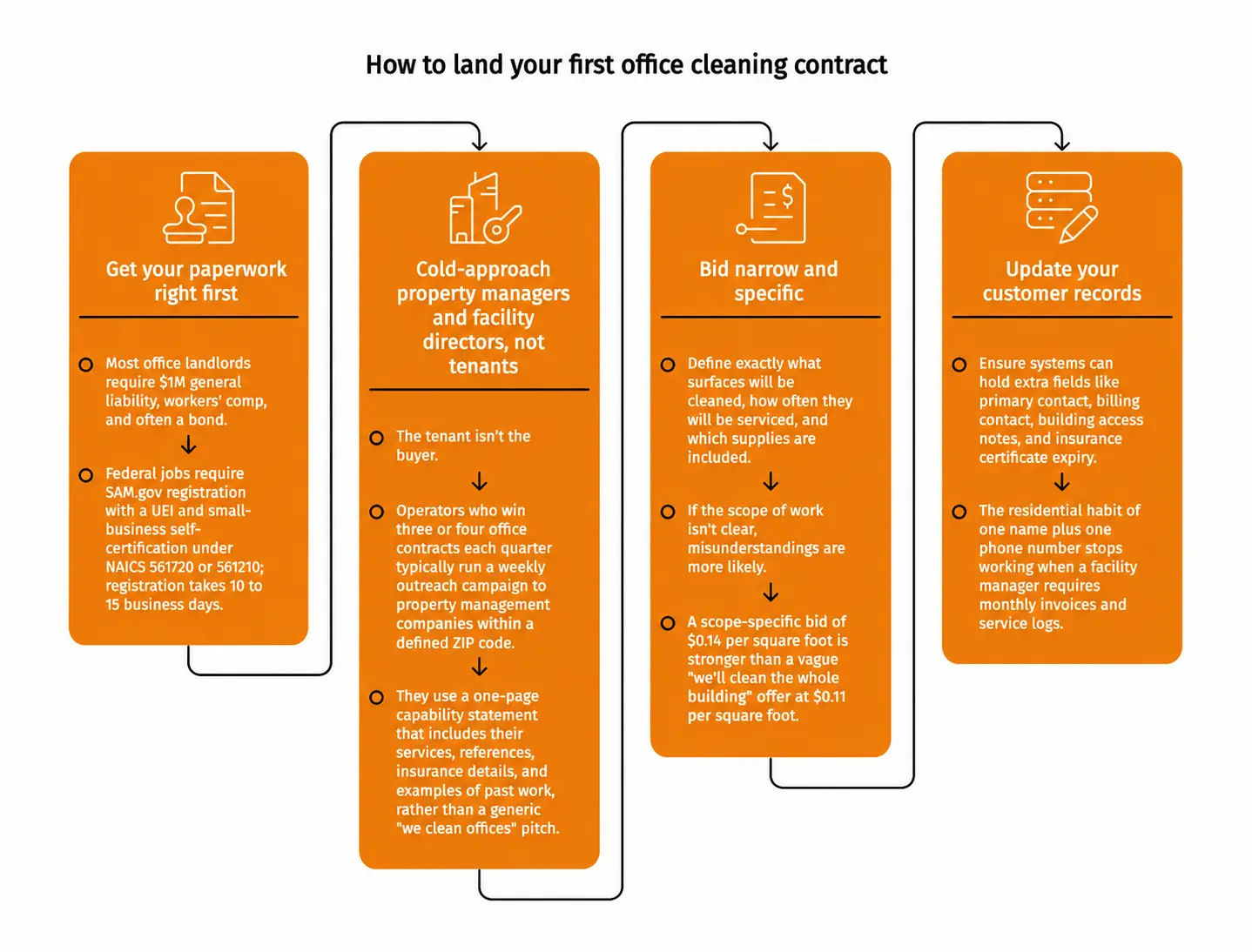
Get your paperwork right first. Most office landlords require $1M general liability, workers' comp, and often a bond. Federal jobs require SAM.gov registration with a UEI and small-business self-certification under NAICS 561720 or 561210; registration takes 10 to 15 business days. Skip this and you cannot bid.
-
Cold-approach property managers and facility directors, not tenants. The tenant isn't the buyer. Operators who win three or four office contracts each quarter typically run a weekly outreach campaign to property management companies within a defined ZIP code. They use a one-page capability statement that includes their services, references, insurance details, and examples of past work, rather than a generic "we clean offices" pitch.
-
Bid narrow and specific. Define exactly what surfaces will be cleaned, how often they will be serviced, and which supplies are included. If the scope of work isn't clear, misunderstandings are more likely. A scope-specific bid of $0.14 per square foot is stronger than a vague "we'll clean the whole building" offer at $0.11 per square foot.
Make sure your customer records can hold the extra fields a commercial account needs: primary contact, billing contact, building access notes, insurance certificate expiry date. The residential habit of one name plus one phone number stops working the moment a facility manager wants a monthly invoice to accounts payable and a service log to operations.
What breaks first when the phone finally starts ringing?
I read every support ticket that comes into Field Promax, and the pattern from cleaning owners in their first year is consistent. They spend three months chasing leads and about a week thinking about the workflow between booking and invoicing. That is backwards. From 14 years of customer conversations, the shops that break past 25 recurring accounts set up scheduling, mobile job cards, and closeout invoicing before the phone gets busy.
Conventional wisdom says buy marketing first and add software later. What we hear on our platform is the opposite: shops that wait to fix operations lose their first happy customers to slow invoicing and missed callbacks, and the referral engine never gets built in time.
- Joy Gomez, Founder of Field Promax
Once a marketing channel starts producing leads, operational problems show up fast. New cleaning shops can go from underbooked to overbooked in a short time. The first thing that usually breaks is the handoff between "the customer said yes" and "the cleaner arrives at the right address with the right supplies." That's where the first negative review lives.
The solution doesn't require a lot of software. It requires a single shared platform that manages the customer, the job, the team, the estimate, and the invoice. This allows the person answering the phone to create a job in less than a minute, while the cleaner can open the mobile app upon arrival and immediately see the address, scope of work, and job notes. Mobile app adoption across the entire cleaning team is the strongest indicator of a successful rollout. If the team can't access the system in the field, desktop reports won't make a meaningful difference.
Turn first clients into a lead engine
Continue with:
- How to Rank for "Plumber Near Me": Local SEO Playbook - the local pack mechanics that apply to any trade.
- Service Business Marketing: A Playbook for Owner-Operators - fix the funnel end to end.
- Customer Referral Programs for Field Service Shops - build the referral engine early.
- Word-of-Mouth Marketing for Field Service Businesses - compound trust into new clients.
- The Local Marketing Playbook for Customer Retention - keep the accounts you win.
Conclusion
Clients 1-25 are a marketing challenge. Clients 26-100 are an operational challenge. Owners who create schedules, assign jobs on mobile devices, and close invoices while the phone is still ringing are the ones who turn their first clients into a referral engine.
Frequently Asked Questions

Content Creator
Bhargavi Halthore is a content writer at Field Promax, a field service management platform serving trades businesses across the USA and Canada. With over a decade of experience writing for business owners, she brings detailed, ground-level insight to every topic she covers. Her research goes beyond search results - she digs into LinkedIn groups, Facebook communities, and Reddit forums to understand what field service business owners are actually dealing with on the ground. She speaks directly with industry professionals, understands their day-to-day challenges, and translates that into content that is practical and actionable. What you read in her articles reflects real industry patterns, not theory.