Service Business Marketing: A Playbook for Owner-Operators
For most small service shops, it does not feel like a marketing problem. It feels like a typical Friday: four missed calls, one scheduled job, a Yelp invoice of $1,800 that is difficult to distinguish from junk, an unpaid dispatcher, and a website that has not ranked for anything since 2019.
In owner discussions on Quora and contractor subreddits over the past 12 months, the main issue is not, "I need more leads." The issue is that visitors come to the website, but almost no one completes a form, and the owner can't tell if the problem is the message, the trust signals, or what happens between the inquiry and the visit. That is what marketing looks like for a typical service company with five to 20 technicians.
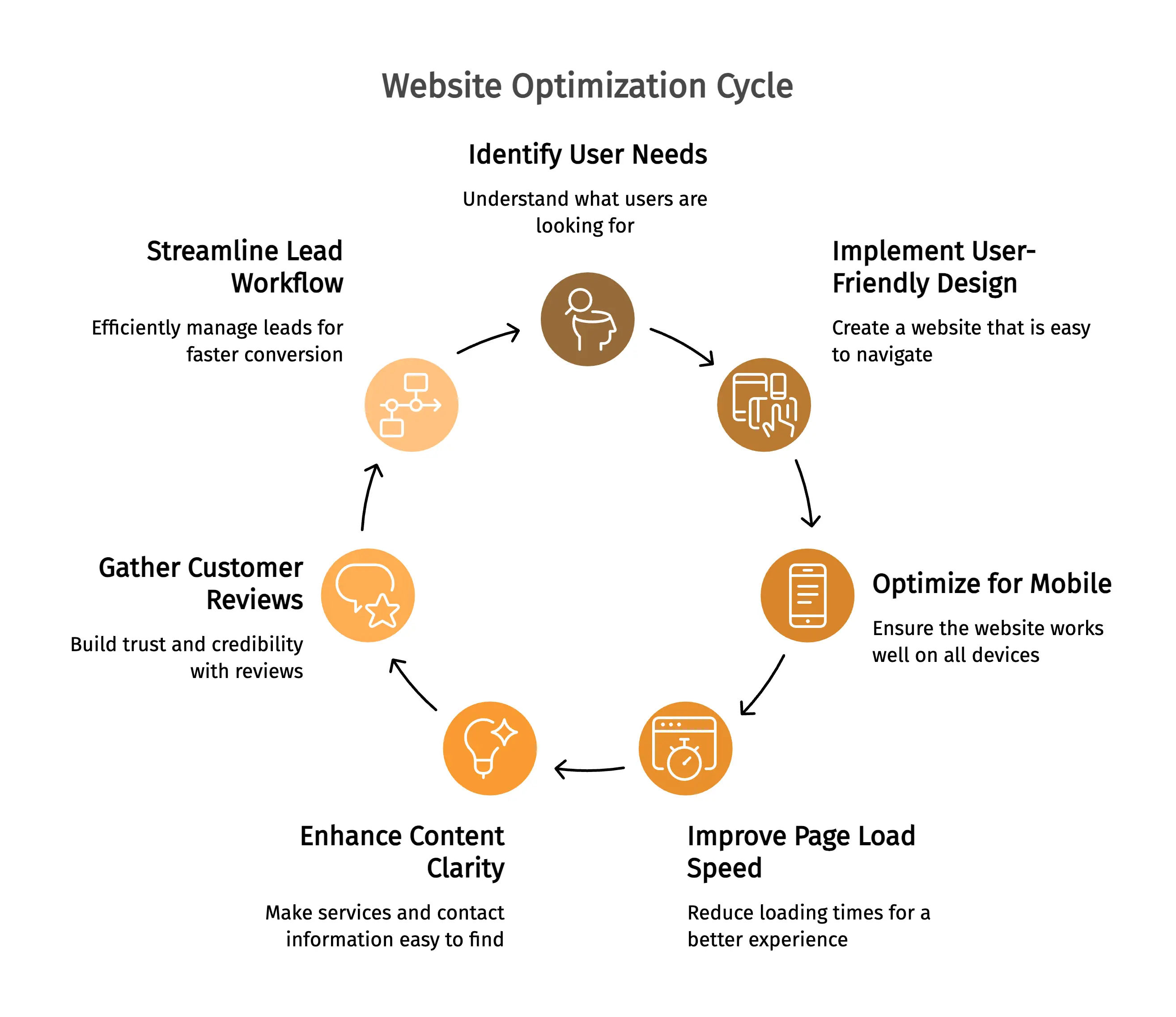
This piece will help you understand what happens when each component of the funnel is repaired: the website, the booking process, the marketing channels you use, the reviews you collect, the referrals you request, and the dispatch-to-invoice loop that converts marketing-generated leads into invoiced revenue. The order of the funnel matters. Most owners invest their advertising dollars at the top of the funnel while the bottom of the funnel continues to leak.
.webp?updatedAt=1757654583153)
Does your website close jobs, or just sit there?
Someone searching for "emergency AC repair in Plano" at around 9pm is not going to read the About page. They are looking for a phone number, a service area, a clear booking option, and some indication that someone will actually respond. If they cannot find all four within 10 seconds, they will hit the back button.
Owners often face the same problem: the website looks good on a laptop but performs poorly on mobile, which is where most traffic comes from. Phone numbers are not tap-to-call. The booking link is hidden in the footer. The services page says "full-service HVAC" instead of listing terms such as "AC repair," "AC replacement," "furnace repair," "ductless mini-splits," and "tune-ups." Google cannot rank your website for search terms that do not appear on the page.
A practical first pass:
- A contact number and scheduling CTA at the top of the page on both desktop and mobile devices.
- A services list that clearly states exactly what you do.
- A separate page for each service area you actually serve, featuring authentic customer photos.
- A page-load speed of less than two seconds. Reduce the hero image, remove the slider, and delay loading of the chat tool.
- At least four reviews on the homepage that include the customer's first name and city.
An HVAC contractor reviewing Field Promax on the QuickBooks App Store discussed using a lead capture form that feeds directly into the dispatch board, allowing technicians to be assigned on the same day a homeowner requests an AC installation. They reported booking about 30% more work without hiring extra office staff, according to their App Store review. A website does not just need to convert visitors - it also needs to move leads into an efficient workflow before they go cold.
What happens when a homeowner can't book at 9pm?
They are already booking with the next shop on their list. Research on speed-to-lead is consistent: contractors who respond within five minutes have a much higher chance of winning the job than those who respond within 30 minutes. If you are the owner and are out in the truck during working hours, the response needs to happen without you having to touch the phone.
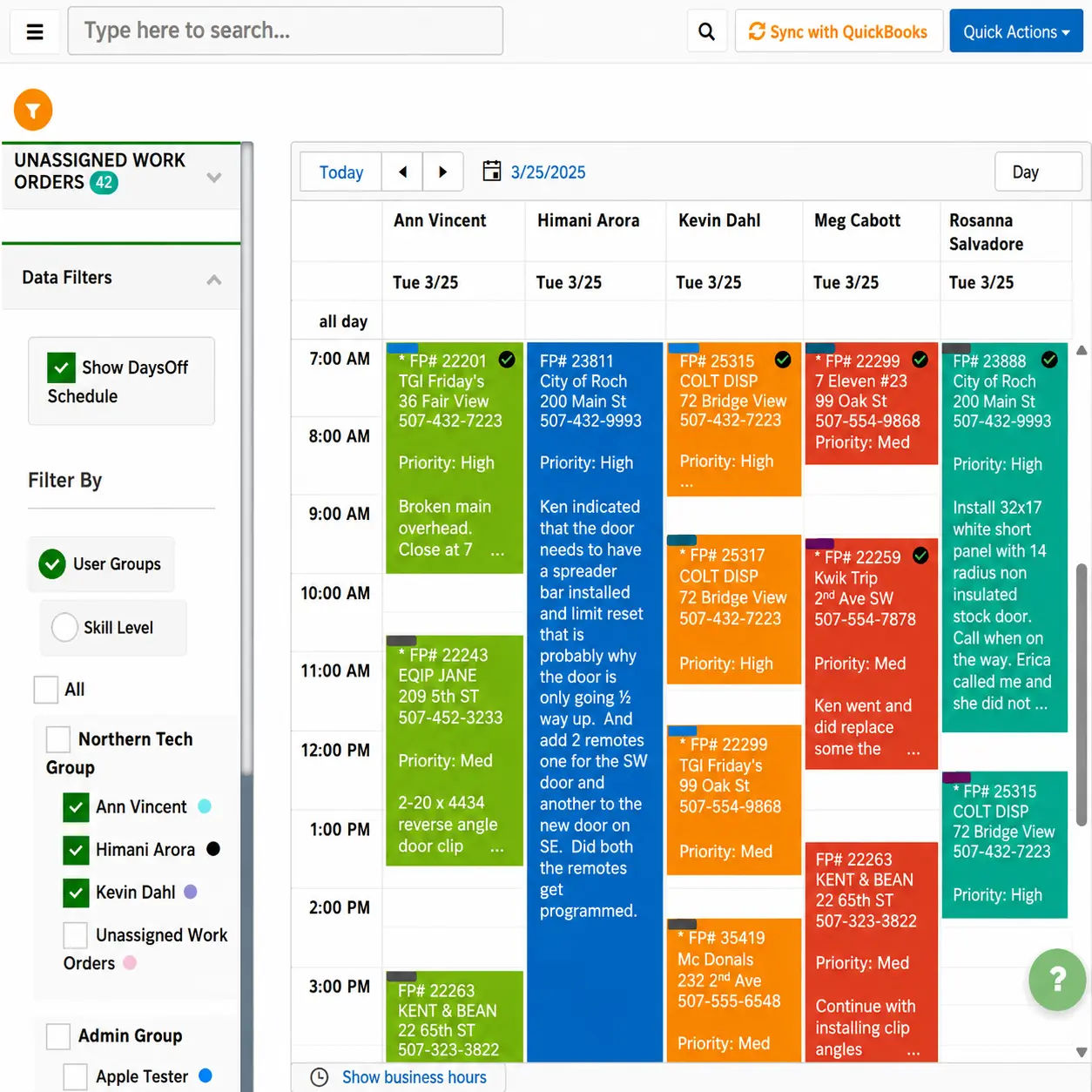
That's what a real online booking flow does. The customer picks a service, picks a window, sees an instant confirmation, and the job lands on your scheduling and dispatch board before anyone in the office sees the email.
Three things break a booking flow:
- Too many form fields. If you ask about system size and system type before requesting a phone number, many users will abandon the form before completing it.
- No appointment windows shown. "We'll call you to confirm the time" tells customers you are not ready to schedule, which erodes trust.
- No confirmation. The customer should receive a text message or email within one minute. Otherwise, they are likely to schedule a backup with another company.
If you do not have a full website, the same principle applies to Reserve with Google, your Facebook page, and the booking link on your Google Business Profile. The booking surface should match where the customer prefers to engage.
Automated customer notifications extend the same logic to the day-of: 'tech is 20 minutes out, here's their photo and ETA.' That single text reduces the no-access callbacks that quietly kill margins.
Where should a small shop actually spend ad money?
It is not a question of "Should I invest in paid search?" It is a question of which marketing dollar is most likely to produce a booked job rather than just a lead.
Industry benchmarks indicate that referral leads close at around 45% for home service contractors, while paid Google Ads leads close at around 18%, and shared marketplace leads (Angi, HomeAdvisor) close at around 12%. Referrals close at nearly four times the rate of shared marketplace leads. That math should change how the first $1,000 per month is spent.
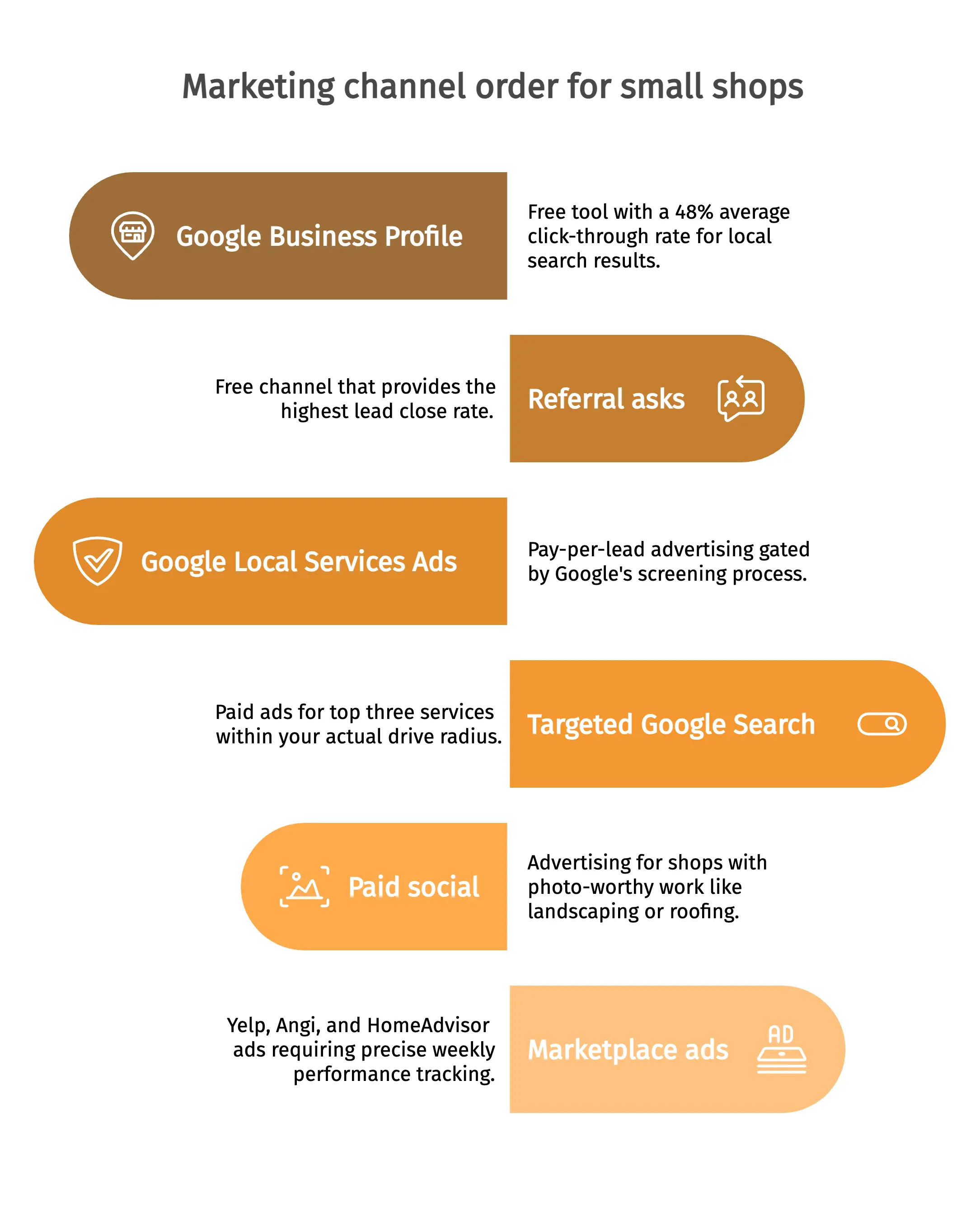
A practical channel order for a 5-20 tech shop:
-
Google Business Profile. Free. Google's Local 3-Pack has an average click-through rate of around 48% for local search results, which means a shop without a claimed, review-rich Google Business Profile sends nearly half of its local search traffic to competitors.
-
Referral asks and partnerships. Free. Highest close rate.
-
Google Local Services Ads (LSAs). Pay-per-lead, gated by Google's screening.
-
Targeted Google Search ads for your top three services in your actual drive radius.
-
Paid social only if you have photo-worthy work (landscaping, roofing, renovations, etc.).
-
Yelp ads, Angi, HomeAdvisor. Only with precise tracking. Shared leads should be kept to a minimum. If you cannot track their performance weekly, eliminate them.
The owners we've spoken to often reverse the order by putting paid marketplaces first and Google Business Profile (GBP) last because the marketplace sends a sales representative, while Google does not. This is backward logic.
How this plays out for a typical multi-trade contractor
Imagine an owner-operator of a multi-trade business running HVAC and plumbing teams, with a dispatcher and about two dozen technicians in the middle of a Midwest metro area. The dispatcher runs the HVAC board in one tool and the plumbing board in another. The two systems overlap. On a Tuesday morning, technicians are assigned to a tune-up while a plumbing rough-in at the same address is already being handled on the other board.
During a busy spring and summer season, this business repeatedly double-booked technicians licensed for both trades because the dispatcher maintained two separate calendars and synchronized them from memory. Estimate disclaimers added to the confusion. HVAC estimates included weather and equipment-availability language, while plumbing estimates included material-assumption language. When a project involved both trades, customers pointed to whichever disclaimer worked in their favor. By mid-week, no one trusted either calendar.
The owner consolidated the two boards into a single calendar that the dispatcher worked from exclusively, requiring every booking to be made through that one calendar, even though the plumbing team initially pushed back. He also revised the estimate disclaimer into a single template covering the usual exclusions, scope limitations, weather conditions, and access contingencies for all trades in plain English.
Double-bookings were essentially eliminated after a difficult first month, during which the unified calendar exposed conflicts that had previously been hidden. The disclaimer required two revisions. One customer disputed a water damage exclusion that the plumbing lead considered standard but that was viewed as too broad in the unified template. The plumbing foreman was the primary holdout when it came to adopting the unified calendar.
This is a composite case, with details tied to the most common version of the pattern we have seen across the multi-trade companies we've worked with.
How do you build a presence without becoming a content creator?
Social media supports your marketing; it is not a separate business. It is easy to treat Instagram as a channel that requires daily updates. For a small business, the goal is to be visible where your customers are already scrolling, post useful content each week, and remain accessible.
Picking the platform follows the customer:
- Facebook remains the best platform for reaching homeowners over 40, as well as neighborhood groups.
- Instagram and TikTok work well for visual trades such as landscaping, painting, and pressure washing, especially for before-and-after content.
- LinkedIn is designed for commercial customers, including property managers, facility managers, and general contractors (GCs).
- Nextdoor is a hyperlocal platform that is often overlooked.
Useful content includes quick before-and-after clips, 30-second explanations of topics such as "why your AC stops working," photos taken with the homeowner's permission, and genuine posts about callbacks you have handled. The goal is to build trust, not reach.
Offline still matters. Sponsoring a kids' league, participating in the chamber of commerce, offering furnace inspections for senior centers in November, or attending the chamber breakfast all make a difference. These activities do not scale, and they do not need to. They turn a Google search for "AC repair near me" into, "Isn't this the company from the church newsletter?"
Why are referrals still the most reliable lead source?
Because close rates don't lie. A referred customer already trusts you, so they are less likely to compare estimates, ignore your callback, or negotiate the deposit amount. The 45% close rate comes from that built-in prequalification.
Most shops treat referrals as something passive: "If they like our company, they'll recommend us to others." That is hope, not a strategy. A referral system consists of three parts:
-
The ask. At the end of the job, the tech says, "We get most of our work through referrals. If we did a good job today, would you recommend us to two of your neighbors?" The request is made in person, not through an email sent two weeks later.
-
The incentive. The structure is designed to make the customer feel appreciated, not bribed. A $50 service credit toward their next visit is often more effective than $50 in cash because it also encourages them to return.
-
The partnership layer. Real estate agents, property managers, electricians, home inspectors, plumbers, and HVAC contractors can all be valuable referral partners. Three or four active partnerships often outperform six months of paid advertising.
Tracking is where most shops fall down. If you don't ask every new customer how they found you, and write the answer in the same field every time, you can't see what's working. See our referral program ideas for incentive structures by vertical.
The most common marketing mistake I see across our customer base isn't underspending on ads. It's running the dispatch-to-invoice handoff on memory and sticky notes, then blaming the marketing channel when leads don't turn into invoiced work. We had a shop ask us last quarter why their Google Ads weren't 'working,' and when we pulled the data, the issue wasn't the ads. 31 of 87 leads in 60 days had been booked but never invoiced, because tech notes never made it back to the office cleanly.
The cheapest marketing win for most 5-20 tech shops isn't a new channel. It's closing the loop between the lead and the deposit. Fix the loop, and the same ad spend produces meaningfully more revenue without buying a single extra click.
- Joy Gomez, Founder of Field Promax
.webp?updatedAt=1757654583589)
What turns a review collection into booked calls?
BrightLocal's 2024 Local Consumer Review Survey found 92% of consumers read reviews of local businesses before their first visit, and most expect between 20 and 99 reviews before they trust the average star rating. For a typical shop relying on a handful of stale 4-star ratings, nearly every prospect is comparing you against competitors actively collecting fresh reviews after every job.
The mechanics:
- Ask at the right moment. Within two hours of job completion, the customer still remembers the technician's name. Waiting 48 hours cuts response rates nearly in half.
- Send the direct link. A tappable Google Review link sent by SMS gets clicked far more often than one sent by email.
- Respond to every one, good or bad. A negative review followed by a calm, specific response from the owner turns "worse than it could have been" into "this owner is on top of things." No response is worse than a negative review.
- Surface the best reviews. Display your Google Business Profile (GBP) on your service pages and your truck wrap, where it is visible on the street.
Automated Google review management closes the loop: when a tech marks a job complete in the mobile app, the customer gets a review request before the truck leaves the driveway. Shops running this in 2024 saw more reviews, higher star averages, better local ranking, and a bump in inbound calls from the GBP.
Which channel actually refills the slow season?
Email, by an embarrassing margin. Litmus and DMA benchmarks put email marketing ROI in the range of $36 per $1 spent. The small plumbing and HVAC shops that actually send seasonal tune-up reminders and post-service follow-ups consistently tell us email is the cheapest repeat-revenue channel they run.
List-building is unglamorous: collect email at booking, at invoicing, in the customer management record, in the post-job review ask. Two or three sends a month is the rhythm, and the content owners are afraid to send is exactly what works:
- Seasonal reminders. "Spring AC tune-up period begins March 1st. Here's the early-bird pricing."
- Post-service follow-ups. "It's been six months since we cleaned your line. Here's the contact information to book your next visit."
- Anniversary asks. "You installed the water heater two years ago. Here's the chance to flush it for free.”
SMS is the more engaging sibling. A plumbing review on Capterra noted that automated SMS follow-ups after each service call encourage customers to respond within minutes to schedule their next service. SMS open rates top 90%, and click-through rates pass 20%. However, customers typically tolerate only one text every six weeks before opting out. It is best to use SMS for high-intent occasions such as post-job follow-ups, appointment reminders, or on-the-way notifications - not for general marketing.
For customer nurturing, use email campaigns, and reserve SMS for transactional or urgent communication. Keep customer communication centralized under the same account so you avoid sending duplicate messages.
How do you run promos without training customers to wait?
Special offers work because they attract new customers. However, they become counterproductive when they train existing customers to delay purchases while waiting for another discount. Follow these two principles:
- Offer discounts only for first-time customers, not repeat customers. For example, provide a $49 inspection or a free first lawn service. After that, standard pricing applies.
- Focus on adding value instead of cutting costs. Bundle an AC tune-up with coil cleaning, or include a smoke detector battery upgrade with an electrical service call.
Avoid:
- Permanent discounts displayed on your homepage. Over time, customers begin to treat them as your standard pricing.
- Discounts on urgent services. Customers with immediate needs are generally willing to pay full price.
- Discounts that stack across multiple channels (for example, a Yelp offer combined with a Google Ads coupon and referral credit on one job). Track each offer separately, or you will never know which channel actually drove the conversion.
Every offer should have its own unique phone number, landing page, or tracking code so you can measure closing rates, average ticket size, and six-month repeat customer rates against your baseline. Offers that generate high lead volume but fail to produce repeat customers ultimately result in net losses.
Which marketing metrics actually tell you what's working?
Two numbers determine whether marketing is paying for itself:
- Cost per booked job, based on channel. Cost per lead is not the key factor, nor is cost per click. The amount spent on a channel should be divided by the number of jobs it generates. A channel that brings in low-quality leads and a 5% booking rate is more expensive than a channel that generates costly leads but maintains an average booking rate of 35%.
- Six-month revenue per new customer. Revenue from the first job alone is a misleading number. A customer who purchased a $49 tune-up and later bought a $7,000 replacement system in October is far more valuable than someone who only purchased the $49 service and never returned.
ServiceTitan's state-of-the-trades reporting found the top 10% of contractors book 62% of inbound calls while the rest book 39%. That gap isn't about marketing spend. It's about whether the phone gets answered, whether the booking link works, and whether the dispatcher closes the call instead of taking a message. Spending more on marketing while losing 60% of inbound calls is the most common waste pattern we see.
Ask every prospective customer how they found your business. Record that information in the customer account, review it monthly by channel, eliminate what is not profitable, and increase the budget for the channels that consistently deliver results.
What marketing mistakes drain budgets fastest?
Five patterns we see across HVAC and plumbing shops moving off spreadsheets:
-
Buying paid leads outside the drive radius. A 40-mile Yelp target circle centered around a 15-mile profitable service radius means nearly three-quarters of the spend goes toward jobs that aren’t profitable, even when they close.
-
Treating Google Business Profile as 'set it and forget it.' A GBP that isn’t updated regularly with weekly photos, answered Q&As, and service-area pages will rank below competitors who actively maintain their profiles.
-
Spending on lead gen while ignoring the dispatch-to-invoice loop. Every completed job that remains unpaid after 72 hours represents a marketing cost with no realized return.
-
Asking for reviews by email two weeks after the job. Response rates drop sharply outside the same-day window. The request should be made while the technician is still on-site whenever possible.
-
Running offers without unique tracking. If three different channels use the same coupon, it becomes impossible to identify which channel actually generated the paid customer.
Marketing problems that appear to be channel selection issues are often workflow issues instead. The lead is there. The booking is in place. The job gets completed. The real loss happens in the handoff between each stage, and that is where money slips away.

Conclusion
Marketing a service business is the process of ensuring that clients can find you, trust you, book your services, and ultimately pay for the work completed. Your website, booking flow, GBP reviews, emails, referrals, offers, and tracking all play a role. Each piece works together and is not meant to stand alone.
For a shop with 5 to 20 technicians, it is important to fix the bottom part of the funnel (booking, dispatch, bookkeeping, and invoicing) before focusing on the top. The shops we see grow the fastest stopped buying leads and instead began closing the loop with the leads they already had.
Choose the two changes from this guide that seem the most manageable. Implement them this month, measure the results the following month, and then pick two additional improvements.
Frequently Asked Questions

Content Creator
Bhargavi Halthore is a content writer at Field Promax, a field service management platform serving trades businesses across the USA and Canada. With over a decade of experience writing for business owners, she brings detailed, ground-level insight to every topic she covers. Her research goes beyond search results - she digs into LinkedIn groups, Facebook communities, and Reddit forums to understand what field service business owners are actually dealing with on the ground. She speaks directly with industry professionals, understands their day-to-day challenges, and translates that into content that is practical and actionable. What you read in her articles reflects real industry patterns, not theory.