15 Minutes in Decimal: What It Actually Means for Field Service Payroll
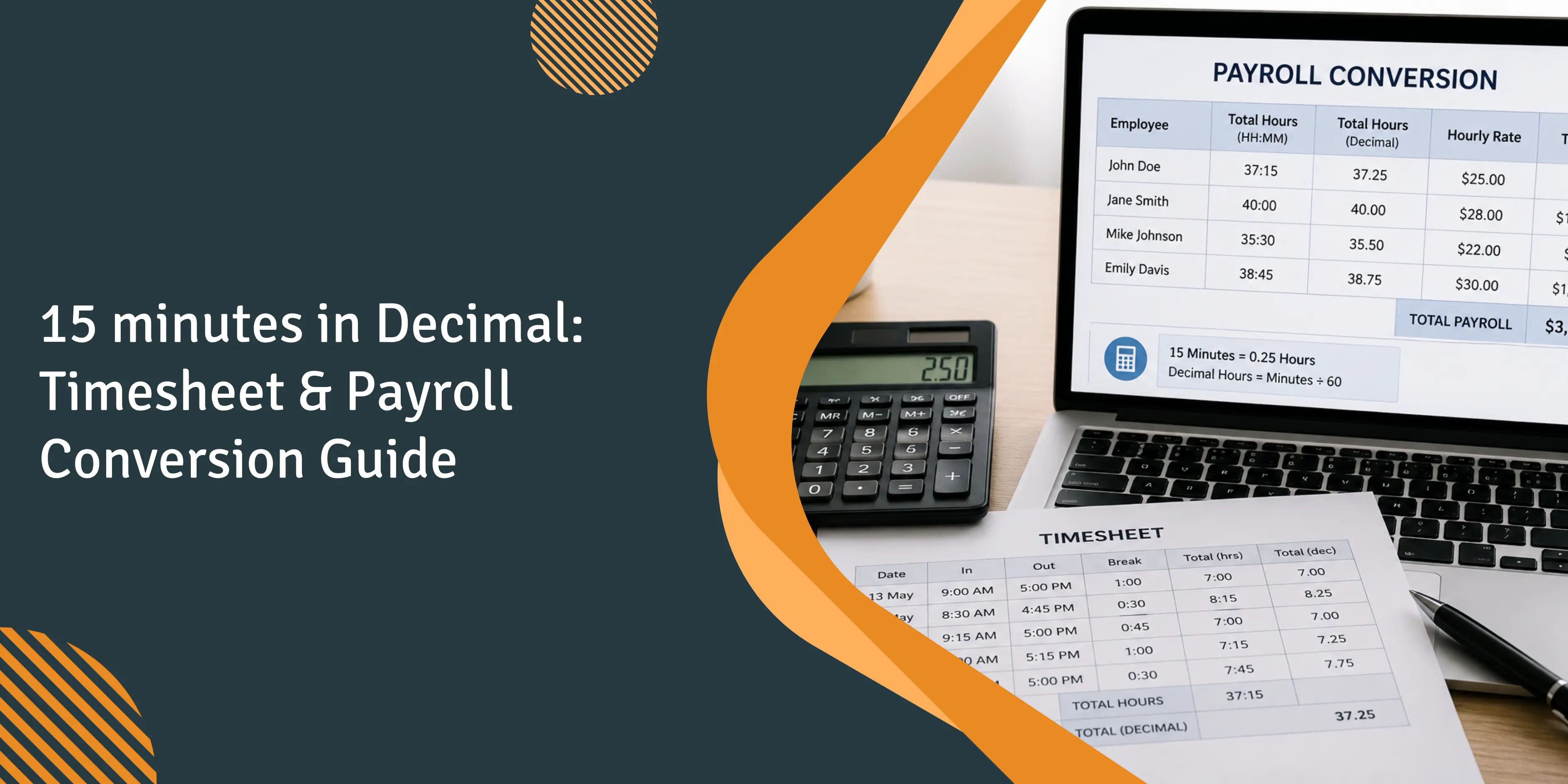
Why does 5:15 PM turn into a Friday payroll fight?
The most common interpretation of 15-minute payroll rounding is that it is simply a mathematical calculation. Divide 15 by 60 to get 0.25, and you are done. That is the boring 5% of the problem. The math takes a calculator. The mess takes a whole Friday afternoon.
Here is what actually happens. A technician at an eight-person HVAC company writes “2:00 to 5:15” on a timesheet at the end of the day, relying on memory because he failed to clock in at 1:47 as required. On Friday morning, the office manager reviews eight of these handwritten timesheets, converts the hours into decimals, and applies the seven-minute rounding rule differently while trying to interpret unclear handwriting before submitting everything to payroll. By the afternoon, two technicians are texting back and forth, disputing their hours for the day. Eventually, the business owner discovers a 2.5-hour discrepancy that throws off the company’s labor budget.
Business owners on Quora repeatedly point to the same underlying problem with job safety analyses, compliance forms, and timesheets: paper forms completed from memory at the end of the week rarely reflect what actually happened during the workday. As a result, supervisors are left with little confidence in the accuracy of the information recorded before the crew went home.
Ready to get started with Field Promax?
Sign Up FreeSo what is 15 minutes in decimal, exactly?
15 minutes equals 0.25 hours. Divide 15 by 60 to get 0.25. A 3-hour, 15-minute service call is recorded in 3.25 hours. A 22-minute drive rounds to 0.25 hours under the seven-minute rule.
This is what every payroll program - from ADP and Gusto to QuickBooks - expects during imports. Enter “3:15” instead of “3.25,” and the system either ignores the row or interprets it incorrectly, causing overtime calculations to be processed inaccurately. This is the most common reason small-shop payroll exports fail during the initial run. The fix is not a smarter spreadsheet - it is making the conversion happen once, at the source, before the number lands in front of an office manager.
.webp?updatedAt=1754464593302)
Why do field service shops bother with 15-minute increments at all?
The increment isn't arbitrary. Within the different trade verticals service firms operate in, shops choose different rounding rates due to operational reasons. HVAC residential service operates in 15-minute/ 0.25-hour blocks due to the way customers view calling. Commercial electrical contractors utilize 6-minute/ 0.1-hour blocks as general contractors require when they bill construction. Plumbing shops often round emergency dispatch at 15-minute intervals and planned commercial work at 6-minute intervals.
Why is it that almost no one follows exactly to the minute? Because it creates downstream headaches. When you clock out at 5:07, it creates a 3.1166... decimal that batch payroll imports have a difficult time managing. Standardizing timecard data lets it work seamlessly with invoicing, payroll, as well as job costs.
There is a second issue that business owners frequently mention in conversations: there is often no reliable way to verify that a technician has reviewed, acknowledged, or complied with safety training, job safety assessments, or time-rounding policies before starting work. Standardizing the rounding increment and applying the same procedure at clock-in helps eliminate one layer of uncertainty.Pick the increment that matches how customers pay you, then apply it identically to every tech, every shift.
Why does the 7-minute rule keep tripping up field service shops?
The FLSA allows employers to round to the nearest quarter hour, but only if rounding is neutral on average. The regulation is 29 CFR §785.48, and the mechanic is the 7-minute rule: punches 0-7 minutes into a quarter round down, 8-14 round up. A 9:07 clock-in stays at 9:00. A 9:08 round to 9:15.
Two problems hit small shops. First, the rule only works if applied uniformly - most paper-timesheet shops apply it differently to different techs depending on whose handwriting is legible. Second, federal courts are ruling hard against policies that systematically benefit employers. A 2024 Seattle jury awarded $98.3 million over illegal time-clock rounding and meal-break practices, and the Eighth Circuit has held that even facially neutral timekeeping software can violate the FLSA if rounding reliably underpays workers (see DOL Wage and Hour enforcement data).
In the field service businesses that hold up in a wage-and-hour audit, rounding is logged automatically the second a tech clocks in from a GPS-verified mobile field service app. Manual rounding by an office manager interpreting a paper timesheet leaves no defensible audit trail, and an auditor knows it.
A pattern across multi-trade contractors we've worked with
For operators in the multi-trade contractor sector, the documentation discipline problem that is present in the process of rounding payrolls shows up wherever paper forms are in the field. Consider a mid-sized multi-trade contractor operating all over Texas with field teams subject to OSHA regulations. The shop operated for years using paper safety binders, ad-hoc training folders that were kept by foremen, and a spreadsheet for time entries. The system worked fine pretty well until the next level of scrutiny arrived.
When OSHA showed up, the contractor could not produce safety training records for crews on site. Some existed on paper in foremen's trucks. Some lived in old email threads. Some were verbally acknowledged but never written down. The gap triggered a penalty in the tens of thousands. For context, the National Safety Council pegs the average medically consulted work injury at roughly $43,000 in 2023. A single recordable in a 20-40 tech operation can wipe out a quarter of an annual safety-program budget once indirect costs stack on top.
The action was structural. Leadership moved every training record, signature, and certification date into one centralized digital system, where completion dates were recorded by each technician and could be retrieved at any time.The same process was applied to job safety analysis and time entry.
The results were real, but not perfect. The subsequent audits uncovered records within minutes instead of days. However, the crews initially opposed the new sign-off process ,and the office staff spent weeks back-filling historical training data. This pattern is common across the various operators in this vertical - the details above are the most common version of it.
What does the conversion chart actually look like?
Print it. Tape it next to the payroll computer. The 7-minute rule is built into the rounded column.
Two things matter for a 5-20 tech shop. First, the 7-minute behavior is asymmetric in a way most office managers do not internalize: A clock-in 7 minutes past a quarter rounds down; a clock-in 8 minutes past rounds up, and that gap compounds into a 1-3% annual payroll leak across a complete team. In addition, the printed chart is reduced to a small number of technicians. After 14 years of customer conversations, the office hours saved by automating the conversion are greater than the cost once the shop reached six or seven active timesheets per week
An HVAC contractor who was reviewing Field Promax on the QuickBooks App Store said the timecard feature was so accurate that no service company should be without it. Each rounding error adds, and owners in 8-tech operations report each tech consumes roughly 5 hours a week on time and compliance paperwork Move the conversion to a mobile timestamp and the weekly reconstruction ritual disappears.
| 1 to 7 | 0.02 to 0.12 | 0.00 |
|---|---|---|
| 8 to 15 | 0.13 to 0.25 | 0.25 |
| 16 to 22 | 0.27 to 0.37 | 0.25 |
| 23 to 30 | 0.38 to 0.50 | 0.50 |
| 31 to 37 | 0.52 to 0.62 | 0.50 |
| 38 to 45 | 0.63 to 0.75 | 0.75 |
| 46 to 52 | 0.77 to 0.87 | 0.75 |
| 53 to 60 | 0.88 to 1.00 | 1.00 |
| Minutes Worked Past Quarter | 7-Minute Rule Action | Decimal Value (0.25 base) |
| 0-7 minutes | Round DOWN to prior quarter | +0.00 (no change) |
| 8-14 minutes | Round UP to next quarter | +0.25 added |
| 15 minutes = 1 quarter | Exact quarter-hour hit | 0.25 |
| 30 minutes = 2 quarters | Exact half-hour hit | 0.50 |
| 45 minutes = 3 quarters | Exact three-quarter hit | 0.75 |
| 7 min past any quarter | Round DOWN — no pay added | 0.00 increment |
| 8 min past any quarter | Round UP — full quarter added | +0.25 increment |
| Gap (7 min to 8 min) | 1-minute swing = 0.25 hour = $6-8 at typical rates | The payroll leak |
What changes when clock-in moves off paper?
The solution to payroll rounding does not require a better chart. It is removing where errors enter: the gap between when a tech finishes a job and when someone in the office notes the time of completion.
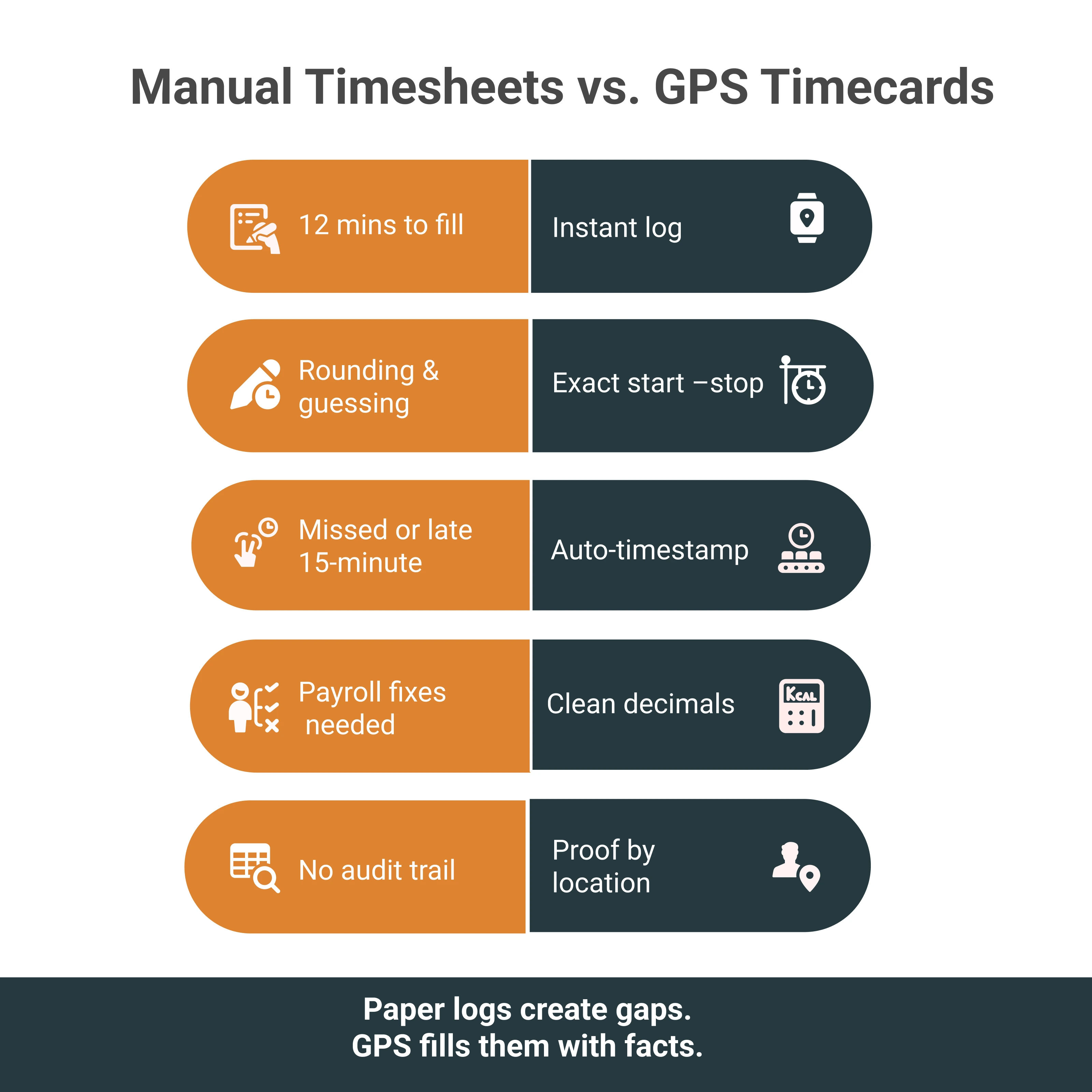
When clock-in or clock-out occurs at the tech's mobile phone at the site, three things change. The system keeps track of the exact time. The rounding rule applies automatically and identically to every tech. The decimal enters into payroll without anyone to re-type. Owners describe the broader version : they would like a defined procedure to track regulations, internal policies, and certifications on a continuous basis - not scrambling at audit or payroll time. Choose one rule, implement it in the first place and then the audit trail grows itself.
Mobile adoption is the single biggest predictor of a successful rollout, because techs who clock in from the job site stop the "round up to the next 15" habit. Clean decimal hours flow through QuickBooks Integration, feed into Job Costing, and reconcile against Scheduling & Dispatch without weekend re-keying.

I read every support ticket that lands in our queue, and payroll-rounding questions are a steady drumbeat. The real question that comes week after week is not "what is 15 minutes in decimal," because owners can do that math. It is "why does my QuickBooks import keep rejecting 0.116666?" or "how do I show 7 minutes as a decimal without manually editing every row?" That tells me where the friction actually is. It is not the conversion. It is the loop between the tech's last job of the day and the payroll batch on Friday. Once a shop running 5 to 20 techs moves clock-in to the mobile app, the rounding conversation stops being a conversation. The form auto-fills, the decimal pushes into payroll, and* *the owner gets their Friday afternoon back.
- Joy, Founder, Field Promax
For more information, contact Field Promax
We're here to help you get started
Payroll accuracy benchmarks for field service
The following table is a compilation of studies conducted by the industry research on payroll error rates, correction costs, and the ROI of automated time tracking. Use it to benchmark where your shop stands and where the highest leverage points are.
Year-by-year growth in digital time tracking adoption across field service:
Market size: Fieldwork (2025). Adoption estimates derived from FSM vendor reporting and industry survey data.
| KPI | Industry Baseline | Best-in-Class Target | Source |
| Payroll error rate per pay period | 1.2% | Under 0.2% | ADP (2024) |
| Payroll runs requiring correction | 1 in 4 (25%) | Under 5% | ADP Global Payroll Survey |
| Cost per payroll error to correct | $291 | Under $50 with automation | Journal Record (2022) |
| Employee turnover risk after 2+ errors | 50% start job search | Zero recurring errors | PayrollOrg survey |
| Annual gross pay affected by errors | Up to 8% | Under 0.5% | Chronotek (2025) |
| GPS ROI payback period (field service) | Under 12 months (48% of shops) | Under 6 months | Verizon Connect (2025) |
| Weekly payroll time savings with automation | 2-4 hours manual baseline | Under 30 minutes | Field service customer base, aggregated |
| Year | FSM Market Size | Est. Digital Time Tracking Adoption | Key Driver |
| 2020 | $3.2B | ~35% | COVID accelerated mobile adoption |
| 2021 | $3.7B | ~42% | Remote management demand increases |
| 2022 | $4.1B | ~48% | Labor shortage drives efficiency focus |
| 2023 | $4.7B | ~54% | QuickBooks and FSM integrations mature |
| 2024 | $5.1B | ~60% | GPS time tracking ROI proven at scale |
| 2025 | $5.64B | ~65% | Anomaly detection enters mainstream FSM |
| 2030 (proj.) | $9.68B | ~80%+ | Payroll integration becomes table stakes |
Sources consulted
- Cornell Legal Information Institute - 29 CFR §785.48, rounding practices under FLSA
- U.S. Department of Labor Wage and Hour Division - FY2024 and FY2025 back-wage enforcement data
- DOL Fact Sheet #53 - hours worked under FLSA in health care (rounding precedent applies broadly)
- average cost of a medically consulted work injury, 2023 - National Safety Council
- Aggregated owner pain themes from 12 months of Quora threads on job safety analysis documentation, compliance ownership, and field-worker safety communication
More payroll and compliance reading
Frequently Asked Questions

Content Creator
Bhargavi Halthore is a content writer at Field Promax, a field service management platform serving trades businesses across the USA and Canada. With over a decade of experience writing for business owners, she brings detailed, ground-level insight to every topic she covers. Her research goes beyond search results - she digs into LinkedIn groups, Facebook communities, and Reddit forums to understand what field service business owners are actually dealing with on the ground. She speaks directly with industry professionals, understands their day-to-day challenges, and translates that into content that is practical and actionable. What you read in her articles reflects real industry patterns, not theory.