Tracking Field Employee Attendance: A Practical Guide for Field Service Owners
In an office, attendance is easy to see. Someone is at their desk or they aren't. In a field service business, your crew starts the day at a dozen different addresses, and the first sign that a tech didn't show is often a customer calling to ask where everyone is.
That's why attendance tracking matters more for field teams than for almost any other kind of business. It decides whether jobs start on time, whether payroll is right, whether overtime surprises you at the end of the month, and whether you can back up your pay records if the Department of Labor ever asks.
1. Why attendance is harder to track for field teams
Field crews break every assumption that office time tracking is built on:
- There is no front door. Techs go straight from home to the first job, so there's no single place to clock in.
- The day moves. A tech might hit four sites, a supply house, and the shop before heading home, and each stop changes what the day costs you.
- Nobody sees the start. A dispatcher can't tell the difference between a tech who is stuck in traffic and one who hasn't left the house.
- Paper travels badly. Timesheets filled in on Friday from memory are guesses, and the guesses tend to round up.
The result is that many shops find out about attendance problems late: when a customer complains, when a job runs over, or when payroll doesn't match what the work orders say.
2. What poor attendance actually costs you
A missed or late start rarely costs you just one hour. It sets off a chain:
- The first job starts late, so every job after it slides, and the last customer of the day gets rescheduled.
- Someone else covers the gap, often on overtime.
- Billable hours drop while payroll hours stay the same, because the tech still gets paid for the day.
- Customers who were promised a window and missed it are the ones who leave reviews.
Payroll is the other leak. When hours come from handwritten timesheets, small errors add up: a 7:15 start written as 7:00, a lunch that never gets deducted, a Friday that gets rounded to a full day. None of it is dramatic, but across a crew of 15 techs over a year it is real money, and it is money you can't get back.
3. What the law expects you to record
Under the Fair Labor Standards Act, employers must keep accurate records of hours worked and wages paid for every non-exempt employee. Payroll records must be kept for at least three years, and the time cards and wage-computation records behind them for at least two. The Department of Labor doesn't require a particular method. It requires that the records are complete and accurate.
Three attendance details trip up field service shops most often:
- Overtime. Non-exempt techs earn time and a half for hours over 40 in a workweek. If start times are guessed, overtime is guessed too.
- Travel during the day. Driving from the shop to a job, or from one job to the next, is generally work time. The normal commute from home to the first job usually isn't. Your records need to show the difference.
- Edits after the fact. If someone changes a timesheet days later, you should be able to see who changed it and why.
The stakes are not small. The DOL's Wage and Hour Division recovered nearly $150 million in back wages in fiscal year 2024. Accurate daily records are the cheapest defense you can have, and when those hours flow straight into QuickBooks payroll integration, nobody has to retype them.

4. Five ways shops track field attendance today
There's no single right method. It depends on how your crews work:
- Paper timesheets: fine for two or three techs you see every day. They depend on memory and can't show where anyone was.
- Punch-in kiosks: work for crews that start and end at the shop. Useless for techs who go straight to the first job.
- Mobile app with GPS: built for crews spread across job sites. Each clock-in is tied to a time and a location. The catch is that it only works if every tech actually uses the app.
- Biometric clock-in (fingerprint or face): strong proof of who clocked in, but it brings privacy-law obligations. Illinois (BIPA) and Texas (CUBI) both require consent before collecting biometric data.
- RFID badges: suit warehouses and depots. A badge only proves the badge was there, not the person.
For most 5-40 tech field operations, the mobile app approach is the practical choice, because it is the only option that records when and where the day actually started. An enterprise reviewer on the QuickBooks App Store rolled Field Promax out across four of its businesses, citing customer service and customizations other out-of-box products couldn't match.
5. Red flags hiding in your attendance data
Once attendance is recorded properly, patterns start to show. Signals worth watching:
- Monday and Friday absences that keep landing on the same techs
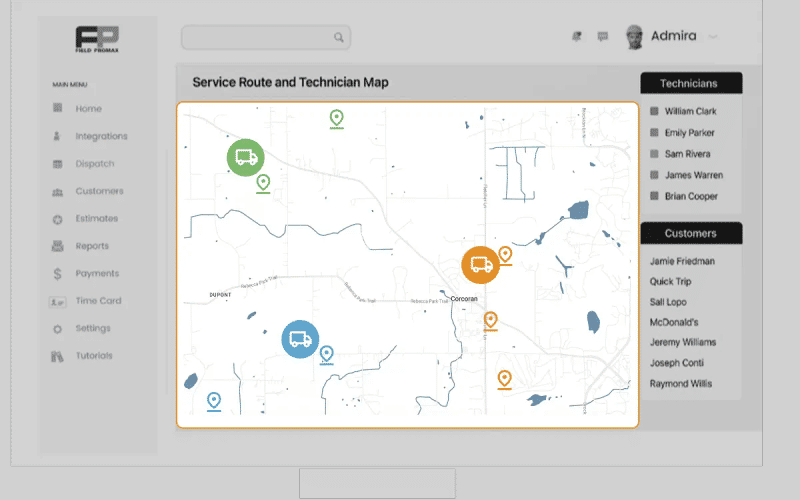
- Clock-ins with no matching GPS location, a common sign of buddy punching
- Site arrival times that miss the dispatched time by more than 15 minutes, again and again
- Timesheet edits made more than 48 hours after the shift
- Two techs clocking in from the same phone or the same spot every morning
- Overtime piling up on one or two people while others run short days
If two or more of these show up in your last quarter of data, it's worth a closer look. Automated notifications and dashboard alerts can flag most of them within days instead of at month end.
6. No-shows, late starts, and the techs about to leave
Attendance data is also one of the earliest warnings that a tech is unhappy. People rarely quit out of nowhere. Before they go, the pattern usually changes: more sick days, later starts, shorter weeks, less interest in overtime they used to take.
Owners who review attendance weekly can spot that change while there is still time to have a conversation. Owners who only see timesheets at payroll time usually find out when the notice arrives.
That early warning is worth a lot. Per BLS OEWS 2023 data, the median plumber earns $61,550 a year, and experienced techs at the top of the range earn more than $103,000. In our HVAC customer base, replacing a senior tech means months of lost capacity while someone new learns your customers, your trucks, and your way of working.
7. When something goes wrong on a job site
Attendance records matter most on the worst days. If someone is hurt on a job, the first questions are simple: who was on site, and when did they arrive? Employers must report a work-related fatality to OSHA within 8 hours, and an in-patient hospitalization, amputation, or eye loss within 24 hours. The OSHA 2024 severe injury report shows how many of those reports come in each year.
Construction and trade work is covered by 29 CFR 1926, and falls remain the most common problem: Per NSC's summary of OSHA's FY2024 Top 10, Fall Protection alone drew 6,307 citations. When an inspector or an insurer asks who was on a site at a given time, a clock-in record with a time and a location answers it in minutes. A paper timesheet filled in on Friday doesn't.
8. Rolling out attendance tracking without a mutiny
Techs push back on tracking when it feels like surveillance. A few rules make the change go smoother:
-
Explain the why. Accurate hours protect the tech's pay as much as yours: no more lost overtime, no more arguments about a forgotten clock-out.
-
Pick a tool that fits how your crews work, not the best demo. If the trial can't handle your actual day, the full version won't either.
-
Train at the truck, not in a classroom. A 15-minute walkthrough on the tech's own phone beats a two-hour meeting.
-
Make the app the only way hours get recorded. After the first couple of weeks, stop accepting paper corrections.
-
Track location only during working hours, and tell your techs exactly what is recorded and when.
-
Review the attendance dashboard every week for the first three months, then monthly.
9. What's next for attendance tracking
Geofencing, where the app reminds or clocks a tech in when they arrive on site, is becoming standard. The next step is fewer manual steps for the tech and more useful information for the office: late-start alerts sent to the dispatcher before the customer notices, overtime warnings before the week ends, and attendance trends that flag who may need a conversation long before anyone resigns.
More attendance and time tracking reading
Conclusion
Attendance is the first number in every field service day: it decides whether jobs start on time, whether payroll is right, and whether you can back up your records when someone asks. If you're still piecing it together from paper timesheets and phone calls, you're paying for problems you can't see. Field Promax's timecard and GPS tracking gives 5-40 tech shops one record of who started where and when, feeding straight into payroll. Book a demo to see mobile clock-in, GPS, and payroll sync in action.
Frequently Asked Questions

Content Creator
Bhargavi Halthore is a content writer at Field Promax, a field service management platform serving trades businesses across the USA and Canada. With over a decade of experience writing for business owners, she brings detailed, ground-level insight to every topic she covers. Her research goes beyond search results - she digs into LinkedIn groups, Facebook communities, and Reddit forums to understand what field service business owners are actually dealing with on the ground. She speaks directly with industry professionals, understands their day-to-day challenges, and translates that into content that is practical and actionable. What you read in her articles reflects real industry patterns, not theory.
Reviewed by

Founder and CEO
Joy Gomez is an engineer, process automation expert, and the Founder of Field Promax. Known for his technical expertise and commitment to field service innovation, Joy writes about transforming traditional business models into paperless, efficient operations. He is a Lean Six Sigma Black Belt based in Rochester, MN, dedicated to helping field professionals work smarter through better technology.