Re-engaging Cold Leads: The Field Service Playbook

A 2026 home-services benchmark reports referral traffic converts at 4 to 6%, roughly three times higher than PPC channels that typically convert at 2.5 to 3.6%. In our customer base, that ratio is what makes a referred estimate the most reliable booking on any given week's schedule - a pattern we have watched hold across 14 years of conversations with small plumbing, HVAC, and electrical outfits.
Yet the most untapped source of referrals and repeat work found in the typical 5-20 tech shop is the stack of unfinished contacts on the computer in the office. Estimates were sent out six months ago but were never followed up on. Customers visited the shop one time and were never contacted again. Leads were generated through a Google Ads click, received a quote, and then disappeared.
According to our experience, businesses of this size usually have a large portion of their client list in cold status, meaning they were contacted, invoiced, or even made an inquiry at some point and were never contacted again. This is the process this article focuses on. Not net-new leads. Reactivation.
Owners on Quora and other small-business subreddits frequently discuss one issue they face when they attempt to fix it themselves: they're overwhelmed by the number of lead capture tools and email software options available and are unsure which tools are appropriate for a 5-20 tech operation without connecting three different platforms. The majority of re-engagement tips online are intended specifically for SaaS marketing teams with 12 employees, not for plumbing shops where the owner is the dispatcher.
In this playbook, it works the other way around.
Warm leads, cold leads, and the ones you can still save
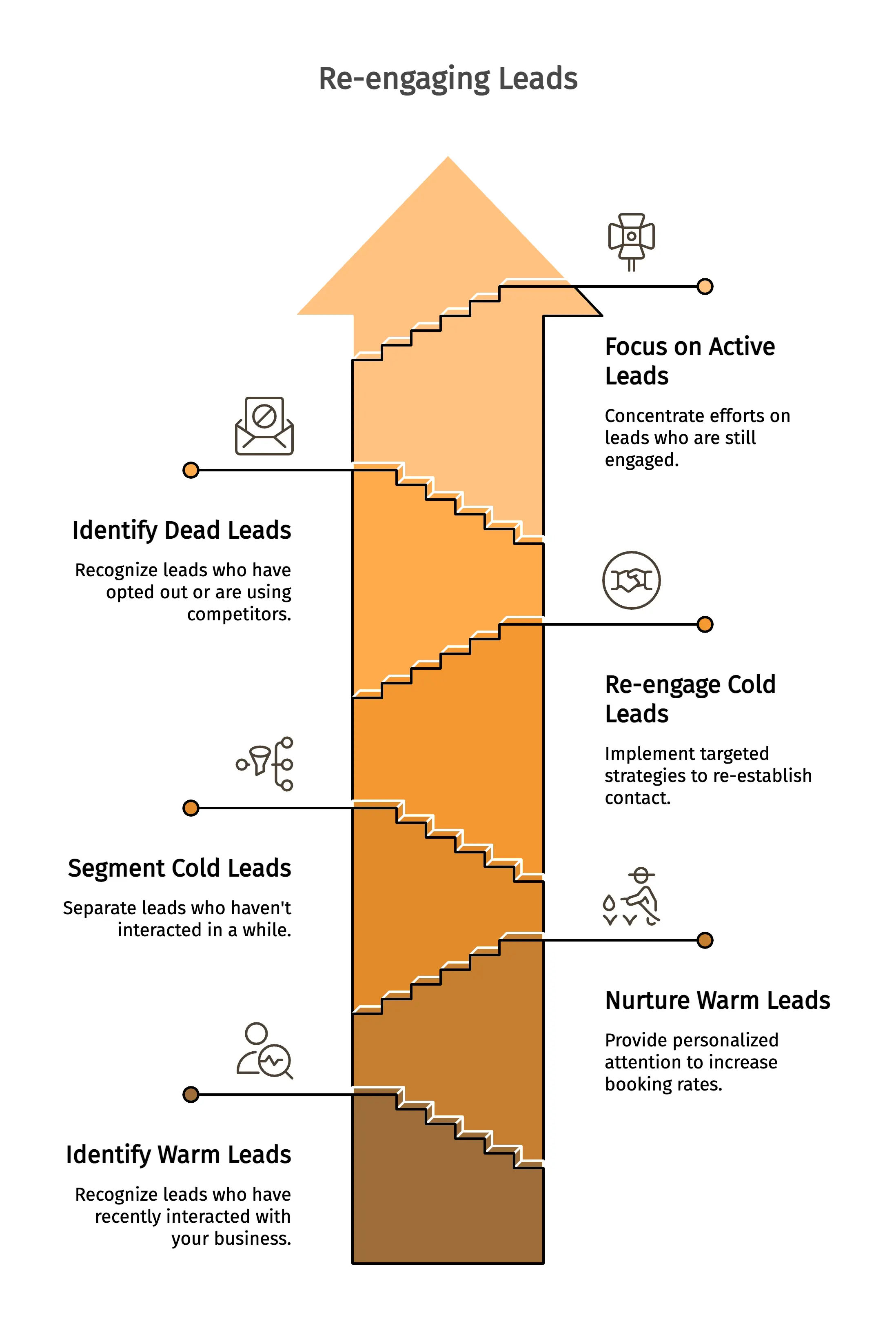
Cold, warm, dead. Three different issues and three different solutions.
A warm lead has taken action to follow up recently. They received an offer, responded to an email, revisited the website, or made an inquiry. According to our experience, warm leads are booked at a significantly higher rate than cold leads, so you should treat them differently.
A cold lead showed interest at first, but then went silent. They asked for an estimate 3 to 18 months ago. They scheduled one service call and did not call back to schedule seasonal service. The most important thing to note is that they haven't unsubscribed, and they haven't engaged a competitor you know of. The door is not locked.
Dead leads are those who have opted out of the process, bounced hard, or told you they're using a different company. Don't spend your time trying to reactivate dead leads.
The trap that most businesses fall into is treating all three databases the same. Bombarding the whole database with the same generic "we miss you" email leaves a sour note with warm clients, and wastes money on dead ones.
Segment first. Everything that follows assumes that you've reduced your list to cold leads, defined as prospects or customers who have not communicated in 90-540 days.
Why field service leads go cold
Owners we've talked to repeatedly point to the same few causes, from the most common to the least common:
-
The follow-up died on Friday afternoon. An estimate went out, the customer said "let me think about it," and nobody put a task on the calendar to check back. As per HubSpot's 2024 research on customer economics, acquiring a new B2B customer costs 6 to 7 times more than retaining an existing one, and 72% of B2B revenue comes from existing accounts. In our customer base, the dropped follow-up is the most expensive line item in the field service P&L that nobody sees.
-
Timing did not match. A homeowner inquired about a heater in June when their AC was still in operation. By November, they'd lost your contact information and searched Google to find someone else.
-
The estimate was off. They compared three bids and found that yours was 20% higher because your pricing sheet had not been updated for two years. They chose the lowest-priced option.
-
Communication was noisy. Three voicemails, six emails, and two texts over eight days came across as desperate. Those messages were never opened.
-
A bad review or a hesitation. They found an 18-month-old two-star review on your Google Business Profile. You never replied to it, and they moved to another website.
BLS projects HVAC technician employment growing 8% through 2034, adding 34,500 jobs, and electricians 9%. An HVAC operator reviewing Field Promax on G2 described how lead capture feeds straight into the dispatch board so technicians get assigned the same day a homeowner inquires about a new AC install, booking more jobs without adding office staff. In our customer base, the shops that absorb that demand growth without hiring another dispatcher are the ones with that kind of systematic capture and follow-up wired into the day.
What re-engaging a cold pipeline is actually worth
The math on reactivation is far better compared with net-new acquisition.
In our experience, email is the cheapest repeat-revenue channel a small plumbing or HVAC shop can run, well ahead of paid search. The small shops that actually send seasonal tune-up reminders and post-service follow-ups tell us the same thing every year: the list is already there, the customers already know your name, and one well-timed send pays for the tool many times over.
Nielsen's Global Trust in Advertising research finds that 92% of consumers trust recommendations from friends and family above any other form of advertising, which is why the referral loop compounds. In our customer base, the shops that automate a post-job review request and a 6-month check-in start seeing referral density climb by their second quarter - the Nielsen finding shows up in our shops as more inbound calls that name a neighbor before they name a service.
What kind of re-engagement is typical in a 5-20 tech shop?
- Revenue recovery in the same quarter from inactive customers who didn't need service the first time you reached out
- More profitable repeat work than lead-based work (in our experience, referrals are booked at approximately three times the rate of similar PPC leads for residential trades)
- More accurate segmentation information for the next campaign
- A legally valid review profile as a by-product
- Fewer empty "How did they hear about us?" fields in the customer record
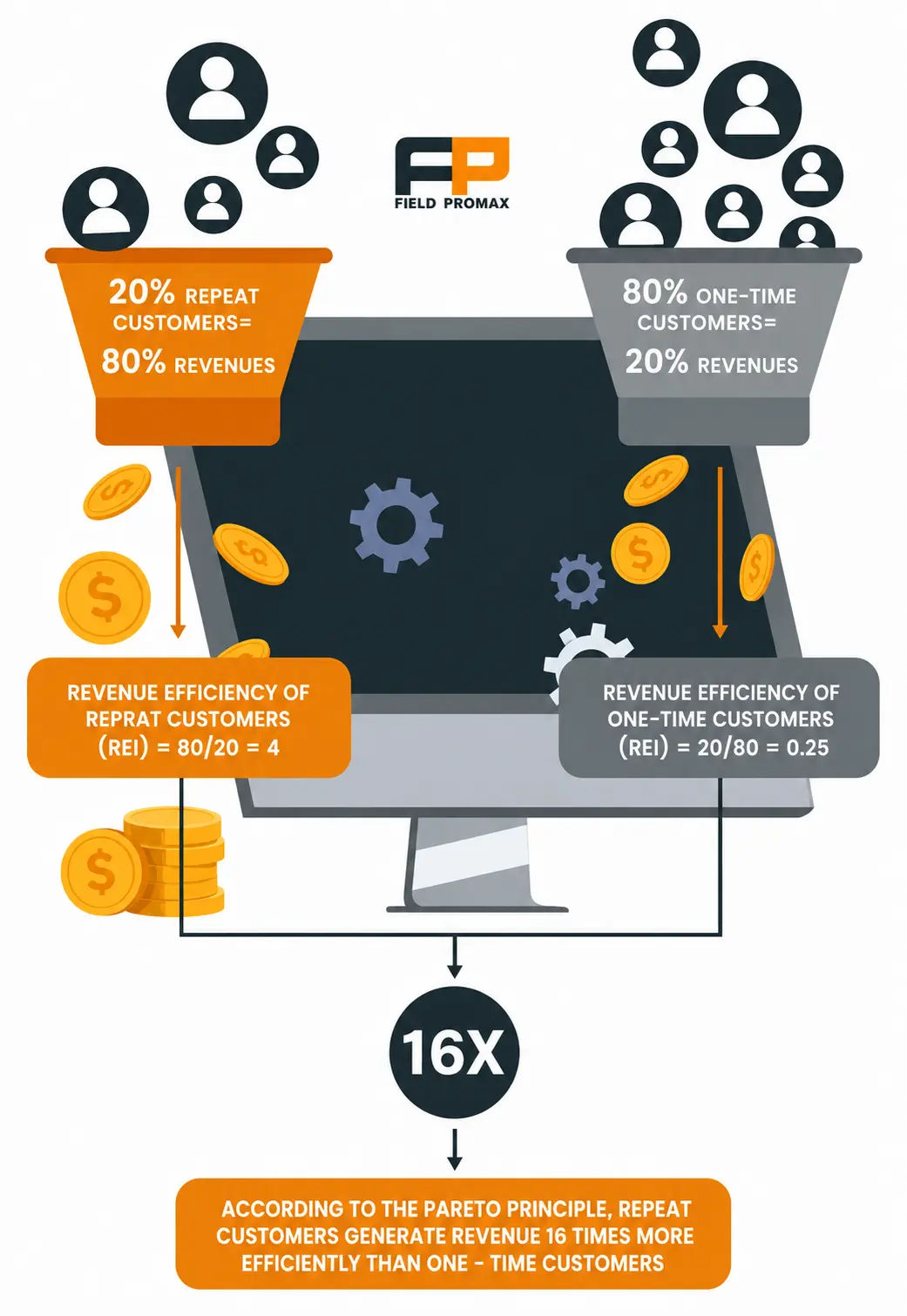
The last point is more important than it seems. Blank referral-source fields are the main reason most business owners can't honestly say whether their Google Ads spend is worth renewing in the next quarter.
I read every support ticket that comes in, and the same question keeps landing in my inbox from small HVAC and plumbing owners: how do I get the customers I quoted last year to answer the phone? What I have come to believe is that the re-engagement problem is almost never a message problem. It is a record problem. Across our customer base, roughly two out of three cold contacts in a QuickBooks-only setup have a blank referral-source field, a partial equipment history, or a missing last-service date.
The marketing industry keeps selling contractors expensive email tools to fix this, and I disagree with that framing. Buy the discipline before you buy the software: make source tagging required, make service notes required, make the equipment tag required. Then any re-engagement tool you already own works three times harder.
- Joy Gomez, Founder of Field Promax
A pattern we see across small residential contractors
Small contractors we have worked with in the under-10-tech group almost always have the same configuration. Consider an owner-operator of a residential service company with six technicians operating out of one shop, who handles estimates and bookkeeping himself, along with a part-time office manager. The customer database is in QuickBooks. Estimates are built line by line each time because nobody kept the last one as a template that could be reused. The referral source dropdown is empty on about two out of three new entries because it's not a mandatory field by default.
In the second half of a busy spring, the owner will be working two nights a week rebuilding estimates that are almost identical to the ones he submitted the previous month. Even more troubling, when he has to determine whether to renew his Google Ads for another six months, he is unable to distinguish ad-driven work from word-of-mouth referrals in his customer database. There is a chance that a neighbor's referral could be driving revenue, but he has no way to verify that.
The fix wasn't an entirely new tool. Over the course of a weekend, the owner created six estimate templates based on job type: the four most common service calls and two installation variants. They were saved as recurring estimates within QuickBooks. Then, he made referral source tags a firm rule for the admin to follow, and no estimate would be released until the customer's account included a source selection, even if it was "unknown." The first dropdown offered fifteen options. He cut it down to seven after two weeks because nobody was using the long-tail options.
Estimate turnaround was reduced to around half the time by the end of the second month, mainly for repeat job types. The tagging rules slipped during the first eight weeks. The admin kept letting estimates go out untagged on rush jobs until the owner started sending incomplete documents back to her. Backfilling past customers never really became a reality. A portion of the accounts created before the rule still had blank source fields. The owner chose to leave them as they were rather than try to guess.
The case is actually a composite case made from the most common variation of the pattern we've seen across smaller contractors in this size range.
The 7-step re-engagement playbook
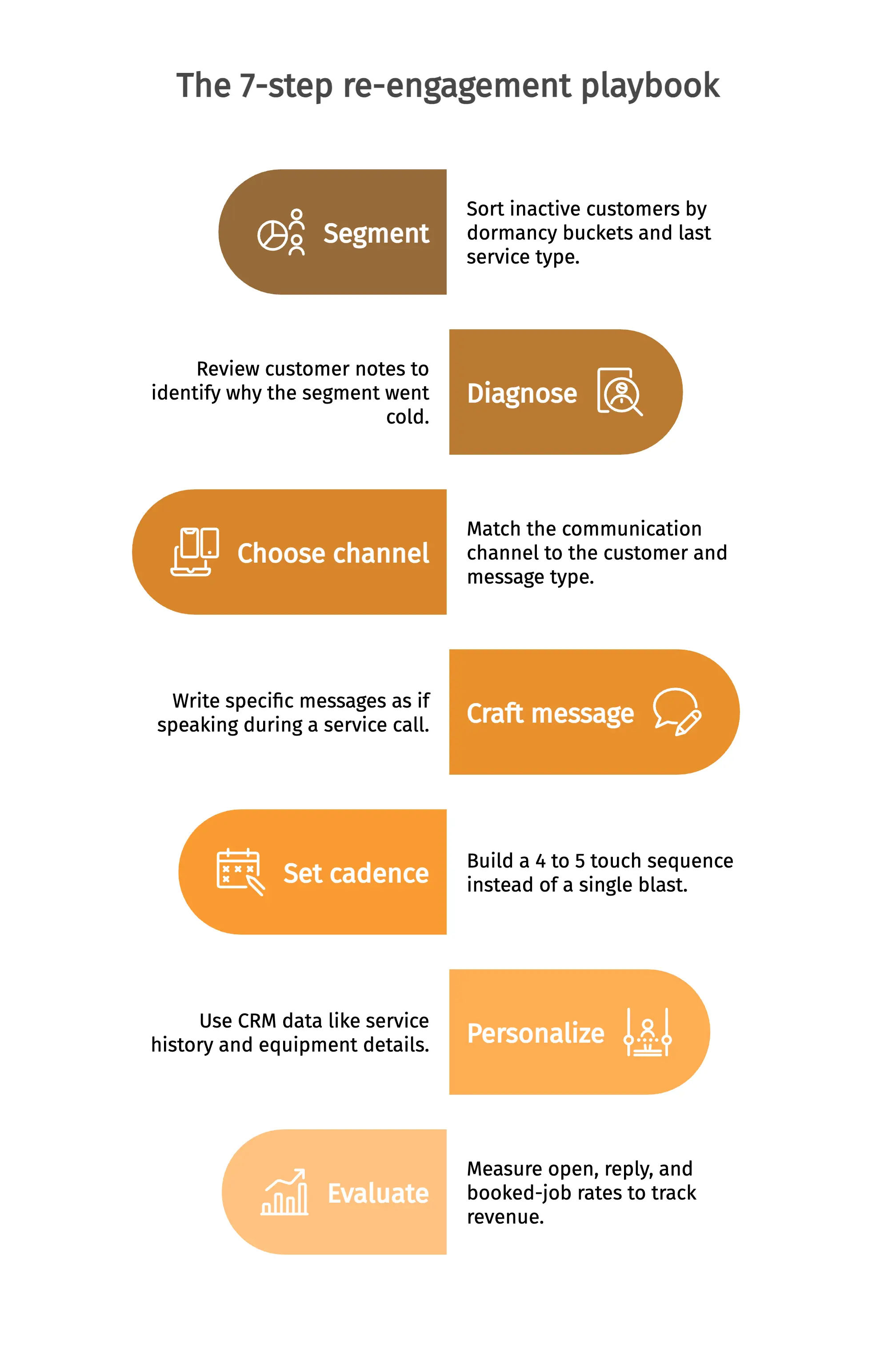
Segment. Diagnose. Choose the channel. Craft the message. Set the cadence. Personalize. Evaluate. In that order.
1. Segment by dormancy and last service type. Sort your inactive customer list into three dormancy buckets: 3-6 months since the last interaction (still warm around the edges), 6-18 months of inactivity (classic cold leads), and 18+ months of inactivity (deep-winter cold). Then segment each bucket by the last service you performed. A customer whose previous visit was an HVAC tune-up requires a completely different message than someone whose last service was drain cleaning. This two-dimensional segmentation often produces higher response rates, in our experience, than sending one generic campaign to everyone.
2. Diagnose why the segment went cold. Review the customer notes before you write a single message. If most of your 6-18 months segment consists of customers who received estimates but never received a follow-up, the problem isn't customer interest; it's your follow-up process. Fix the workflow before launching the campaign.
3. Pick the channel to match the customer. SMS response rates average roughly 45% versus about 6% for email, with SMS open rates around 98% and 90% of texts read within 90 seconds. In our customer base, that gap is why SMS wins hands down for short, time-sensitive nudges - quote follow-ups, seasonal windows, day-of confirmations - while email carries anything that needs a paragraph. Use SMS for short, time-sensitive nudges (appointment reminders, seasonal windows, quote follow-ups). Use email for content-heavy messages (annual maintenance plans, financing, service history). Use a phone call for 18-plus month deep-cold leads worth over $2,000 in lifetime value.
4. Write the message the way you would say it at a service call. Salesforce reports average email open rates around 36% for 2024, but Convertcart's win-back research puts automated win-back emails at 42.51% open and 18.27% CTR when the message is specific. From years of watching customers do this, the specificity is the whole game: "Following up on your April AC quote, prices are locked through October" beats "Hi, we haven't heard from you in a while" every time, and our reports surface that gap in reply rates every quarter.
5. Build a 4 to 5 touch cadence, not a single blast. Don't rely on a single email blast. A practical cadence for a 5-20 technician shop might look like this: Day 1: Email referencing the customer's previous service, Day 5: SMS with a short, conversational question, Day 12: Email highlighting something new, such as seasonal maintenance, financing options, warranty updates, or a limited-time offer, Day 21: Phone call from the dispatcher, not a salesperson, Day 35: A "break-up" email, such as: "We're closing your file unless you'd like us to keep it open. Let us know if you'd still like to hear from us." Industry data from ConvertCart suggests that break-up emails often generate the highest response rates in a re-engagement sequence.
6. Personalize with the data you already have. Use information already stored in your CRM, such as Previous service date, Equipment installed, Warranty status and Neighborhood or service area. If your CRM doesn't surface this information on one screen, personalization becomes much harder. Among our customers, strong mobile app adoption is one of the most reliable indicators that re-engagement workflows are being followed consistently.
7. Measure open, reply, and booked-job rates. Not just opens. Open rate tells you whether the subject line captured attention. Reply rate tells you whether the message resonated. Booked-job rate tells you whether the entire campaign generated revenue. The shops that consistently improve quarter after quarter are the ones that connect every campaign back to actual booked jobs, not just email metrics.
The 6 mistakes that kill re-engagement campaigns
Six patterns that kill re-engagement campaigns, in rough order of how often we see them:
-
Blasting the whole database. Warm, cold, and inactive customers all receive the same email. This hurts deliverability and trains customers to ignore or filter your messages.
-
Ignoring the "why they went cold" data. Without knowing why customers stopped responding, your campaign is built on guesswork. If a significant portion of your inactive customers left because of an unresolved billing dispute or a poor service experience, no amount of follow-up messaging will fix it. Address the root cause first.
-
Pretending nothing happened. "Just checking in!" comes across as generic and robotic. If your records show a $3,400 estimate that never received a response, acknowledge the previous interaction. Referencing the last conversation makes your outreach more relevant and authentic.
-
Overbuilding the cadence. Six follow-up messages in seven days feels more like harassment than helpful reminders. Space the sequence.
-
Skipping the unsubscribe link. Failing to provide an unsubscribe link can create legal issues in many jurisdictions and damages trust with your audience.
-
Measuring only opens. A high open rate simply means your subject line captured attention. It doesn't measure business results. Booked jobs are the number that pays payroll.
How Field Promax handles the plumbing under the playbook
Re-engagement is 20% strategy and 80% execution. The strategy fits on a napkin. This procedure (segmenting your list of contacts, pulling last service dates, sending the text, logging the response, and routing the booked task) is where businesses stall.
- Customer records built for the re-engagement workflow. Every customer's full service history, equipment tags, warranty dates, and referral source live on one screen inside customer management. Personalization is a click, not a search across three systems.
- Automated notifications For seasonal and post-service triggers: Six-month post-install reminders, annual tune-up notifications, and warranty expiration alerts run automatically - without anyone having to remember.
- Scheduling and dispatch Tied to lead capture: A plumbing contractor reviewing Field Promax on the QuickBooks App Store described how automated SMS follow-ups after every service call generated customer replies within minutes and saved the dispatcher hours each week.
- Estimates With reusable templates: The single biggest cause of "estimate sent, but we never heard back" is that the estimate itself took a week to prepare. Reusable templates reduce that turnaround time from days to minutes.
- Google Business Profile review management. BrightLocal's 2024 Local Consumer Review Survey found 81% of consumers used Google to read online reviews of local businesses, down from 87% in 2023. In our customer base, the shops that pin a review-request SMS to job completion are the ones pulling ahead on Google Business Profile visibility inside two quarters, because Google is still where the homeowner checks before they call.
- Reports and dashboards: Track per-technician close rates, per-campaign booked-job rates, and referral-source revenue attribution.
- QuickBooks integration: Most shops start with spreadsheets, paper-based processes, or QuickBooks alone. This integration adds a field service management layer without disrupting the existing accounting workflow.
The workflow applies across the trades we serve: HVAC, plumbing, electrical, lawn care, and pest control among roughly two dozen verticals. The seasonal-reactivation shape changes (a pool service list wakes up in April, a snow-removal list in October), the day-to-day process is the same.

The bottom line on cold-lead re-engagement
Cold leads are the cheapest revenue on your books. Every quarter you do not reactivate them, a competitor with a better follow-up rhythm eventually does.
Three things to do this month, in this order:
- Segment your customer list into three dormancy buckets. Create a list for each segment. The insights may surprise you.
- Focus on the segment most likely to buy right now - typically customers whose last service was completed 3-6 months ago. Send them one personalized, context-rich message designed to re-engage them.
- Measure bookings, not sends. Success isn't determined by how many emails you send, but by how many jobs those emails generate.
If these three steps produce even a modest improvement, you'll have a strong case for building a complete re-engagement playbook. If they don't, the reason is usually one of two things: the customer data isn't detailed enough to personalize your outreach, or follow-up is still treated as an occasional task instead of a consistent process. Both problems are fixable. Neither is solved by simply switching to a different email platform.
Related playbooks on leads & retention
Conclusion
Cold leads are among the least expensive sources of revenue you can generate. If you don't re-engage them, a competitor with a better follow-up process eventually will.
Frequently Asked Questions

Content Creator
Bhargavi Halthore is a content writer at Field Promax, a field service management platform serving trades businesses across the USA and Canada. With over a decade of experience writing for business owners, she brings detailed, ground-level insight to every topic she covers. Her research goes beyond search results - she digs into LinkedIn groups, Facebook communities, and Reddit forums to understand what field service business owners are actually dealing with on the ground. She speaks directly with industry professionals, understands their day-to-day challenges, and translates that into content that is practical and actionable. What you read in her articles reflects real industry patterns, not theory.