Retainage in Construction: How Much Is Held and How to Get It Back

What Retainage Is, and What Your Contract Calls It
Retainage refers to a portion of any progress payment that the general contractor or owner holds back until the project reaches a specific milestone. The contract you sign may refer to it as the retention of funds or a holdback. Same amount, same issue.
Two aspects of it are often misunderstood by contractors who are new to the commercial sector. The first is that it is withheld from every application, not taken out at the end of the month, which means the amount withheld increases with every payment application. In addition, retainage can continue to accumulate throughout the project. If the owner withholds 10 percent from the GC, the GC most likely withholds 10 percent from you, and you could have the same amount withheld from your own subs or second-tier subcontractors.
I've had conversations with the owners of eight-person mechanical and electrical shops who were able to tell me their contract value in dollars, but they didn't know how much their total retainage exposure was across four open projects. It is often the biggest single receivable in the company.
How Much Is Actually Held
The most common range in the sector is 5 to 10%. Five percent is becoming more frequent on private work, while 10% is still common in many contracts.
What is actually held is less than what is reported in the headline. Clemson University research, which is widely referenced in guides to construction retention, estimates the average amount withheld at 7.59% for private projects, 5.56% for state projects, and 3.26 percent for federal projects. For federal fixed-price construction projects, the contracting officer may be allowed to retain up to 10 percent of the contract amount, but only if progress is not deemed satisfactory.
The most popular arrangement that is negotiated is variable retainage: 10 percent is retained until the project reaches 50% completion, followed by 5 percent for the work completed after that. Illinois has codified precisely that form in private project contracts. If the contract you are signing has an option to step down, it isn't going to happen automatically. Someone must change the retainage rate on the application. If you are the accounting clerk for the GC, the responsibility falls on you to spot the change.
Where Retainage Sits on a G702/G703 Pay Application
This is the aspect that nobody can explain, and it is the point where money is lost.
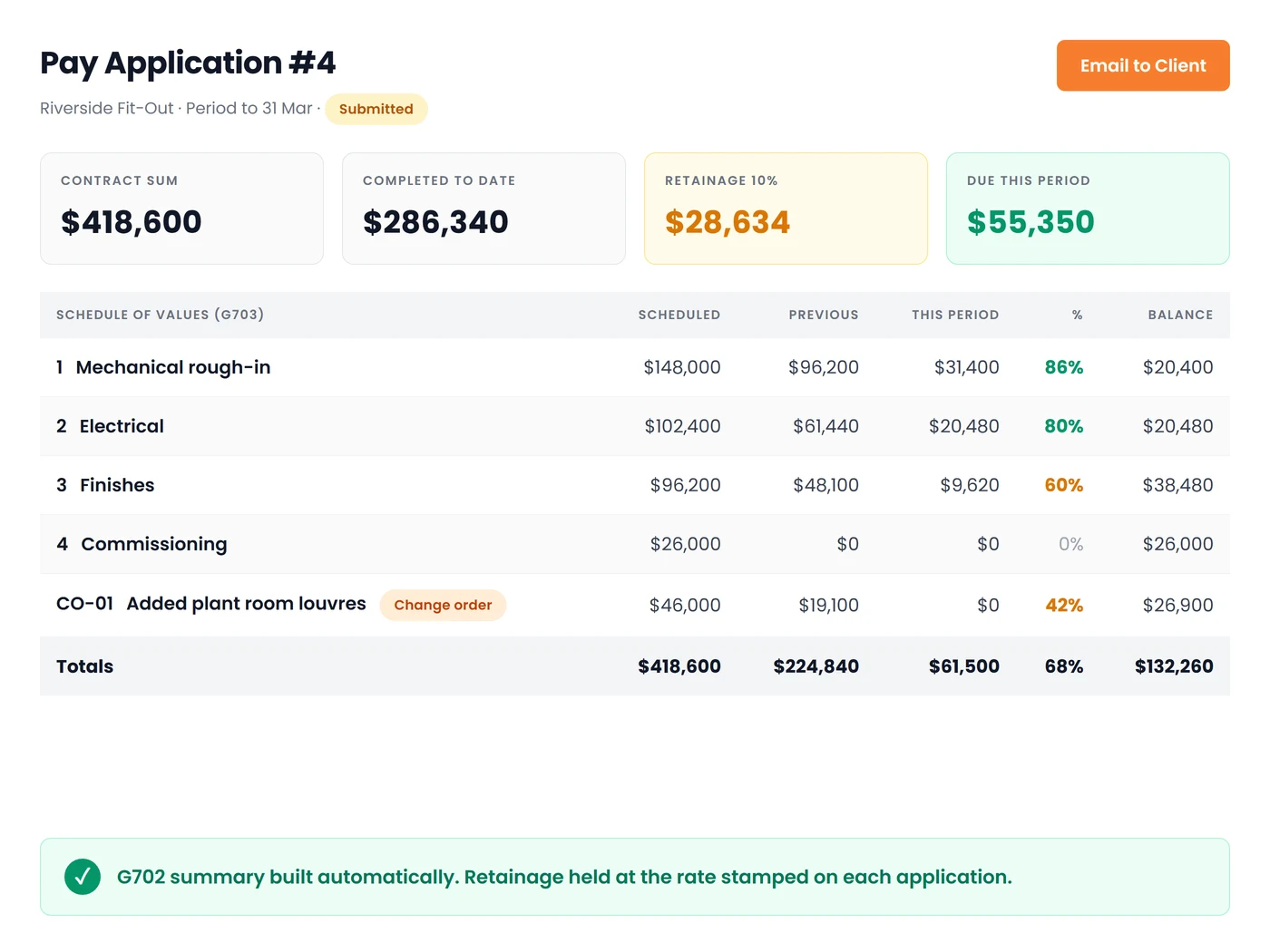
In the G703 report, every line in your schedule of values contains work that was completed on earlier applications, work completed during this period, current materials stored, and the total of work stored and completed to date. The G702 summary then applies retention in two buckets that include a percentage of completed work along with a portion of the stored materials. Both of these figures are added to the total retained. Add that figure to the total of completed and stored work, and you will have Total Earned Less Retention. Subtract any prior certificates for payment, and you've got the Current Payment Due.
An example of an application for a subcontract worth $480,000, number four:
- Work completed to date: $210,000
- Materials currently stored: $12,000
- Total completed and stored to date: $222,000
- Retainage of 10% of work completed: $21,000
- Retainage of 10% of materials: $1,200
- Total retainage: $22,200
- Total earned less retainage: $199,800
- Less previous certificates: $150,000
- Current payment due: $49,800
If you're running a variable retainage arrangement, the G703 comes with an additional column to track retainage precisely for this reason. The step-down should be documented line by line so that the person reviewing it can determine which lines are carrying 10 percent and which ones carry 5 percent. Apply the blended rate in the summary, but do not show that work. Then, the application is returned.
Based on 14 years of customer interactions, approximately 14 percent of manually completed G702/G703 payment applications at small shops are rejected due to arithmetic or formatting mistakes: the totals do not connect with retainage calculations, and changes to orders are not made. Each rejection adds up to 30 days to a cycle that is already lengthy. Shops using integrated progress billing will see this decline to zero, as the G703 line totals and G702 summary automatically reconcile.
What Retainage Actually Costs You
Consider that $480,000 subcontract upon its conclusion. Ten percent is $48,000, which you've already paid in the form of burden, wages, and other materials. Do up to three jobs of equal size take place simultaneously, and you're tying up close to $150,000 as a risk cushion.
Data from the industry's CFMA and specialty contractor 10-K filings estimates commercial subcontractors' DSO at around 83 days, compared with a 60-day industry benchmark. Through 14 years of customer interactions with small commercial business owners, they describe this timeframe as the structural reality of retainage, which is stacked upon multi-tier approval of applications. The lever that you have control over is the front end: simple pay applications, quick lien waivers, and instant submissions if something goes wrong.
It's most difficult to get paid on the first trades. Concrete, sitework, and underground utilities complete their work in the second month, and for contracts that require retainage to be released at the end of the project rather than at the time of completion, you may have to wait until the fourteenth month. This isn't an issue of billing. It is a line of credit that you did not consent to extend.
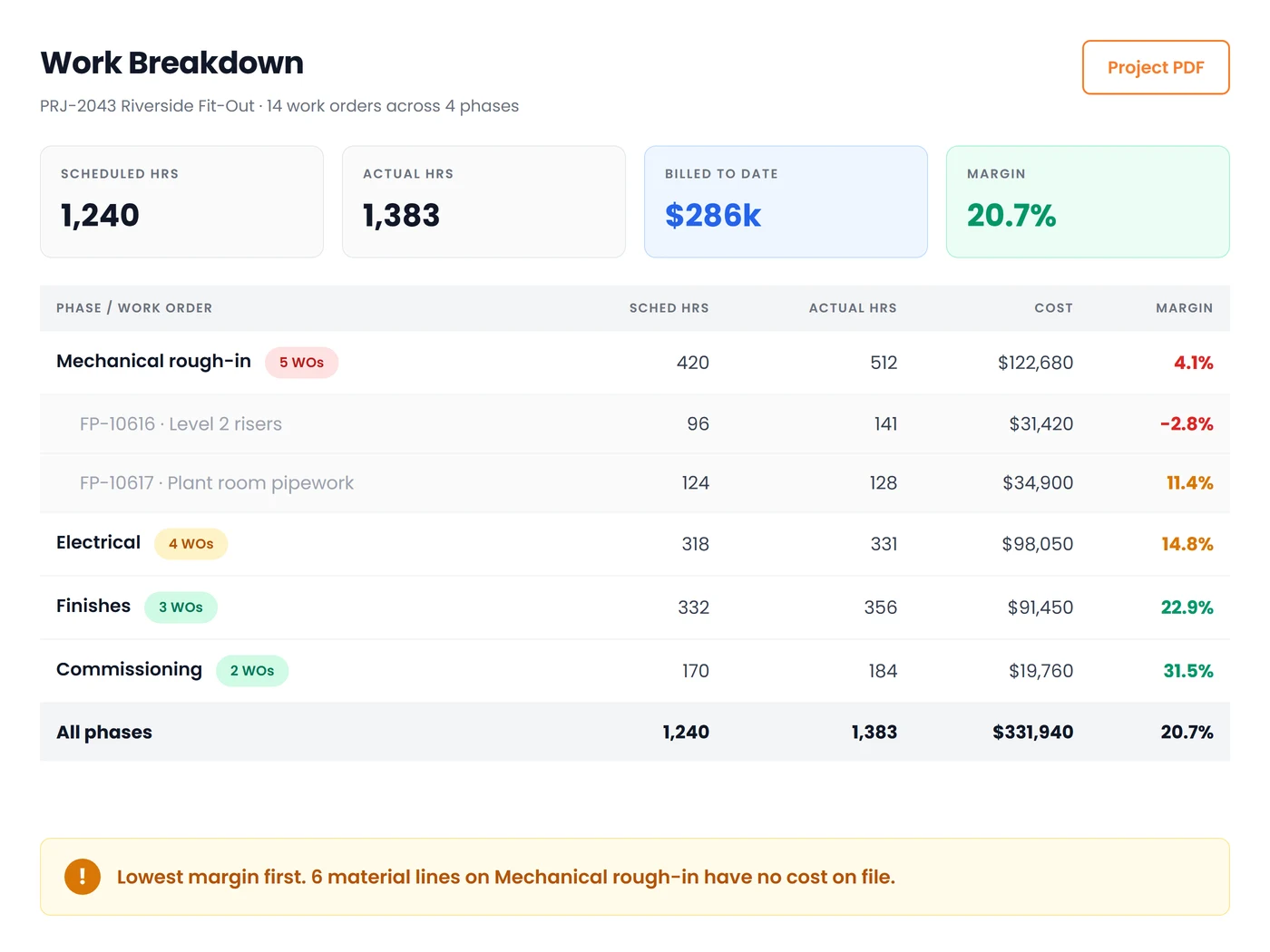
Retainage also hides margin fade. A 10 percent labor overrun on a $120,000 labor budget quietly erases about 27 percent of the job's gross margin, turning $45,000 into $33,000. If you are tracking labor at end-of-month reconciliation and your retainage is not visible as a receivable, you will discover both problems at closeout. Getting field hours converted and costed accurately matters here, and the mechanics of that are worth reading up on separately in our guide to payroll time rounding and decimal conversion.

When Retainage Should Be Released, and Five Reasons It Isn't
The typical process includes substantial completion signoff, punch-list closeout, the closing package being handed over, and the unconditional lien waiver being exchanged, followed by release within the timeframe specified in the contract. New York's 5 percent Retainage Law, in effect from November 17, 2023, allows a prime invoice for retainage to be issued upon completion, with the owner having 30 days from the date of final approval.
Release is an intentional act. It is not something that happens automatically. These are the five failures I am most familiar with:
-
Substantial completion is undefined. If the contract doesn't specify who is responsible for declaring completion and what proof is needed, the clock will never start.
-
Closeout documents are missing. As-builts, O&M instructions, warranties, and training sign-offs. One missing warranty letter can hold up five figures.
-
Pay-when-paid runs upstream. The GC has your closeout package and is waiting for the owner or an entirely different subcontractor.
-
One open punch item. A $300 fix was holding up a $48,000 release because nobody had planned a return trip.
-
Your retainage is collateral for someone else's problem. In United Riggers & Erectors v. Coast Iron & Steel (California, 2018), the court ruled that retainage can be withheld only if there is a reasonable dispute about the contractor's performance.
In subcontractor discussions across subcontractor forums, Reddit, and Quora, retainage is the subject of more discussion than any other billing topic. Owners frequently discuss firms that hold the wrong amount, clients who hold funds after the practical deadline, and subcontractors chasing payments months past due. The issue that is repeated isn't the issue itself. It's that there isn't any record of what information is in dispute or when it was submitted.
What Varies by State, and How to Check Yours
I do not have the qualifications of a lawyer, and this article is not legal advice. Four factors can vary from state to state, and you need to be aware of which one is affecting you the most: the cap percentage, whether public and private work are treated differently, whether the funds are required to be escrowed or deposited into an interest-bearing account, and the deadline for release following a trigger event.
Concrete anchors sourced from named sources:
- Florida sets the maximum retention at 5 percent throughout the duration of the development (NIGP).
- Texas requires 10 percent retention for private projects; New Mexico prohibits retainage completely (Levelset).
- Illinois requires 10 percent retainage until the 50 percent mark is reached, then 5 percent for both local and private government work, with the change extending to state agencies starting in June 2027 (Saul Ewing, HB 1224).
- New York caps retainage on private projects of more than $150,000 at 5 percent (Peckar & Abramson).
- California's 5 percent retention limit for private construction contracts goes into effect on January 1, 2026 (O'Melveny Alert).
Levelset maintains a state-by-state retainage map, which is the most efficient resource I've seen. It is a good starting point, but then go over your contract in its entirety, since for private work, the contract will typically set limits that are higher than the ceiling set by law.
The Release Playbook: Getting Your Money Back
Seven steps, in order. The first two happen before you ever need them.
1. Read the release trigger before you bid. Find the clause that names the milestone, the notice requirement, and the days-to-pay. If it says retainage releases at project completion rather than your scope completion, price the carry into your number the way you would price any other cost. The same discipline applies to any recurring commercial contract, which is the logic behind our breakdown of how to price commercial building services.
2. Build the closeout package as you go. Collect warranty letters, O&Ms, and as-builts at the end of each phase rather than scrambling to gather them in month twelve.
3. Invoice retainage as a discrete line item. When the invoice is complete, you can submit a payment application whose only line item is the accumulated retainage, tied precisely to the running total shown on the G703. Do not include it in the final invoice.
4. Send a written release request with evidence attached. Include the certificate of completion, signed punch list, closing transmittal, or final conditional waiver. Make sure the request is dated, written, and sent to a designated person.
5. Serve a notice of intent if the clock passes. The majority of states have some form of preliminary escalation before filing a lien. Sending a lien notice is not necessarily an act of aggression. It's a scheduled event.
6. Calendar the lien deadline separately from the retainage due date. In certain states, you need to file your claim before the retainage is actually due. This will prevent more claims for retainage from expiring than any dispute about the work.
7. Escalate. Consider a demand letter, mechanic's lien on the retained amount, and a prompt-payment interest claim. Retainage is money due for improvements to property, which can make it lienable in certain jurisdictions.
If the disagreement is really about scope or quality rather than paperwork, handle it as a billing dispute on its own terms. Our field guide on construction invoicing dispute management covers the documentation trail that keeps those from turning into write-offs.

Reducing Retainage: Bonds, Step-Downs, and Escrow
There are four real levers.
Retainage bond. Sometimes, it is referred to as a release or retainage bond. You pay a surety cost, and the owner gets similar security while you're fully paid as the work is completed. The calculation works when the premium is lower than the cost of carrying the withheld cash on a line of credit for the anticipated hold period. This usually happens when you have long-tail jobs with an early trade scope.
Step-down at 50 percent. A reduction from 10% to 5% after 50% completion is the most widely accepted option in the industry. Many states have begun to codify it. Make sure it is written into the contract, and ensure the change is noted on Form G703.
Interest-bearing escrow. Certain public-sector contracts require it. For private work, you may request it, but being rejected still tells you something about the contractor.
Reputation. Subs with a clean record of submitting pay applications and complete closing packages will be released earlier than a sub that has to be chased down. I've observed that this can be more valuable than any contract clause.
The real caveat is that a three-truck subcontractor bidding on a fourth-tier deal has nearly zero leverage on retainage terms. The shop that will succeed is not necessarily the one that gets a better deal. It's the one that understands the risks and gets paid at the right time.
Tracking Retainage Receivable Across Every Open Job
Retainage receivables deserve their own bucket, aged separately from regular AR and separated by job, since they are not the same as invoices with a 30-day payment period. Mixing them together makes your AR aging look shabby and your collection priorities appear incorrect.
Three important things should be visible on a single screen: the retention rate per job, the number of days since substantial completion for every closed-out job, and the closing documents that remain outstanding. The third item is what transforms an unfinished release into a completed release because it turns an argument into a checklist.
On the other hand, if you hold retainage from your subs, the same accrual is applied in reverse. This is real money you owe, so it is not a valid way to view available cash. One of the contractors on our review pages stated the idea clearly: pulling AIA-formatted pay applications and not rebuilding them from scratch each month is what made their electrical division's larger commercial projects easier to manage. Another contractor described the transition from paper logs and spreadsheets to tracking each job on one screen and cutting down on daily admin work.
Retainage should also be included in job costing. If your gross margin report indicates that you haven't received, and won't receive, retainage for the year, your margin is exaggerated, and any bid you set based on it will be inaccurate.
Part of our small commercial project series
Continue with:
- Project Management for Small Commercial Construction: G702/G703, Progress Billing, and POs Without the Overhead — the full operating system for shops under 25 people: SOV, committed cost, job costing, and cash flow
- AIA Pay Applications and the Schedule of Values Explained — column-by-column G703, line-by-line G702, and where retainage lands on the application
Conclusion
Retainage is not a billing footnote. It's typically one of the biggest receivables a small contractor holds, and the reason it remains in limbo is often that no one has an exact record of what's being held, which job it was associated with, and when the release clock was started. First, fix the front end by implementing a G703 that uses a mathematical formula that cannot be incorrect, a step-down percentage that can be seen line by line, a closing program that can be built on the fly, and a retention bucket that is aged by job. Make release a scheduled action with a name and a scheduled date, rather than something you expect your GC to remember. In 14 years of these discussions, the businesses that make more money are rarely the ones with the most favorable contract conditions. They're the ones that send a clear, accurate retainage invoice as its own line when substantial completion happens and follow up according to the calendar, not an inclination.
Frequently Asked Questions

Founder and CEO
Joy Gomez is an engineer, process automation expert, and the Founder of Field Promax. Known for his technical expertise and commitment to field service innovation, Joy writes about transforming traditional business models into paperless, efficient operations. He is a Lean Six Sigma Black Belt based in Rochester, MN, dedicated to helping field professionals work smarter through better technology.
Reviewed by

Content Creator
Bhargavi Halthore is a content writer at Field Promax, a field service management platform serving trades businesses across the USA and Canada. With over a decade of experience writing for business owners, she brings detailed, ground-level insight to every topic she covers. Her research goes beyond search results - she digs into LinkedIn groups, Facebook communities, and Reddit forums to understand what field service business owners are actually dealing with on the ground. She speaks directly with industry professionals, understands their day-to-day challenges, and translates that into content that is practical and actionable. What you read in her articles reflects real industry patterns, not theory.