The Field Service Estimate Playbook: Quoting Faster and Winning More Work
.webp)
The short version is that what wins more field service work is not a more precise pricing calculation. It is quotes that are delivered more quickly, appear professional, and include the six elements that eliminate reasons for a customer to hesitate. This guide explains what to include in the estimate form, how to use the terms estimate, quote, and proposal correctly, why speed matters more than polish, the impact of e-signatures, and how document design changes across HVAC installations, plumbing repipes, electrical service upgrades, lawn maintenance agreements, and roofing replacements.
Across 30 to 40 small trade shops we've watched build a digital estimating workflow for the first time, the same scenario plays out repeatedly. The owner receives a request on Tuesday morning. The customer says, "Send me a proposal." That afternoon, between dispatch-related tasks, the owner creates the estimate using a Word document template. The calculations are done with a calculator. The estimate is then exported as a PDF and sent on Wednesday evening. By Friday, the customer hasn't responded responded. The following Tuesday, the owner learns that the project was awarded to a competitor who provided the same scope within 90 minutes. That competitor also had the agreement approved on the customer's phone before leaving the driveway.
The real issue in field service estimating isn't the math behind pricing. It's the time between when a client is ready to accept and when your paperwork catches up.
Across owner conversations on Reddit and Quora in the last 12 months, the most-described frustration around quotes isn’t accuracy. It’s the lag. Operators describe visiting a job, promising to send the estimate, then taking three to seven days to deliver it, or ghosting entirely because the quote gets buried under active-job work.
This pillar goes in a different direction from the majority of estimating advice, which focuses on per-square-foot costs and labor cost formulas. Those approaches are of course important, but they are not as important as the 11 workflow issues below.
1. The Conventional Wisdom About Quotes Is Half Wrong
The majority of estimating tips begin with constructing accurate pricing and end with the calculator. Based on 15 years of customer conversations, the main issue is that the document itself isn’t doing its job. It outlines work in words that customers can’t understand. It is open to disputes about scope creep. Drafts sit in draft status for too long because the author is hesitant to release them without further checks.
The most successful quote isn’t necessarily the most thorough quote. It’s the one that arrives first, looks professional, and removes any doubt about what will happen next.
Estimate, Quote, Proposal: Pick the Right Word
An estimate is the best guess at price based on the assumptions made, with the understanding that the final price may change. A quote represents a fixed price within specified terms, which becomes binding once accepted. A proposal, on the other hand, is a more formal document that includes pricing, scope, terms, and supporting information for larger projects.
On Quora, questions from contractors about estimate-versus-quote ambiguity surface constantly: customers treat any written number as binding, while operators treat it as exploratory. The solution lies in the document itself. Clearly label whether it is an estimate or a quote, specify the conditions under which pricing may change, and include an expiration date.
When Each Form Fits
For diagnostic work where the scope of work isn’t clear until a technician is present (such as drain camera inspections, electrical fault tracing, or HVAC airflow diagnosis), a quote functions as a true estimate. For defined-scope jobs (such as furnace replacement, 200-amp service upgrades, seasonal lawn contracts, and roof tear-off and replacement), a quote is what closes the deal. Quotes are also suitable for commercial maintenance contracts, multi-phase installations, and jobs valued at more than $15,000.
2. The Anatomy of an Estimate That Wins
Owners with a track record of consistently winning bids send out proposals that contain six components in the exact same sequence each time. Any incompleteness creates a stall in the process.
Scope Block Written in Customer Language
A scope block outlines the work in terms the customer can evaluate: “Replace existing 60,000 BTU furnace with a new 96% AFUE high-efficiency unit, including new venting, flue and condensate lines, and thermostat. This includes haul-away and standard permits.” Avoid trade-internal vocabulary. The buyer reads this, determines whether it matches what they believe they are purchasing, and either agrees or asks a clarifying question.
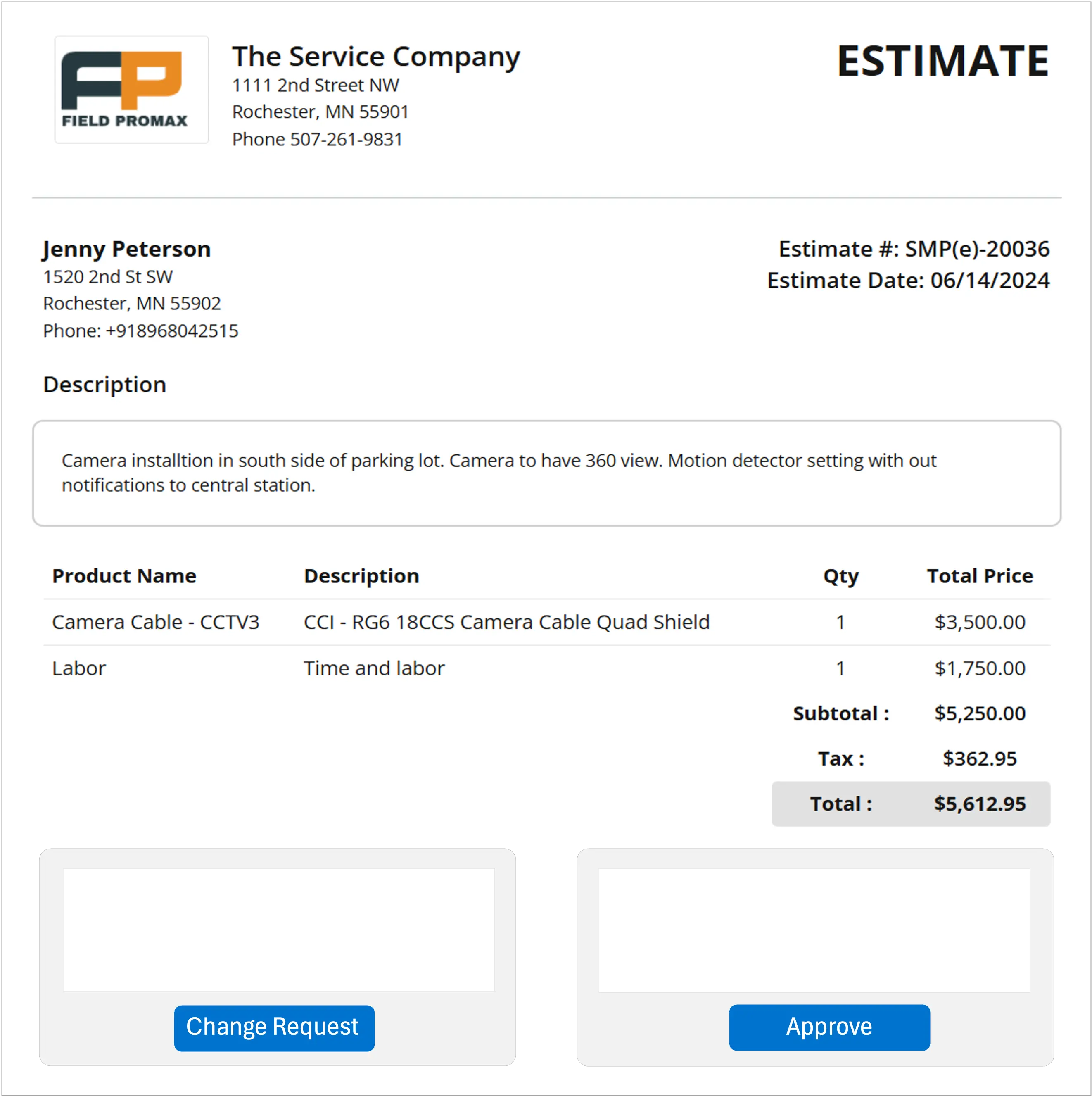
Line Items With Short Rationales
Every item that is priced includes a one-line explanation of its purpose in plain English. For example: “Permit fee, required by the city for service-panel upgrades over 100 amps.” When customers compare your offer against one that has none of these notes, they are more likely to trust your bid - even at a higher cost. Shops that include rationale lines receive fewer “why do I have to pay this?” questions prior to signing.
Terms Language That Prevents Disputes
The scope is set at the quoted figure. Any changes requested after acceptance will be handled through a written change order with T&M rates of $X/hour. The quotation is valid for 30 days, which helps reduce invoice disputes more than any other single modification to a quote workflow.
Expiry, Signature, and a Clear Next Step
The real expiry date is the one that forces a decision. A signature block ends the loop. It is a single step to follow. “Sign to confirm acceptance. We will confirm a time within 48 hours.” clearly informs the customer what happens after approval. Vague closings such as “Let us know if you have any questions” can be quiet killers of closing rates.
3. Line-Item vs. Flat-Rate: Take a Side
The Internet’s answer to this question is usually “it depends.” You can take the opposite approach. If you are installing or replacing items with a well-defined scope, use flat-rate pricing. If you are performing repair or service work with variable scope, use time and materials (T&M) with a not-to-exceed cap. Setting a default pricing model for each job type eliminates the time owners spend every week deciding how to structure each job.
When Line-Item Pricing Helps
Line-item pricing can be helpful when a client is comparing apples-to-apples with another bidder, especially on projects with add-ons that require mixing and matching scope items or when the work is spread across multiple trades. Roofing replacements, electrical service upgrades, and HVAC installations are among the best candidates for this approach.
When Flat-Rate Wins
Flat-rate pricing is a winner when residential service calls are under $2,000, for recurring service contracts such as monthly commercial cleaning service rates, annual pest control, and seasonal lawn maintenance, and for any job that would otherwise require itemizing the scope and forcing buyers to break down each line item. This can unintentionally limit the scope of work you actually need to perform. Flat-rate pricing also closes faster - there is just one number to respond to instead of multiple line items.
Pick One Default Per Job Type
Choose upfront: Furnace replacement: flat-rate. Drain camera inspection: T&M with a cap. Annual landscaping agreement: flat-rate per month. Add-ons - line items. Note it down and instruct the office accordingly.
4. Speed Beats Polish
Every day a quote sits in draft status can cost a contractor about 7% of their close rate. For an average 5-20 tech shop, moving from a three-day turnaround to a same-day digital estimate could roughly double the win rate. Faster shops don’t focus on sending more polished quotations - they send same-day rough estimates and refine them only when needed. A 90% accurate estimate delivered Tuesday afternoon beats a 99% accurate estimate delivered Friday morning.
Reusable Templates Beat Custom Builds
Owners who regularly provide same-day quotes keep between 8 and 15 price templates for their most frequent jobs and prefer to edit and send rather than create from scratch. Reusable templates - for example, for furnace replacement with part numbers and pre-estimated labor hours - reduce quote creation time from around 60 minutes to approximately 10 minutes. The majority of Field Promax customers come from QuickBooks-only or spreadsheet-based setups, where every quote had to be rebuilt from scratch.
Quote From the Truck, Not the Office
The tech finishes the walkthrough, opens the template on a phone, swaps in customer-specific details, and sends the quote before leaving the driveway. Mobile-app adoption by the field is the single biggest predictor of whether a faster-quote workflow actually sticks. Without it, the tech promises to send the quote, the owner rebuilds it that night, and the speed advantage evaporates. See our mobile app for on-site quoting.
5. E-Signature Is a Cash-Flow Lever
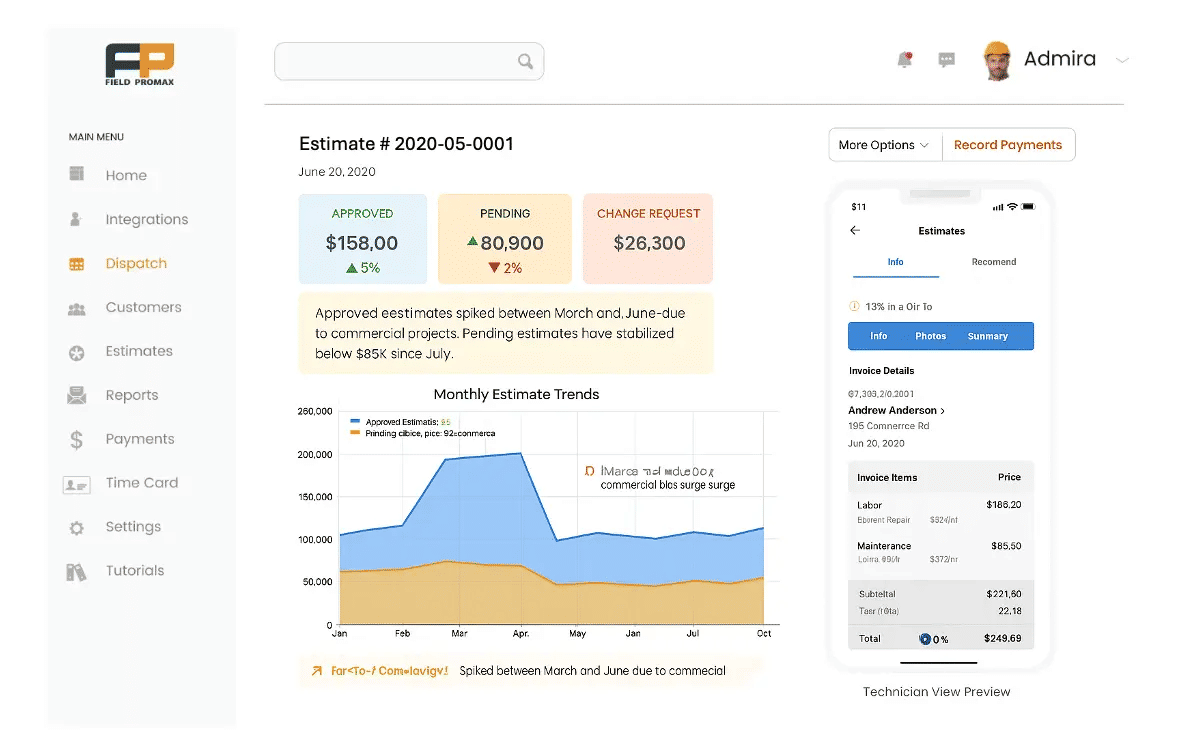
Construction-services research shows that paper subcontracts and estimates take an average of 30 days to be returned signed, while e-signed documents in the same workflow are typically returned in about 2 days. A quote signed on Tuesday can be scheduled on Wednesday, launched on Thursday, and billed for deposit by Friday, compared to waiting four weeks for a scanned and returned document.
E-signature also removes friction that prevents customers from completing the purchase while they are ready to proceed. One-click signing eliminates this delay. Owners report improvements in close rates when they implement e-signature without changing pricing.
6. Six Verticals, Six Estimate Shapes
The principles above are universal. The document design varies based on the type of trade.
HVAC Install Estimate
An HVAC system replacement quote needs the equipment model, AHRI match number, capacity, efficiency rating, and warranty terms front-and-center. Add line items the customer will be asked about by their utility for rebates: SEER2, AHRI certificate, equipment model. Skip Manual J references; the customer doesn't read them. Winning shops ship within 24 hours of the walkthrough, with two or three equipment-tier options on the same document so the customer picks the middle.
Plumbing Repipe Quote
A whole-home plumbing repipe needs pipe-material spec (PEX-A, PEX-B, copper L), fixture count, access plan (drywall cuts and patches included or not), and a timeline with water-on/water-off windows. The line-item the customer cares about most is drywall repair. Quoting "drywall not included" loses jobs against competitors who include patch-and-paint. Be explicit either way.
Electrical Service Upgrade Proposal
A panel upgrade from 100A to 200A is a permitting job. The electrical proposal needs the permit fee broken out as a separate line, utility coordination noted, inspection schedule explained, and a clear before/after on what the new panel supports (EV charger, heat pump, induction range). NEC code compliance language reassures cautious buyers without overwhelming the document.
Lawn Care Seasonal Contract
A seasonal lawn care contract is a recurring-revenue document. Quote a monthly fee that includes the standard service cadence (mow, edge, blow), with line-item add-ons for fertilization rounds, aeration, and leaf cleanup. Define the term, renewal mechanic, and rate-increase trigger such as a CPI-indexed annual adjustment. Lock March-signed customers into 12-month auto-renewing agreements so July cash flow doesn't depend on June re-sells.
Roofing Replacement Bid
Roof replacement is the most competitive bid environment in residential trades. The bid needs shingle brand and warranty, underlayment spec, ice-and-water shield extent, decking-replacement allowance, tear-off-and-haul, dumpster, and permit. List the cost of unanticipated decking replacement per sheet, so when tear-off reveals rot, the customer has already agreed to the rate. Winning shops quote three tier options: builder-grade, mid-grade, premium. The customer almost always picks the middle.
Commercial Cleaning Service Pricing & Rates
This is where many shops leave money on the table. Commercial cleaning services pricing isn't residential. It scales differently.
Commercial cleaning service rates typically run per-square-foot-per-visit. But there's a floor problem: a 2,000 sq ft office can't be quoted at $0.05/sq ft. That's unsustainable labor.
Quote pricing commercial cleaning services in tiers based on the building size and frequency. A 5,000 sq ft office cleaned twice weekly is different from an office of 2,000 square feet that is cleaned every month.
Factor in:
- Square footage (base commercial cleaning service pricing per sq ft, with minimum floor)
- Frequency (daily, twice weekly, weekly, bi-weekly)
- Complexity (carpet vacuuming, floor waxing, commercial window cleaning pricing-each adds cost)
- Access and after-hours requirements
Commercial window cleaning pricing is an item in its own line. It's specialized. Don't include it in general office cleaning service rates. Window cleaning on its own costs $2-8 per window based on the floor's access and the building's height.
For regular commercial cleaning pricing contracts, include the annual rate increase language (usually 3-5% CPI adjustment). This will protect your margins as labor costs rise. Many shops fail to lock this in, and end up in flat-rate contracts as their costs rise.
7. A Pattern Across Small Multi-Trade Operators
Over the roughly 40 small multi-trade operators we’ve worked with since 2019, the pattern of review follow-up and quote follow-up continues to repeat. Consider an owner-operator who runs a small multi-trade shop with less than ten techs covering HVAC, plumbing, and electrical services in a mid-sized metro area.
Follow-up on quotes and review response duties often fall into the same gap that no one clearly owns. HVAC assumes plumbing will handle outstanding quotes. Plumbing assumes the office is handling them. Google reviews notifications and unsigned quote reminders are both sent to a shared inbox, which is then redirected to dispatch escalations and parts vendor emails for many days.
At the end of the cooling season, the shop had a dozen unanswered one- and two-star reviews in the queue, many referencing the same callback issue involving a particular furnace installation crew. In addition, there were reviews tied to quotes that were 14, 21, and 35 days outstanding with no follow-ups. Nobody felt responsible for chasing either reviews or unsigned quotes.
The owner began blocking 30 minutes every Friday afternoon to respond to reviews from the previous week and follow up on quotes older than 7 days, and started tagging each complaint job for root-cause review during the Monday team meeting. However, the initial version did not succeed. Friday afternoons were consistently consumed by emergency dispatch issues. In the second month, the team shifted the review and follow-up block to 7 a.m. on Mondays, prior to the weekly huddle, which improved consistency.
Over two seasons, new reviews became significantly more positive, and several previously dissatisfied customers rebooked after receiving personal follow-up calls (one even signed up for a maintenance plan). The quote-to-close rate also improved noticeably once outstanding quotes were no longer forgotten. The senior HVAC tech remained skeptical and continued to argue that complaints, reviews, and quote follow-ups were unfair without proper context. The company owner then began reviewing those jobs individually rather than in the group huddle, which helped stabilize the process. This is a composite case, drawn from the most common variation of this pattern seen across the small multi-trade companies we’ve worked with.
Composite case, with specifics drawn from the most common version of this pattern across small multi-trade operators we've worked with.
8. Follow-Up Cadence on Outstanding Quotes
An unsigned quote from day 3 is very hot. Day 7 is warm. Day 14 is cold. Day 30 is almost always lost. The formula that works is a check-in text or an email at the end of day 3 ("Any questions about the proposal? ") and contact by the owner on day 7 and a final "we're closing this deal until we hear from you" on day 14 with the option of extending the deadline.
The gap between submitting a quote and being paid is the time when most shops silently lose money.
9. Tracking Win-Rate Without Spreadsheet Gymnastics
The industry data puts the median conversion of quote-to-job from contractors at around 74%. Smaller shops, an average 5-20 tech shop running digital estimates using reusable templates and e-signatures reaches 80% or more. Track three numbers: quotes sent per week, quotes accepted per week, average days-to-signature. Anything more complex is discarded in two months.
A reports view that surfaces those three numbers alongside per-tech and per-job-type performance is what owners actually read on payroll Friday.

10. Where Margin Actually Leaks
Industry research shows roughly 40% of contractors underestimate labor by at least 10% on manual estimates. A 5% labor miss stacked with a 7% material overrun routinely pushes a job 15%+ over its quoted cost. The fix is structural: build labor estimates from historical job-cost data on completed jobs of the same type. Without that anchor, owners are guessing from memory, and memory is generous.
11. Tooling Reality for a 5-20 Tech Shop
Small shops shopping for estimating software get pitched the same enterprise tier the 200-tech shops use, with seven figures of integration complexity baked in. That tier doesn't fit a 12-tech HVAC outfit. The estimating workflow a 5 to 20 tech shop actually needs is narrow: priced templates, mobile entry, e-signature, one-click conversion from accepted quote to scheduled job, and QuickBooks sync that doesn't break the books.
Enterprise-tier FSM platforms do all of this on top of so much else that the contract price kills the math. The gap in the middle, priced fairly and built for the shop quoting 30 to 150 jobs a month, is where the real work happens. That's the segment whose support tickets I read.
- Joy, Founder, Field Promax
On the QuickBooks App Store, an enterprise customer that rolled out Field Promax across four companies cited customer service and customization capabilities as key reasons for its satisfaction, noting that out-of-box or niche products couldn't match. That's the real integration challenge for a multi-business operator: the question isn't whether the software has enough features, but whether it can be customized to match the way the business actually creates estimates and manages work.
The Five Non-Negotiables for Estimating Software
For a typical 8-tech HVAC outfit or 12-tech multi-trade shop:
- Reusable estimate templates with predefined labor and material pricing
- Mobile estimate creation and e-signature capture in the field
- One-click conversion of an accepted estimate into a scheduled job with an assigned team
- QuickBooks Online or Desktop synchronization that prevents duplicate entries and maintains invoice history
- Job-cost reporting that compares quoted hours with actual hours per job type
If a tool fails any of those five, the workflow leaks. Field Promax product pages:
Estimates & Quotes | Scheduling & Dispatch | QuickBooks Integration
The most significant option for small-scale trade shops seeking to increase close rate isn't an actual pricing change. It's a speed improvement. Quotes created from price templates and sent the same day via the mobile app, and that have a valid expiry date and an e-sign with one click, close at a higher rate than slower competitors with prettier documents.
The rest compounds. Labor estimates are anchored by historical data. Cadence for follow-up on outstanding quotes. Tracking win-rates with three numbers. Shops that get this right quote more frequently, and faster while the document is doing the work that the conversation isn't.
Conclusion
Document discipline, speed, and a measurable follow-up cadence beat the pricing micro-optimization process every time. Create the workflow once then let your document take on what the conversation cannot.
Book a demo to unlock your 14-day free trial and see how Field Promax helps HVAC, plumbing, electrical, and commercial cleaning companies cut estimating time from hours to minutes while closing 54% more jobs.
Frequently Asked Questions

Content Creator
Bhargavi Halthore is a content writer at Field Promax, a field service management platform serving trades businesses across the USA and Canada. With over a decade of experience writing for business owners, she brings detailed, ground-level insight to every topic she covers. Her research goes beyond search results - she digs into LinkedIn groups, Facebook communities, and Reddit forums to understand what field service business owners are actually dealing with on the ground. She speaks directly with industry professionals, understands their day-to-day challenges, and translates that into content that is practical and actionable. What you read in her articles reflects real industry patterns, not theory.