Field Service Compliance Documentation: The JSA, Safety, and Audit-Trail Playbook
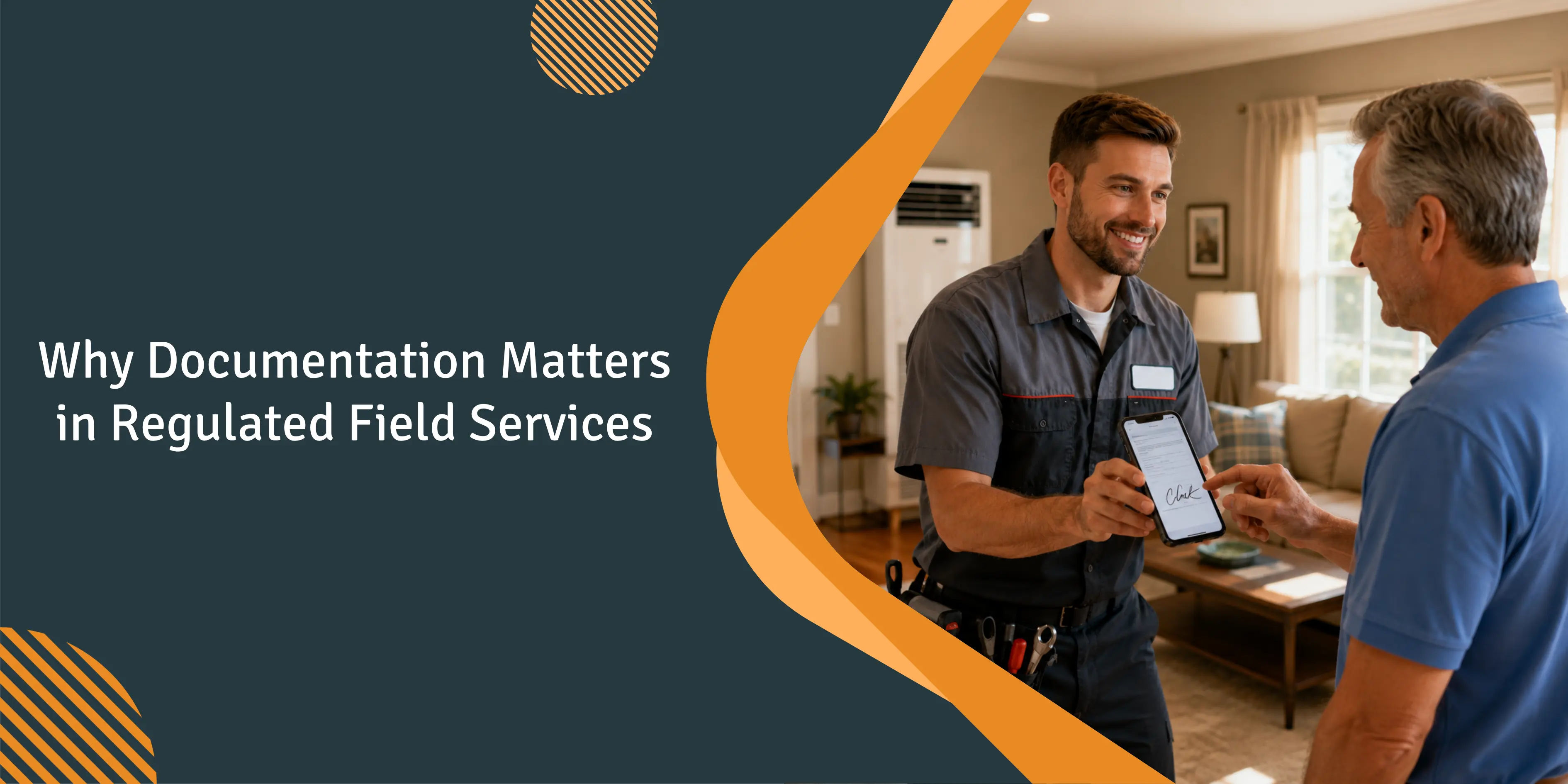
The most important thing isn't whether you have documented field work. It's whether your documentation is fast enough to withstand an OSHA audit, comprehensive enough to justify a billing dispute, and traceable enough to support a workers' compensation claim without having to take an operator off the line for three days to reconstruct it.
In 14 years of customer interactions, one pattern has shown up across plumbing, HVAC, electrical, and pest control. The tech performs the job properly. The certificates are valid. What is missing is the paperwork that travels from the truck to the office in the short time between the moment a job ends and when someone writes the report.
OSHA's maximum penalty for a serious violation reached $16,550 per violation in 2025, with willful or repeated violations topping out at $165,514 per violation. The Ponemon Institute's non-compliance benchmark puts total compliance failure costs far higher than the fines alone. In our customer base, a single recordable in an 8-tech operation can consume a quarter of the annual safety budget once indirect costs stack up.
What follows are the steps to create documents that can stand up against regulatory pressure and cut down on paperwork time simultaneously. The wedge is called the Job Safety Analysis.
Documentation is legal evidence, not paperwork.
Compliance documentation is a traceable record of what was accomplished, by whom, when, and how it complied with the regulations. For HVAC refrigerant recovery, this means EPA-compliant logs. For a plumbing backflow test, it means the signed-off certificate. For electrical testing, an inspection report as well as a permit.
It's the evidence you present when a client, regulator, or lawyer asks whether the work was performed according to the standard. If there's no record, the work is regarded as unverified.
The seven records that make an audit defensible.
The core stack for a regulated trade shop:
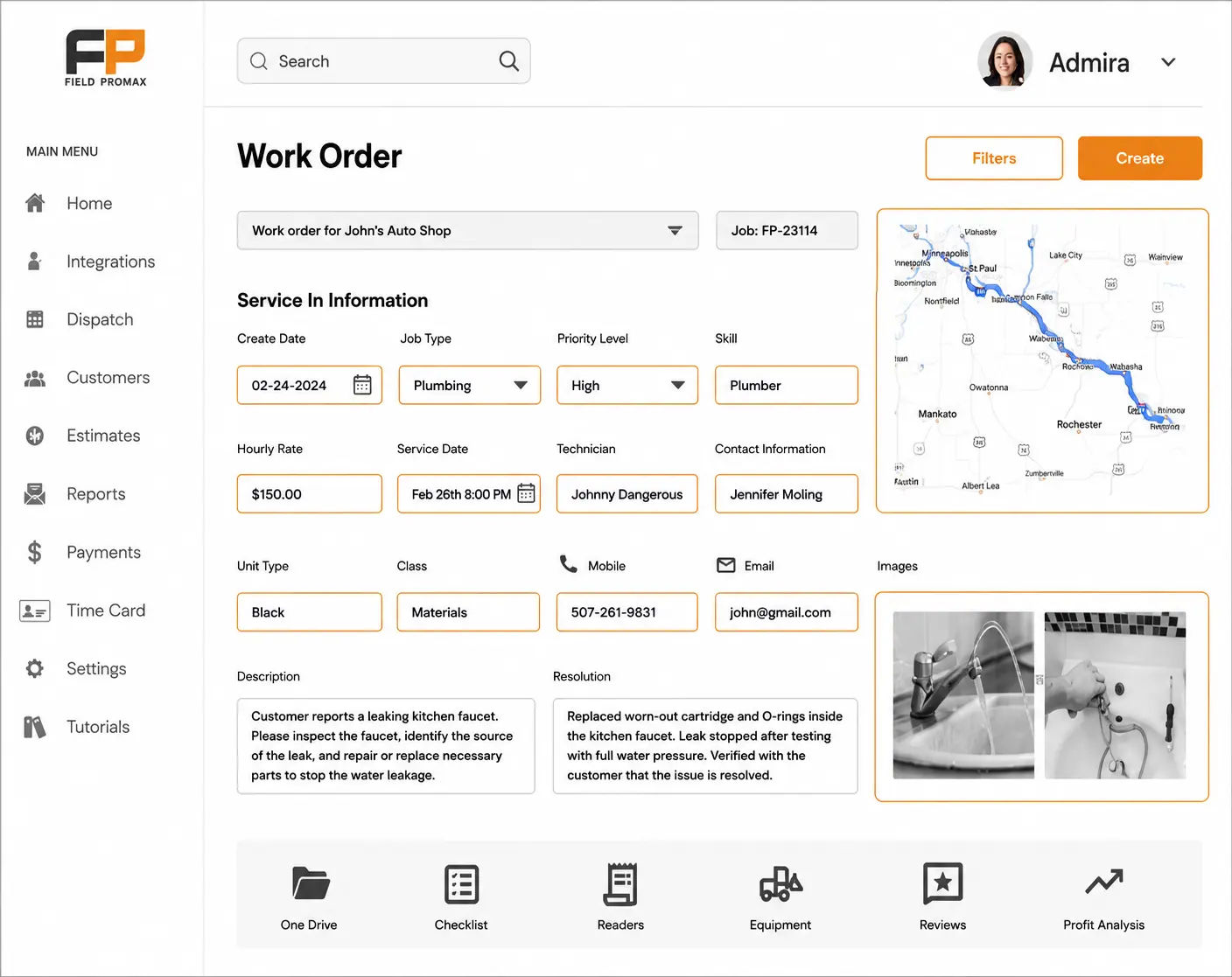
- Work orders that include job information, including the assigned technician, materials, completion status, and the customer's signature.
- Inspection logs to record on-site observations, equipment, and safety checks.
- Incident reports on accidents, near misses, or equipment malfunctions.
- Safety and Job Safety Analyses, as well as checklists, required by OSHA, state licensing bodies, and specific trade regulations.
- Chemical and refrigerant application records: substance, quantity, date, method, and disposal, mandatory for HVAC, pest control, and environmental services.
- Licenses and certifications for every technician, dated and current.
- PPE hazard assessments with the written certification required by 29 CFR 1910.132(d)(2).
Miss one and you give an inspector an easy way to find fault.
Compliance is a workflow problem, not a paperwork problem.
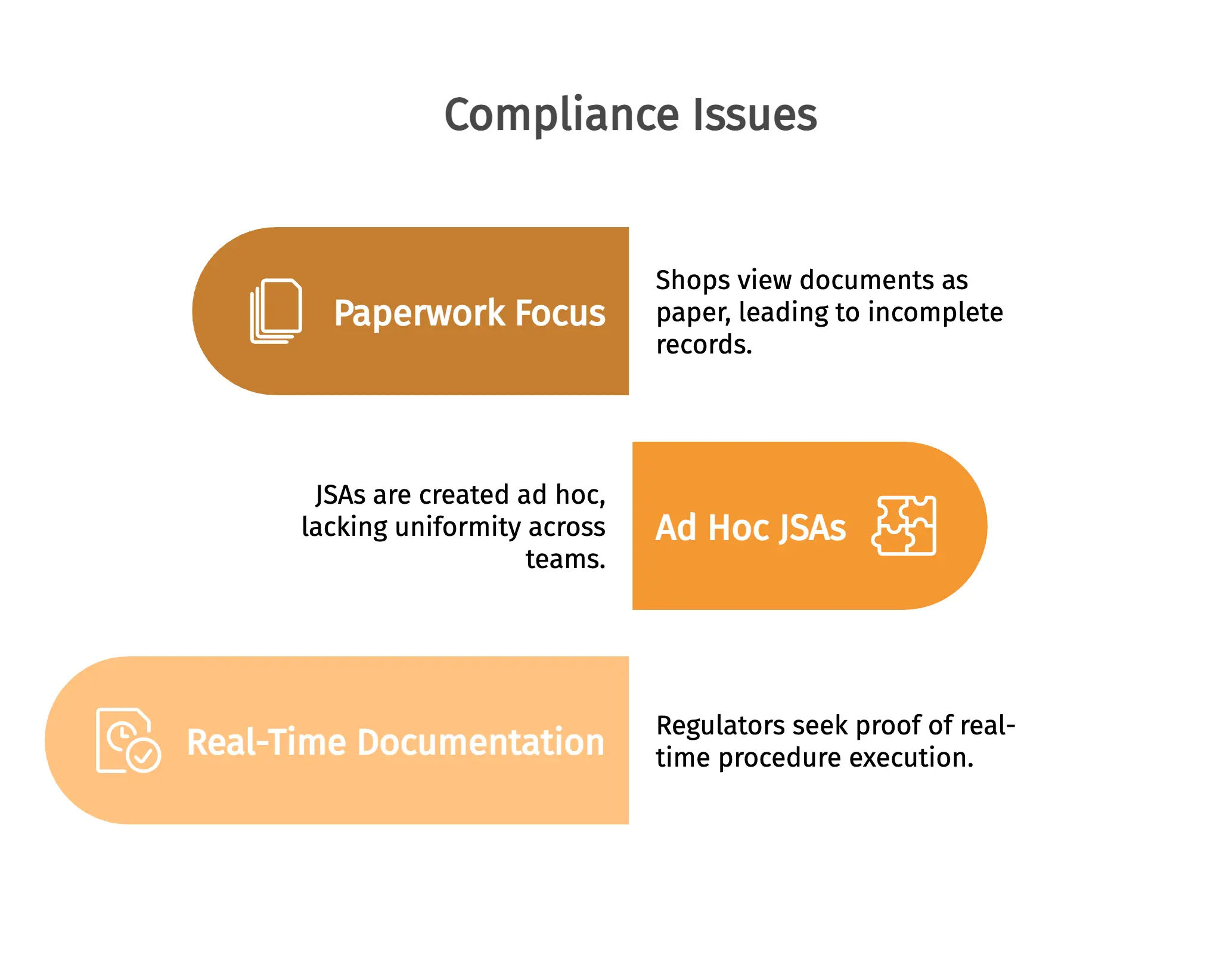
Most shops view documents as paper. Complete the form. Save it. Then move forward. This is why some shops fail audits even if the work was completed properly. The form is completed, however, not at the time of taking action. The photo isn't captured. A signature isn't recorded because the customer had to leave.
In owner discussions on Quora and in contractor communities, the JSA problem is seen the same way across all trades: JSAs are created ad hoc using paper and then reviewed separately by each new employee, never creating a uniform standard across teams. This is a workflow issue, not a documentation problem.
Regulators are looking for proof that the proper procedure was carried out in real time by a qualified individual and documented at the moment it took place.
Where lost context costs 4 hours per tech per week.
A technician spots wear and tear on the compressor during an ordinary PM. It's not an urgent issue, so they plan to record it later. At the end of the day, the details are unclear. The note they record from memory isn't complete. Three months later, the compressor malfunctions, and the customer blames the shop. Missing context is the same as a missing record.
In a business with 8 techs, owners say that each tech spends about five hours per week on compliance and safety forms. Shops that incorporate these forms into a mobile compliance workflow often reduce that time to less than one hour per tech each week, as the form automatically fills out, timestamps, and saves itself as soon as the tech clicks Submit.
What the regulations actually require by trade.
The regulatory picture for 2026:
- HVAC. EPA Section 608 requires refrigerant handling logs retained at least 3 years under 40 CFR Part 82. Appliances with 50+ pounds of refrigerant require on-site service, leak inspection, repair, and verification-test records for 3 years. Layer on OSHA 29 CFR 1910.132 PPE hazard assessments and state codes like California Title 24, and a mid-sized HVAC contractor generates dozens of regulated documents per week. The record most commonly missed is the refrigerant recovery log, because the tech tries to fill it out after packing up.
- Plumbing. Potable water safety certificates, backflow prevention inspection logs, and permit documents. The retention period is between three and seven years in the majority of cities.
- Electrical. Permits, inspection sign-offs, and NEC-compliant job records. State licensing boards establish retention and continuing education (CE) requirements for documentation.
- Pest control. The EPA requires chemical application records for substance quantity, date, method, disposal, and client notification in a variety of states.
- Sanitation and facility services. Safety Data Sheets, cleaning product logs, and incident reports linked with OSHA's Hazard Communication Standard at 29 CFR 1910.1200.
BLS 2024 data puts plumbing, heating, and air-conditioning contractors at 3.0 nonfatal recordable cases per 100 full-time workers, versus 2.2 for construction overall. The shops that survive audits cleanly aren't the ones with the most binders. They're the ones whose records are searchable in seconds.
California footnote: AB 5 and AB 2257 make the ABC test the default for classifying field workers. Every tech's status, hours, and job assignments become part of the audit surface.

What poor documentation actually costs.
The fine is only the visible cost.
Take a look at a mid-sized multi-trade contractor in Texas that fails an OSHA review because safety training records aren't produced in a timely manner. The work was performed. The certificates were in place. The paperwork was scattered across personal folders and binders, and the gap between what was actually done and what could be proven turned a routine inspection into an offense carrying penalties in the tens of thousands.
The Ponemon Institute's benchmark puts total non-compliance spend at roughly 2.71 times the direct penalty. Direct fines average less than 15% of the total.
The National Safety Council puts the average cost of a medically consulted work injury at roughly $43,000 in 2023. A single recordable in a 20-40 tech operation can wipe out a quarter of the annual safety-program budget once indirect costs stack at the typical 3-5x multiplier.
Billing disputes start where signatures don't exist.
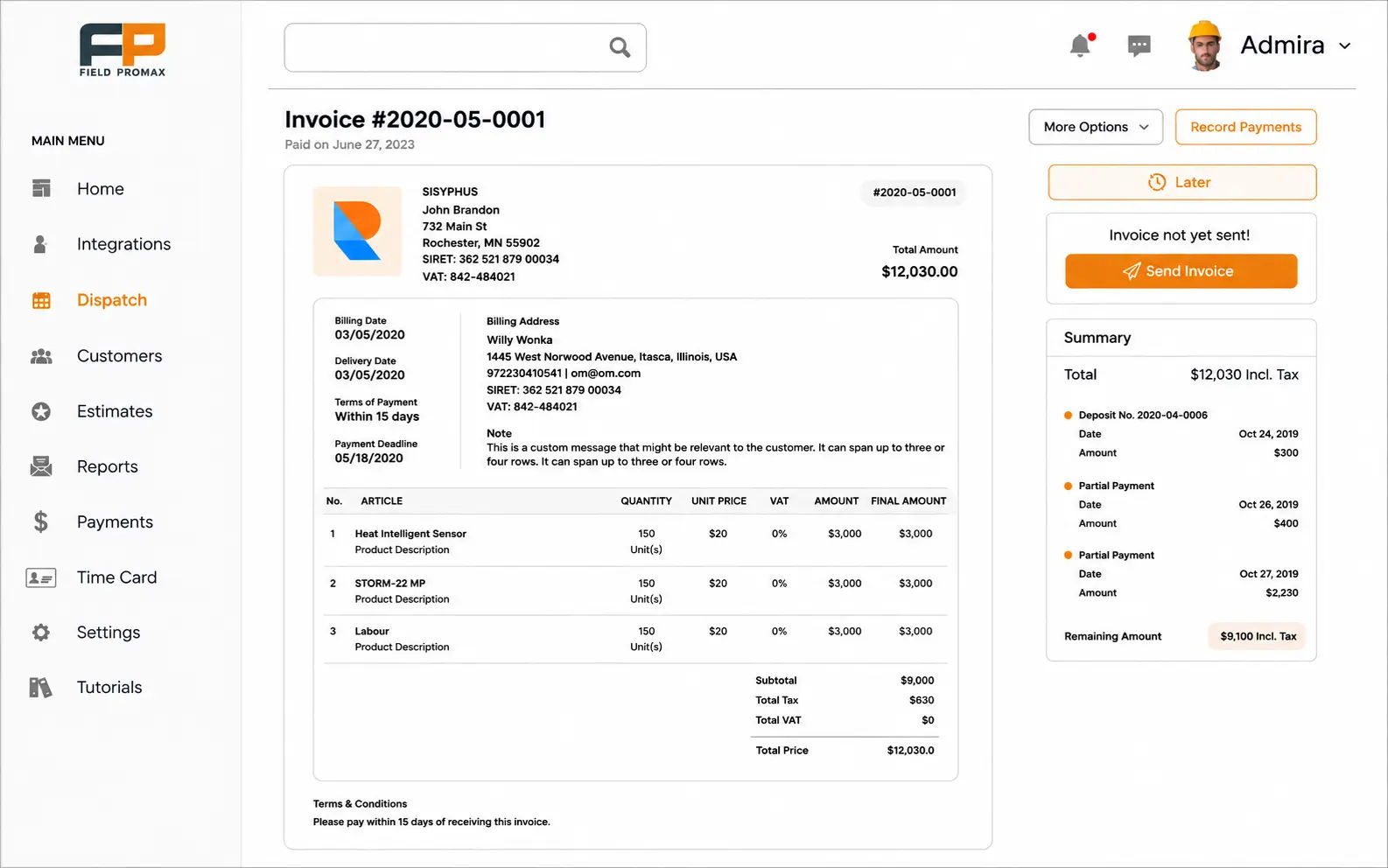
When work orders don't include the customer's signature, timestamped photos, or itemized materials, invoices can be disputed. The client claims the work wasn't completed. Without documentation, you cannot prove it, and the AR clerk spends the next week making collection calls instead of taking payments.
HVAC shops we work with report ongoing revenue losses from document gaps that impede billing cycles or create disconnects between the office and the truck. The losses are quiet and cumulative. They're hard to see until you examine the year's aging receivables.
Paper JSAs come back complete only 60% of the time.
For a typical 5-20 tech shop using paper JSAs, just 60% of pre-task safety forms are complete and legible at the end of the week. Shops that convert to a digital JSA module with mandatory fields and missed-form notifications regularly achieve completion rates as high as 95% because the technician can't complete the work order without this information. The gap between 60% and 95% is where audit exposure exists.
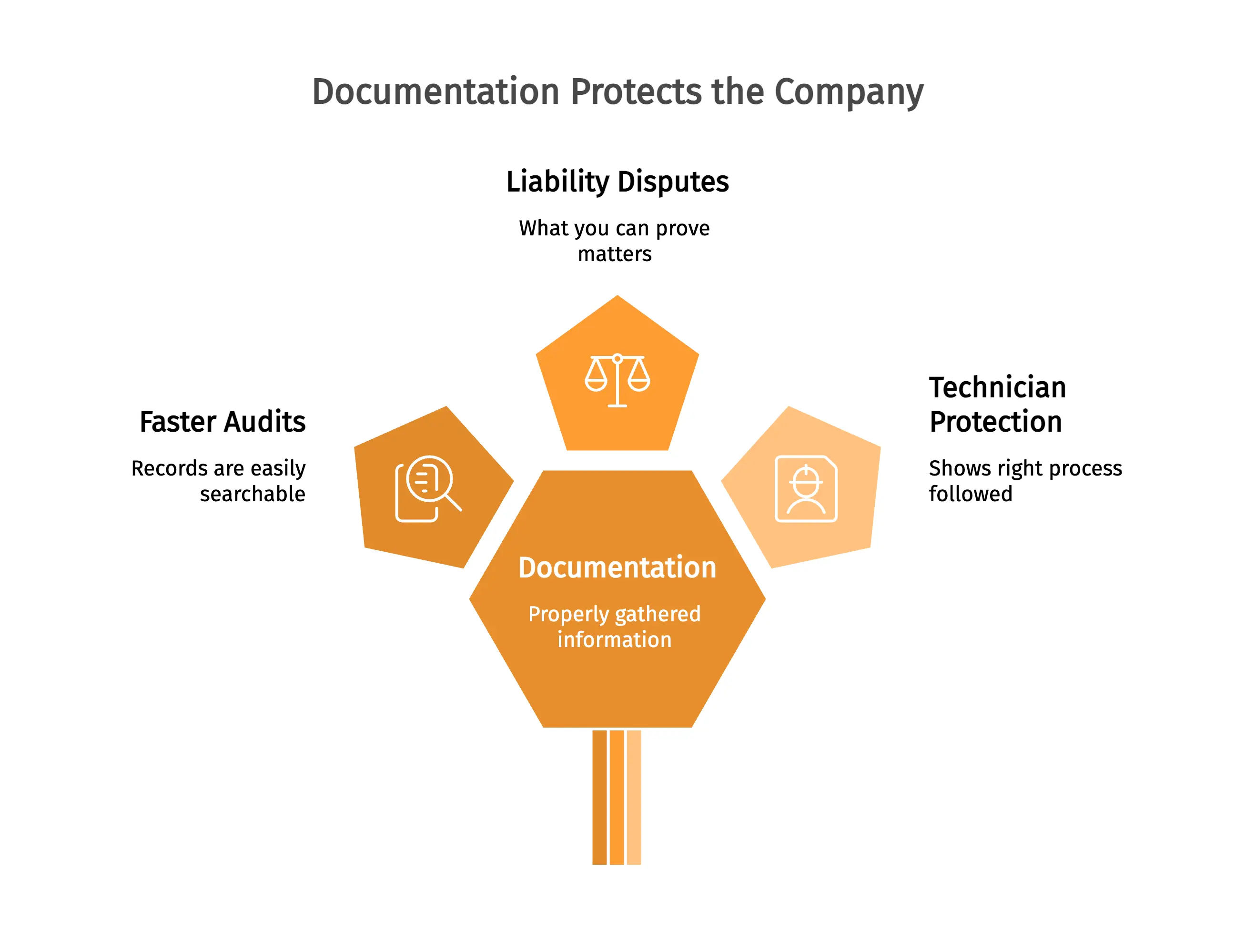
Documentation protects you in three directions.
Documentation helps protect the company from regulators, protects against customer disputes, and protects the individual technician from personal responsibility. The same document can do all three of these tasks when the information is properly gathered, and none when it isn't.
Audits go faster when records are searchable.
If records are stored digitally, audits are simple. You can pull any record in less than an hour. The inspector observes a disciplined operation, which makes the visit shorter.
When documents are scattered across emails, personal phones, and paper records, audits can become costly firefighting exercises. Inspectors who must wait are more likely to scrutinize the other documents they see while they are there.
Liability disputes turn on what you can prove.
A timestamped photograph of the finished work, the client's signature, and a comprehensive service note together provide every possible answer to "Did it happen?" before anyone asks. Without them, an excellent job becomes risky. The record is either in place at the time of the action, signed and timestamped, or the work is legally regarded as unauthenticated. Partial credit isn't an official category.
Technicians need the record as much as the shop.
When something goes wrong, your technicians need a record showing they followed the right process. Without those records, even a well-trained tech has no evidence the right steps were taken, and that matters in workers' comp disputes, client liability claims, and OSHA investigations.
The JSA is the backbone of a compliant trade shop.
OSHA 3071 describes the JHA/JSA as the systematic process of identifying hazards step by step before work begins. For construction trades, 29 CFR 1926.21(b)(2) requires hazard-recognition instruction, which most shops document through JSAs.
In contracting businesses, JSAs are created ad hoc on paper and reviewed separately with each new employee, but they never establish a uniform recordkeeping standard. Supervisors aren't able to easily determine who has been trained on what.
A JSA that runs within the tech's mobile app at the beginning of each work order, including geotags, required fields, and supervisor sign-off, accomplishes three things in one go: it creates the audit-ready document, triggers the safety walk-through that OSHA requires, and records the training acknowledgement.
According to Bridgit's 2026 workforce benchmarks, skilled trades experience a 73% average annual technician turnover rate, whereas mechanical contractors with formal safety-first training programs experience around 20% less turnover. Safety-first training documentation can be an effective retention tool as well as a compliance tool.
The single biggest predictor of whether a documentation program actually sticks is mobile-app adoption, not the sophistication of the JSA form. I read every support ticket that comes in, and the pattern is the same. Shops that build the JSA into the tech's phone screen at the start of every work order get completion rates above 90%. Shops that email a PDF template and hope for the best get maybe 40%.
Most trade shops adopting formal safety documentation are coming from paper binders or a QuickBooks-only setup, which means their compliance baseline is effectively zero structured recordkeeping. That's not a training problem. It's a workflow problem, and it gets fixed at the point where the tech opens the job on the truck, not at a quarterly safety meeting.
- Joy Gomez, Founder of Field Promax
A pattern across multi-trade contractors.
In the roughly 30-40 mid-sized multi-trade contractors we've observed, one failure type shows up more often than the others: an OSHA visit exposes a documentation gap, even if the safety-related work was carried out correctly. The model is a mid-sized multi-trade company in Texas with field workers who are subject to OSHA regulations.
Field crews consist of thirty to sixty technicians spanning electrical, HVAC, and general trades. Safety training is conducted through toolbox talks and specialized JSAs led by lead technicians. Documents are stored in paper binders and partly as PDFs on the safety manager's laptop. Safety documentation ownership floats between the operations supervisor, the safety lead, and whichever supervisor is closest to the incident.
In a typical OSHA review, the compliance officer isn't able to produce training records for particular crews upon request. Training was completed, and signed-off sheets were placed in one binder, certificates were stored in another cabinet, and about a third of the recently completed JSAs weren't scannable. The documentation gap, not an unsafe procedure, can result in fines reaching hundreds of thousands.
The solution isn't more training. Management moved safety records from bound books into a single digital system in which completion dates, signatures, and certificates were stored per technician and were accessible at any time. JSAs were migrated to a mobile version at the beginning of every work order. Later audits went well, with records retrieved in a matter of minutes. The cost: initially, teams refused to sign off on the new steps, and office personnel spent several weeks filling in old training records. Composite account: pattern seen across multiple operators, anchored to the most common version.
Consistency comes from workflow, not from training.
A few technicians are extremely meticulous. Others cut corners when they're under pressure to meet deadlines. Your documentation is only as reliable as the least consistent technician on your busiest days.
The answer isn't more training. It's integrating documentation into the workflow. If a technician can't complete a work order without filling in the required fields, the documentation gets completed by default, not because of diligence, but because the process requires it.
Standardized templates force complete records.
Templates with mandatory fields ensure completeness. Safety checks: required. Customer signature: required. Photos: required. If a required field can't be left blank, it won't be left blank.
This is especially important for businesses operating across multiple locations or working with rotating technicians. Whether a job takes place in Dallas or Denver, the process remains the same. Standardization transforms individual jobs into a complete audit trail rather than relying on individual memory.
Service history compounds into fewer callbacks.
A searchable service history for every customer or piece of equipment is one of the most valuable assets a shop can build. When the next technician arrives, they can immediately see when the last visit occurred, what work was completed, what issues were flagged, and what to watch for.
A technician who sees that a drain line was temporarily repaired just four months ago is more likely to investigate the root cause instead of applying the same temporary fix. In regulated trades, service history isn't just operational - it's also a legal record.
How paper fails, and what digital replaces.
Every field service owner has experienced the ways in which paper can fail:
- The handwritten report is indecipherable, and office personnel spend twenty minutes trying to translate it.
- The work order was left in the vehicle or on a clipboard that fell into a pool.
- The customer disputes a charge, and there is no signature to prove they approved the work.
- An OSHA inspector requests a safety log dating back 18 months, and it takes three days to locate it.
- The technician forgets the details of a job by the time they return to document it.
Digital documentation eliminates them:
- Records are created in real time, at the exact moment the event occurs.
- Mandatory fields prevent incomplete submissions.
- Timestamped and GPS-verified, creating an audit trail that can't be questioned.
- Records sync immediately with the office.
- Any record can be searched and retrieved within seconds, regardless of when it was created.
Honest counterpoint: paper requires no learning curve, works without an internet connection, and has no subscription fees. For a residential business with only two technicians and limited regulatory exposure, paper may still be sufficient. However, as a business grows, the risks and failure points of paper become far more costly than any savings.
Digital captures context at the point of action.
Job costing, dispatching, invoicing, and audit preparation all draw from the same record. As a result, the paperwork burden can drop to less than an hour per technician each week instead of five.
FSM software makes documentation part of every job.
Field service management (FSM) software makes the report a natural outcome of completing the job rather than a separate admin task afterward.
The features that actually make FSM audit-ready.
For HVAC, plumbing, pest control, and electrical businesses, look for:
- Customizable templates that capture trade-specific information, including safety checklists, equipment readings, refrigerant logs, application details, and other required fields.
- Photo capture with timestamps that are automatically attached to the work order.
- Digital signatures collected on-site.
- Service history organized by equipment or location.
- Real-time job status reporting, flags for incomplete records, and compliance reporting.
- Audit-ready records that are searchable by date, customer, technician, equipment, and job type.
- A Job Safety Analysis (JSA) module that runs at the beginning of every work order, with required fields and missed-form alerts.
- Integrated equipment tracking and job costing so the safety record lives in the same thread as labor and materials.
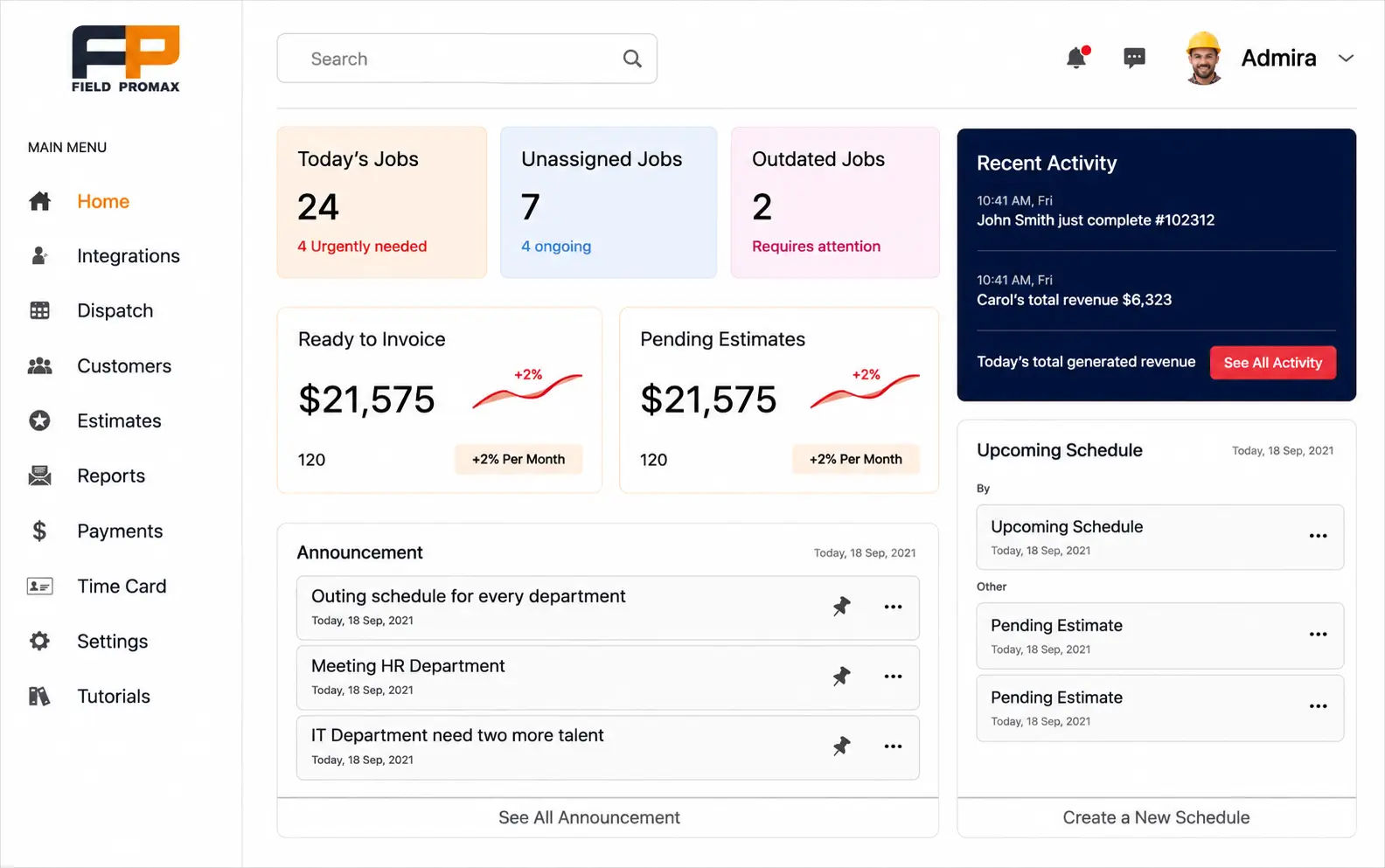
How Field Promax handles documentation for regulated trades.
HVAC contractors, plumbing shops, electrical service businesses, and pest control operators use Field Promax to run every job with documentation embedded at every step.
Customizable work order templates let you create trade-specific forms. Technicians can fill them out on their smartphones, capture signatures and photos on-site, and sync everything in real time. QA checklists ensure that technicians don't miss any steps. Labor tracking links every hour to the right job. A complete service history for every customer or piece of equipment is just a tap away.
Our documentation workflows have been tested across 24 different service verticals. As a result, the same JSA, timecard, and audit-trail workflow works for electrical inspections, HVAC refrigerant logs, and plumbing backflow reports.
An enterprise that deployed Field Promax across four of its business units, as featured in a QuickBooks App Store case study, cited customizations that other tools couldn't match. That's exactly what regulated multi-trade companies need: workflows tailored to each trade rather than a one-size-fits-all checklist.
Documentation is a client-trust signal.
Clients in regulated industries want to know the work was done properly. A detailed digital service report after every visit showing what was found, what was done, and what to watch for isn't just a record. It's a demonstration that you run a professional operation.
Over time, proper documentation transforms one-time service jobs into long-term service contracts. It also protects your business if a customer later disputes what was discussed or agreed upon.
Make documentation work for you, not against you.
The question isn't whether you should document your work. It's whether your documentation is detailed enough to protect your business, organized enough to retrieve quickly, and integrated well enough that it doesn't slow your team down.
Field Promax gives HVAC contractors, plumbing shops, electrical service businesses, pest control operators, and other regulated trades the tools to build audit-ready documentation as a natural output of every job.
Further reading
Conclusion
Documentation transforms your team's fieldwork into defensible business records. With the right workflow in place, audits, disputes, and callback investigations become much easier to manage while keeping your business compliant and organized.
Frequently Asked Questions

Founder and CEO
Joy Gomez is an engineer, process automation expert, and the Founder of Field Promax. Known for his technical expertise and commitment to field service innovation, Joy writes about transforming traditional business models into paperless, efficient operations. He is a Lean Six Sigma Black Belt based in Rochester, MN, dedicated to helping field professionals work smarter through better technology.
Reviewed by

Content Creator
Bhargavi Halthore is a content writer at Field Promax, a field service management platform serving trades businesses across the USA and Canada. With over a decade of experience writing for business owners, she brings detailed, ground-level insight to every topic she covers. Her research goes beyond search results - she digs into LinkedIn groups, Facebook communities, and Reddit forums to understand what field service business owners are actually dealing with on the ground. She speaks directly with industry professionals, understands their day-to-day challenges, and translates that into content that is practical and actionable. What you read in her articles reflects real industry patterns, not theory.