How to Become a General Contractor: A Step-by-Step Guide
The construction industry needs 349,000 new workers in 2026 alone. And more than 80% of construction firms say they struggle to find qualified people. If you are a tradesperson who has been thinking about stepping up, this is the right moment.
Becoming a general contractor (GC) is one of the best ways to grow your career and your income in the trades. You go from working on a project to running it. Instead of following instructions, you give them.
This guide walks you through every step. No guessing. No vague advice. Just the path that works.
1. What Does a General Contractor Actually Do?
A general contractor manages construction projects from start to finish. They are the persons in charge when multiple trades are involved, like when you need an electrician, a plumber, and a framer all working on the same job.
Here is what a GC does on a typical project:
1. Pulls building permits: You are legally responsible for making sure the project meets all local code requirements.
2. Hires and manages subcontractors: You bring in the electricians, plumbers, HVAC techs, and other specialists as needed.
3. Orders materials and manages suppliers: You keep the project stocked and on schedule.
4. Tracks the budget: You make sure the job stays profitable for both you and the client.
5. Communicates with everyone: clients, architects, inspectors, and subs. This is actually the number one skill of a great GC.
6. Handles problems: Something always goes wrong. A GC keeps the project moving anyway.
One thing the best GCs all say is this: over-communication is impossible. Clients never complain that you told them too much. They only complain when they feel left out of the loop.
2. Step-by-Step: How to Become a Licensed General Contractor
Step 1: Get Hands-On Construction Experience First
This is the part most people miss. Before you can get a GC license in most states, you need 2-5 years of verifiable, journeyman-level construction experience. Not general labor. Actual construction work where you can name the projects, the supervisors, and the roles.
If you are already an HVAC tech, plumber, or electrician, you are ahead. Most states will count your trade experience toward the GC requirement. That puts you closer than you think.
If you are starting from scratch, begin as a carpenter, laborer, or construction helper. Work your way up to foreman or site supervisor. Document everything as you go.
What to document:
-
Project names, dates, and estimated values
-
Your specific role on each project
-
Names of supervisors who can verify your work
-
Any permits, inspections, or code compliance you handled
Step 2: Get Educated (Formal or Informal)
You do not need a four-year degree to become a general contractor. But you do need to know your stuff. Education fills in the gaps that field experience alone cannot cover.
Your main options:
1. High school diploma + self-study: The minimum. Focus on construction math, blueprint reading, estimating, and basic business. Many GCs go this route.
2. Trade school or apprenticeship: Typically 1-4 years. You earn while you learn, get hands-on experience, and graduate with clear credentials. Popular starting trades for future GCs: carpentry, electrical, plumbing, and masonry.
3. College degree: A bachelor's in construction management, civil engineering, or business is not required but opens doors to bigger commercial projects. Some programs let you use your degree to reduce the experience hours your state requires.
Certifications worth getting:
-
OSHA 30-Hour Construction Safety (required on many job sites)
-
First Aid/CPR
-
NASCLA Exam (accepted by 16+ states - saves you retesting when you expand to other markets)
-
LEED Accreditation (if you want to work on green/sustainable projects)
Step 3: Apply for and Pass Your Contractor License Exam
Once you have your experience and education, it is time to get licensed. This is where many people stall out. Do not let it be you.
Most state licensing exams have two parts:
1. Business and Law section: Contracts, lien laws, tax basics, safety regulations, and licensing rules.
2. Trade-specific section: Construction materials, building codes, HVAC/plumbing/electrical basics, and construction methods.
Exam tips from real GCs:
-
Take a licensed exam prep course, not just self-study books
-
Do practice tests over and over until the format feels automatic
-
Most exams are multiple choice. Eliminate two obviously wrong answers first
-
Know where to find answers in open-book sections rather than memorizing everything
Most licensing applications also require proof of work experience, a background check, financial stability documentation (credit score, bank statements), and sometimes a reference letter from a current or past employer.
Step 4: Get Insured and Bonded
You cannot skip this step. In most states, insurance and bonding are required before your license is issued, not after.
Here is what you need:
1. General Liability Insurance: Protects against third-party property damage and injury claims. Most states require a minimum of $1 million per occurrence. Annual cost: roughly $500-$2,000 for small contractors.
2. Surety Bond (Contractor License Bond): Acts as a financial guarantee that you will follow state laws and fulfill your contracts. Bond minimums vary: $5,000 in some states, up to $25,000 in California. Annual bond premium: typically 1-5% of the bond amount.
3. Workers' Compensation: Required in most states if you hire employees. Covers medical costs and lost wages for injured workers.
4. Commercial Auto Insurance: If you use vehicles for business, your personal policy will not cover work-related accidents.
5. Budget tip: Most clients will ask to see your Certificate of Insurance (COI) before hiring you. Get your insurance in place early and keep it current.
Step 5: Set Up Your Business
Once you are licensed and insured, it is time to set up the business side. This is where a lot of new GCs make costly mistakes. They dive into jobs before building the structure that keeps things legal and profitable.
Your business setup checklist:
1. Choose a business structure: an LLC or a corporation is recommended. Both protect your personal assets if a project goes sideways.
2. Register your business name and get an EIN: An EIN is your business tax ID, required for opening accounts and filing taxes. Free from the IRS.
3. Open a dedicated business bank account: Never mix personal and business money. This is non-negotiable for legal protection.
4. Set up accounting software: QuickBooks Contractor Edition is the industry standard. Job-cost accounting lets you track profitability project by project.
5. Create standard contract templates: A proper contract covers scope, payment schedule, change orders, and liability. Get a construction attorney to review your first template.
6. Get a business plan in place: Define what types of projects you will take, your target market (residential, commercial, specialty), and how you will price and win jobs.
One of the most common early mistakes new GCs make is trying to handle the books themselves while also running job sites. The two jobs are incompatible. Get an accountant familiar with construction businesses from day one.
.png?updatedAt=1747763704661)
Managing work orders, scheduling, and job tracking becomes a real challenge once you have multiple crews running at once. Field service management software like Field Promax helps GCs stay on top of work orders, dispatch crews, and track job progress from one dashboard without the paperwork.
Step 6: Build Your Network and Land Your First Clients
Getting licensed is the easy part. Getting clients is the work. Most new GCs report it takes 7-10 weeks to land their first real job. Budget for that gap.
Ways to build your client base:
-
Google Business Profile: Set it up and fill it out completely. This is how local homeowners and businesses find contractors online. Reviews here are gold.
-
Join trade associations: NAHB (National Association of Home Builders) and AGC (Associated General Contractors) connect you with other GCs, subcontractors, and potential referral sources.
-
Build a subcontractor network: Your subs are your reputation. Pay on time, schedule fairly, and treat your team well. The best subs prioritize contractors who treat them right.
-
Referrals from your trade work: If you are an HVAC tech or plumber, your existing clients already trust you. Tell them you are branching into GC work. A warm referral is worth 50 cold calls.
-
Connect with real estate agents and architects: These professionals need reliable GCs constantly. One strong relationship here can fill your calendar.

3. General Contractor License Requirements by State
There is no single national GC license. Every state sets its own rules. Some states have strict requirements with multiple exams and high bond amounts. Others have no state license at all.
Here are key examples:

| State | Experience Required | Bond Requirement | Key Notes |
|---|---|---|---|
| California | 4 years journeyman-level | $25,000 surety bond | 2 exams (Law + Trade). State license required for projects over $500 in labor + materials. |
| Florida | 4 years construction experience | Proof of insurance required | Background check and fingerprinting. Credit score reviewed. No state bond amount, but insurance minimums apply. |
| Texas | None at state level | None at state level | No state GC license. Local registration is often required (Austin, Houston, and Dallas each have their own rules). |
| New York | Varies by project type | Varies by county | No state GC license. NYC requires a home improvement contractor license for residential work over $200. |
| Illinois | None at state level | None at state level | No state license. Chicago requires a GC license for most construction work with proof of insurance. |
| Arizona | 4 years experience | $5,000 to $9,000 | A trade exam and a business management exam are required. Three license classes based on project size. |
4. How Much Does It Cost to Become a General Contractor?
The costs to get licensed vary by state, but here is a realistic breakdown of what to budget:
-
Exam prep course: $200 to $4,000 depending on format (online vs. in-person school)
-
License application fee: $100 to $500 depending on state
-
Surety bond: $5,000 to $25,000 bond face value; annual premium typically 1-5% of the bond amount ($50 to $1,250/year)
-
General liability insurance: $500 to $2,000/year for new small contractors
-
LLC formation: $50 to $500 in state filing fees
-
License renewal: Typically $200/year; required every 1-3 years depending on state
-
Continuing education: Many states require ongoing CE hours to maintain your license
Total startup costs for a new GC business (excluding experience/training time): roughly $2,000 to $8,000 depending on your state and how much exam prep you need. That is a low barrier to entry compared to most businesses.
5. How Much Do General Contractors Make?
This is the question everyone wants answered. Here is what the data shows as of early 2026:
-
Average salary (Glassdoor, Feb 2026): $84,843/year. That is roughly $41/hour. Salary range for most GCs (ZipRecruiter, Feb 2026): $63,000 to $100,000 per year. Top earners hit $107,500+.
-
Median salary with bonus and incentives: $115,000 to $125,000 total compensation for experienced GCs.
-
Entry-level GC: Typically $45,000 to $65,000/year when first starting out.
-
California GC average: Up to $148,000/year due to the higher cost of living and more complex licensing market.
Three things that raise your income the most:
-
Years of experience (contractors with 4+ years earn significantly more)
-
Project scale (commercial GCs consistently earn more than residential)
-
Location (Northeast, California, and Pacific Northwest pay the highest rates)
Once you build a book of business, your earning potential is not capped by a salary. It is capped by how well you run your operation.
6. How Long Does It Take to Become a General Contractor?
The honest answer is it depends on where you are starting from.
-
Starting with zero construction experience: 6 to 12 years total. This includes trade school or apprenticeship (2-4 years), journeyman experience (2-5 years), and then licensing prep and application.
-
Starting as a licensed HVAC tech, plumber, or electrician: 3 to 5 years. Your trade experience counts toward the GC requirement in most states. You are already much further along.
-
Starting as a construction project manager or foreman: 2 to 4 years. If you already have documented supervisory experience, the licensing path is shorter.
-
Once you meet experience requirements: 3 to 6 months from application to approval in most states.
Here is the key thing to keep in mind: most of the time you spend becoming a GC is paid field experience. You are being paid to learn. That is a different kind of investment than spending years in school.
%20(1).webp)
7. Skills You Need Beyond Construction Knowledge
Knowing how to swing a hammer is not enough. The GCs who succeed long-term are the ones who master the business side too.
-
Communication (the most important skill): No client has ever complained about getting too many updates. GCs who over-communicate are the ones who get referrals.
-
Estimating and bidding: Underbidding kills profitability. Overbidding kills your pipeline. Accurate estimates require both math skills and real-world material and labor knowledge.
-
Blueprint reading: You need to be comfortable with architectural and engineering plans. Not just floor plans, but structural, mechanical, and electrical drawings too.
-
Financial management: Cash flow is the number one killer of new GC businesses. You need to understand job costing, progress billing, and how to stay cash-positive between invoices.
-
Subcontractor management: Your subs are your product. Choosing reliable people, setting clear expectations, and building those relationships is what separates good GCs from struggling ones.
-
Problem solving under pressure: Construction always throws surprises. Weather, material delays, permit issues, sub no-shows. Great GCs keep the project moving anyway.
8. Tools and Software That Help General Contractors Manage Projects
Running a GC business means managing people, schedules, materials, and money all at once. The right tools make the difference between organized growth and constant chaos.
-
Field service management software: For scheduling crews, managing work orders, dispatching techs, and tracking job progress. Tools like Field Promax handle this end-to-end for contractors running field teams. See also: field service software options on SoftwareFinder (https://softwarefinder.com/field-service).
-
Construction project management: Buildertrend and Procore are popular for larger residential and commercial projects, covering plans, schedules, and client communication.
-
Estimating tools: PlanSwift and Stack are commonly used for digital takeoffs. Clear Estimates is popular for residential jobs.
-
Accounting: QuickBooks Contractor Edition is the industry standard. It tracks job costs per project, not just overall revenue.
-
Document management: Google Drive or Dropbox for storing contracts, permits, plans, and inspection reports. Accessible from your phone on the job site.
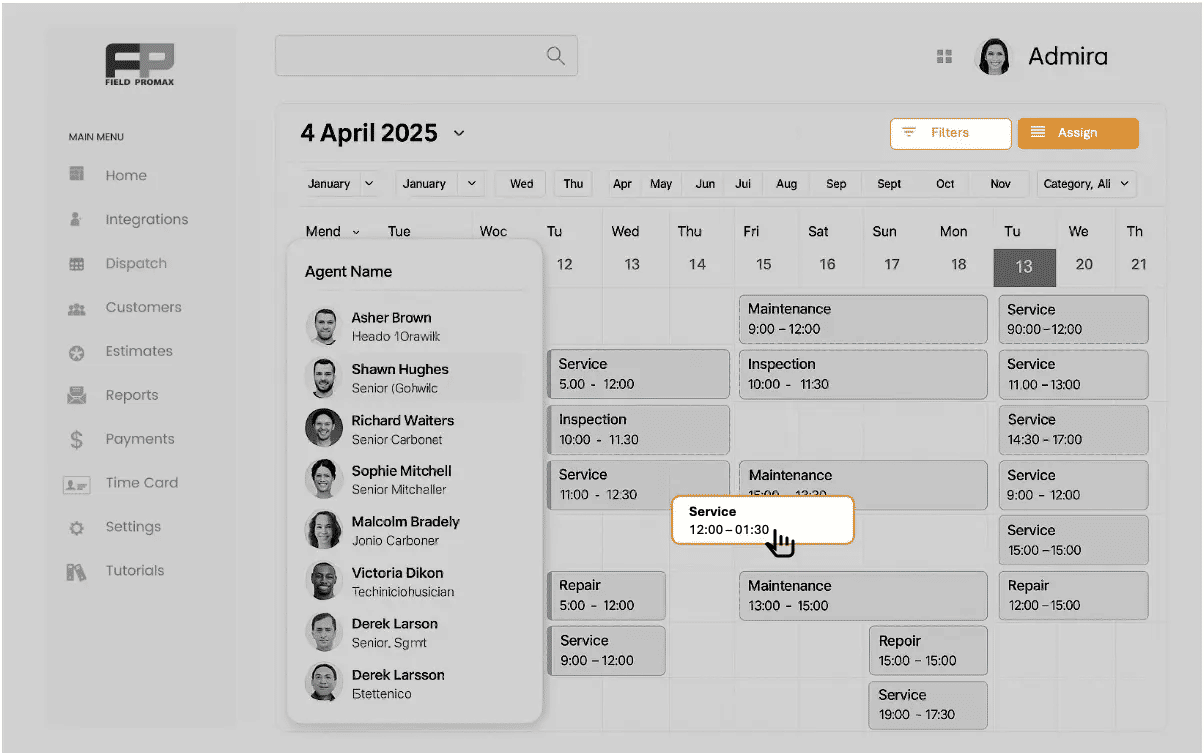
For contractors managing multiple crews, scheduling and dispatch software can eliminate double-bookings, missed jobs, and the endless back-and-forth that comes with managing people by phone. Check out Field Promax's guide to construction scheduling software for a breakdown of what to look for.
9. Common Challenges When Starting Out as a GC
Most new GCs hit the same walls. Knowing what is coming helps you prepare:
-
Cash flow gaps: You finish a job, submit an invoice, and wait 30-60 days to get paid while your next project is already costing you money. Set up a line of credit before you need it, and use progress billing contracts whenever possible.
-
Winning the first few jobs: Most new GCs report 7-10 weeks before landing their first real contract. Price competitively but not desperately. Low prices attract problem clients.
-
Subcontractor reliability: Your best subs are in high demand. They choose who they work with. Pay on time, always. Schedule fairly. Be easy to work with. Those things fill your call list.
-
Doing the books yourself: New GCs often try to handle accounting themselves. It is a mistake. Get a construction-savvy bookkeeper from day one. Messy books lead to tax problems and profit leaks.
-
Underestimating project costs: Material prices, labor overruns, and change orders eat margins fast. Build a 10-15% contingency into every bid and be explicit about what changes cost in your contracts.
Ready to Make the Jump?
Becoming a general contractor is one of the best career moves a tradesperson can make. You already have the field knowledge. Now it is about building the legal structure, the business skills, and the team around you.
The path is clear: gain your experience, get licensed, get insured and bonded, build your business structure, and invest in the right tools from day one. The construction industry needs more qualified GCs, and the opportunity is wide open.
Once you have crews running, scheduling, dispatching, and managing work orders gets complex fast. Field Promax's work order management tools are built for exactly that stage of growth. Explore how it helps field service contractors stay organized and profitable from the first job to the hundredth.