Plumbing Labor Valuation Overview
Plumbing Labor Price List: From Hourly Rates to Profitable Pricing
If you are a plumber and run a business, there is one thing that is certain that your pricing could keep your company afloat or lead it to the bottom of the barrel. You charge too little, and you are basically paying customers to call you. If you charge too much, they disappear quicker than the water that flows through a broken pipe. That's where a solid price list for plumbing labor is essential.
Consider it your business's plan for profit. This guide will take you through how to set plumber rates per hour that make sense, how to cover every cost without guesswork, and how to make your pricing reasonable enough to get jobs yet firm enough to improve the bottom line of your business. We will make sure that it is light, practical, and, unlike a ruptured pipe, fully in control.
Labor Rate Calculator
Find your profitable hourly rate in 5 steps
What's your annual overhead?
Include rent, insurance, utilities, marketing, and all other business expenses not tied to specific jobs.
What is a Plumbing Labor Price List?
A price list for plumbing labor is like a menu for your business, but instead of fries and burgers, it lists an hourly fee, flat charges, and other service charges. It outlines precisely what you charge for labor, regardless of whether it's an ordinary hourly rate for plumbing or a flat rate for a specific task, or a cost for travel or late-night work. The use of a pricing system keeps your prices constant and your earnings steady.
Here's why it's important:
- Covers all costs - Ensures every job pays for plumbing labor, overhead, and still leaves room for profit.
- Prevents undercharging - Stops those “how did we lose money on this job?” moments.
- Keeps quotes predictable - Customers know what to expect before you even grab your toolbox.
- Adapts to rising costs - Adjusts for increases in fuel, insurance, or materials so your margins stay intact.
With a well-calculated plumbing labor price list, you stay competitive, avoid pricing surprises, and keep your bottom line flowing in the right direction.
Flat-Rate vs. Hourly Plumbing Pricing
When you are creating your plumbing labor price list, one of the initial choices is whether to charge an hourly rate or offer flat prices. Both are acceptable, and the most successful plumbing companies typically use a mix of both.
Hourly pricing works well for:
- Large, unpredictable projects where you can't estimate the total duration until you begin.
- Jobs that could expand in scope once you're into the work.
- Situations where getting paid for each hour is the best way to safeguard your margin.
Flat-rate pricing is ideal for:
- Simple jobs that have a fixed time frame, such as drain cleaning or faucet installations.
- Customers who require price certainty before they arrive.
- Rewarding efficiency, when you finish faster, your effective hourly rate goes up.
Utilize hourly rates for unplanned work and a flat-rate plumbing labor price list for predictable work. Both should be based on the calculated labor rate to ensure that each service remains profitable.
Average Plumbing Hourly Rates
Plumber rates per hour can vary widely based on the place you are employed, the nature of the job, and the expertise level of the plumber. Across most of the United States, the average plumbing hourly rate is between $80 and $130.
The range can be greater:
- Lower end: Approximately $45-$75 in smaller towns or for less experienced plumbers.
- Mid-range: $90 and $110 for the majority of standard commercial or residential jobs.
- High end: $150-$200 or more for work in large cities, in emergencies, or after-hours call.
In Canada, licensed plumbers generally charge between CAD 100 and CAD 170 in larger cities, with lower rates in smaller ones.
The plumbing labor cost per hour that you charge isn't identical to the wages you pay your staff. The average wage could be $30 per hour, but your charges must be sufficient to cover your overheads and allow you to make a profit. This is the reason knowing the market price is crucial, as it allows you to stay competitive without accidentally pricing yourself out of business.
How to Calculate Your Plumbing Labor Rate?
Making your plumbing labor rates isn't guesswork. It's a math issue that you must solve to ensure your costs are covered and make profits.
Here are the steps:
- Add up your total annual overhead
Include rent, insurance, utilities, office salaries, trucks, fuel, tools, and marketing. It is the price to ensure your business is running even when nobody is working. - Calculate your team’s annual working hours
Begin with 2,080 hours annually for a full-time worker, then subtract holidays, vacations, and sick days. Divide the total by the number of technicians you employ. - Figure out your billable hours
Not every hour is billable. Driving, paperwork, and loading the truck take time, too. A 50 percent billable rate is great. Multiply your total working hours by your billable percentage to get your true billable hours for the year. - Find your break-even hourly rate
Add your overheads and the wages for your billable hours together, then divide by the billable hours. (Wages for unbilled time, driving, paperwork, loading, should already be counted in your overhead.) This is the amount you should be charging per hour to cover the costs - Add your desired profit margin
Divide your break-even rate by (1 − your profit margin). If you are looking for a 30 percent profit and your break-even rate is $80, divide 80 by 0.70 (that is, 1 − 0.30) to arrive at $114.29. Round it up to an even figure for your plumbing labor price list.
This approach offers you a rate that covers the plumbing work, overheads, and ensures you make money on every job.
Best Practices for Setting Plumbing Labor Rates
A plumbing labor price list isn't something you can set once and forget about. To ensure your business remains successful and competitive, take it as an ongoing document.
- Review and update yearly
The cost of fuel, materials, and wages will never sit in the same place. Revise your rates at least every year, so that inflation and increasing expenses aren't squeezing away your profits. - Know your local market
Find out the plumber rates per hour in your region. If you're far above the norm, you run the risk of losing customers. If you're far below, then you may be leaving cash on the table. - Charge a premium for special situations
Emergency calls, weekends, and complex jobs should cost more. Build this into your plumbing labor price list so customers know what to expect. - Use flat rates for common jobs
For repeat tasks like drain cleaning or faucet installs, flat pricing makes quoting easier and customers happier. Just make sure those rates are still based on your calculated labor cost. - Be transparent about your rates
Explain what your plumbing labor rates include, from skilled licensed workers to insured service and warranty support. Customers respect clear, honest pricing.
Keep your rates updated, fair, and justified, and you will protect your profit without scaring away customers.
Using a Plumbing Cost Calculator Tool
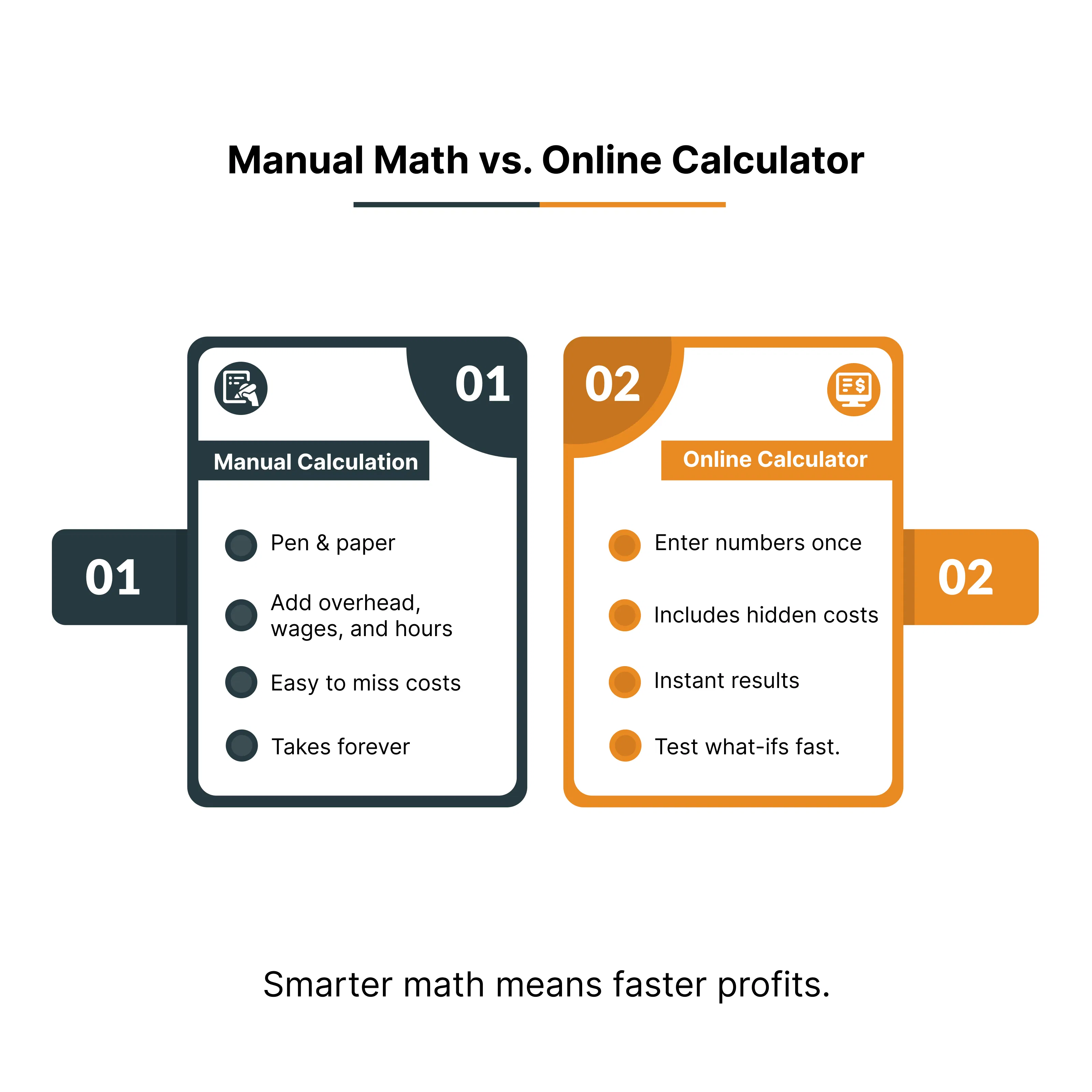
Figuring out your rates by hand is possible, but why torture yourself with endless math when a tool can do it faster and more accurately? A plumbing cost calculator takes your specific numbers, such as overhead, crew size, working hours, and profit goals, and turns them into a ready-to-use plumbing labor price list.
Why use one?
- Saves time – You enter your data once and get your ideal rate in seconds.
- Reduces mistakes – The tool prompts you to include costs you might forget, such as vehicle maintenance or software fees.
- Test scenarios – If you are thinking of hiring another plumber or upgrading your van, you can see instantly how it changes your rate.
- Improve confidence – You can present your prices knowing they are backed by solid math, not guesswork.
With a good plumbing labor calculator, you are not just setting rates. You are making sure every job pays what it should without leaving profit behind.
Final Thoughts
A well-built plumbing labor price list is more than just a sheet of numbers. It is your blueprint for profitability, your safeguard against undercharging, and your best tool for keeping rates consistent and fair. When you calculate your rates based on real costs, update them regularly, and use tools like a plumbing cost calculator, you take the guesswork out of pricing.
By blending hourly and flat-rate pricing, adjusting for market trends, and communicating your value clearly, you set your business up to thrive. The right rate does not just cover your plumbing labor; it fuels growth, protects margins, and shows customers that you run a professional and reliable operation.
From price list to paid invoice
You've set a profitable rate, now hold the line on it. Field Promax plumbing software turns your labor rate into quotes, scheduled jobs, and invoices so the price you set is the price you collect. Trusted by 100,000+ contractors across the USA and Canada.
Book my free demoFree demo · no credit card required.