How to Price Plumbing Jobs Profitably in 2026: A Working Guide

This guide explains how to price plumbing jobs in 2026 for service shops with 5-20 techs. It covers cost structures, pricing models, residential versus commercial pricing, transparent quoting, break-even calculations, and the dispatch-to-invoice workflow that helps protect your margins.
Most plumbing shops we work with do not lose money because they do not understand pricing. They have established rates. They generally know their costs, at least within a reasonable range. Yet many still finish the year wondering where the money went. The rate itself is rarely the problem. What hurts a plumbing business profitability is everything that happens between the initial call and the moment the deposit hits the bank.
Ready to get started with Field Promax?
Sign Up FreeTalk to enough contractors on Quora and Reddit, and the same complaint comes up again and again. A tech promises to provide an estimate on the spot. The estimate then sits in a drafts folder for three or four days while live jobs consume the rest of the week. By the time the quote is sent, the customer has already hired someone else.
Industry benchmark research suggests that the likelihood of winning a job declines with each day an estimate remains unsent. For an 8-tech shop, ten quotes sitting idle for three days can represent a substantial amount of pipeline slipping away.
This guide explains how small and mid-sized shops handle pricing a plumbing job profitably in 2026. It covers cost structures, pricing models, residential versus commercial pricing, practical pricing scenarios, and what happens when the dispatch-to-invoice workflow becomes tight enough to protect the margins built into your business.
How do you read your local pricing market without underbidding?
It’s not about copying your competitors. The real question is: what does the local market expect, and what is the minimum price at which the work remains profitable?
Price-matching is how you race a competitor to the bottom. Neither of you wins that race. Survey four things instead:
- Price ranges for your five most common jobs. Research pricing for common services such as water heater installations, drain cleaning, faucet replacements, repipes, and sewer line repairs. Compare both hourly and flat-rate pricing using competitor websites, HomeGuide, and Angi.
- The pricing model split. Some markets strongly favor flat-rate pricing, while others remain comfortable with hourly billing. Understand which model your local market expects before setting your pricing strategy.
- Reviews on your top three competitors. Look for recurring customer complaints. "Surprise fees" is one of the most common. In many cases, the problem is not the price itself but the pricing structure and how costs are communicated.
- Your own 90-day win-loss ratio. If you are winning 90% of your bids, you may be priced too low. If you are winning less than 40% of your bids, the issue may be your estimating and sales process rather than your pricing.
Geography also affects pricing. High-cost metro markets tend to operate with higher pricing floors and ceilings. Rural shops often charge lower prices overall, but they may carry more overhead per job because of travel time, lower job density, and longer service routes. That gap matters because residential and commercial work rarely share a market or a margin, so they should not share a single rate.
How do you build trust through transparent pricing?
Customers are more concerned about hidden costs than high prices. A clear, well-defined quote is better than a lower-priced but unclear one every time. The shops with the cleanest upfront pricing are the ones that stop arguing at the door.
- Line-item estimates, upfront. Provide separate line items for labor, materials, and an allowance for code-related add-ons such as expansion tanks, pressure-reducing valves (PRVs), and drain pans. Clearly flagging these items acts as a trust signal.
- Itemized invoices, not lump sums. A detailed breakdown helps prevent disputes before they begin.
- Value framing on the document. Include value-framing elements in the proposal, such as licensing, bonding, and warranty terms that competitors may not offer. Make sure these are clearly presented in the quote.
- Plain-English wording. Many disputes arise when a customer interprets an estimate as a fixed, legally binding price. A single disclaimer can help prevent confusion: "This is an estimate. The final price may change if the scope of work changes or additional code requirements are identified. We will review and approve any changes with you before work begins."
- Good-Better-Best tiers. When expectations are clear, customers are more likely to make decisions confidently rather than negotiate aggressively, and the average ticket value often increases.
The strongest pricing policies aren't about being cheap. They’re about leaving zero room for "wait, what's this charge?" at the kitchen table.
Which pricing model fits the work you actually do?
Hourly or flat rate? That's the wrong question. The better question is which pricing model best fits the work being performed. The most successful shops use multiple pricing models and apply them based on the type of job.
- Hourly pricing works best when there is genuine uncertainty in the scope of work, such as sewer line diagnostics or repipes in older buildings. These jobs require accurate time tracking and often justify an upfront diagnostic fee.
- Flat-rate pricing is the standard for most residential service work. It shifts scheduling and productivity risk to the shop, where it can be managed more effectively. It also eliminates customer anxiety about the clock and rewards efficient techs. By 2026, most residential plumbing services should be priced on a flat-rate basis.
- Project-based pricing is best suited for jobs that are large enough to require a formal scope of work. Examples include commercial fit-outs and multi-day installation projects. These jobs typically include a contingency allowance of 10-15% to account for risk.
- Hybrid pricing - a flat rate up to a defined scope, followed by hourly billing beyond a predetermined threshold - is how many mature shops operate. The key is to clearly document the trigger point in the estimate.
"We use whatever the customer prefers" isn’t a pricing model. It means your rate gets set by whoever yells loudest on the phone. Picking models on purpose is half of how to price plumbing jobs without bleeding margin on the jobs that go sideways.
What separates a winning plumbing estimate from a leaky one?
A winning estimate is easy to understand, detailed enough to hold up if questions arise later, and structured so the customer can simply tap "Approve" on their phone without needing to call for clarification. A leaky estimate does none of those things.
- On-site scope check before you commit a number. Phone-quote habits eat margin alive.
- Clear scope language. What’s in, what’s out, what counts as a change order.
- Itemized labor, materials, and disposal. No mystery lines.
- A visible contingency line for surprise access work or code items.
- E-signature before the tech leaves the driveway. Benchmark data shows paper estimates take roughly 30 days to come back signed. E-signed ones come back in about 2.
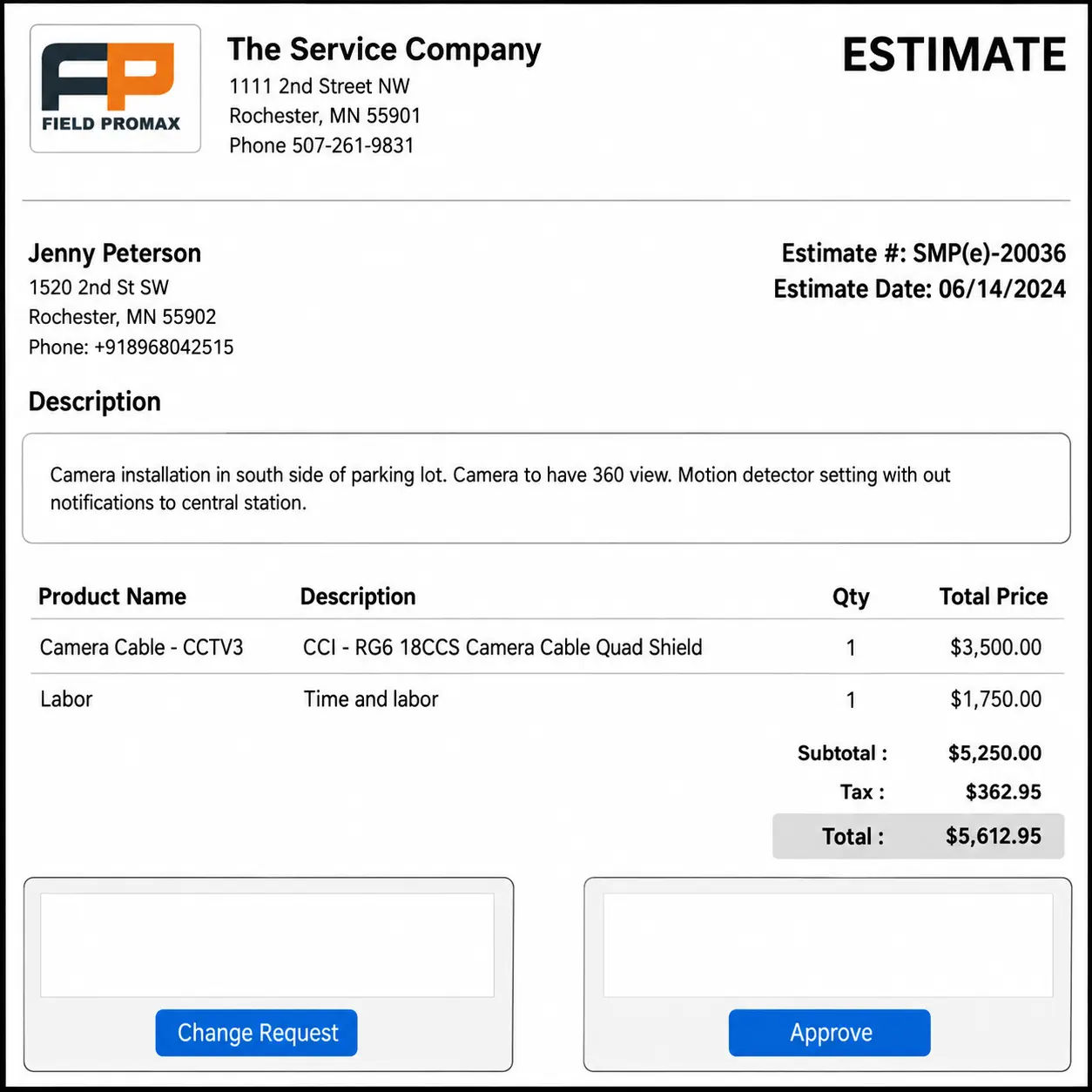
An accurate estimates workflow that hands your tech a templated pricebook right on the truck does more for your win rate than any rate tweak ever will.
When should you adjust prices to match market shifts?

Push it to the back of your mind, and that is how margins die. Instead, implement three review cadences:
- Quarterly material costs. Copper, PEX, water heaters, brass fittings, and other key materials all fluctuate in price. A price book that is nine months out of date is effectively funding your supplier's margin with your own.
- Annual labor review taking into account insurance renewals, wage increases, and fleet costs. Most shops update their material pricing more often than their labor pricing. Labor is where margin erosion often occurs quietly.
- Seasonal adjustments for emergency calls, holidays, after-hours service, and weather-related demand spikes. Clearly disclosing after-hours premiums reduces disputes and helps set customer expectations before the work begins.
A discount that's lived on your website for a year isn’t a promotion. It’s a price cut you never admitted to.
Do you actually know what each job costs you?
A quick gut check: are you able to identify the true cost of your previous job in dollars? Most owners are not. That blind spot is precisely where underpricing begins. You can’t figure out how to price plumbing jobs right until you know what each one actually costs you.
- Labor cost, fully burdened. A tech earning $30 per hour will often cost the business $42-$48 per hour after payroll taxes, workers' compensation, benefits, paid time off, and other employment-related expenses are included. Many owners know the wage rate but underestimate the true labor cost.
- Material cost. Track all material costs, including pipe, fittings, fixtures, fasteners, and consumables. Apply an appropriate markup, often 40-60% in residential work and lower in high-volume commercial projects. Avoid passing materials through at cost.
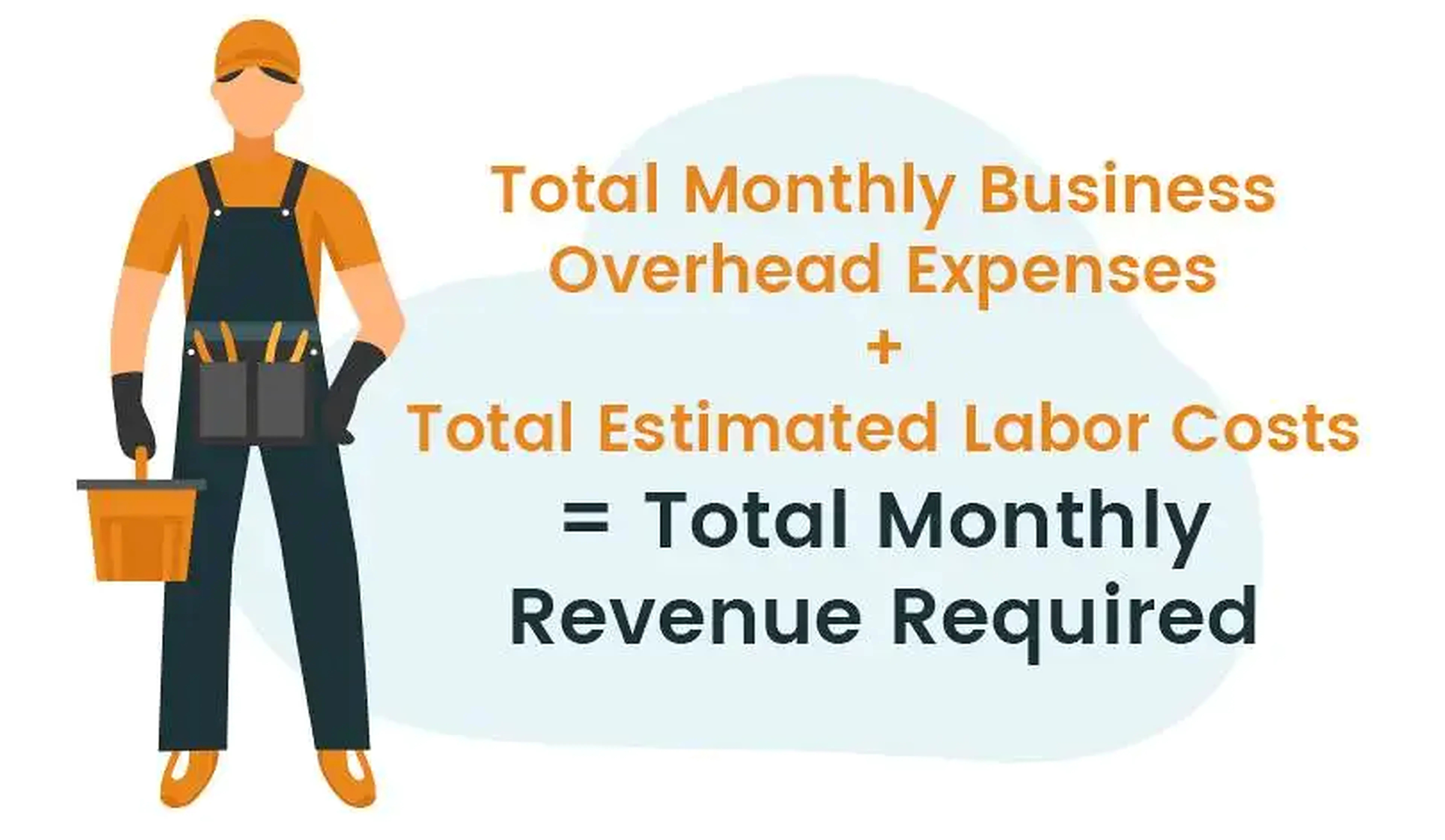
- Overhead. Account for overhead expenses such as licenses, insurance, vehicles, software subscriptions, dispatcher wages, and owner compensation. Calculate these costs on a monthly basis, divide them by your billable hours, and allocate a portion to each job.
If you don’t allocate overhead per billable hour, your hourly rate is a fantasy. A job costing workflow that updates in real time is what separates a 12% net margin shop from a 4% net shop pulling the exact same revenue. That gap is the whole game for plumbing business profitability.
How do you calculate your break-even hourly rate?
There is no mystery to math. Follow these four steps, and you'll be able to determine your pricing floor.
- Add monthly overhead. Utilities, software, vehicle payments and insurance, business insurance, rent, office and leadership pay, maintenance. Call it $O.
- Total monthly labor. (techs) x (avg fully-burdened hourly pay) x (billable hours). Call it $L.
- Add your profit target. Multiply ($O + $L) by 1.20 for a 20% target.
- Divide by total billable hours per month. That's your break-even hourly rate, before any markup on materials.
Run the numbers. An 8-tech shop with $22,000 overhead, $46/hour loaded labor, and 1,100 billable hours: ($22,000 + 1,100 x $46) x 1.20 = $87,120. Divide by 1,100 and you get about $79/hour. Your flat-rate book builds up from there. That $79 isn't your price. It’s the number below which you're paying customers to let you work.
A pattern across emergency plumbing operators we've worked with
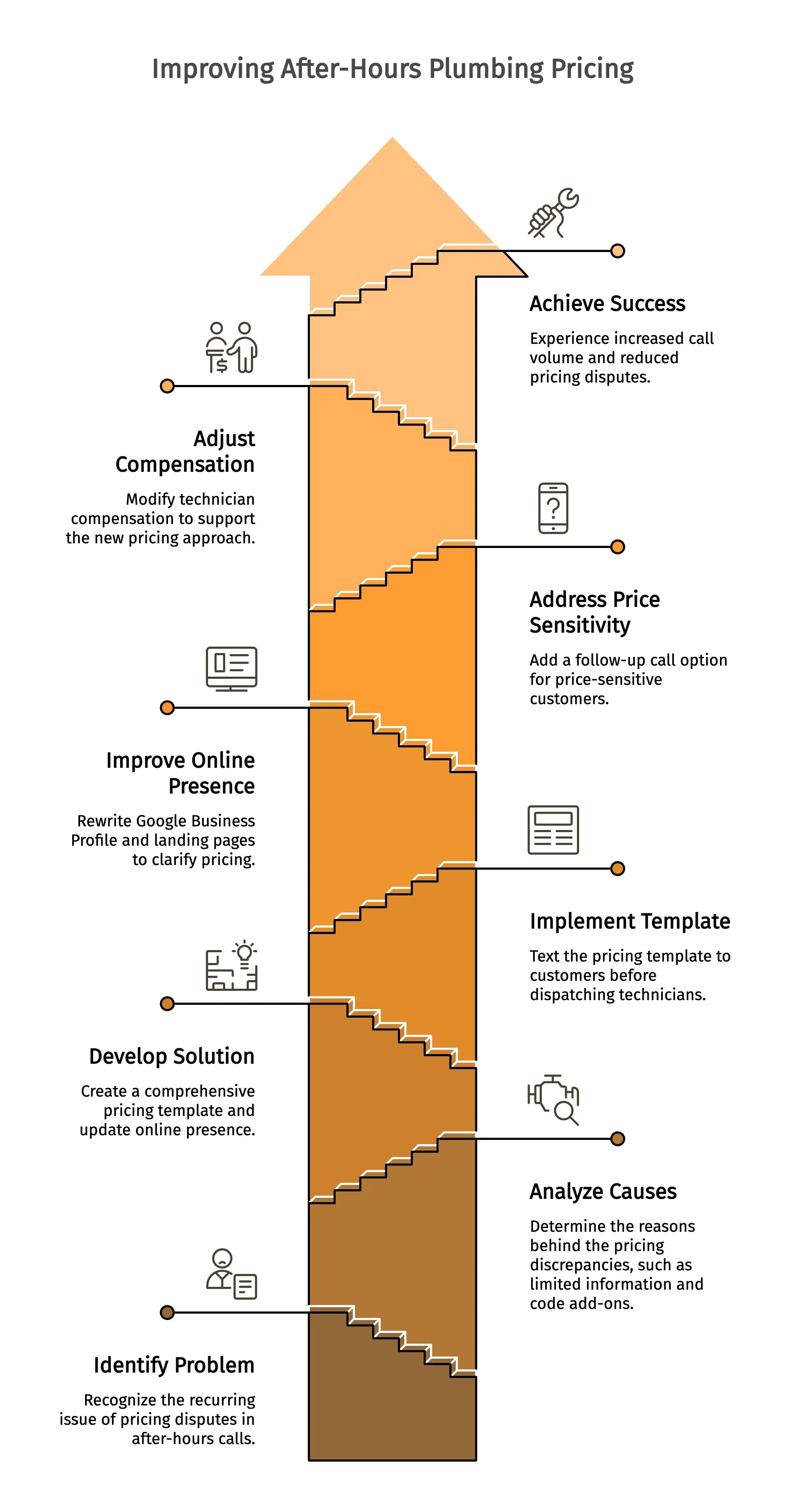
Across 40-50 small plumbing contractors we have worked with since 2018, the same after-hours pricing problem continues to surface. Consider an owner-operator running an emergency plumbing business with six techs in a typical Sun Belt metro area.
Whoever answers a 1:00 a.m. service call wants to secure the job before the customer moves on to the next listing. As a result, the phone quote is often given quickly and with limited information. Once the technician arrives, however, code-required add-ons that were not discussed during the call may come into play. The truck is already rolling, the on-site quote ends up 20-30% higher than the original estimate, and the argument begins before the technician even gets through the door.
The shop did not appear in local search results after hours across two of its three target ZIP codes. As a result, emergency calls were being routed to national franchises instead. When calls did come in, the price quoted over the phone often differed from the written estimate. A second pricing structure had been added, creating inconsistency. Technicians either collected the additional charges on-site or were turned away at the door, and there was no reliable data showing which outcome occurred more often.
To address the problem, the owner created a one-page emergency pricing template. It included a diagnostic fee, a call-out charge, Good-Better-Best pricing ranges, and a section highlighting common code-related add-ons that might affect the final price. The template was texted to the customer before the truck was dispatched. The company’s Google Business Profile and landing pages were also rewritten to clearly explain after-hours and weekend pricing within the specific service areas they covered. The first version of the text template was too dense. In fact, the layout had to be revised twice before it became clear enough for customers to understand at 2:00 a.m.
By the second summer, after-hours call volume had increased significantly, and on-site pricing disputes had almost disappeared. There was a real trade-off, however. Some price-sensitive customers stopped responding after receiving the pricing text, particularly on weekends and late at night. To address this, the owner added a follow-up option: if a customer did not respond within 10 minutes, the owner would place a call to answer questions and explain the pricing. Two senior techs adopted the process immediately. Newer hires struggled to follow it consistently until their compensation structure was adjusted to support the new approach.
Composite case: details derived from the most common variation of this approach.
Want a plumbing estimate template to start from?
Download a basic template and set up your own pricebook from it. Customize your line items, markup levels, and contingency language to suit your market.
What does field service software actually change about pricing?
Software doesn’t determine your prices. It bridges the gap between your pricing decisions and the customer making payment, and that’s exactly the point where margins are often lost. That's one of the most important factors for choosing job management solutions for plumbers: not the feature list, but how few handoffs it leaves room to fumble.
Industry data puts the median quote-to-job conversion rate for contractors at 74%. Owners that use digital estimates with reusable templates and e-signature capture land in the top band, reaching closer to 80% or more. The reason isn’t just the price. It’s the structure and speed of the quotation. If you’ve ever wondered how plumbing contractors double their booked jobs without adding a single lead, that conversion jump is most of the answer.
An enterprise reviewer on the QuickBooks App Store described rolling out plumbing business software across four businesses, pointing to customizations off-the-shelf tools couldn’t match. That’s the usual story: configurability, not a marketing pitch, decides multi-location rollouts. When owners weigh the important factors for choosing job management solutions for plumbers, the ones who run more than one location put "does it bend to how we already work" near the top.

How do scheduling and real-time cost tracking protect priced margin?
Two failures that happen silently can destroy the margin you set. The first occurs when a technician finishes ahead of schedule, the dispatcher doesn’t realize it, and the next job isn’t assigned quickly enough to fill the open slot. The second happens when material costs increase in the middle of a job (extra trips, unexpected installation issues) and the office doesn’t notice until invoicing, and by then, it’s too late to issue a revised estimate for a scope change.
Scheduling and dispatch workflows that show route progress fix the first. Job-cost tracking that updates as materials and labor land fixes the second. Shops that move job costing to a live view, not a Friday report, catch overruns mid-job, while they can still reprice or call the customer. A Friday report just tells you where the money already went. Tighten this loop and you start to see how shops book more jobs off the same crew, by filling every open slot instead of letting finished techs idle.
What does data-driven pricing look like in practice?
Your job history can answer questions that a spreadsheet cannot. Which types of jobs generate the highest profit per hour instead of per ticket? Which technicians are the closest to their bid estimates? Which service areas experience the highest number of unexpected issues?
Shops that generate margin-per-job-type reports often discover the same pattern. Sewer and drain cleaning usually produces higher gross margins than new installations, often by a significant amount. This insight changes marketing spend, dispatch priorities, and pricebook strategy. Most spreadsheet-based shops never conduct this analysis, because the data is scattered across three different tools and a stack of paperwork sitting in the truck.
Here's what I see when shops show me their pricing. The rate isn't wrong. The pricebook isn't wrong. What breaks is the gap between what the tech sees in the basement and what gets typed into the invoice three days later. We read tickets every week from owners who built a clean flat-rate book, trained their techs, and still watched jobs come back under-billed because someone forgot the second permit fee or the access charge.
From 15 years of customer conversations, the most-requested feature isn't a fancier pricebook. It's tighter dispatch-to-invoice automation. Every handoff between field and office is a place where priced-in margin leaks. Fix the handoffs and your existing rate starts working. The pricing was never the problem.
- Joy Gomez, Founder of Field Promax
How do faster invoicing and clear customer comms feed cash flow?
Invoicing same-day from the truck, with the customer's e-signature already captured, is one of the biggest cash-flow wins a plumbing shop can grab. Days-to-payment shrink. Disputes shrink, because the customer signed off before the tech left. And bookkeeping reconciliation shrinks when the work order, invoice, and payment all flow into QuickBooks with no rekeying.
ETA text messages, on-the-way alerts, and digital invoices that customers can pay through their phone all help speed up payment. Owners on Capterra report that tap-to-pay customers often settle payments within hours rather than weeks. A signed quote and a same-day invoice beat a polite reminder email every single time.
Why do spreadsheets quietly fail your pricing model?
Your pricing inputs are never static. Product lines can change during the installation process. Fuel costs fluctuate. Code requirements get rewritten. Insurance policies renew. Wages increase.
A pricebook held together with an Excel sheet ages quickly. Even more importantly, the gap between what you see on the sheet and what technicians actually charge in the field continues to grow because the field team does not know that the spreadsheet was updated last Tuesday.
Research suggests that about 40% of contractors underestimate their labor costs by 10% when relying on manual estimates. If you combine a 5% labor error with a 7% material overrun, a job can easily run 15% or more over the estimated cost. The business owner often does not recognize the pattern because it does not appear on a single invoice. Instead, it shows up as lower-than-expected margins at the end of the year, with no obvious reason as to why. Knowing how to set different pricing levels for residential vs commercial plumbing work means nothing if the field is quoting off a stale sheet.
Most shops that have not adopted digital pricing tools still rely on paper, spreadsheets, or QuickBooks-only setups. Your pricebook templates should build on what is already working rather than forcing a complete operational overhaul.
Which factors actually decide your pricing sweet spot?
Six factors, ranked by how much they can increase your rate
- Cost of living in your service area. A metro shop priced at rural rates will go broke. A rural shop priced at metro rates will struggle to win bids.
- Tech skill and certification. Master plumbers, backflow certifications, and gas line certifications justify higher rates, but only if those certifications are reflected in the estimate.
- Job complexity. Repipes, sewer-line replacements, and slab leak repairs should be priced differently from a simple faucet replacement.
- Client type. Residential customers are generally more expensive than commercial clients or property managers. Price maintenance relationships to retain long-term customers, not based only on the first ticket.
- Emergency and after-hours premium. Rates typically range from 1.5x to 3x the standard rate. Make these charges publicly visible and clearly communicated.
- Materials and equipment quality. Premium fixtures and warranty-backed equipment allow for higher markups that customers are willing to accept when positioned as a quality and warranty benefit, rather than as an upsell.
It’s not about a fixed number. It’s the rate that, across all six factors, hits your target win rate and net margin at the same time. Review it quarterly. Make adjustments based on your own data, not on a competitor’s panic discount.
Conclusion
Pricing plumbing work profitably in 2026 is less about figuring out the best rate and more about bridging the gap between what the technician sees on-site and what appears on the invoice three days later. The shops that finish with strong profits are the ones where pricing, estimate templates, scope definition language, and invoicing workflows all stay aligned. Review each of these elements every quarter. When the numbers stop matching, fix the workflow before you touch the price.
Want every handoff from quote to invoice working in your favor? Pricing a plumbing job profitably gets a whole lot easier when the workflow stops fighting you.
Frequently Asked Questions

Content Creator
Bhargavi Halthore is a content writer at Field Promax, a field service management platform serving trades businesses across the USA and Canada. With over a decade of experience writing for business owners, she brings detailed, ground-level insight to every topic she covers. Her research goes beyond search results - she digs into LinkedIn groups, Facebook communities, and Reddit forums to understand what field service business owners are actually dealing with on the ground. She speaks directly with industry professionals, understands their day-to-day challenges, and translates that into content that is practical and actionable. What you read in her articles reflects real industry patterns, not theory.