What Are Overhead Costs in a Service Business? A Complete Guide
.webp)
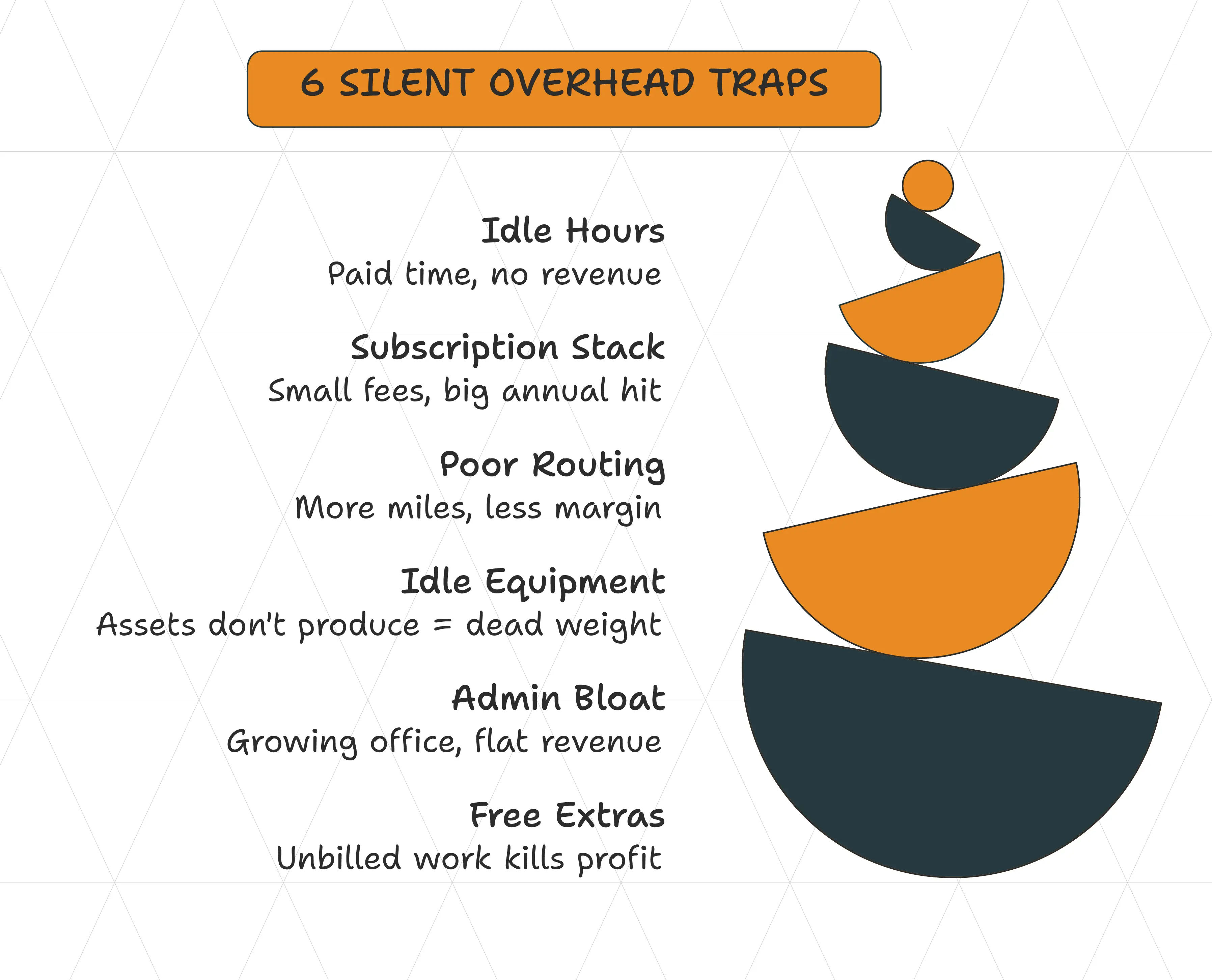
We hear this story a lot. A service business is completely booked, the team is working all the time, and from the outside it looks like things are going great. But when the owner checks the numbers, they're barely making any money. How can that happen?
The answer is usually overhead costs that weren't understood or managed well. To really understand what is overhead and how much money your business is making, you first need to understand what overhead costs are and why they matter. Understanding overhead cost meaning and how it quietly eats away at your profits is key to running a healthy service business.
Overhead expenses are the costs that keep the lights on, the vans running, and the business going but they aren't connected to any one specific job. If you're not tracking them the right way, you could be losing money on every project. Understanding what is overhead cost from day one is the difference between a profitable business and one that's constantly struggling.
Financial guidelines suggest that overhead costs are often around 10% to 20% of total sales for established companies. But many service businesses go over that because of labor, vehicles, insurance, and how complicated operations can get. Without watching these costs closely, overhead can slowly eat up your profits without you noticing.
This guide will walk you through what overhead costs mean, what is overhead in business, how to figure out your overhead rate, and how to control these expenses so you can protect your profits. Tools like Field Promax can also help track overhead costs automatically and help you make smarter pricing decisions right away.
What Exactly Are Overhead Costs? (And What Aren't They?)
Many owners still ask what does overhead mean in business because they've never clearly sorted out their indirect expenses. It's a simple idea, but one that many business owners get wrong and getting it wrong can be really bad for your profits.
Overhead Cost Meaning: The Hidden Cost of Being in Business
The official overhead cost meaning refers to indirect operating costs that support your company. More broadly, overhead in business includes every expense that's not tied to doing a specific job for a specific customer but is still needed to keep your business running. At its core, overhead expenses are the cost of being in business, no matter how many jobs you complete.
Think of them as the price your business pays just to exist. Whether you do one job this month or one hundred, these overhead expenses will still be there. Understanding this difference is the foundation of what overhead costs are and why they matter so much. Understanding the overhead definition clearly also helps you communicate costs to your team and make better financial decisions across the board.
Direct Costs vs. Overhead Expenses: A Clear Difference
The most important difference to understand is between direct costs and overhead expenses. Direct costs are expenses you can connect directly to a specific job if you didn't do the job, you wouldn't have the cost. Indirect costs, or what are overhead expenses, are the opposite: they are costs you have to pay no matter how many jobs you complete.
To understand what an overhead cost is, you need to clearly separate direct and indirect expenses:
| Cost Type | Description | Examples (Plumbing) |
|---|---|---|
| Direct Costs | Expenses tied directly to a specific job | Plumber's wages for that job; pipes and fittings used; specific job permits |
| Overhead Costs (Indirect) | Ongoing expenses to keep the business running | Office/workshop rent; marketing costs; business liability insurance; office manager salary |
Overhead Costs Examples Across Service Industries
Overhead costs examples can look very different from one service industry to another. Understanding these overhead costs examples helps you spot every dollar that's quietly reducing your profits. Here are common overhead cost examples across different service businesses:
| Industry | Common Overhead Cost Examples |
|---|---|
| HVAC | Rent for workshop/storage; fleet vehicle maintenance and fuel; dispatching and invoicing software; ongoing technician training and certifications |
| Plumbing | Business liability and workers' comp insurance; marketing costs; office staff salaries (receptionist, dispatcher); uniforms and safety equipment |
| Traffic Control | Wear and tear on traffic cones, signs, barriers; fleet and TMA truck maintenance; high-risk road work insurance; certifications for flaggers and traffic controllers |
| Electrical | Licensing and permit fees; professional liability insurance; continuing education for electricians; office utilities (internet, phone) |
| Cleaning | Marketing and advertising (Yelp, Angi); cleaning supply costs (when not billed to the job); vehicle insurance and maintenance; scheduling and CRM software subscriptions |
The 3 Main Types of Overhead Costs Every Service Pro Should Know
To get an even closer look at your business overhead, it helps to sort your overhead expenses into three main types. Understanding how each type works differently is key to understanding what does overhead mean and how to manage it effectively in your service business.
1. Fixed Overhead: Predictable and Consistent
Fixed overhead costs are expenses that stay the same every month, no matter how busy you are. They're the easiest to plan for because you always know what's coming. For small business overhead costs, fixed expenses are often the biggest predictable burden that owners need to plan around.
Examples of fixed overhead include:
-
Rent: Your monthly payment for office, workshop, or storage space.
-
Insurance: Premiums for liability, auto, and workers' compensation insurance.
-
Salaries: Wages paid to office staff, like your office manager or receptionist.
-
Software Subscriptions: Monthly fees for accounting, CRM, or scheduling software.
2. Variable Overhead: Changes with Activity
Variable overhead costs change from month to month based on how busy your business is. When you're busier, these costs tend to go up; when you're slower, they go down. Variable overhead is one area where small business overhead costs can fluctuate significantly, so tracking is essential.
Examples include:
-
Marketing and Advertising: You might spend more during busy seasons and less during slow ones.
-
Fuel Costs: The more jobs you do, the more you'll spend on fuel.
-
Office Supplies: More invoices and proposals mean more supply usage.
3. Semi-Variable Overhead: The In-Between Costs
Semi-variable overhead costs have both a fixed part and a variable part. You pay a set amount each month, and then costs go up based on how much you use. Your utility bill is the most common example there's a fixed service charge plus a charge based on how much electricity or water you use.

Why Overhead Is the Silent Killer of Profitability
Now that you understand what overhead is and the different types, let's talk about why it's so dangerous if you don't manage it. The simple truth is this: if you don't clearly define your overhead expenses, you will keep pricing your services too low and overhead is a huge part of your true costs.
The Direct Impact of Overhead on Your Profit Margins
Every dollar you spend on business overhead comes directly out of your profit margin. If you're not accounting for overhead costs in your pricing, you're basically giving away your services for free. You might be covering your direct costs, but you're not covering the cost of being in business and that's a recipe for failure.
Field Promax helps service businesses automatically add overhead costs to each job so nothing gets missed. By including your overhead rate in your estimates, you can price every job with confidence.
The Danger of Pricing Too Low: A Real-World Example
Here's a simple example. Imagine you run a small HVAC company with a job to install a new air conditioner:
-
New AC unit: $2,000
-
Technician's labor (8 hours at $50/hour): $400
-
Total Direct Costs: $2,400
You charge the customer $3,000. On the surface, it looks like a $600 profit. But what about your overhead expenses? If your monthly overhead is $5,000 and you do 10 jobs per month, each job needs to cover $500 of overhead. When you factor in business overhead, your true profit on the job is only $100 ($3,000 - $2,400 - $500). If you had priced the job at $2,800, you would have actually lost $100 even though it looked like you were making money. This is why some businesses stay busy but still lose money.
How to Calculate Overhead Cost: The Right Way
Learning how to calculate overhead cost correctly makes sure every job covers its fair share of expenses. This important number tells you how much to add to the price of every job to cover overhead. Knowing how to calculate overhead is one of the most valuable financial skills any service business owner can develop. Here are three proven methods.
Method 1: Overhead Rate as a Percentage of Sales
This is the simplest method and tells you what percentage of your revenue goes toward overhead costs. It's the most common starting point when learning how to calculate overhead rate for a service business.
Formula: (Total Monthly Overhead ÷ Total Monthly Sales) × 100
Example: If your total monthly overhead is $10,000 and total monthly sales are $50,000, your overhead rate = ($10,000 ÷ $50,000) × 100 = 20%. This means for every dollar you earn, 20 cents goes toward covering overhead costs.
Method 2: Overhead Rate Based on Labor Costs
This method is useful when labor is your biggest expense. It tells you how much overhead you have for every dollar spent on labor. This is particularly helpful when trying to understand how to calculate overhead for labor-intensive trades like cleaning and plumbing.
Formula: (Total Monthly Overhead ÷ Total Monthly Labor Costs) × 100
Example: $10,000 overhead ÷ $20,000 labor costs × 100 = 50% overhead rate. For every dollar you spend on labor, you need to add 50 cents to cover your overhead.
Method 3: The Hourly Overhead Rate
This method is great for service businesses that charge by the hour. It tells you the overhead cost per billable hour directly. For electricians, plumbers, and HVAC techs billing hourly, this is the most precise way to understand what is overhead cost per job.
Formula: Total Monthly Overhead ÷ Total Monthly Billable Hours
Example: $10,000 overhead ÷ 640 billable hours (4 technicians × 40 hrs/week × 4 weeks) = $15.63 per hour. You need to add $15.63 to your hourly rate just to cover overhead.
The Overhead Cost Formula: Which Method Is Right for You?
The overhead cost formula you choose depends on your business model. Each method has its strengths, and in many cases service businesses will use more than one. Understanding the overhead cost formula for your specific situation lets you price with precision and avoid the trap of underbidding. Here's a quick comparison:
| Method | Best For | Pros | Cons |
|---|---|---|---|
| Percentage of Sales | Businesses with a mix of labor and material costs | Simple to calculate and understand | Can be inaccurate if material costs change a lot |
| Percentage of Labor Costs | Labor-heavy businesses (consulting, cleaning) | Good for understanding true labor cost | Doesn't account for material costs |
| Hourly Rate | Businesses billing by the hour (electricians, plumbers) | Very accurate for pricing hourly work | Requires careful tracking of billable hours |
What Is a Good Overhead Percentage for a Service Business?
This is one of the most common questions service business owners ask when trying to understand what is overhead in business, and the answer is: it depends. There's no single number that works for everyone, but knowing what a good overhead percentage looks like for your industry helps you set goals and spot problems early.
As a general rule, a good overhead percentage for a service business falls between 20% and 35% of revenue. The overhead meaning in business context is particularly important here it's not just a number on a spreadsheet, it's a reflection of your operational efficiency. Here are industry-specific targets:
Disclaimer: These are estimatesand can vary based on your specific business and location. Comparing your overhead expenses to industry benchmarks helps prevent losing profit margin. If your numbers are much higher, it may be a sign that you need to look at your expenses.
Smaller companies need to be especially careful about small business overhead costs because they don't have enough revenue to absorb waste the way larger companies can. Keeping a close eye on your small business overhead costs early can stop them from getting out of control.
| Industry | Average Overhead Percentage (of Revenue) |
|---|---|
| HVAC | 20% - 30% |
| Plumbing | 15% - 25% |
| Traffic Control Services | 25% - 35% |
| Electrical | 18% - 28% |
| Cleaning | 30% - 40% |
5 Actionable Strategies to Reduce Your Overhead Costs
Once you have a handle on your overhead business expenses, the next step is to look for ways to reduce them. Managing what does overhead mean in practical terms starts with making deliberate, strategic cuts. Here are five strategies you can start using right away:
1. Audit Your Subscriptions and Software
Are you paying for software you no longer use? Do you have subscriptions renewing automatically without you knowing? Go through all your recurring overhead expenses and cancel anything that's no longer worth it. This is one of the easiest ways to cut your overhead business costs.
2. Negotiate with Suppliers and Your Landlord
Don't be afraid to ask for a better deal. Contact your suppliers and ask about discounts for paying early or buying in bulk. Talk to your landlord about lowering rent. Cutting fixed overhead is powerful because the savings happen every single month.
3. Use Field Promax to Automate Admin Tasks
How much time are you and your staff spending on manual tasks like scheduling, invoicing, and following up with customers? Investing in field service management software like Field Promax can automate many of these tasks. This frees your staff to focus on work that earns money and greatly reduces your admin overhead expenses. With Field Promax, you can track job costs, manage your team well, and keep overhead firmly under control.
4. Optimize Vehicle Routes and Fuel Use
Fuel is a major variable overhead expense for most service businesses. Use route optimization software to find the most efficient paths for your technicians. Keep vehicles well maintained to get the best fuel efficiency and avoid unexpected repair bills both are big contributors to overhead costs.
5. Go Paperless to Cut Office Supply Costs
The cost of paper, ink, and printers adds up over time. Going paperless greatly reduces office supply overhead and makes operations more efficient. Digital invoices, work orders, and customer communications remove a surprisingly common drain on your overhead budget.
Overhead Cost Allocation Methods for Multi-Service Companies
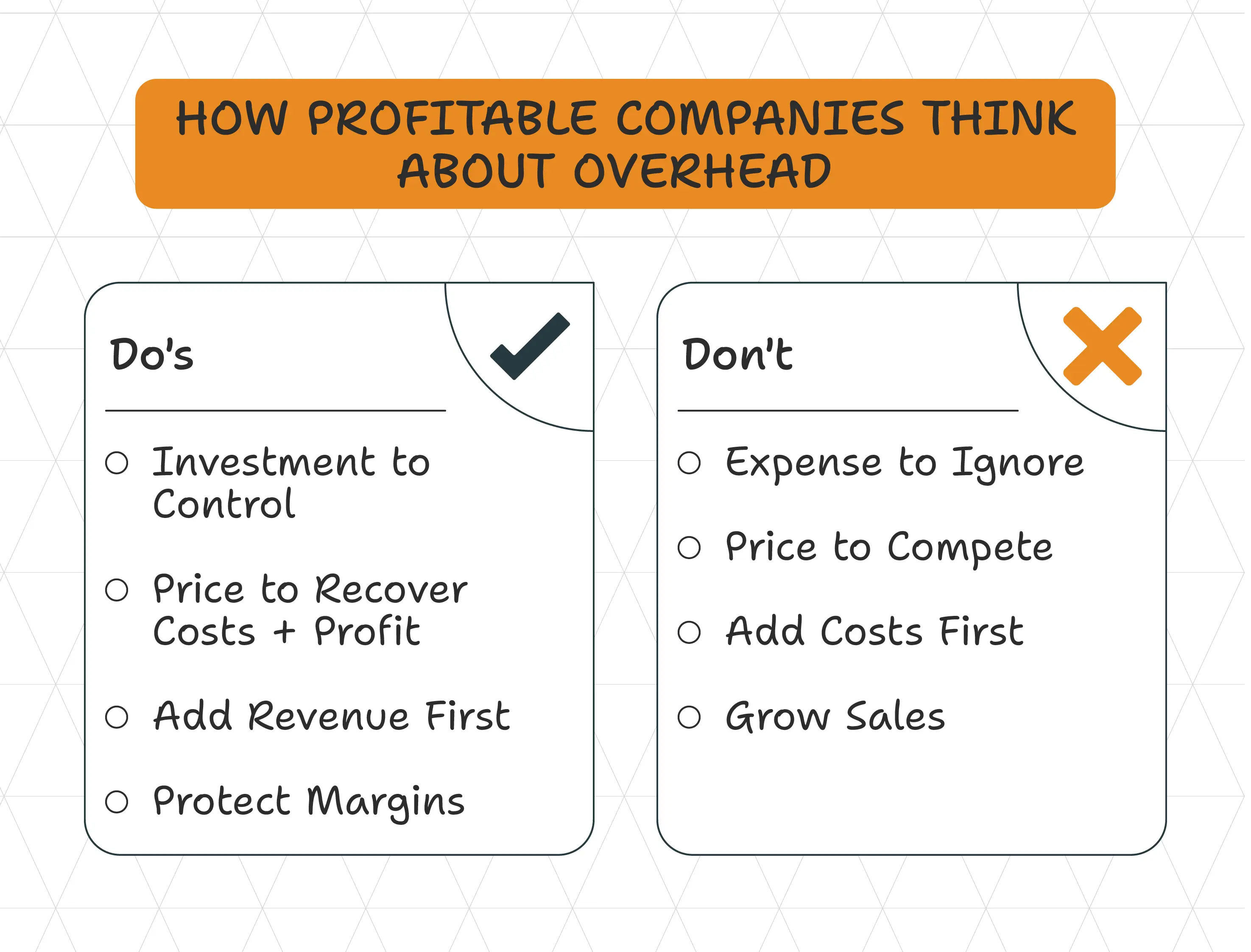
If you offer more than one type of service, understanding overhead cost allocation methods is essential. You need to spread your overhead across each service to understand the true profitability of each one. The overhead cost allocation methods you choose will have a big effect on how you price, manage, and grow each service line.
Why Overhead Cost Allocation Methods Matter
Imagine you offer both HVAC installation and repair services. Your installation services might have high material costs but lower labor costs, while repair services have low material costs but high labor costs. Without dividing overhead properly using the right overhead cost allocation methods, you might think installation is more profitable than it really is and you might price repair work too low because you never figured out its true cost.
Simple Overhead Cost Allocation Methods to Start With
Two of the most practical overhead cost allocation methods for service businesses are:
-
Revenue-Based Allocation: Divide overhead based on the percentage of revenue each service brings in. If installation accounts for 60% of revenue, assign 60% of overhead to it.
-
Labor-Hour Allocation: Divide overhead based on the number of labor hours each service needs. This works especially well when labor is your main cost driver.
Field Promax makes applying these overhead cost allocation methods straightforward by tracking job-level data in real time, so you always know exactly how much each service line truly costs.
Conclusion: Take Control of Your Overhead, Take Control of Your Business
Understanding and managing overhead isn't just about accounting It's the foundation of running a profitable service business. When you understand what is overhead, calculate your overhead rate correctly, and use steady allocation methods, you gain control over pricing, decision-making, and long-term profits.
Overhead in business is the daily financial commitment needed to keep your operations running including rent, insurance, admin salaries, software, and more. These overhead expenses are easy to overlook when you're busy, but ignoring them can slowly destroy your profits. Knowing how to calculate overhead rate is what separates business owners who guess at margins from those who plan them carefully.
Managing overhead is an ongoing job. Regularly review your costs, improve your overhead cost allocation methods, and adjust as your business grows. Tools like Field Promax can help by tracking job-level costs, automating workflows, and making sure overhead is built into every estimate so every job brings in real profit, not just revenue.
Frequently Asked Questions

Content Creator
Bhargavi Halthore is a content writer at Field Promax, a field service management platform serving trades businesses across the USA and Canada. With over a decade of experience writing for business owners, she brings detailed, ground-level insight to every topic she covers. Her research goes beyond search results - she digs into LinkedIn groups, Facebook communities, and Reddit forums to understand what field service business owners are actually dealing with on the ground. She speaks directly with industry professionals, understands their day-to-day challenges, and translates that into content that is practical and actionable. What you read in her articles reflects real industry patterns, not theory.