Review Management for Field Service Businesses: A Methodology-First Guide
.webp)
Your next 10 customers are looking at your Google reviews right now - not your website. Your truck wrap isn’t what they’re judging. It’s your reviews. And what if what they find is just a few four-year-old ratings and two negative reviews that remain unanswered? They’re calling someone else.
2024 Local Consumer Review Survey by BrightLocal found 92% of consumers read reviews of local businesses before their first visit. For a typical 5-20 tech HVAC, plumbing, or electrical shop with stale 4-star ratings, nearly every prospect is silently comparing you to competitors collecting fresh reviews after every job.
In conversations between business owners on Quora, the most frequently reported pain isn’t a single bad review - it’s the gap between website traffic and calls booked. The trust signal that bridges this gap is recent, specific, and responded to reviews. And the key moment to capture those reviews is right after the technician completes the job on-site.
What review management actually is
Review management for field service businesses involves tracking, collecting, and responding to customer reviews across platforms like Google, Facebook, Yelp, Angi, and other channels that actually generate calls for your business.
A functional definition includes three components: consistent review requests after each completed job, public responses to every review, and a private feedback loop that links customer complaints to what your dispatchers, technicians, and CSRs are actually changing in the near future. Most shops are missing at least one of these. Do you recognize any gaps in your process?
Review management vs. reputation management
Reputation management is a broader category that includes PR, social branding, and Google rankings. Online review management is the most leveraged part of it, as it’s based on ratings buyers check within 30 seconds before making a call. This is where most of your effort should go - the slice that directly converts into booked jobs.
The distinction is crucial. A business spending $800/month on a full reputation management service but not responding to Google reviews for two weeks is solving the wrong problem first.
Why online review management matters more than ever
According to Google's local search documentation, prominence - driven by review count, freshness, and ratings - is one of three core local ranking factors. Shops that go from a static profile to a steady weekly review pace surface in the local 3-pack within a quarter. That's not a marketing claim. That's the algorithm.
Referral leads close at around 45% for home service contractors, compared to roughly 18% from paid Google Ads and about 12% from shared marketplace leads. Reviews are the public version of a referral. Unlike ads, they compound over time.
Six criteria that decide your review program's fit
Before you pick a tool, define the criteria you’ll use to evaluate it. Most shop owners skip this step and end up choosing tools without a scorecard - often based on price alone - only to regret the decision six months later.
Trigger latency. The time between closing the job and sending the review request is critical. Ideally, the request should be sent immediately. After 72 hours, you lose most of the momentum.
Channel mix. SMS gets read faster. Email allows for longer, more detailed requests. Most shops use SMS first, with email as a fallback after 48 hours.
Response coverage. Percentage of reviews replied to within 72 hours. ReviewTrackers research found businesses replying to at least 32% of reviews see 80% higher conversion than those replying to only 10%.
Platform coverage. Prioritize Google first, then trade-specific platforms like Angi for residential work, BBB for commercial credibility, and Yelp in metro areas where it actively drives traffic.
Negative-review routing. Do 1- and 2-star reviews trigger an internal alert? If a business owner sees a 1-star review within the hour, they can often recover it to a 4-star with a quick phone call. But what happens if they see it four days later, after others have already read it? It becomes much harder.
Operational feedback loop. Are review themes being communicated to technicians and dispatchers, or are they sitting in an unread dashboard?
Make sure you score your setup across each of these areas. The two lowest scores should guide your next improvements.
How reviews shape trust and local SEO
Google's local 3-pack pulls a click-through rate above 48% on local service searches. Shops close that gap fastest by pairing a complete profile with automated post-job review requests fired from the field service mobile app the minute the tech marks the job done. The sequence matters - request fires from the field, not the dispatcher's queue two days later.
Stats that prove reviews drive conversions
- BrightLocal research suggests that 4.0 stars is the minimum trust threshold for most customers, while 31% only consider businesses rated 4.5 or higher.
- Responding to reviews can significantly increase conversion rates.
- Around 57% of customers visit a business’s website after reading a positive review.
The long-term ROI of review management and reputation building
Harvard Business School research on Yelp found a one-star rating increase was associated with a 5-9% revenue lift, concentrated in independent businesses. That's not a rounding error for a 5-10 tech shop doing $1.2M a year.
.webp)
A pattern across multi-service contractors we've worked with
Across the roughly 30-40 operators we’ve worked with since 2019, the operational factor driving the highest number of 1- and 2-star reviews isn’t poor workmanship - it’s no-access events. This insight comes from an operations lead at a mid-sized commercial service contractor employing around 20 techs across mixed residential and light commercial routes.
Lack of access is most common on commercial routes, including gated complexes, property manager sites, and after-hours retail locations. Dispatch often only becomes aware of the issue when the technician arrives on-site - resulting in a 30-50 minute delay and a wasted trip. The booking script captured the address and time window but failed to include access instructions. Each failed attempt led to an unhappy customer - often leaving a review without ever interacting with the tech.
The intake process was revised to include an access notes field, confirmation of the customer’s mobile number before the call ended, and a 24-hour confirmation message. The initial version wasn’t successful because CSRs often skipped filling out the form for repeat customers. In the second month, the process was made mandatory, and a weekly Monday huddle was introduced to review mistakes.
The number of no-access events fell by roughly half within one quarter. However, the added friction of confirmation messages initially triggered a surge in reschedule requests, and the calendar became more cluttered over a three-week period. Two senior dispatchers, who were used to booking from memory, pushed back on the changes. However, negative reviews related to no-shows dropped significantly.
This is a composite case based on a standard version of this operational pattern.
How to manage online reviews effectively
It’s not just about responding to a few reviews. It’s a system that connects the office, the field, and the dashboard. Most shops that “do reviews” are only completing the first step - collecting feedback - while ignoring the second and third.
1. Build a consistent review request process
Make review collection a part of every job. After completion, send a brief message:
Thanks for choosing us. If you liked the service, please leave a quick review on Google. It really helps local families find us.
Recent reviews matter more for local rankings than older ones. A steady stream of reviews outperforms occasional bursts by a significant margin, and it doesn’t require much - just a simple step added to your job-closing checklist.
2. Automate review requests via SMS and email
Manual requests get skipped on busy days. Every time. When the job closes in the field service mobile app, the request fires within minutes - no dispatcher memory required. Mobile-app adoption by technicians is the single biggest predictor of whether automated requests actually fire consistently. If your techs aren't on the app, you don't have automation. You have a policy that doesn't run.
3. Use templates, then personalize
Templates are a starting point, not a final response. Always include specific customer details such as the service provided and the tech’s name. Keep the information factual and relevant.
Positive: “Thanks for sharing, [Name]. Glad the installation went smoothly.”
Negative: For negative reviews: Acknowledge the issue, apologize, and provide a direct phone number if needed. Never engage in public debate.
4. Handle negative reviews strategically
A properly handled negative review can become more effective marketing than positive reviews. People tend to read reviews more carefully when they include 1- and 2-star ratings, as this is where they look for character and credibility.
We're sorry the appointment didn't go as expected. Our service manager has reached out to make it right. Thank you for the feedback.
5. Track trends and take corrective action
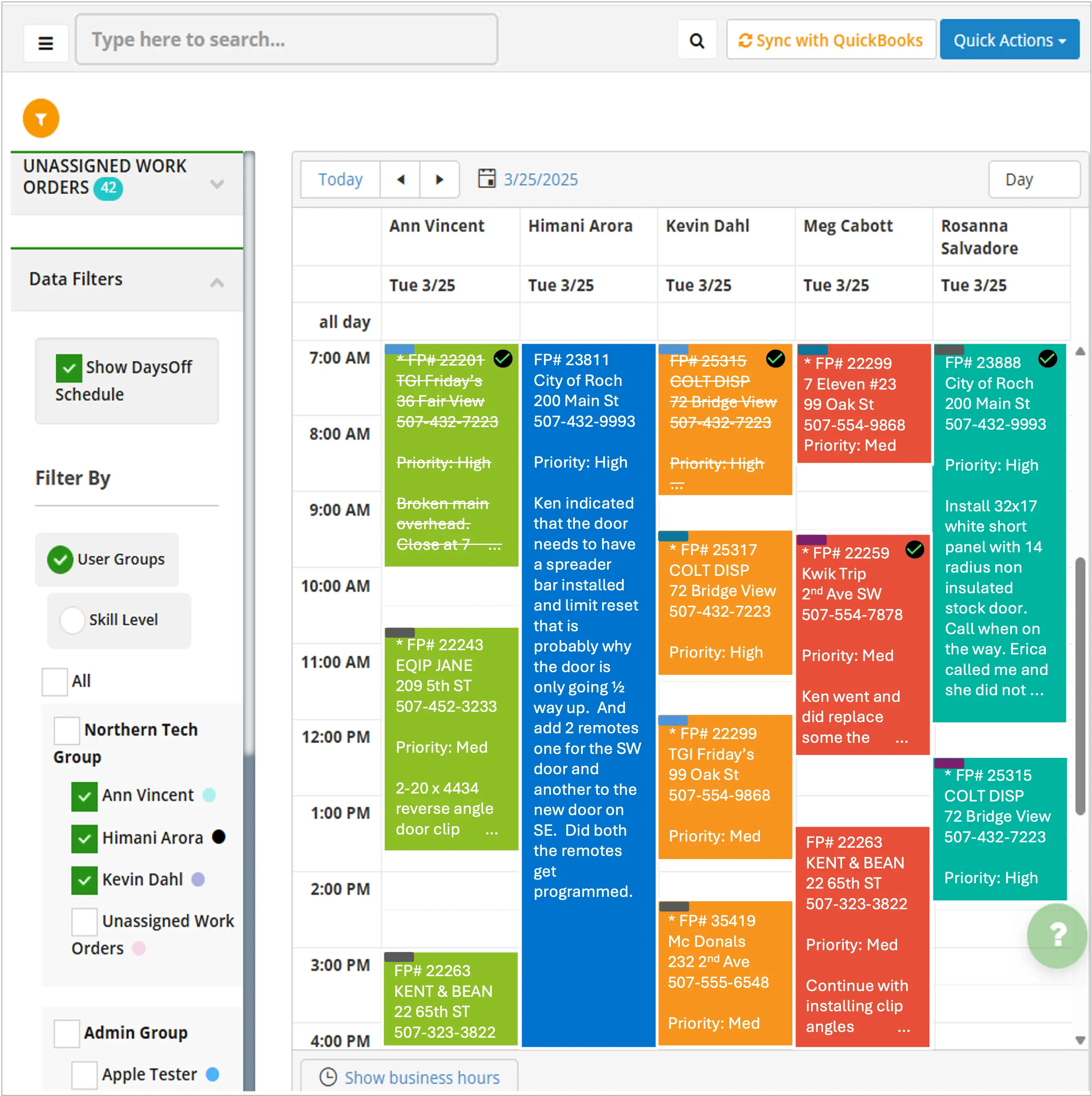
Look for patterns - late arrivals, billing confusion, communication gaps - and feed them back into operations. A reports dashboard makes patterns visible across techs and weeks. One bad review is a bad day. Five reviews in a month mentioning the same tech arriving late is a dispatch problem.
Benefits of a strong review management strategy
A good review strategy can change not only how the profile appears, but also how the entire operation is run.
Builds trust and loyalty
A consistent 4-5 star rating combined with thoughtful responses can reduce the gap between calls and booked jobs. Customers who have already read your reviews come in warmer than cold leads - they’ve already formed trust in your business. Closing becomes quicker, objections are fewer, and referrals increase from there.
Boosts conversions and local visibility
Positive reviews can help businesses appear in the local 3-pack. An HVAC contractor reviewing Field Promax on the QuickBooks App Store described how lead capture forms feed directly to dispatch, allowing technicians to be assigned the same day a homeowner makes an inquiry - resulting in around 30% more jobs without hiring additional office staff. In this case, reviews supported visibility, which helped the workflow gain traction in search results. The system became fully operational.
Improves retention through feedback loops
Every review is a free feedback form. Recognizing patterns in them helps keep customers coming back. Shops that don’t track recurring themes often only discover them months later in churn reports - an expensive way of learning the same lessons.
Strengthens brand credibility
Quick, professional responses signal that someone is paying attention to the situation. This is still surprisingly rare in the trades. When a potential customer sees a negative review addressed calmly, specifically, and with a clear offer to resolve the issue, it often builds more confidence than anonymous five-star reviews.
.webp)
Customer review platforms worth monitoring
You don’t need to be everywhere - you need to be where your customers check before calling. Here’s what that looks like for a 5-20 tech field service shop in the US or Canada.
Google Business Profile reviews
This is the highest-performing platform for local service businesses, full stop. Reviews directly impact Maps and Search rankings through the prominence factor.
- Include real images of your jobs and team - not stock photos.
- Keep business hours, service categories, and service areas up to date and accurate.
- Respond to every review. All of them.
Facebook recommendations
Facebook Recommendations reach homeowners through community groups - the same channel where someone asks, “Who’s a good plumber?” and gets 15 replies. Respond to every recommendation, share positive ones in your feed, and encourage tagged posts from customers who want to help.
Third-party and industry-specific platforms
- Yelp continues to drive traffic in certain metros, particularly for cleaning and pest control services.
- Trustpilot is growing, but it is not yet a primary platform in most markets.
- Angi and HomeAdvisor influence residential bookings through lead routing for HVAC, plumbing, and electrical services.
- BBB carries credibility with homeowners and commercial property buyers who still actively check it.
- Use G2 only if you are selling B2B.
Focus on two or three key customer channels. Don’t spread your message across platforms your customers don’t actually use.
How multi-platform monitoring boosts credibility
Strong ratings on Google, Facebook, and Angi together are harder to fake than a single-platform profile - and buyers sense that. A single reports dashboard consolidates the view so you're not bouncing between four browser tabs on a Tuesday morning.
Building a customer feedback strategy that works
You need structure, not a marketing team. The right customer feedback management system is something a single owner or office manager can run in 20-30 minutes a week.
When and how to ask for reviews
You should request a review within the first two hours after a service is successfully completed - that’s the optimal window.
- Ask in person at the door, then follow up with a text message within 24 hours.
- Keep the message brief. Customers don’t read long explanations.
- Include a direct review link and a QR code. Every extra click reduces conversion.
“Hi [Name], thanks for choosing us. Could you share your experience on Google?” Followed by the link. Done.
Balancing quantity and quality
Do not chase only 5-star ratings. Customers become wary of profiles that show nothing but perfect reviews with no specifics. A wall of flawless reviews can actually raise suspicion, as most buyers have seen enough fake reviews to recognize the pattern. Specific, occasionally imperfect feedback at high volume is more trustworthy than curated perfection.
Incentivizing reviews ethically and legally
Incentives are allowed under the FTC's final rule on fake reviews, but can't be conditional on a positive review. A monthly drawing open to all reviewers is fine. A discount for 5-star reviews is not - that's review gating, and it's now explicitly grounds for civil penalties. Always disclose any incentive in the request itself.
Setting team KPIs for review management
- Review count per technician per month
- Average response time to reviews
- Percentage of reviews rated 4 stars or higher
- Resolution time for negative reviews
Tie one or two of these metrics to a small monthly bonus. The bonus should not be tied to review outcomes or customer requests - it should reward operational consistency. This is compliant with policy and keeps technicians engaged without influencing ratings.
How Field Promax simplifies Google review management
Automating routing, review requests, and the dashboard keeps the workflow consistent every month. Without this layer of automation, asking for reviews becomes a task that everyone is willing to do - but no one does consistently.
Automated Google review requests
When a job is closed, Field Promax sends a request via SMS or email through the notifications engine. A plumbing business reviewing Field Promax on the QuickBooks App Store described automated SMS follow-ups generating replies within minutes to schedule the next job. The same SMS doubles as the review-ask while the job is still fresh - two outcomes from one trigger.
Customizable triggers and smart filters
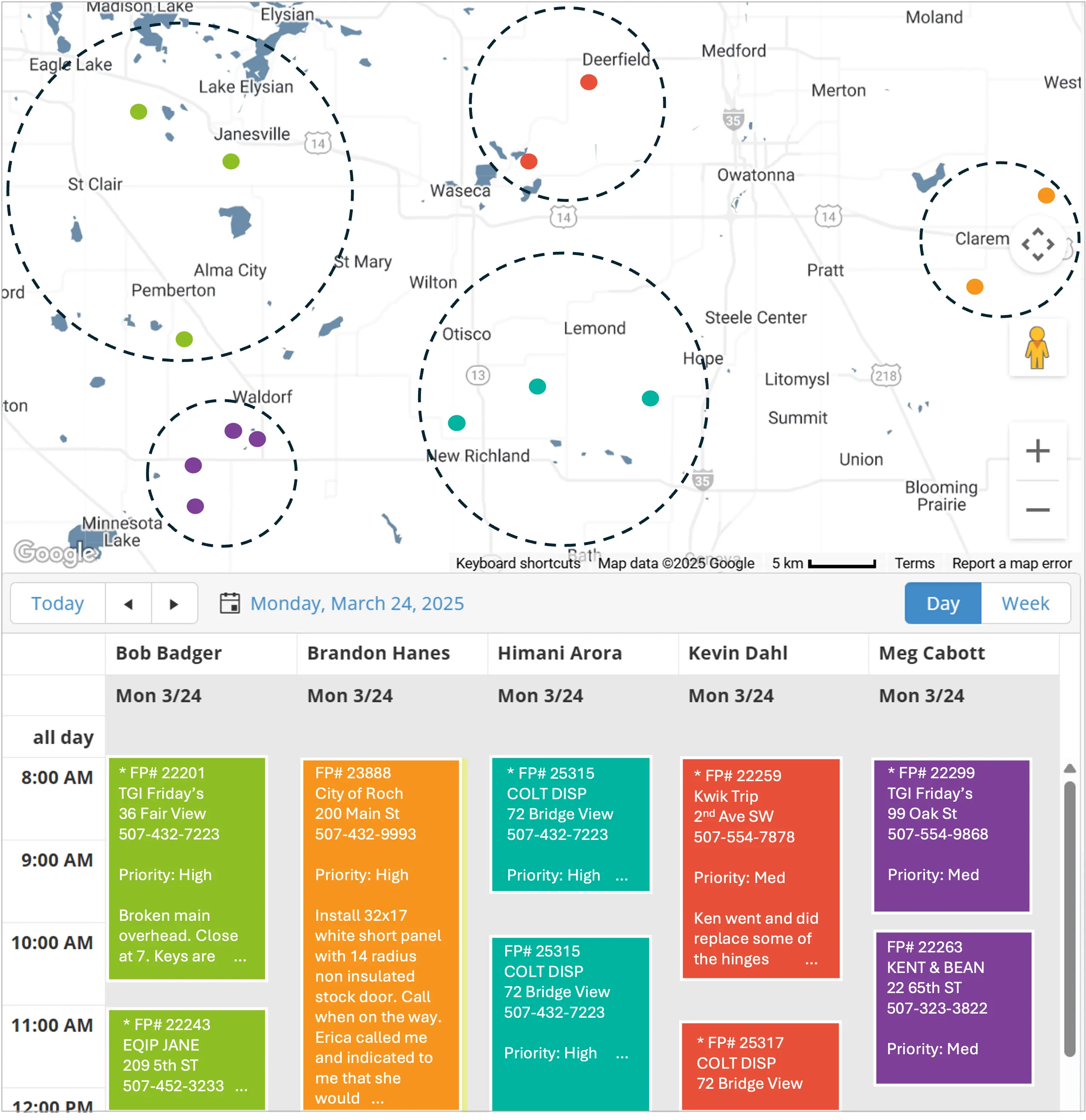
Triggers can be set based on job status or type of service. Smart filters prevent review requests from being sent when an issue has not been fully resolved. This gives the customer a chance to contact the business and resolve the problem before a request is sent.
Avoiding negative reviews with smart screening
Internal alerts flag at-risk jobs: a customer who called twice during service period, a site that is difficult to navigate, and a bounced invoice. The business owner is aware of the problem but a call to the company can help to resolve the issue. This is the proactive aspect of online review management - not only responding to any harm, but finding the issue before it is posted.
Centralized dashboard for tracking feedback
Each review appears in one dashboard with sentiment trends, response-time tracking, and per-tech breakdowns. A minimum of 15 minutes a week, instead of 4 browser tabs. Field Promax plans start at $99/month for single-user operations (Light plan), with the Standard plan at $159/month for up to 5 users covering the customer CRM and communication tools that support a complete review workflow.
A founder's note on what actually moves the needle
The conventional wisdom is to collect more reviews. From 14 years of customer conversations, that's the wrong target. Volume alone doesn't move the local 3-pack and doesn't close more calls. What moves both is recency and response cadence: a steady weekly drip of recent reviews, and a public reply within 72 hours on as many as you can. Owners who chased a one-time push to 200 reviews and then went quiet for six months saw their ranking erode anyway, because the algorithm reads freshness, not just totals.
The second piece nobody talks about is who pushes the button. Office-driven requests sent two days after the visit underperform field-driven requests sent the minute the technician closes the job. The trigger has to live in the mobile app on the truck, not the dispatcher's queue. If your techs aren't on the mobile app, your review automation is theoretical. Fix the adoption problem before the marketing problem.
- Joy, Founder, Field Promax
Measuring success in review management
Every review strategy requires an underlying set of metrics that the reviewer actually examines. It's not a 14-tab spreadsheet. Four or five numbers are reviewed every week.
Key metrics to track
- Review volume: new reviews per platform per month.
- Average rating: target 4.5 or more.
- Sentiment themes: common keywords that are tagged in review texts - look for the common friction before it gets worse.
- Response time: a few hours from post to response.
- Platform coverage: what percentage of platforms have been reviewed in the last 30 days.
Using review data for improvement
Multiple reviews mentioning scheduling issues indicate a route or CSR script issue - not a marketing issue. Positive reviews that mention an individual technician should be included in your hiring documents and training contents. The data is in place. The majority of shops don't see it in that way.
Benchmarking against competitors
Compare your ratings and response time against the three other competitors in the same 3-pack in your area. If their average response time is 6 hours and yours is 6 days, that's your most likely outcome - and it costs nothing.
Benchmarks and market context
KPI benchmarks for field service review programs
| Metric | Minimum Benchmark | Strong Performance | Notes |
| Google star rating | 4.0 | 4.5+ | BrightLocal 2026: consumers increasingly filter to 4.5+ only |
| Total Google review count | 20 (trust threshold) | 100+ | SocialPilot: 33% won't trust businesses with fewer than 20 |
| New reviews per month (active business) | 5 | 15-25 | Recency matters - old reviews alone don't rank |
| Response rate (all reviews) | 80% | 100% | 88% of consumers prefer businesses that respond to all |
| Response time to negatives | 48 hours | 24 hours | Faster responses signal active management to Google |
| Review request conversion rate (SMS) | 8-12% | 20-25% | Personalized requests with direct links convert higher |
| In-person ask conversion rate | 20-30% | 35-45% | Verbal commitment before sending link boosts follow-through |
Year-by-year growth: the online review management software market
| Year | ORM Software Market Size (USD) | Key Driver |
| 2020 | ~$3.8 billion | COVID-19 accelerates digital trust dependency |
| 2021 | ~$4.5 billion | Post-COVID service business recovery drives adoption |
| 2022 | ~$5.0 billion | Local SEO competition intensifies across trades |
| 2023 | ~$5.6 billion | AI-generated fake reviews trigger regulatory scrutiny |
| 2024 | $5.2 billion (software) / $6.5 billion (services) | FTC Consumer Review Rule enacted (Oct 2024) |
| 2025 | $6.47 billion (software) | FTC enforcement begins; AI monitoring tools mainstream |
| 2026 (proj.) | $7.75 billion | SME subscription tools close the capability gap |
| 2031 (proj.) | $14.01 billion | CAGR 12.59% through 2031 (Mordor Intelligence) |
The ORM market's expansion isn't just an enterprise story. Subscription tools designed specifically for small businesses are now available at any price - which means your competitors are starting to take this issue seriously, regardless of whether you're or not.
Common mistakes in online review management
Even the most disciplined shops fall into these patterns. Most of them remain unnoticed until their review count slows or a complaint goes unanswered for several weeks and prospects start calling someone else.
Ignoring negative reviews
Silence is interpreted as guilt each time. Respond within 72 hours with a clear and concise message. The rate of low-rated reviews can often be improved through genuine, personal engagement. Not a copied template response, but an actual reply from a real person.
Over-automating responses
Similar responses across 50 reviews are read as automated. Customers notice this as well. Make use of the template as frames, then you can add the specific details of the customer prior to sending it. The process takes about 20 seconds, and the change in perception is substantial.
Not updating your review strategy
Google, Yelp, and Angi change their review policy often. The FTC has tightened their rules since October 2024. Review your workflow every quarter - What was the common complaint in the past might not be one in today.
Relying on one platform
A five-star Google profile but no activity elsewhere is a one-dimensional impression. This leaves you open when your Google profile gets removed or suspended. Select at least two or three platforms that are current.
Choosing the right review management software
Decision criteria for a 5-20 tech field service shop:
- Automation: does it fire when the tech closes the job, or via batch at the end of the week?
- Integrations: does it sync with Google Business Profile and your FSM/CRM?
- Reporting: can you observe sentiment, response time, and per-tech trends all in a single view?
- Trade fit: designed for field service, or generic SaaS connected to a plumber's workflow?
Tool evaluation criteria
A standalone online review management software tool that is not linked to your job-close event in a lower rate of fire than an integrated version. Every shop we've visited buy a standalone tool searched for an integrated solution within the first 18 months. The standalone is activated when a user remembers to sign in. The integrated version fires each time a job closes.
Field Promax does not win in every aspect. The depth of reporting fits a 5-20 tech shop but is less than requirements of a 50-tech franchise. The interface is more functional than refined. The UI is designed specifically for small and medium-sized trade shops - the ones ignored or overcharged by enterprise-level FSM platforms - not multi-location operations that require a 40-seat ops console.
Why ease of use and Google integration matter most
If the workflow requires greater than three clicks on the truck, adoption decreases and the automation that doesn't work will result in no reviews. It's not something that field crews want to have. It's the requirement.
Compliance and ethical review practices
The rules were tightened by the end of 2024. Here's what matters operationally.
FTC guidelines and platform rules
The FTC's final rule on fake reviews took effect on October 21, 2024, and authorizes civil penalties of up to $51,744 per violation. It covers fake or bought reviews, undisclosed insider testimonials, and review-suppression tactics.
- Do not ask for only satisfied customers - Selective solicitation can be a reason for taking action.
- Never make rewards conditional on a positive rating.
- Always make it clear if the reviewer is an employee or relative.
How to avoid fake or paid reviews
Ask only verified customers who paid. Automation should fire from a closed job in scheduling and dispatch, not a marketing list you pulled from somewhere else. The trigger source matters - both for compliance and for conversion quality.
Keeping review requests transparent
If you provide an incentive, make it clear in the original request. Do not hide it within the request itself. “We enter all reviewers into a monthly $50 gift card drawing” is acceptable. Failing to mention it and hoping no one notices is not.
The future of online review management
Review management is moving from collection to interpretation. Volume was the game in 2020. In 2026, the advantage is given to stores that know what reviews are saying and act quickly on it.
AI-driven sentiment analysis
AI now tags review content to detect tone and themes that recur. The increase in "billing" across a month of 3-star reviews is what a dashboard detects - and an inbox misses completely. The kind of signal used to require a dedicated ops manager who was specifically assigned to identify. Now it's a weekly automated report.
Predictive alerts and AI-summarized reviews
Predictive alerts highlight jobs that are at risk before the negative review is posted. If the previous customer's service was delayed, dispatch is warned at the time of the next visit, before the tech calls the doorbell.
LLMs often provide reviews in a way that summarizes rather than lists them, and so the same themes are now shaping AI-generated responses to your company's needs. ChatGPT suggests a local HVAC company is drawn from public review data. Be sure to keep your reviews specific, recent, and respond to - this is the GEO game in a business reputation management service strategy that is more than Google rankings on their own.
Final thoughts: make review management effortless
Reputation is the working version of the next job lead. A working system collects automatically each time a job is closed, responds in a single dashboard, and stays within the FTC lines without the need for a daily checklist.
Set up your Google review management workflow into your job-closing event, set the response cadence, audit it quarterly. Compounding takes about a quarter of time to show up in booked calls, it won't stop.
%20(1).webp)
Conclusion
Reputation is the working version of the next job lead. The workflow should be connected to the job closing, set the time frame for responding and review it every quarter. The shops that have won maps in your local area do not have anything that you cannot do. They simply started earlier and kept growing.
Frequently Asked Questions

Content Creator
Bhargavi Halthore is a content writer at Field Promax, a field service management platform serving trades businesses across the USA and Canada. With over a decade of experience writing for business owners, she brings detailed, ground-level insight to every topic she covers. Her research goes beyond search results - she digs into LinkedIn groups, Facebook communities, and Reddit forums to understand what field service business owners are actually dealing with on the ground. She speaks directly with industry professionals, understands their day-to-day challenges, and translates that into content that is practical and actionable. What you read in her articles reflects real industry patterns, not theory.
Reviewed by

Founder and CEO
Joy Gomez is an engineer, process automation expert, and the Founder of Field Promax. Known for his technical expertise and commitment to field service innovation, Joy writes about transforming traditional business models into paperless, efficient operations. He is a Lean Six Sigma Black Belt based in Rochester, MN, dedicated to helping field professionals work smarter through better technology.