How to Improve Field Service Customer Experience with the Right FSM Tools
.webp)
Why does customer experience really break in field service?
The most frequent complaint in conversations with shop owners isn't about pricing or technical skill. It's communication. A customer schedules an appointment, but the tech is running late on the previous job and no one calls to provide an update. By the time the truck arrives 90 minutes late, the customer has already written a one-star review in their mind. Do you recognize the pattern? This is the field service customer experience gap, and the vast majority of it has nothing to do with the quality of the work itself.
Owners on Quora and Reddit describe the same pain from the office side: dispatch burns the morning fielding "where's my tech?" and "can I reschedule?" calls. The cost isn't just time. It's that those calls signal customers who feel uninformed between visits - and uninformed customers churn. Aberdeen's field-service complaint research found 41% of customers cite "technician did not arrive on time" as a primary reason for service dissatisfaction.
We've observed that in shops without a customer portal, inbound status calls can consume much of a dispatcher's morning. When customers can self-serve scheduling and check the status of their jobs online, call volume is reduced significantly, freeing up roughly half a day of dispatch capacity each week. The shops that turn this around don't necessarily have the most advanced CX technology. They're the ones that address operational gaps in the right order.
Our STANCE: Most small trade businesses think they lose customers to price. They don't. They lose them to the all-day arrival window and the invoice that doesn't match the quote. Both of those are software problems - and they're easier to fix than you think.

Ready to get started with Field Promax?
Sign Up FreeWhat does a 'good' field service experience actually look like in 2026?
The working definition is narrow. Customers want to know when you're coming, see the tech is on the way, get a clean invoice, and have someone they can text if something goes wrong. That's it. Trimble research cited in Glympse's field service work found 51% of customers say their biggest frustration is technicians failing to show up on schedule - and 89% say they'd pay more for services that actually respect their time. Every Field Promax shop running ETA notifications reports it's the touchpoint that moves CSAT first.
McKinsey's work on digital field operations describes a 20 to 40% improvement in customer satisfaction for shops that move to tech-enabled field forces. In our customer base, the shops that actually move CSAT fix four things in this order: a unified customer record, automated reminders, a self-serve portal, and a real feedback loop. AI and predictive maintenance come later.
A pattern we've seen across operators we've worked with
The no-access failure mode shows up most often on commercial-adjacent routes: gated complexes, property-manager-coordinated sites, and after-hours retail locations. Imagine an operations manager at a mid-sized commercial services contractor with around 20 techs handling a mix of residential and light commercial routes. Dispatchers often don't discover the problem until a tech arrives on-site and calls in from the curb. At that point, the team can lose 30 to 50 minutes resolving the issue, not including the return drive.
During the second half of the summer, the company experienced a steady stream of inaccessible job sites. The booking script captured the address and an available technician time slot, but not the specific instructions needed to access the facility. On paper, the schedule looked efficient. In reality, nearly a quarter of the day's productive time was being lost to access-related failures. It was like arriving at a job site only to discover that the key needed to enter was locked in an office drawer somewhere else.
They changed the intake form to require access notes and a verified mobile number before any call could be closed. They also started sending a 24-hour confirmation message. The first version was not successful because CSRs continued to skip the access field for repeat customers. In the second month, they made it a mandatory field and introduced a Monday huddle to review the previous week's mistakes.
Based on our experience with similar providers, the number of access-related failures drops significantly within a quarter after a hard-required access field is put in place. An unexpected challenge is that confirmation messages often trigger a wave of reschedule requests. As a result, the calendar can become chaotic for two to three weeks before the process stabilizes. This is a composite example based on a common pattern we've observed across multiple organizations.
How do you actually get customers to self-serve?

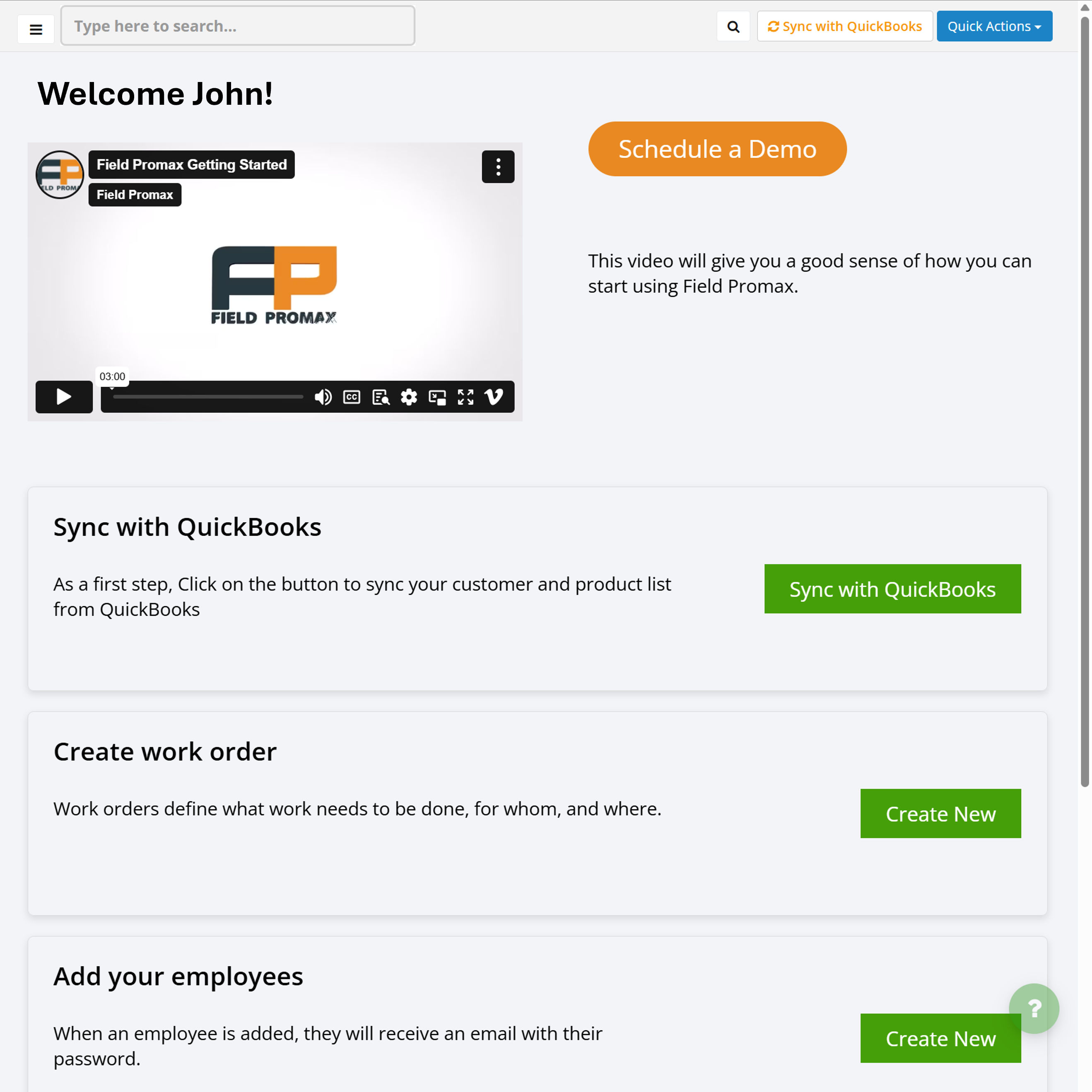
The notion that customers need to contact your office for updates is incorrect. What they really want are answers. Across several Quora discussions about inconsistent customer communications across channels, a common theme emerges: service providers often juggle texts, emails, and phone calls without maintaining a single communication thread for each customer. As a result, the next employee who accesses the account may not know what has already been discussed. The problem isn't necessarily the technology itself. It's connecting your scheduling software to a customer-facing interface that works reliably the first time a customer uses it.
An HVAC contractor who reviewed the QuickBooks App Store praised the ability to manage multiple customers and services in one location. However, the portal experience is only as good as the customer record behind it. If the office maintains three different records for "Mrs. Garcia at 412 Elm," the self-service experience can fail the first time the customer logs in and sees an incorrect service history.
The practical version of self-service for a 5-20 tech shop is straightforward: a booking link on your website, a confirmation text after booking, a status link the day of service, and an invoice the customer can pay from their phone. Each one removes a call from dispatch's queue. Field Promax customers deploy this through the customer portal wired to automated notifications at each step of the work order lifecycle.
Why do techs arrive at repeat jobs as strangers?

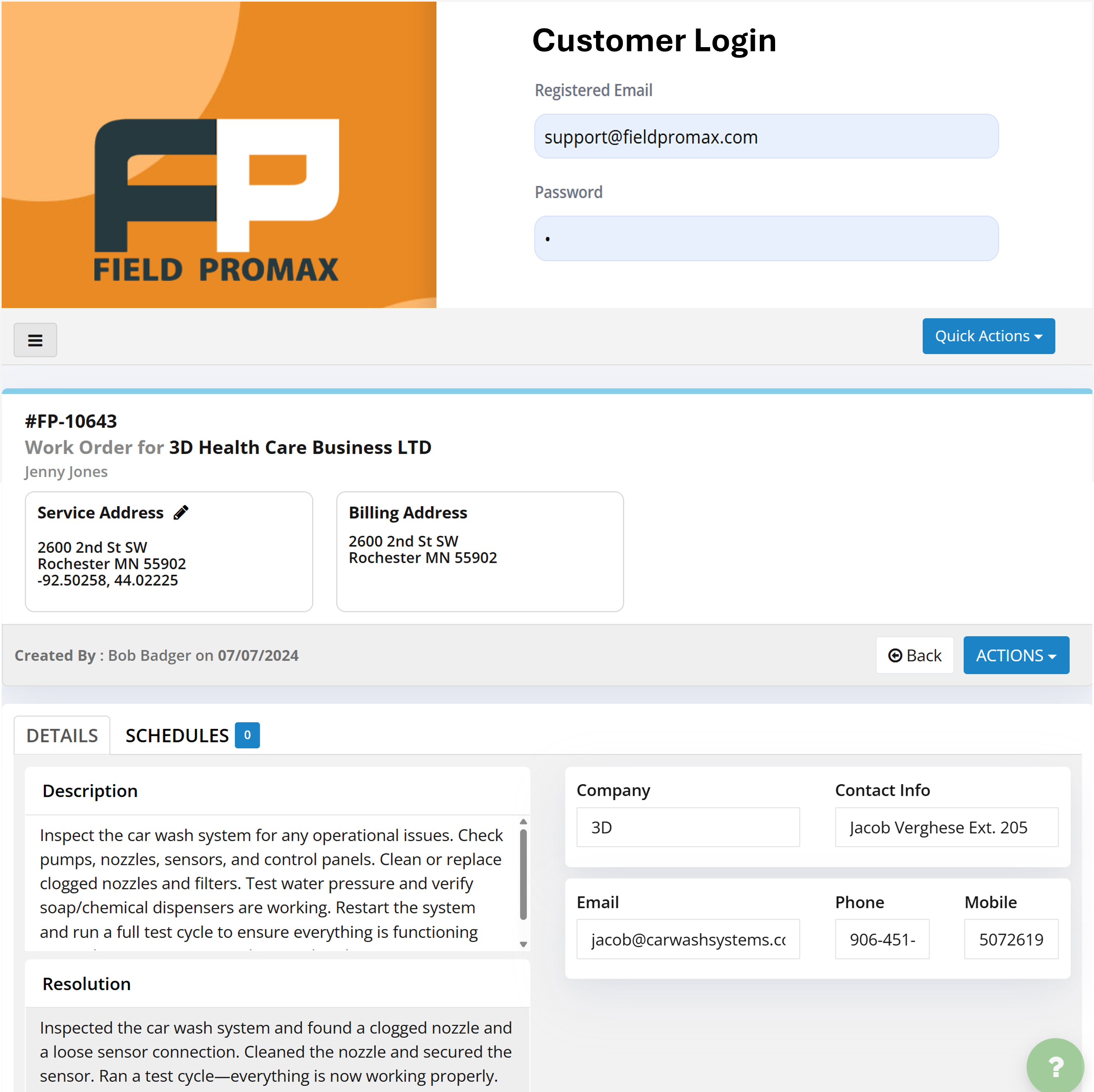
Owners on Quora often discuss the challenges of using a CRM that stores only names and phone numbers, with no job history, communication records, or other customer information. Without that complete picture, tools designed to streamline repeat service lose much of their value. Every visit feels like a fresh start, and every customer ends up explaining information that the business should already know.
Based on our experience, in a multi-tech business without an integrated customer profile, technicians spend significant time reviewing invoices, notes, and text messages to understand the history of a site. Shops that consolidate all of that information into a single CRM view recover a meaningful portion of that time on every customer interaction. Multiply those savings across multiple technicians and repeat customers, and the result can be several hours regained each week.
Every contact, invoice, photo, and prior tech's note needs to live against the customer record - not in someone's inbox, not in a spreadsheet that only one person knows how to read. Field Promax handles this through customer management and QuickBooks integration so your AR system and your field system aren't fighting over which Mrs. Garcia is real. Owners rank this as the single biggest CX upgrade per dollar - because it shows up in every single customer touch, not just the ones you planned for.
Our STANCE: The businesses that consistently rack up five-star reviews aren't necessarily doing better technical work. They're doing better documentation, better communication, and better follow-up. CX is mostly process - and process is exactly what software is built to fix.
What changes when customers can see where their tech is?
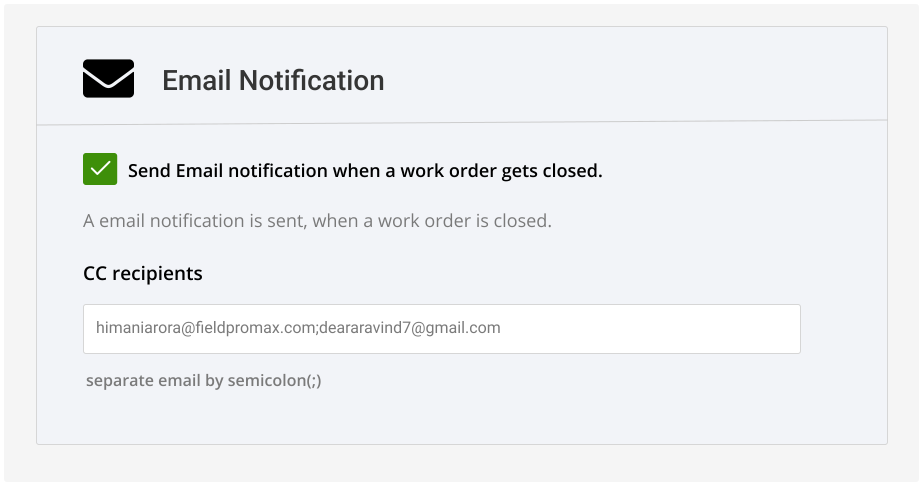
Reminders and ETAs don't constitute a high-end layer of customer experience technology. They're among the most efficient CX tools a 5-20 tech shop can implement. Full stop.
Across our customer base, the trend is consistent: businesses that use automated email and SMS reminders often see a noticeable decrease in missed appointments within the first month. For many contractors, that can mean the difference between losing appointments regularly and keeping the schedule on track. A contractor on the Reddit community r/HVACadvice described one of the biggest improvements in their business after switching to software that automatically notified customers when a technician was leaving the previous job. As they put it, "We stopped getting 'Is your tech coming?' calls almost entirely." This isn't a CX theory - it's a practical workflow improvement that can often be implemented in about an hour.
The mobile app side matters just as much as the customer side. In our experience, mobile-app adoption among technicians is the single biggest predictor of whether a CX technology rollout actually sticks. If your techs aren't updating job status on the field service mobile app, the customer notifications go out wrong, the ETAs slip, and the portal shows stale data. The whole stack reads as broken from the customer's side - even when every individual feature works perfectly.
Here's what the complete automated notification sequence looks like in real life:
Source: Field Promax workflow analysis, 2025
| Trigger Event | Customer Gets | Customer Feels | Calls to Dispatch Eliminated |
| Job created / booked | Confirmation text with date, window, and job summary | Confirmed, not forgotten | "Did you get my request?" calls |
| 24 hours before job | Reminder text with rescheduling option | Prepared, respected | No-access events and last-minute cancels |
| Tech dispatched / en route | ETA text with live tech location link | Informed, in control | "Where is my tech?" calls |
| Job marked complete | Completion message + invoice link for card payment | Closed out cleanly | Invoice chasing calls |
| 2 days post-job | Automated review request | Remembered, valued | You stop relying on memory to ask for reviews |
How do you turn one job into the next one?

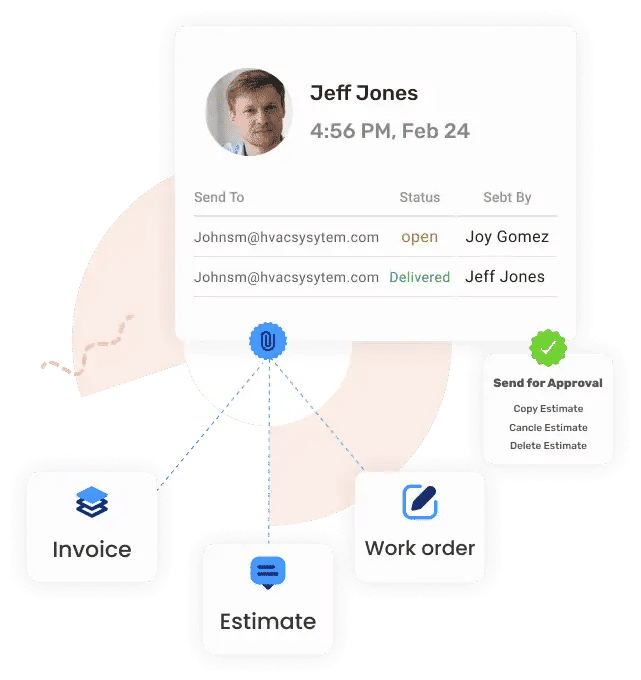
Customer retention and feedback collection share similar workflows, yet most businesses haven't connected them effectively. Our research shows that small plumbing and HVAC businesses that run CRM follow-up workflows - birthday greetings, post-job check-ins, maintenance reminders - increase their repeat-customer share faster than those still relying on memory or spreadsheets. They succeed not because they're more efficient, but because they're present before the customer needs to search for a service provider.
The collection process itself isn't complicated: an SMS sent within minutes of job completion and triggered by the work-order-closed event, not the invoice event. The same survey sent the following morning drops response rates by more than half. Timing is crucial. An enterprise reviewer on the QuickBooks App Store noted deploying Field Promax across four of their organizations, citing its customization capabilities as something other software products couldn't match.
For recurring service, it is easier to go with automation. A pest control account that is accessed every quarter, an HVAC maintenance plan, and lawn care contracts are all good options. They should create their own next work orders on a schedule, and with a notification to the customer. Revenue you used to chase becomes revenue that schedules itself, and customers see an organization that remembers them without having to ask. This is the loyalty flywheel in action. It doesn't require a marketing budget. It requires a system that won't let you down.
Where most shops should actually start
I've spent 14 years talking with shop owners about which CX upgrade actually pays back, and the answer surprises people. It isn't AI. It isn't a chatbot. The most common feature request we hear is better dispatch-to-invoice automation - because that's where customer-experience friction actually lives for small operators. Customers don't care whether you have predictive maintenance. They care that you arrived at the window, fixed the thing, sent a clean invoice they could pay from their phone, and didn't make them call the office four times. Across Quora discussions about "Low user adoption stalls CRM rollouts" - roughly five posts deep - owners describe buying CRM software only to watch teams quietly revert to spreadsheets. The tool gets blamed, but nobody updates the record. Most of our customers migrate from spreadsheets, paper, or QuickBooks-only setups, and the biggest CX lift is a unified customer record plus automated reminders, in that order.
- Joy, Founder, Field Promax
Most field-service-CX content tells you to start with AI and predictive maintenance because those are the high-margin categories enterprise FSM vendors push. For a 5-20 tech shop, that order is backwards. Start with the customer record. Layer reminders and a self-serve portal on top. Build the feedback loop. Let recurring orders compound the retention math. Use reports and dashboards to see which step is actually paying back before you spend on the next one.
Also read: 5 Simple Steps to Improve Customer Experience with Efficient Field Service Management.
The CX metrics that actually tell you if it's working
It is impossible to improve what you don't monitor. Most field service companies measure customer satisfaction based on review volume, which is a lagging indicator that shows what has already gone wrong. The best FSM platforms reveal operational metrics that indicate customer satisfaction before it is reflected in ratings and reviews.
Source: Industry benchmarks compiled from Global Growth Insights and FIELDBOSS research, 2025
Global Growth Insights data shows that 69% of companies report better first-time fix rates when they implement FSM software. Forrester's 2024 research found that customer-focused businesses achieve 49% faster profit growth and 51% more customer retention rates than peers. In terms of field service, this gap can be described as the distinction between a company that is constantly seeking new leads, and one that relies mostly on referrals and regular contracts.
| KPI | What It Tells You | Industry Benchmark | Red Flag |
| First-Time Fix Rate (FTFR) | Jobs closed without a callback or return visit | 75-85% residential; 85%+ commercial PM | Below 65% |
| CSAT Score | How satisfied customers are after each job | 70-90% | Below 70% |
| On-Time Arrival % | Whether your ETA promises are actually kept | 90%+ | Below 80% |
| Callback Rate (30-day) | Jobs that needed a return visit within a month | Under 10% | Above 15% |
| Invoice-Estimate Match Rate | Whether final invoices match approved quotes | 95%+ | Below 85% |
| Response Time (Urgent) | Time from service request to confirmed appointment | Within 24 hours | Over 48 hours |
More from the Customer CRM cluster
Continue with:
- Customer CRM for Service Businesses: The Operator's Playbook - the pillar on what a unified customer record actually holds.
- Field Service Customer Experience: An Operator's Playbook for 2026 - the touchpoint rules and dispatch patterns this tooling supports.
- Customer Retention Strategies for Field Service Businesses - the CLV math, follow-up cadence, and upsell triggers that compound from a clean customer record.
Conclusion
Start with the customer's record. Add reminders and portals on top. Create a feedback loop. Repeat orders will improve the retention math. The CX stack operates in this order, not the way many trend articles suggest.
Every missed ETA, every "I didn't agree to this" billing call, and every tech who arrives cold at a repeat job are process issues. And process issues have process solutions. The companies delivering the field service customer experience today aren't the ones with the most technologically advanced stacks. They're the ones that have mastered the basics and automated them. That's what FSM software is designed to do.
Frequently Asked Questions

Content Creator
Bhargavi Halthore is a content writer at Field Promax, a field service management platform serving trades businesses across the USA and Canada. With over a decade of experience writing for business owners, she brings detailed, ground-level insight to every topic she covers. Her research goes beyond search results - she digs into LinkedIn groups, Facebook communities, and Reddit forums to understand what field service business owners are actually dealing with on the ground. She speaks directly with industry professionals, understands their day-to-day challenges, and translates that into content that is practical and actionable. What you read in her articles reflects real industry patterns, not theory.