Responding to Bad Reviews: A Field-Service Playbook for HVAC, Plumbing, and Trade Shops

The 48-Hour Rule for Reviews
When a review is a single star, it is usually the result of an operational failure that happened days earlier. The tech may have been late, and no one followed up. The invoice may have been 30% higher than the written estimate. The repair may have been delayed for four days without communication.
1. Why most review-response advice misses the actual problem
The usual playbook says your response can shape opinions more than the review itself. That's partly true, but it misses the upstream cause.
From 15 years of customer conversations, the bad reviews that drag a small shop's rating down cluster around three operational failures, not tone failures:
- An unintentional delay in arrival
- The first price the customer saw on the invoice
- A service call that ended without a follow-up
Potential clients who read an offensive or generic response to any of these three complaints are likely to move on to the next listing. The reply is the visible edge of an upstream problem.
Who actually reads your reply?
The audience isn't the unhappy customer. Every prospective client is comparing your business with two other competitors in the local 3-pack.
BrightLocal's 2024 Local Consumer Review Survey found:
- 88% of customers prefer a business that responds to reviews
- Only 47% would choose a business that does not respond at all
Shops that treat each reply as a sales document for the next customer - not just a resolution for an unhappy one - are able to maintain conversion rates even after receiving a one-star review.
Instead of: "We apologize for the inconvenience."
Write: "We're sorry the tune-up Tuesday ran 90 minutes late, Alex. We've changed our SMS cadence so future customers get a 30-minute heads-up." The detail is the trust signal.
2. Do review responses move your local rank?
Google's local ranking documentation names review count and average score as signals. Responding isn't a direct ranking factor. But the indirect case is strong:
- The local 3-pack pulls above 48% CTR on local service searches
- Nearly half of intent-driven traffic chooses between three profiles. Review score, review count, and recency are among the strongest indicators of trust.
- Shops that pair a complete Google Business Profile with automated post-job review requests close the visibility gap fastest
What can you learn from each bad review?
Treat every negative review as free operational research. Michael Luca's 2011 HBS study of Yelp data found:
- A one-star increase in rating can result in a 5-9% increase in revenue for independent businesses.
- Chain companies barely notice the effect because they already have an established brand that absorbs it.
- Small-scale shops, however, feel the full impact of every lost star in revenue.
Each review should be shared with both the dispatcher and the technician who closed the job - not as blame, but as data.
3. The seven rules of a reply that actually works
ReviewTrackers' data found:
- 53% of clients expect a response within a week.
- 33% expect a response within three days.
The speed problem is rarely urgency. It's lack of details. Owners hear about a bad review Wednesday, but the tech worked Monday - and the office can't pull the arrival timestamp without a phone tree. Mobile-app adoption in the field service mobile app is the biggest predictor of whether the owner has those details 30 minutes after the review posts.
Rule 1: Speed matters - but details unlock it
- Respond within 24-48 hours
- Pull job details, work orders, arrival time, parts list, and photos - from the mobile app before drafting your response.
- A lack of data leads to generic responses, which means every future prospect who reads your reply gets no real context.
Rule 2: How do you stay calm when the review feels unfair?
- Acknowledge the frustration you feel, and avoid reactive filler words like 'actually.
- Write the response, save it as a draft, review it the next morning, and then post the reply.
- Example: “We’re sorry your service didn’t meet expectations. We’re reviewing your note to understand how the call was scheduled and closed.”
Rule 3: Why does personalization beat templates?
- Include the customer’s name, the specific job or transaction, and the problem.
- For example, “Hi Alex, the AC short-cycling after our tune-up on Tuesday isn’t acceptable” is more powerful than “We apologize for the inconvenience.”
- Shops whose techs use the mobile app at the job have the name, equipment, and date in the work order. Paper-and-spreadsheet shops default to generic because they don't have anything specific to anchor to.
Rule 4: When should you take responsibility?
- If something went wrong on your side, tell the truth.
- If something went wrong on the customer’s side, explain it clearly and take the next step in a private manner.
- Example: “Our technician logged arrival at 2:47 PM on Tuesday, and the homeowner was not on site until 3:30. I’d like to review this directly. Please call [number].”
- Certain timestamps distinguish a legitimate response from a defensive one.
Rule 5: When does the conversation belong offline?
- When medical, financial, or other sensitive personal information is involved, it is best to move the conversation to email or phone after the second exchange.
- Provide a short public acknowledgement of the issue, resolve it privately, and optionally post a public update once it is resolved.
Rule 6: Why is defensiveness the worst trap?
- A defensive reply reads as a confession to every future prospect.
- Do not use phrases such as “as we explained,” “as the contract states,” or any sentence beginning with “actually.”
- Replace blame-based language with operational language, such as: “We’ve updated the dispatch step that caused this.”
- The FTC's Consumer Reviews and Testimonials Rule, effective October 21, 2024, bans threats and false-claim accusations aimed at suppressing negative reviews
Rule 7: Should you ask for a follow-up review?
- If the issue is resolved and the customer agrees, you may ask once.
- Do not offer discounts or money in exchange for review edits (the FTC considers this a potentially unfair practice).
- Example: “I’m glad we got this sorted. If your view of the work has changed, an updated review would be appreciated. If not, that’s completely fine.”
4. Templates that work in field service
Template 1: When the complaint is about tardiness
"Hi [Customer Name], thank you for flagging this. Our records show [Tech Name] arrived at [time] against a [arrival window] window. That's on us. I've raised this with our dispatcher and changed the SMS cadence so future customers get a 30-minute heads-up if a job is running long. I'd like to credit your next visit. Please reply or call [number]."
Why this works: Names the tech and timestamp, points to a specific operational change, offers a concrete remedy - built on scheduling and dispatch data the office can pull in under two minutes.
Template 2: When the complaint is poor workmanship
"Hi [Customer Name], the [system] not holding [outcome] after our visit isn't where we wanted this to land. I'm sending [Tech Name] back tomorrow morning at no charge to inspect and re-do the section. Our warranty covers callbacks within 30 days. I'll confirm the window by text this evening."
Why this works: Commits to a return visit with a named tech, states the warranty in plain language, doesn't argue.
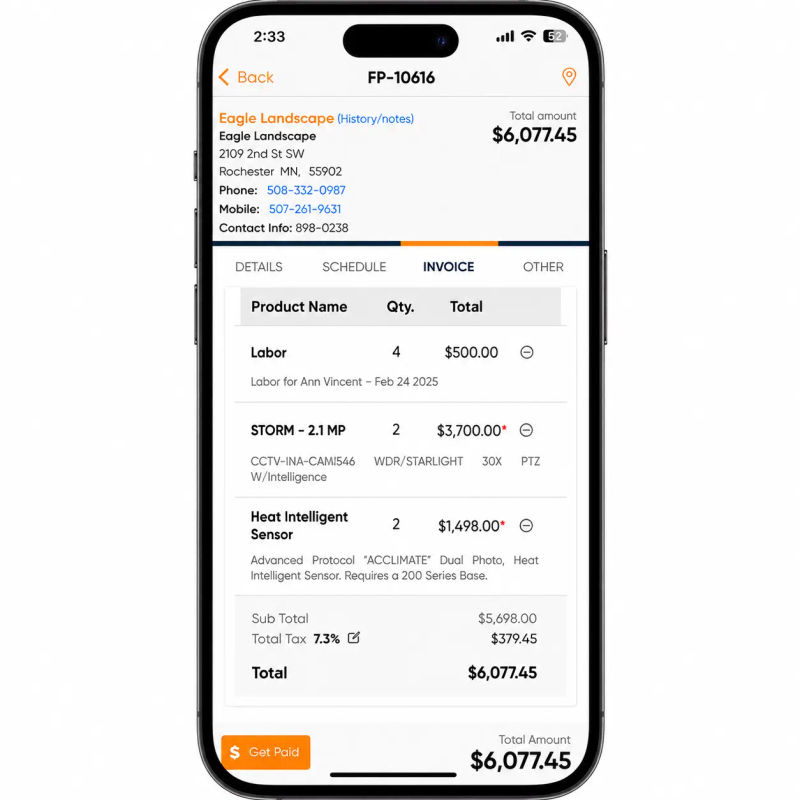
Template 3: When the dispute is about billing
"Hi [Customer Name], I hear you on the invoice. We quoted [verbal amount] and the final came in at [final amount] because [reason]. That gap should have been confirmed before the work, not after. Please call [number] and we'll walk through line by line. If we missed a step, we'll adjust."
Why this works: Owns the missing confirmation step, names the numbers, routes resolution to a phone call. Billing-dispute reviews are the most preventable category if invoices can be sent and confirmed at the moment of close, while the tech is still on site.
Template 4: When the review is mistaken or unfair
"Hi [Reviewer Name], thank you for the note. We don't have a service record matching this name or address. It's possible the review was placed on the wrong listing. Could you call [number] or email [address] so we can check? If there's a job we missed, we'll fix it."
Why this works: Doesn't accuse the reviewer of lying, opens a verification path, positions the shop as the party that wants to get it right. An HVAC contractor on the QuickBooks App Store described feeding lead capture forms into the dispatch board (roughly 30% more jobs without adding office staff) - that record discipline makes a verification reply possible inside two minutes.
5. How this plays out across multi-trade operators
Across roughly 40 to 50 operators. We've worked with since 2018, the public complaint is about a tech, but the breakdown is two systems away.
Here's the pattern we see most:
- An owner-operator runs HVAC and plumbing teams with one dispatcher and around two dozen technicians in a mid-sized Midwest metro.
- The dispatcher manages HVAC scheduling in one tool and plumbing in another, manually tracking overlaps from memory.
- This results in double-booking of technicians licensed in both trades, because there is no unified calendar to prevent conflicts.
Estimate disclaimers made it worse:
- HVAC estimates included weather and equipment availability assumptions.
- Plumbing estimates included material-related assumptions.
- When a scope impacted both trades (for example, a re-pipe close to an air handler), customers often focused on the disclaimer that appeared more favorable to them and then raised complaints publicly.
What actually fixed it:
- Both scheduling boards were consolidated into a single shared calendar.
- The estimate disclaimer was updated into one unified template covering exclusions across both trades, scope limits, key weather assumptions, and access contingencies.
- The updated disclaimer required two revisions after a client disputed a water damage exclusion. The plumbing lead considered it standard, but it was flagged as overreach under the unified template.
- Double-bookings were eliminated after an initially difficult first month, once the unified calendar revealed previously hidden conflicts.
- A plumbing technician ultimately drove adoption by enforcing the process. As part of the change, a Monday stand-up was introduced to flag any scheduling conflicts before technicians left the yard.
This is a composite case, with specifics anchored to the most common version of this pattern across multi-trade operators we've worked with. - Joy Gomez, Founder of Field Promax
6. What do real HVAC review responses look like?
Quick action, clear policy
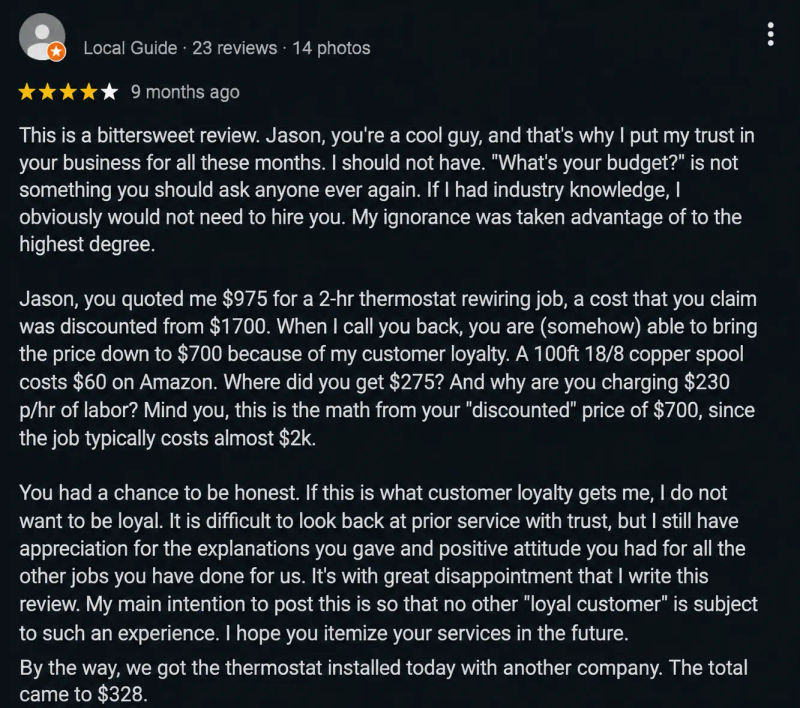
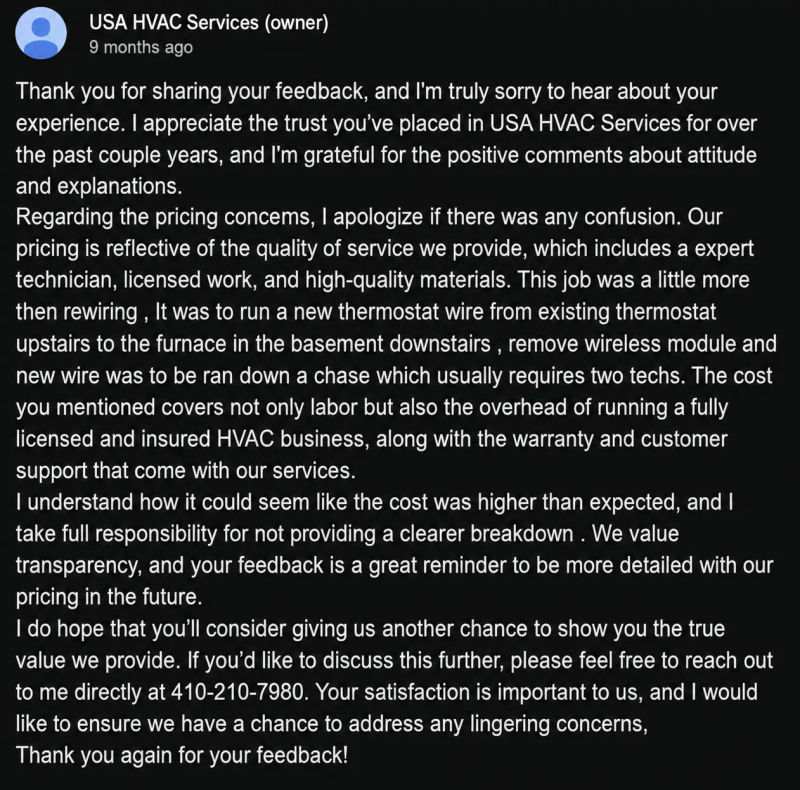
Why it works: Human, explicit on pricing, routes the rest of the conversation offline. The owner explains the charge without sounding defensive and offers a private path forward.
Empathy with a named operational fix
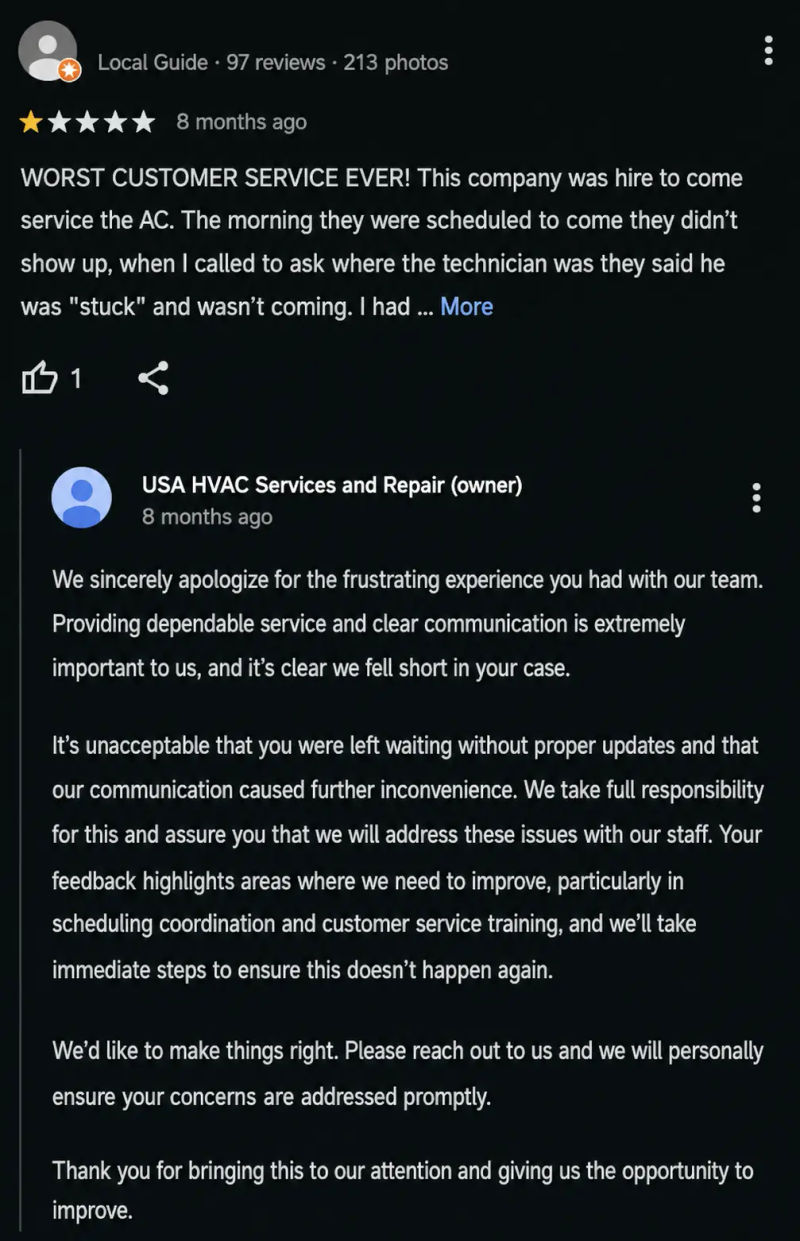
Why it works: The company acknowledges the error without making excuses, explains the operational change, and invites the customer to return.
Direct response with defined warranty terms
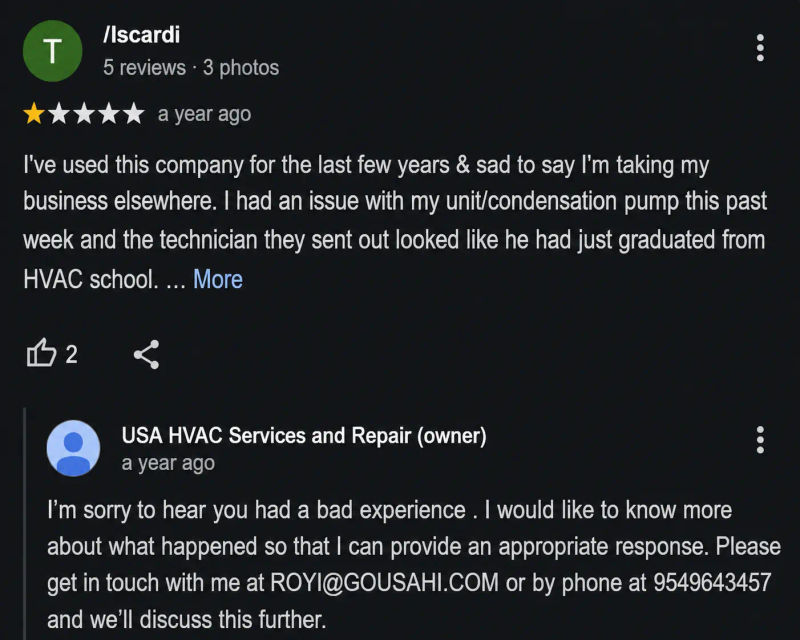
Why it works: Stays calm. Doesn't defend the tech publicly, doesn't argue facts future readers can't verify, routes the conversation private.
Turning a complaint into prompt resolution
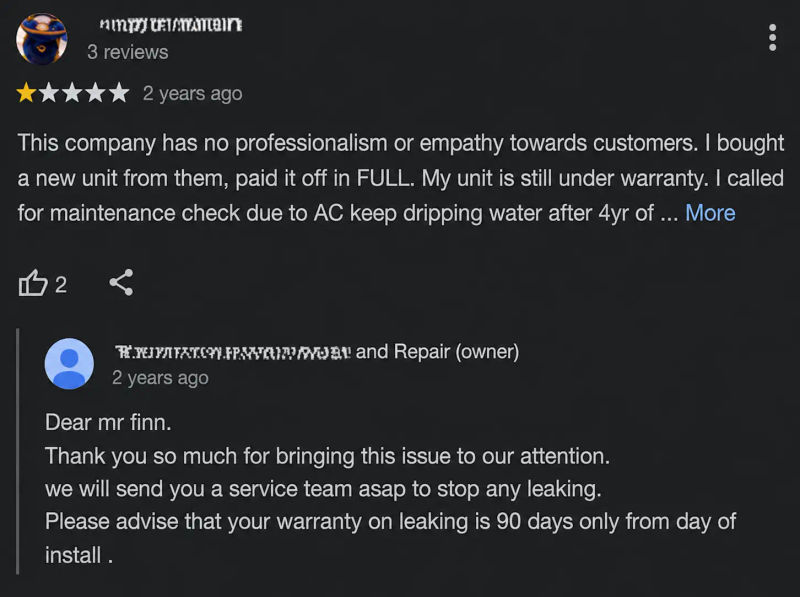
Why it works: Action-focused. Thanks to the customer, commits to fast service, spells out the warranty in plain words.
7. What changed when shops fixed their review process
The HVAC and plumbing shops that improved their review pattern made four changes, in order:
- Tone and empathy. Defensive responses were changed into shorter, warmer notes that referred to the customer, the tech, and the date.
- Transparency. Replies contained one or two operational details: warranty term, arrival timestamp, line-item breakdown.
- Action and accountability. Every response ends with the next step being identified instead of an unresolved apology.
- Public reassurance. The responses are written in the assumption that the reviewer won't read them but the following 10 potential customers will.
The average rating is increasing gradually. The main indicator is form-fill conversion within 90 days after the new response pattern begins. Industry benchmarks for lead close rates:
A professional public reply functions as a referral-quality trust signal aimed at the highest-converting traffic you have.
| Lead Source | Avg. Close Rate (Home Services) |
| Referral leads | ~45% |
| Paid Google Ads | ~18% |
| Shared marketplace leads (Angi/HomeAdvisor) | ~12% |
8. What should happen after you reply?
Every negative review reveals a gap. Map it to a specific step: scheduling, communication at arrival, scope confirmation, or invoice close.
- Update the SOP
- Send the change to the dispatcher and affected techs
- Check if the same complaint shape appears within 90 days
Combine with SOP update with a tooling check. If the dispatcher can't take the work order, photos, and arrival timestamps without leaving their desk, the next response will be equally slow.
From 15 years of customer conversations, the bad reviews that hurt most cluster around three operational breakdowns: an arrival window the dispatcher promised but didn't honor, a price that wasn't quoted before the tech showed up, and a job that closed without anyone calling back to confirm the fix was held. None of that starts in tone.
It starts in the handoff between booking, dispatch, and invoicing. I read every support ticket that comes in, and the shops who recover from a one-star fastest can pull the technician's arrival timestamp, the signed work order, and the parts list inside two minutes. The ones who can't are still typing apologies from memory, which reads to every future prospect exactly that way.
- Joy Gomez, Founder of Field Promax
How do you ask for a review update without pressure?
- If the customer confirms that the fix worked, ask once: "If your work view has changed, an updated review would help. If you'd rather leave it as is, that's fine."
- Don't trade anything to edit
- Customers on Capterra report automated post-service SMS follow-ups that send replies within minutes - doubling as an early-warning channel where dissatisfaction is discussed in private before it appears publicly on Google
How should you monitor your overall reputation?
- Pull your overall rating, response rate, and review velocity monthly from reports and dashboards
- Be aware of indicators that are lagging (rating, count) and the leading ones (response time, complaint categories)
- Move the top complaint category back into the team training every quarter
- Templates alone won't move the number. Shops that hold 4.6-plus year over year.
Your 5-minute action checklist
-
Record the review the same day, in the customer record
-
Get the work order, arrival timestamp, parts list, and photos in less than two minutes from the field mobile app
-
Write a thoughtful, personalized response within 24-48 hours - have someone to read it before posting
-
Resolve the issue, or commit publicly to a specific next step with a clear deadline.
-
Ask once for a review update if the issue has been resolved. Don't offer anything in exchange for it.
-
Push the complaint category into scheduling and dispatch or invoicing process changes
-
Track response rate and category trends monthly through Google review management
.webp?tr=f-auto,q-80,w-800,pr-true)
Related reading on reviews & reputation
Continue with:
- How to Rank for "Plumber Near Me": A Local SEO Playbook - the pillar on local pack ranking for emergency shops.
- Google Review Management for Field Service Businesses - the post-job ask workflow and 9 tactics that move review volume.
- Ways to Manage Negative Online Reviews - 5-step recovery process and prevention checklist.
- Review Management: Control, Grow, and Protect Your Online Reputation - multi-platform monitoring and FTC-compliant practices.
Conclusion
Every bad review is a free operational audit. Most shops treat it as a reputation problem. The ones that recover fastest treat it as a process signal. The public reply is the visible edge. The dispatch, pricing, and follow-up changes behind it are the actual work.
Field Promax gives your team the work orders, timestamps, and invoice history to provide specific responses - not just apologies copied out of memory.
Frequently Asked Questions

Content Creator
Bhargavi Halthore is a content writer at Field Promax, a field service management platform serving trades businesses across the USA and Canada. With over a decade of experience writing for business owners, she brings detailed, ground-level insight to every topic she covers. Her research goes beyond search results - she digs into LinkedIn groups, Facebook communities, and Reddit forums to understand what field service business owners are actually dealing with on the ground. She speaks directly with industry professionals, understands their day-to-day challenges, and translates that into content that is practical and actionable. What you read in her articles reflects real industry patterns, not theory.