Electrical Contractor Safety: Hazards, Compliance and Program Build

Where the safety burden falls in a small electrical shop is a question that many owners struggle to answer. The answer is not in the training binder. It is in the truck of a senior tech, in a half-finished JSA, or in a toolbox talk that was skipped when the call schedule became too busy. On Quora and contractor-focused subreddits, owners often express a similar frustration. JSA is frequently described as the backbone of pre-task hazard control, yet it is still created by hand on paper and must be reviewed with every new employee. This inconsistency is where many safety violations originate.
As an electrical business owner, your exposure concentrates in three places: the hazards themselves, the documentation that proves you controlled them, and the cultural defaults that decide whether a tech fills out the form before energizing a circuit.
What does one electrical injury actually cost your business?
The number that gets quoted, roughly $43,000 for the average medically consulted work injury per National Safety Council figures, undersells the real exposure. In our customer base, a single recordable in a 20-40 tech operation can wipe out a quarter of the annual safety-program budget once indirect costs stack on at the typical 3-5x multiplier.
One injury moves several levers at once:
- Workers' comp severity. Burn injuries average $63,119 per claim per NCCI-derived NSC data.
- OSHA penalty exposure. Federal maximums sit at $16,550 per serious violation and $165,514 per willful or repeated violation as of January 2025, per the OSHA penalty schedule.
- Insurance premium history. EMR impact follows a claim for three to five years.
- Contract eligibility. Many commercial GCs require safety records before bid.
- Retention. Skilled-trades turnover is reported to average 73% per year, according to 2026 Bridgit benchmarks. Shops that maintain documented JSA histories and provide ongoing training experience turnover rates that are approximately 20% lower than the industry average.
Which standards apply, and where does the paperwork live?
Owners often begin with a fragmented understanding of compliance requirements: OSHA for worker safety, the NEC for electrical installations, and NFPA 70E for arc-flash protection. Clearly defining which document governs each workflow is what makes the difference when audit time comes around.
- 29 CFR 1910 Subpart S covers general industry electrical work.
- 29 CFR 1910.147 (LOTO) controls energy isolation. LOTO sat at #4 on the OSHA Top 10 most-cited standards list for FY 2024 with 2,443 violations.
- 29 CFR 1910.137 and 1910.269 set PPE and live-line requirements.
- 29 CFR 1926 Subpart K covers construction-site electrical exposure.
- NFPA 70E (2024 edition) defines the practices OSHA considers compliant for arc flash and shock protection, anchored to the 1.2 cal/cm² arc-flash boundary at working distance per NFPA 70E 2024 commentary.
- NEC enforces installation rules; violations are usually surfaced by the local AHJ, not OSHA.
The most common issue raised in discussions with owners stems from their systems rather than the standards themselves. Operators want control, monitoring, scheduling, and escalation processes centralized in one place rather than scattered across multiple spreadsheets.
How often do shocks actually happen, and what do they cost?
Electrical shock incidents account for roughly 400 workplace fatalities annually. NFPA's analysis notes that construction and extraction occupations made up 37% of electrical fatalities in 2023, or 52 deaths. The shops absorbing these are almost always the ones that let "a quick energized check" creep into routine workflow.
One serious shock:
- Workers' compensation claims ranging from $50,000 to $150,000; OSHA penalties of up to $165,514 per citation for willful violations
- Increased insurance premiums that can persist for three to five years
- Project delays and lost productivity
What do you require before any tech touches a live circuit?
De-energization first. No work should be performed on energized circuits without a documented justification and a manager's approval. A simple verification checklist - de-energized, locked out, and tested - can prevent most common failure scenarios.
LOTO that gets used. Each tech should be issued a personal lock and tag and undergo quarterly compliance reviews.
Testing equipment, every truck. An accurate voltage tester ($50-$200) and a test-before-touch record on every work order are essential.
Voltage-rated PPE. Class 0-4 insulated gloves with leather protectors, plus insulated hand tools.
Documentation is where many businesses struggle. In an 8-tech company, each technician may spend around 5 hours per week on safety documentation. Shops that integrate forms into automated mobile compliance workflows can often reduce that time to less than one hour per technician per week.
Why is arc flash a different category of risk?
Arc flashes are less common than routine shocks, but their consequences are often far more severe. Potential outcomes include fatalities, long-term disabilities, OSHA penalties of more than $165,514 per willful violation, and liability exposures that can threaten the survival of a business.
In one widely cited manufacturing incident, an arc flash resulted in a worker fatality, $1.2 million in OSHA fines, a $4.5 million wrongful-death settlement, and the closure of the business within 18 months.
What PPE and process does arc flash demand?
Arc-rated clothing on any work over 50 volts where an arc flash hazard exists. Budget $300-$800 per outfit per tech. NFPA 70E's table method assigns minimum arc ratings of 4, 8, 25, and 40 cal/cm² for Categories 1-4, with face shields, hoods, gloves, and footwear specified per category, per the NFPA 70E incident-energy reference.
Three operational rules:
- Do not bid on industrial or commercial work if arc-flash labels are unavailable or an incident energy analysis has not been completed.
- Conduct a safety briefing before every arc-flash-rated job, covering hazards, required PPE, and emergency procedures.
- Provide annual training on arc-flash hazard recognition and PPE selection, with participation documented for each technician.
Shops that maintain a policy of declining work at sites that have not been properly assessed may experience a short-term reduction in revenue, but they often benefit from stronger margins and lower risk over the long term.
A pattern across multi-trade operators we've worked with
Among approximately 30-40 mid-sized multi-trade contractors operating across Texas, the same pre-audit scramble often appears. Field crews have been doing the work for years, and the required forms are being completed. However, documents are scattered across supervisory trucks, office file cabinets, outdated shared drives, and binder trays near the back door.
The failure often occurs during an OSHA review. In one case, a contractor was unable to produce requested safety documentation for field crews during an inspection. The penalty stemmed from a documentation gap rather than a lack of training. The training had been completed, but the records were so dispersed that retrieving 90 days of certificates within the inspection window was not feasible. The result was a penalty totaling hundreds of thousands of dollars.
Leadership migrated training records to a centralized digital system where completion dates, signatures, and certificates were recorded for each technician and could be accessed at any time. Forms were configured as mandatory, preventing incomplete JSAs from being submitted. Toolbox talk acknowledgments were attached to each technician's profile with date stamps, and certifications approaching expiration within 30 days automatically triggered alerts for the safety lead.
Subsequent audits were completed without issues. There was, however, an initial challenge. Crew members were reluctant to adopt the additional documentation steps, and office staff spent weeks updating historical records. Adoption improved only after senior technicians personally experienced the value of the workflow during incident investigations.
This pattern was observed across multiple operators. The specific requirements varied depending on the version of the standard being followed.
Why do overloaded circuits become your liability?
Overloaded circuits may appear to be minor issues on a punch list, but they can become major liabilities on a loss run. Potential consequences include fire-damage claims that exceed seven figures, professional liability claims, license revocation for repeated code violations, and the loss of insurance coverage following a pattern of citations.
Most overloaded circuit claims do not originate from the initial installation. Instead, they result from service changes made years later when load calculations were skipped because the existing design was considered "close enough."
What do you enforce on circuit loading?
Code competence as a hiring bar. Every tech knows the NEC requirements for circuit loading, conductor sizing, and overcurrent protection.
Load calcs on every modification. Required for any circuit add or alter. Documented on the service report.
QC inspections. Random inspections of completed work can identify mistakes before the final inspection, making them far less expensive than callbacks.
Documentation as liability shield. Recording circuit-loading information on service reports creates the documentation trail needed if a fire inspector reviews the work years later.
A 15-minute consultation with a technical expert costs far less than the expense of rework or a claim resulting from an incorrect decision.

What's the exposure when wires get left exposed?
Exposed wiring can create a double layer of liability risk. In the immediate aftermath, businesses may face OSHA citations, code violations, stop-work orders, and injuries to occupants after a technician has left the site. The long-term consequences can be even more significant. During a later inspection, previously completed projects may be reviewed, potentially resulting in fault being assigned retroactively.
The shops that handle these situations most effectively maintain pre-work documentation that clearly distinguishes between existing site conditions and the work performed by their technicians. In other words, they can demonstrate "what was already there when we arrived" versus "what we installed."
Which inspection rules close the exposed-wire gap?
Pre-work photos, every job. Techs should photograph existing site conditions before any work begins. It is one of the most valuable risk-management practices a contractor can adopt.
Truck inventory that doesn't force improvisation. Junction boxes, wire nuts, electrical tape, and conduit should always be kept in stock. Material shortages can pressure technicians into taking shortcuts that compromise safety and compliance.
Final-walk checklist before leaving site. Connections enclosed, devices terminated, panels closed.
Warranty policy that splits new work from pre-existing conditions.
Why do wet conditions become a negligence question?
Electrocutions that occur in wet conditions are often considered preventable, which is why they can create significant negligence exposure. OSHA inspectors closely examine fatalities that occur in wet environments to determine whether proper safety procedures were followed. Insurance carriers may be reluctant to approve claims when required precautions were not documented. Licensing boards can revoke credentials for serious or repeated violations, and in cases involving gross negligence, criminal charges may be pursued.
What GFCI and weather rules hold up under audit?
Portable GFCIs in every service vehicle. $30-$100 per unit. Required in any damp environment, not optional.
Weather-appropriate PPE. Provide waterproof, insulated boots and electrically rated rain gear for every technician. The typical cost ranges from $150 to $300 per technician.
A clear weather-postpone policy. Establish clear stop-work thresholds for lightning, standing water, and saturated soil conditions. Document who has the authority to make the decision, along with customer communication templates and rescheduling procedures.
Implement a strict "no wet work without GFCI protection" policy, supported by clearly defined disciplinary consequences for non-compliance.
Who owns the consequences when a tool fails?
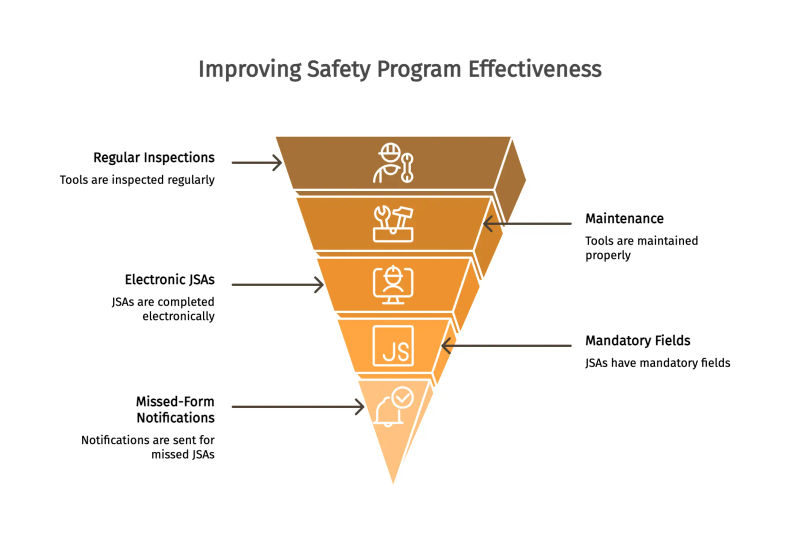
The employer. Always. OSHA requires regular tool inspections and maintenance. Injuries caused by defective tools are generally treated as the employer's responsibility, and failure to inspect or maintain equipment can create additional liability exposure. Inspectors who observe poorly maintained tools often view them as indicators of broader weaknesses in a company's safety program.
In a typical shop with five to 20 technicians using paper-based JSAs, owners often estimate that only about 60% of pre-task forms are fully completed by the end of the week. Shops that adopt electronic JSA systems with mandatory fields and missed-form notifications routinely achieve completion rates above 95%.
How do you build a tool inspection program that holds?
Daily visual inspections before use, monthly documented formal inspections. Tag-or-sticker system to track dates. We built Field Promax's tool inspection workflows because owners kept asking us to stop inspection dates from falling through the cracks per asset.
Replacement budget at 10-15% annual. Worn tools are dangerous and produce callbacks.
Voltage-rated insulated tools on any electrical work. $300-$800 per tech for a complete set.
Checkout system with tech accountability.
Empower technicians to remove unsafe tools from service immediately, with no questions asked. The cost of an unreported defect is almost always far greater than the cost of replacing a tool.
Why are PPE citations so often classified as willful?
OSHA 1910.269 and 1910.137 require proper electrical PPE. Failure to provide it is not seen as an oversight; it is a choice. Willful violations can mean penalties of up to $165,514 per citation, along with criminal liability in fatality cases and denial of insurance coverage.
The shops that get flagged are rarely the ones unaware of the rule. They are usually the ones whose PPE budget was squeezed during a slow quarter and never fully recovered.
What PPE must you provide, and at what real cost?
Per technician baseline:
- Voltage-rated gloves with leather protectors: $75-$300
- Arc-rated clothing: $300-$800
- Hard hat with face shield: $50-$150
- Safety glasses: $10-$50
- Hearing protection: $5-$30
- Insulated footwear: $100-$200
Initial: $800-$2,000 per tech. Annual replacement: 10-20%.
Practical training in selecting, using, inspecting, and maintaining gloves should be documented for every technician. For insulated gloves, regular electrical retesting must be conducted according to the manufacturer’s schedule. This schedule should be built into your equipment management system, not left in a technician’s memory.
An HVAC contractor using Field Promax described in a QuickBooks App Store review that handling and tracking business operations became simple and reliable, calling it software every service business should have. The same principle applies to PPE management, where replacement schedules shift from relying on "someone's memory" to "the system tells you."
Why do LOTO citations punch above their weight?
LOTO ranked among OSHA's most-cited standards for FY 2024, with 2,443 violations OSHA Top 10 most-cited standards list for FY 2024 with 2,443 violations. Average penalty range hits $4,000-$156,000 per violation. Multi-person crews multiply citations quickly. Fatalities almost always trigger criminal investigations. Absence of a written LOTO program is an automatic citation.
Shops that successfully pass LOTO audits store their procedures in a mobile application that technicians can access directly from the job site or their truck, rather than relying on an office binder.
What does a written LOTO program need to contain?
Written program meeting 29 CFR 1910.147. Templates are widely available; customize for your equipment categories.
Personal locks and tags per tech. $20-$50 per tech.
Annual authorized-employee training, documented. $100-$300 per employee.
Equipment-specific energy-control procedures. Laminated cards or mobile app access.
Shops that maintain this level of LOTO compliance keep their operations steady even during spikes in service demand. If they do not, the process breaks down during the very first extreme heat wave or emergency freeze week.
Where does inadequate training show up on the P&L?
OSHA requires documented training, and insufficient training often becomes a focal point in plaintiff claims. Training deficiencies can increase the frequency of workplace incidents, which in turn raises workers’ compensation costs and claim severity.
The recurring Quora pain for new hire training programs is that many companies rely heavily on apprenticeships and informal shadowing rather than a structured training program. Technicians are often hired without standardized documentation, and supervisors are unable to easily determine who has been properly trained on specific tasks. In contrast, shops that use documented JSAs and provide continuous training tend to retain technicians with seniority beyond the three-year mark.
How do you build a training spine that survives an audit?
Initial safety training before any work. 40-80 hours for a new hire.
Annual refresher. 8-16 hours per tech.
Role-specific training: arc flash, LOTO, confined space.
Documentation system. Dates, content, instructors, test scores, expiration dates, refresher queues. Your primary defense in litigation and fastest path through an audit. Field Promax stores certifications and triggers refresher notifications so windows don't slip.
What's the actual ROI on safety training?
Ranges that hold up:
- 20-30% fewer workplace injuries
- 15-25% lower workers’ compensation costs
- Higher retention compared to the industry baseline of 73% in skilled trades
- Improved work quality and fewer callbacks
Annual training budget: $500 to $1,500 per technician. Shops that invest in training also tend to maintain stronger documentation and operational consistency across other areas of the business.
What separates a paper safety program from a working culture?
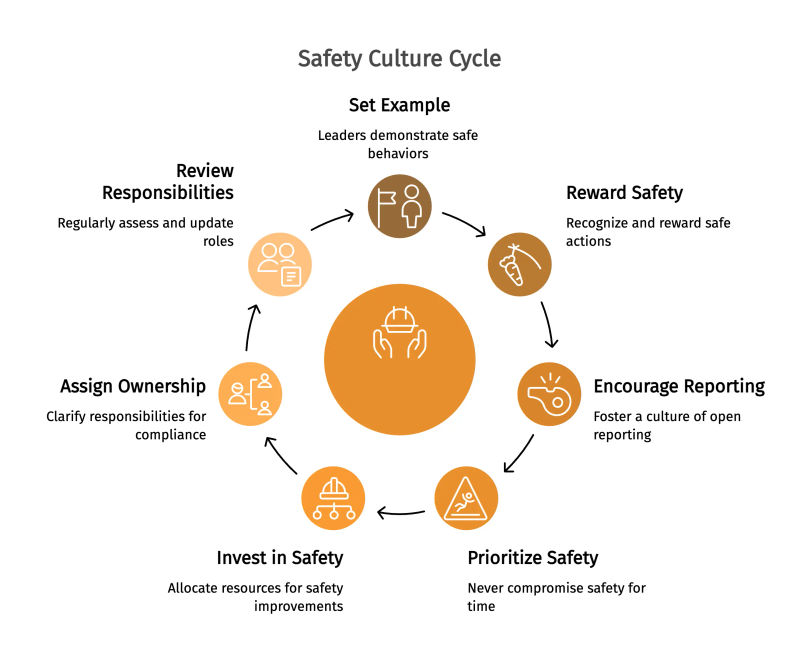
Successful programs are built around cultural defaults, which determine whether the rules are followed even when no one is watching.
- Set the right example during every site visit. Technicians pay attention to behaviors, not policies.
- Reward safe behavior. Recognizing hazard reporting is more effective than creating a system that penalizes the person who reports it.
- Encourage reporting without fear of retribution. Near misses, hazards, and job refusal actions should be logged without consequences for the person reporting them.
- Never trade safety for time.
- Invest visibly. This can include purchasing new PPE, replacing equipment, or funding training programs.
The main source of Quora related issues is confusion about who is responsible for compliance. For smaller field service companies that do not have an assigned safety officer, these tasks are often left unfinished until an audit or incident forces attention. The solution is to assign ownership by category within the organizational chart and review responsibilities every three months.
I read every safety-related support ticket that comes through, and the pattern is almost monotonous. The shops getting tagged on 29 CFR 1910.147 are rarely the ones who don't know the rule. They're the ones whose written program lives in a binder no tech has opened since onboarding. The JSA gets filled out on a clipboard, photographed maybe, then disappears into a glovebox.
The form isn't the problem. Retrieval is. When the audit lands, the question is never "do you have a program" but "can you produce the last 90 days of completed JSAs by tech, by site, by date." If the answer takes more than ten minutes, the inspector has already drawn their conclusion.
- Joy Gomez, Founder of Field Promax
What does a 90-day rollout actually look like?
Month 1: assessment and policy.
- Check your current OSHA compliance status with respect to the standards that create the highest exposure risks.
- Review the PPE and tools currently in use.
- Write or revise documented safety guidelines.
- Budget for safety based on exposure to real claim risks.
Month 2: equipment and training.
- Purchase the required PPE and safety equipment.
- Schedule first-round employee safety training.
- Roll out a tool inspection program.
- Create a workflow for incident reporting.
Month 3: documentation and culture.
- Create specific safety protocols for each job.
- Launch a recognition program.
- Run the first all-hands safety meeting.
- Refine the process based on technician feedback.
The recurring Quora frustration on communication: verifying that every tech actually received and acknowledged a safety message before starting work. Routing messages through a system that captures acknowledgment per tech with mobile sign-off plus real-time visibility into who opened what closes that loop.
A large enterprise customer described on the QuickBooks App Store deploying Field Promax across four of its businesses, citing the customer service for exceeding expectations, along with customization features that other products couldn't match.

Why is electrical safety good business, not just compliance?
Shops with strong safety programs perform better than their competitors in terms of profits, growth, and retention.
- Reduced workers’ compensation claim severity and frequency.
- Lower insurance premiums as EMR improves.
- Fewer delays, disputes, and legal risks.
- Stronger reputation during bid opportunities.
- Access to larger and higher-margin commercial contracts.
- Better employee retention compared to the 73% industry baseline for trades.
The underlying foundation is documentation. When JSAs, tool inspections, training records, and incident reports are stored in a system instead of in someone’s head, accountability is strengthened and operational risk is reduced.
The most important goal is to build a shop where every technician can return home safely.
Conclusion
Electrical safety is a company decision long before it becomes a compliance requirement. Make sure proper documentation is in place, and most of the program comes with it.
Frequently Asked Questions

Content Creator
Bhargavi Halthore is a content writer at Field Promax, a field service management platform serving trades businesses across the USA and Canada. With over a decade of experience writing for business owners, she brings detailed, ground-level insight to every topic she covers. Her research goes beyond search results - she digs into LinkedIn groups, Facebook communities, and Reddit forums to understand what field service business owners are actually dealing with on the ground. She speaks directly with industry professionals, understands their day-to-day challenges, and translates that into content that is practical and actionable. What you read in her articles reflects real industry patterns, not theory.
Reviewed by

Founder and CEO
Joy Gomez is an engineer, process automation expert, and the Founder of Field Promax. Known for his technical expertise and commitment to field service innovation, Joy writes about transforming traditional business models into paperless, efficient operations. He is a Lean Six Sigma Black Belt based in Rochester, MN, dedicated to helping field professionals work smarter through better technology.