Plumbing Landing Pages: The Operator's Playbook for Pages That Book Jobs

Across plumbing business operators we've worked with since 2018, one pain shows up again and again at shops running fewer than ten techs out of a single location: the after-hours phone-quote habit. Whoever answers the 1 a.m. call wants to lock the job before the homeowner dials the next listing. The verbal estimate routinely undershoots the on-site number once code-required add-ons - expansion tanks, PRVs, drain pans - get added at the door.
The next downstream symptom and the one this guide is based on, is strong traffic and plenty of clicks from local search, paired with an unreliable plumbing landing page that still doesn’t convert into booked jobs. Visitors are coming to the site, but the funnel breaks somewhere between inquiry and booking. The owner of the funnel often can’t identify whether the issue is in the text, the form, trust signals, or what happens after the form is submitted.
Most of this playbook is about the page. The most useful part is about 90 seconds after the form is submitted.
What a plumbing landing page actually has to do
A plumbing business landing page is not the homepage. The homepage is the hardware store. The landing page is the wrench the customer asked for at 2 a.m.
Three jobs, in order:
- In five seconds, a customer should be able to confirm that this shop can fix what’s broken right now.
- In the next ten seconds, they should be reassured that the business is licensed, insured, and accessible.
- To book, they should be able to call or submit the form in a single tap.
The difference between a 2% page and a 10% page comes down to how quickly it answers these three questions - and how simple the handoff is for dispatch.
What a realistic conversion benchmark looks like
The anchor number for landing pages for service businesses: home-services landing pages post a median conversion rate of 6.7%, with the top quartile above 17.6% per Unbounce. Shops above 10% almost always share three traits: they feed a Google Business Profile with reviews after every job, they reuse the ad headline word for word on the landing page, and they route form fills into a dispatch board, not a Gmail inbox.
The distribution varies significantly depending on traffic sources. Referral leads account for close to 45% of home-service contractor business, followed by Google Ads at around 18% and marketplace leads at roughly 12%. A website designed for referral-driven traffic is not the same as one designed for cold paid search traffic.
A pattern across emergency plumbing operators
Consider an owner-operator of an emergency plumbing shop with six techs operating from a single location in a mid-sized Sun Belt metro. Across the 20 to 30 plumbing shops we’ve observed with a similar structure since 2018, the same operational pattern consistently appears.
The shop was not in the local top 10 for after-hours inquiries in two of its three zip codes, meaning emergency calls were likely being captured by national franchises instead. When calls did come into the shop, the initial phone estimate often fell short of the written estimate once code-required elements were added. Techs were either absorbing the difference or facing disciplinary action when they arrived on-site.
The fix was functional, not cosmetic. The owner created a single-page emergency-rate template that included diagnostic and call-out fees, Good-Better-Best pricing ranges, and a note flagging possible code-related add-ons. The template was texted to the customer before the truck even started rolling. Google Business posts and the landing page were also revised to reflect weekend and nighttime service availability, tailored to specific service areas. The first text template was too dense; it got revised twice before the layout stopped confusing people at 2 a.m.
In two summers, after-hours call volume had increased significantly, and on-site quote disputes had almost disappeared. The downside was that price-sensitive callers dropped off after receiving the evening text, particularly on weekends when overnight coverage was unavailable. The owner added a “call back from owner” option for customers who did not respond within ten minutes. Two senior technicians adopted the template immediately, while the newest hire continued using phone-based quotes until pay structures were adjusted.
This is a composite pattern, with the specifics reflecting the most common variation observed across similar operators.
The headline does the first three seconds of work
Boring openers like "Professional Plumbing Solutions" tell a panicked homeowner nothing. A working headline names the service, the speed, and the geography in one line. HubSpot's analysis of over 330,000 calls to action found personalized CTAs outperformed generic ones by 202%. "Emergency Plumber in Tempe, 30-Minute Response" beats "Quality Plumbing Services" every time.
Our STANCE: Most plumbing operators write their headline for themselves, not for the person holding a mop at 2 a.m. "Family-Owned Since 1994" is a headline about you. "Burst Pipe in Phoenix? We're 30 Minutes Out" is a headline about them. These are not the same thing, and the conversion data makes that gap very clear.
Three things the headline has to shout
- Service: The core services include blockages, leaks, slab leaks, water heaters, and gas lines.
- Speed: Position availability clearly: 24/7 service, same-day response, 30-minute arrival windows, and weekend availability.
- Geography: Target at the neighborhood, city, or zip-code level, depending on how deep your SEO coverage goes.
Examples that work:
- "Burst Pipe in Phoenix? We Are 30 Minutes Out."
- "Same-Day Water Heater Replacement, North Tampa"
- "Drain Cleaning in Boulder County, Open Sundays"
The CTA is where the page either closes or stalls
One CTA per page. The phone number should sit at the top right, and the CTA button should use a bold color that strongly contrasts with the rest of the page. The button text should clearly describe the action. Each additional choice increases the chance that the customer chooses none. This is one of the most reliable plumbing landing page principles, and the data supports it - pages with a single, clearly defined CTA perform up to 371% better than those offering multiple options (WordStream).
CTA copy and placement that earn the click
For emergency plumbing, the difference between "Contact Us" and "Call Now, On-Call Tonight" is the difference between a 0.5% page and a 5% page. Button copy that holds up:
- Call Now, We Answer 24/7
- Book a Same-Day Plumber
- Get a Free Onsite Quote (Today)
"Submit" is not a CTA.
The primary CTA button sits in the hero section and is repeated at the bottom of the page. If the brand colors are white and blue, the CTA button should be red or orange for contrast and visibility. Blending in is the failure mode.
Emergency availability has to be the loudest thing on the page
The person is standing in a flooded bathroom with a mop. If there is no clear indication of availability, they close the tab and call a competitor whose hero section says “24/7 OPEN NOW.” In the r/Plumbing forums, where owners have posted discussions over the past year, one of the most common conversion leaks is this: users can land on the site, but it does not clearly communicate whether anyone is available after 11 p.m.
What to say verbatim above the fold
- Available 24/7
- Same-Day Repairs
- Emergency Plumber Near You
- 30-Minute Response Time (only if you can actually hit it)
The shorter the line, the more it works.
Reviews carry trust the page cannot claim for itself
BrightLocal's 2024 Local Consumer Review Survey found 92% of consumers read reviews of local businesses before their first visit. Shops that automate the post-job review ask consistently report a steady lift in booked calls within a quarter.
The threshold matters. BrightLocal's analysis of star-rating influence shows willingness jumps sharply at 4.0 stars - 87% will hire a 4-star shop versus 71% at 3 stars. Below 4.0, the page is fighting uphill regardless of how well everything else is built.
Where to put the reviews on the page
- Integrate a live Google or Yelp ratings widget instead of a static image
- Add a one-line review near the primary CTA
- Use named, location-specific reviews (e.g., “Maria S. in Mesa”)
- Avoid generic “great service!” quotes. Instead, choose reviews that describe the exact problem that was solved
Pair the post-job invoice flow with a one-click Google review management prompt and review velocity stops depending on whether the dispatcher remembers to ask.
Licensing and insurance are non-negotiable trust signals
One bad install floods a house. The Better Business Bureau reports 85% of consumers are more comfortable doing business with an accredited company. For local home services, that badge does disproportionate work because the trust transaction happens before any service is rendered.
What to display, and where
- Display the state plumbing permit number clearly - this is the verified licensing detail, not a vague “fully licensed” claim.
- Include bonding and general liability insurance information as a trust signal.
- Show BBB accreditation badges only if the business is actually accredited.
- Highlight manufacturer certifications (e.g., Rinnai, Bradford White, Navien) for high-value installation work.
- Add the company’s founding year in plain text near the hero section.
The badge cluster should be placed near the contact form and repeated in the footer.
Phone number visibility decides the mobile call rate
If finding the phone number takes more than two seconds, the page is effectively not accessible. If the number on your mobile site is not tap-to-call, every desktop-adapted page is losing calls. This is one of the simplest fixes for any plumbing landing page - and also one of the most commonly missed.
Three mechanical fixes for mobile contact
- The header is sticky, with the phone number always visible while scrolling
- Every phone number should be a clickable “tel:” link
- Keep forms short: name, phone number, and a one-sentence description of the problem. Move address and ZIP code to a later step.
HubSpot's analysis of more than 40,000 landing pages found conversion rate generally falls as field count rises. Three fields is usually the right ceiling for first contact on a plumbing page.
Visitors scan, they do not read
Nielsen Norman Group’s usability research has been consistent for over two decades: users skim pages to confirm they are in the right place, then either act or leave. Dense sections of text about “hydro-jetting PSI levels” rarely hold attention for long. This pattern holds true across every landing page for service businesses and is even more pronounced in plumbing, where visitors are often stressed and browsing on mobile devices.
Service copy that survives the scan
Write to the problem, not the tool.
- “Pipe Rehabilitation Services” becomes “We Fix Leaky Pipes”
- “Water Heater Diagnostics” becomes “No Hot Water? We’re Here Today”
- “Sewer Camera Inspection” becomes “Find the Clog Without Digging Up Your Yard”
Use bullets. Make sure to bold the name of the service on every line. If a sentence contains more than fifteen words, check whether it can be divided in half. Most of the time, it can.
Mobile is where most of this gets decided
Google's mobile benchmarks found that as page load time goes from 1 to 10 seconds, mobile bounce probability climbs 123%. The Core Web Vitals threshold for Largest Contentful Paint, per web.dev, is 2.5 seconds at the 75th percentile. An improvement from a PageSpeed score of 32 to 84 has been documented lifting plumbing landing page conversion by 27% - no copy changes, no design overhaul, just a faster page.
The single biggest predictor of a successful field service rollout is whether techs actually use the mobile apps to receive dispatched jobs. A page promising a 30-minute response means nothing if the tech is getting the job on a paper ticket.
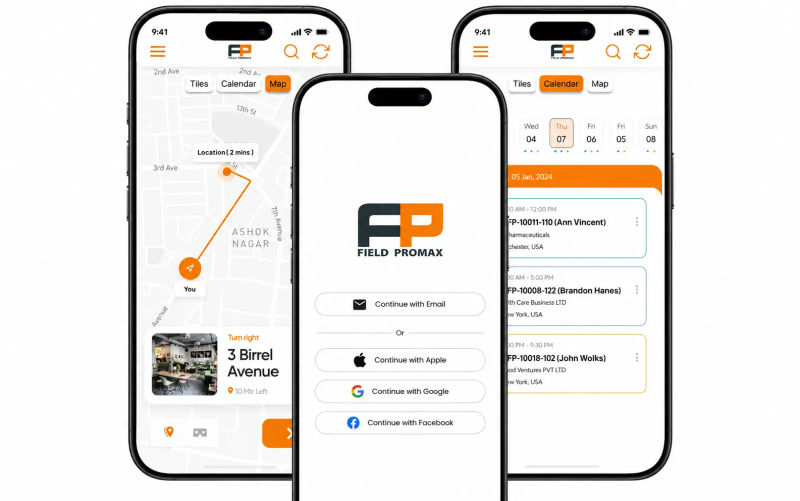
Thumb-zone basics for mobile pages
- Text should be large enough to read without zooming
- CTA buttons should be designed for thumbs, with a minimum tap target of 44px
- Page weight should stay under 2MB for mobile performance
- Test the site on a personal phone using a cellular connection. If it feels slow, it is slow.
Real photos beat stock photos every time
The more polished the image, the more the visitor assumes the shop is hiding something. The standard plumber in clean overalls holding a wrench who has never been on a real job site is instantly recognizable as fake. Real beats are polished, every time, in every plumber-website-conversion we've seen.
What to shoot instead
- Before-and-after photos of actual jobs
- The team, dressed in branded uniforms, standing in front of the truck
- A close-up of the truck with an urban street in the background
- A technician using a phone to complete a work order instead of a clipboard
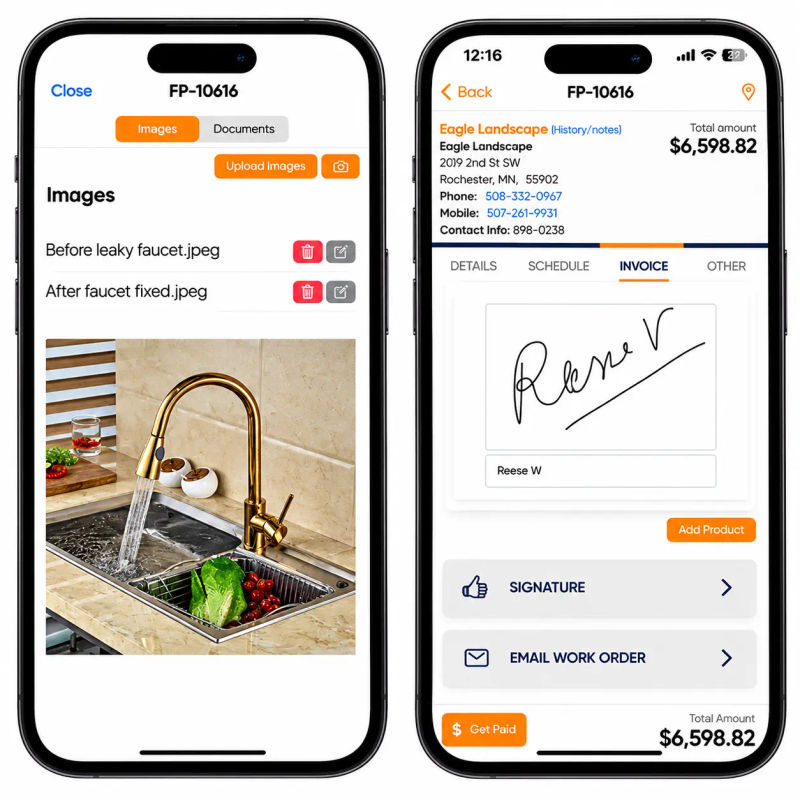
Techs attach "after" photos to the work order from the job site, which builds a stock of real before-and-afters automatically. The landing page pulls from the photo library, not a stock image site.
The form-to-dispatch handoff is where most landing pages die
The page could convert at 10%, but the shop may still lose the sale. What happens in the 90 seconds after submission determines whether the lead turns into a profit.
The most common failure mode is this: A submission lands in a shared Gmail inbox that is only checked every 30 to 45 minutes. If no one calls back quickly, the homeowner books the first plumber who responds. This is one of the most costly breakdowns in digital marketing for plumbers, and it is often unrelated to the website itself.
The pattern separating 5% conversion shops from 15% conversion shops is the routing. Form submissions need to land in the dispatch board, not an inbox. The dispatcher needs an audible alert. The on-call tech needs the job pushed to a phone with tap-to-dial ready. Plumbing shops using Field Promax's scheduling and dispatch route landing-page form fills directly to the board. A Capterra reviewer described the same pattern from the HVAC side: feeding lead capture forms directly into dispatch let them book roughly 30% more jobs without adding office staff.
An experienced Field Promax user on Capterra mentioned that automated SMS follow-ups after service calls generate replies within minutes, with customers responding directly to schedule the next job.
.webp?updatedAt=1770278636533&tr=f-auto,q-80,w-800,pr-true)
I read every customer support ticket that comes through Field Promax, and the single most common feature request from plumbing shops is better dispatch-to-invoice automation. That tells you something about landing pages too. Owners have spent thousands fixing the page and watched the close rate stay flat because nothing changed about what happens after the form submits.
A landing page is a workflow trigger, not a marketing asset. From 14 years of customer conversations, the small plumbing operations that consistently beat the 6.7% home-services median are not the ones with the prettiest pages. They're the ones where a form fill rings a dispatcher's screen, a tech rolls within 20 minutes, and the SMS confirmation sends without anyone clicking send.
- Joy Gomez, Founder of Field Promax
What we see break most often on plumbing pages
These are not just speculation. These are the patterns that appear in plumbing companies with strong traffic but low booking rates.
- Too much content above the fold. Reduce scrolling paragraphs and long sentences. Remove hero sliders that cycle through stock images.
- Generic headline copy. “Quality Plumbing Service” could refer to any of the 200 shops in the metropolitan area. If someone covered your logo, would the visitor know which city you serve? If not, the headline isn't working.
- Slow page load on mobile. Six seconds on mobile is effectively inaccessible. Compress hero images, defer non-critical scripts, and remove any chat-based widgets that add more than 800KB to page weight.
- Forms that demand too much. Asking for address, ZIP code, description, preferred time, and “how did you hear about us” at first contact can cause an average 50% drop in form completion compared to using just three fields. It’s like putting the user at the center of a leak - they are not filling out a questionnaire.
You cannot fix what you do not measure
Plumbing landing pages are a workflow, not a task completed at the end of the day. They should be adjusted every quarter.
Five metrics worth tracking weekly
- Conversion rate based on traffic source (referral, organic, paid, GBP, direct)
- Bounce rate, mobile versus desktop
- Time to receive first call-back after form submission
- Click-to-call rate on the mobile sticky header
- Form abandonment by field
Google Analytics, GTM, and a call-tracking platform like CallRail provide most of this. Find the one place where the funnel is leaking, fix it, then check for the next leak.
| KPI | Underperforming | Industry Average | Top Quartile | Source |
| Landing page conversion rate | Under 2% | 5-8% | 12-18% | Unbounce Q4 2024, Plumbing Partners |
| Mobile page load (seconds) | Over 4s | 2-3s | Under 1.5s | Google PageSpeed benchmarks |
| Form completion rate (3-field) | Under 10% | 25-35% | 50-65% | Cobloom, Plumbing Webmasters |
| Lead response time (hours) | Over 4 hours | 1-4 hours | Under 15 min | Harvard Business Review |
| Click-to-call rate (mobile) | Under 5% | 8-15% | 20%+ | Google mobile behavior data |
| Cost per lead (PPC, competitive) | Over $200 | $80-$150 | Under $60 | Plumbing PPC benchmarks 2025 |
| Google Quality Score (landing page) | 1-4 | 5-6 | 8-10 | Google Ads benchmarks |
| Bounce rate (service-specific) | Over 70% | 45-60% | Under 35% | Plumbing Webmasters, Landerlab 2026 |
Local relevance does double duty
Google's local 3-pack has a click-through rate of 48% for local service search results. A plumbing landing page which is disconnected from a claimed, highly reviewed Google Business Profile is forfeiting approximately half of local intent traffic. Shops that can close the gap quickly combine the complete GBP and automated reviews after the job.
How to make a landing page feel local
- Names of city and neighborhood in the H1 and three places below
- Reviews are tagged with the customer's neighborhood
- An embedded Google Map outlining the service area
- Local phone number (area code is crucial)
- Service-area pages for every major area, linked from the landing page
Local-anchored copy is typically the quickest solution for that "traffic arrives but doesn't convert" pattern that the owners of. One plumbing contractor built 7 city-specific service pages and reported an increase of 215% in visibility for local areas within three months

The same playbook applies across other local trades
The same structure works for any local trade where conversion happens under time pressure:
- HVAC: no-heat and no-cool calls behave like plumbing emergencies
- Electrical: power-out calls map cleanly; permitted-work pages need licensing front and center
- Pest control: less time-sensitive, more shame-sensitive
- Lawn care: seasonal pages with quote forms outperform single-CTA emergency pages
- Garage door: spring-break emergencies behave exactly like plumbing
Regional considerations for plumbing operators across the USA and Canada
The geography of your site determines what your landing page should tell the world. One-size-fits-all approaches treat Minneapolis and Miami as one market. They're not.
- Cold climate regions (Canada, Northern US): Frozen pipe emergencies spike during January and February. Emergency pages specifically designed for pipe freeze and burst pipes need to be up and running by the end of November in places like Edmonton, Calgary, Minneapolis and Detroit. In Ontario, displaying your Certificate of Qualification number is both a trust signal and a regional expectation. In British Columbia, a Class B Gas licence for gas-line work has the same weight.
- Hurricane and flood-prone regions (Gulf Coast, Southeast US): Florida, Texas, and Louisiana experience seasonal demand that is tied directly to weather events. Storm damage service landing page variants - ready to go live when a storm is forecast - convert at measurably higher rates during hurricane season with flood-related messages and fast response times.
- High-cost markets (California, New York, British Columbia): In markets where cost-per-click exceeds $35 to $50, a generic page is extremely expensive. California's C-36 Plumbing Contractor licence is an authority signal that should be placed prominently on every page that targets those markets.
- Mid-size metros and suburban markets: "Plumber in Kanata" and "plumber in Nepean" serve different customers even though both are Ottawa suburbs. Making separate pages for each of the service areas can help capture the search traffic that the same "Ottawa plumbing" page misses completely.
Industry growth context and where the market is heading
The US plumbing industry reached an estimated $191.4 billion in 2026, increasing at a CAGR of 3.1% over the last five years (IBISWorld, 2026). Canada's plumbing market reached $22.4 billion in 2025 with a 5.4% five-year CAGR (IBISWorld Canada, 2025). The more money that is being spent in the industry means there are more competitors running ads - which means that landing page quality becomes an effective differentiator year after year.
Sources: IBISWorld US 2026, IBISWorld Canada 2025, Unbounce Conversion Benchmark Report Q4 2024, Revenuememo Plumbing Statistics 2026
Three trends are shaping landing pages specifically: video on landing pages boosts conversion rates up to 86% (Unbounce data); 94% of customers prefer a business with online bookings compared to those that do not have it; and AI chat on landing pages now handles 80% of routine pre-booking inquiries for operators who use it (amraandelma.com, 2026). Operators who are developing these capabilities today are ahead of a competitive gap that will be difficult to close in the next two years.
| Year | US Plumbing Industry Revenue | Canada Plumbing Revenue | Median Landing Page CVR (All Industries) | % Plumbing Searches on Mobile |
| 2020 | ~$145B | ~$17.5B | ~4.0% | ~65% |
| 2021 | ~$155B | ~$18.8B | ~4.5% | ~70% |
| 2022 | ~$162B | ~$20.1B | ~5.0% | ~73% |
| 2023 | ~$168B | ~$21.5B | ~5.8% | ~78% |
| 2024 | ~$169.8B | ~$22.2B | 6.6% median / 17.6% top quartile | 83% |
| 2025 | ~$172B (est.) | ~$22.4B | ~7%+ (est.) | ~85% (est.) |
How Field Promax connects the landing page to the booked job
OUR STANCE: A landing page without a connected dispatch system is like a fast phone line routed to a voicemail nobody checks. The technology problem was solved years ago. The operational problem - getting the form fill into the dispatch board before the customer calls your competitor - is the only thing left to fix.
If a customer fills out an inquiry form on your drain cleaning landing page, Field Promax routes that request directly to the work order management board in real time. No manual data entry. The email inbox was not checked after 5pm. The dispatcher is aware of the new request, confirms technician availability, assigns the nearest available tech, and confirms the booking - within minutes of the form submission.
For late-night submissions, Field Promax's online scheduling lets customers select an appointment slot directly from the live schedule. The job is automatically filled. The customer receives confirmation. Nobody has to sit at the desk.
Field Promax plans start at $99/month for single-user operations and increase to $239/month for teams up to 12 users.
The bottom line
A high-converting plumbing landing page promises to fix the problem fast, proves that you are legitimate, and makes the call take a single tap. Everything else is clear. Make your own page on a phone right now, on cellular, and count how long it takes to find the number. If you require the entire workflow - page, dispatch, follow-up - running before the next campaign goes live
Pull up your own page on a phone right now, on cellular. Time how long it takes to find the phone number. If you have to think about it, the visitor has already left.
Conclusion
A high-converting plumbing landing page assures you to fix the problem fast, confirms that you are legitimate, and makes the call take one tap. Everything else is clear. Make your own page on a phone right now, on cellular, and count how long it takes to find the number. If you require the entire workflow - page, dispatch, follow-up - running before the next campaign goes live.
Frequently Asked Questions

Content Creator
Bhargavi Halthore is a content writer at Field Promax, a field service management platform serving trades businesses across the USA and Canada. With over a decade of experience writing for business owners, she brings detailed, ground-level insight to every topic she covers. Her research goes beyond search results - she digs into LinkedIn groups, Facebook communities, and Reddit forums to understand what field service business owners are actually dealing with on the ground. She speaks directly with industry professionals, understands their day-to-day challenges, and translates that into content that is practical and actionable. What you read in her articles reflects real industry patterns, not theory.
Reviewed by

Founder and CEO
Joy Gomez is an engineer, process automation expert, and the Founder of Field Promax. Known for his technical expertise and commitment to field service innovation, Joy writes about transforming traditional business models into paperless, efficient operations. He is a Lean Six Sigma Black Belt based in Rochester, MN, dedicated to helping field professionals work smarter through better technology.