VAT Domestic Reverse Charge (DRC): The UK Construction Invoicing Guide

Why DRC compliance hits small subcontractors hardest
The most-described pain point for small UK construction subcontractors is the one HMRC's domestic reverse charge made worse on 1 March 2021: customers blow past net-30, cash-flow planning falls apart, and the working-capital cushion VAT used to provide is gone. You do the work, invoice the main contractor, and the VAT money you used to hold for a quarter before remitting never lands in your account.
If you run a 5-20 technician plumbing, electrical, HVAC, or groundworks shop, the domestic reverse charge for building and construction services changed the cash-flow math on every CIS-registered job. Shops that absorbed it cleanly already had tight dispatch-to-invoice automation. One mis-flagged invoice has to be voided and reissued instead of edited.
This guide explains what DRC is, who it applies to, how to invoice for it, and how to report it on your VAT return.
Ready to get started with Field Promax?
Sign Up FreeWhat is the VAT Domestic Reverse Charge?
The VAT Domestic Reverse Charge (DRC) shifts responsibility for accounting for VAT from the supplier (you, the subcontractor) to the customer (the main contractor). It came into force for building and construction services on 1 March 2021 under Section 55A of the VAT Act 1994 and applies to most services reported within the Construction Industry Scheme (CIS).
Under normal VAT rules, you charge VAT, collect it, and pay it to HMRC. Under DRC, you don't charge VAT. You disclose the VAT amount that would have applied, mark the invoice with the reverse-charge wording, and the customer accounts for both the output and input VAT on their return.
HMRC introduced this to stop missing-trader carousel fraud: if VAT never changes hands between contractor and subcontractor, fraudsters can't disappear with HMRC's money.
For a typical 5-20 tech shop, three things changed: the cash-flow buffer disappeared, invoice wording became compliance-critical, and the line between in-scope and out-of-scope work now matters on every job.

How does DRC work in practice?
Four conditions must all be true for DRC to apply:
-
The customer is VAT-registered in the UK.
-
The work falls inside the CIS list of construction operations.
-
The services are standard-rated (20%) or reduced-rated (5%).
-
The customer has not given you a written end-user or intermediary-supplier declaration.
If any one is false, normal VAT rules apply. DRC is mandatory for in-scope supplies and prohibited for out-of-scope ones. Misclassifying a job means the invoice has to be voided and reissued, not amended.
HMRC's VAT domestic reverse charge technical guide includes a 5% disregard rule: if the reverse-charge element is 5% or less of overall contract value and both parties agree from the start, normal VAT applies to the whole thing. It's calculated on contract value, not invoice by invoice.
When does DRC not apply? End users and intermediary suppliers
An end user is a VAT- and CIS-registered customer not making onward supplies of construction services. A property developer building offices for its own occupation is an end user. A main contractor billing the developer is not.
End users must tell you in writing. Once they do, you invoice them under normal VAT rules. HMRC's accepted wording:
"We are an end user for the purposes of section 55A VAT Act 1994. Please issue a normal VAT invoice."
Without a written declaration, treat the supply as reverse-charge. The most expensive mistakes happen when shops assume an end-user relationship from project context instead of insisting on the email or contract clause.
Intermediary suppliers (group companies passing work through to a connected end-user member) get the same treatment with the same kind of written notice. Moving customer-status flags into the customer record (rather than reading them off project paperwork) cuts reissue work substantially.
How does DRC change a service business?
Three areas take the hit: invoice-level classification, working-capital cash flow, and communication with main contractors. Shops that handle the transition well already had clean dispatch-to-invoice automation. Shops that struggle are still billing from a spreadsheet.
Where does accountability sit under DRC?
The classification decision lives on the invoice, but it gets made when the job is dispatched. The tech knows whether the work is CIS-scope. The office admin knows whether the customer has given a written end-user declaration. The owner needs both at invoice creation, not three days later.
Roughly 10% of manually-keyed invoices come back for correction. Under DRC, every misclassification has to be voided and reissued rather than amended, because HMRC treats the wrong VAT treatment as a new invoice.
What happens to your cash flow under DRC?
Pre-DRC, a subcontractor invoicing £20,000 net plus £4,000 VAT held that £4,000 for up to a quarter before paying HMRC. That float is gone. The contractor pays £20,000 and accounts for the £4,000 themselves.
For shops still mailing paper invoices, DSO regularly stretches past 60 days. Owners who switched to digital invoicing with integrated payments report that gap collapsing closer to 20 days. Under DRC, that 40-day improvement is the difference between making payroll and bridging it with a credit line.
Many DRC subcontractors flip to net VAT repayment traders. HMRC Notice 735 lets you request monthly returns instead of quarterly so refunds land faster. Every shop that becomes a repayment trader should make that switch on the next return cycle.
How do you communicate DRC to clients?
Main contractors know DRC. The friction is with smaller customers who think you're cheating them on VAT. Put plain-English wording on the invoice ("Reverse charge: VAT Act 1994 Section 55A applies. Customer to account for £X VAT to HMRC.") and brief your top ten customers by phone before the first DRC invoice goes out.
What internal processes need updating?
Three things, in order:
-
Customer records need a VAT/CIS-status flag at the point of estimate, not invoice.
-
Estimate templates should already carry the reverse-charge wording for in-scope work.
-
Accounting system mapping needs Box 6 (and Box 7 for the customer side) wired so the VAT return comes out right without manual journals.
The most common request from UK construction shops: better dispatch-to-invoice automation that carries DRC status from estimate to VAT return.
Does DRC hit every trade the same way?
No. Only a subset of trades fall inside DRC scope.
- For a plumbing shop doing residential repair plus new-build, the same crew produces DRC and non-DRC invoices on the same day.
- For a roofing or drywall outfit working mostly with main contractors, almost everything is reverse-charge.
- For a pest control or landscaping operation, none of it is.
Your customer mix, not your trade label, decides how often DRC applies.
When should you actually apply DRC?
Apply DRC every time all four conditions are met. The next sections walk through the practical tests.
Here's what I keep seeing from UK shops getting hit with DRC for the first time. The shops that move first from spreadsheet or paper invoicing to mobile invoicing handle it cleanly. The shops still batching invoices a week after the job closes do not. The reason is timing. The customer-status flag (end user, main contractor, domestic) has to be decided at estimate creation, not at invoice creation. If you batch your invoicing, you batch your DRC classification, and that's when a 10% reissue rate turns into 20% on a busy month. The other thing I'd push back on: most DRC guidance acts like a tax consultant fixes this. For a six-tech shop, the consultant is a £400-a-month line you can't justify. The fix is in the workflow.
How does this play out for a typical small UK contractor?
Picture an owner-operator at a small residential service contractor running six techs out of a single shop, handling estimates and books himself with one part-time office admin. Half the monthly invoice volume is DRC (new-build heating installs for two local main contractors), half is standard-rated repair work.
A QuickBooks-only setup at this size: estimates rebuilt line-by-line every job because nobody saved templates, and the customer record's classification dropdown left blank on two of every three new entries. Under DRC, that gap shows up as a missing main-contractor/end-user flag at invoice time.
By the back half of a busy spring, the owner was spending two evenings a week rebuilding estimates and reissuing reverse-charge invoices that had gone out with standard VAT applied.
Over a weekend he built six estimate templates by job type and made the customer-type flag a hard rule: no estimate goes out until the record has end user / main contractor / domestic selected.
Estimate turnaround tightened to roughly half by month two. The flag-completeness rule slipped for eight weeks until the owner started bouncing incomplete records back. Backfilling legacy customers never fully happened.
Composite case anchored to the most common version of this pattern across small contractors we've worked with.

Does your industry mandate DRC?
Confirm whether your work sits inside the CIS list. Plumbing, HVAC, electrical, roofing, drywall, painting and decorating during construction, scaffolding and groundworks are in. Manufacturing finished goods, supply of staff via an employment business, and most maintenance contracts outside CIS are out.
How big does a transaction need to be?
DRC has no transaction-size threshold. A £200 plumbing repair for a main contractor on a CIS-registered project is in scope; a £40,000 commercial install for an end user with a written declaration is out. Customer classification decides, not job size.
What if your supply chain has subcontractors?
If you subcontract part of a CIS-registered project, you become the customer for DRC on the work they bill you. You account for VAT on their invoice in Box 1 and reclaim it in Box 4. Most shops account correctly for the work they sell, then forget DRC also applies to what they buy.
What compliance benefits does DRC give you?
None beyond not getting penalised. DRC is a fraud-prevention mechanism. The shops that handle it well treat it as overhead. The ones that try to optimise around it end up with wrong classifications and a reissue queue every month.
How do you adapt strategically?
Two moves: switch to monthly VAT returns if you become a repayment trader, and tighten your dispatch-to-invoice cycle so DRC classification lands on the right invoice the first time. Both operational. Neither requires a tax adviser.
Best practices for handling DRC in a service business
These habits show up consistently in shops that handle DRC cleanly. None require a tax consultant. All require workflow discipline.
How well do you know your industry's DRC rules?
Read HMRC Notice 735 and the technical guide once, properly. The shops that get this wrong almost always have an owner who delegated DRC understanding to the bookkeeper without reading the source documents.
Are your team and clients trained on DRC?
Two audiences: office staff and your top ten customers. Staff need to know how to flag a customer record, what wording goes on the invoice, and what to do when work doesn't fit either bucket. Customers need to know your invoices will show £0 VAT charged with a separate disclosure line. A 20-minute Friday meeting covers staff; a five-line email covers customers.
Is your tech stack ready for DRC?
Your invoicing system needs to flag the customer record by VAT/CIS status, carry that flag through to the invoice automatically, insert the reverse-charge wording without manual typing, and map Box 1 / Box 6 / Box 7 correctly. Every extra manual field is a chance to mistype the VAT treatment.
How do you build client buy-in?
End-user declarations are the trickiest moment. You're asking the customer to put their VAT/CIS status in writing. Build the request into onboarding paperwork rather than chasing it after the first invoice gets queried.
When was your last DRC audit?
Run a quarterly internal check: pull every DRC invoice, confirm classification, wording, and VAT return mapping. HMRC enforcement stepped up since 2023. A 30-minute spot check beats a six-figure catch-up.
Are you tracking regulatory changes and getting advice when needed?
DRC scope hasn't materially changed since March 2021, but enforcement has. For edge cases (mixed supplies near 5%, retentions, group-company declarations), pay a VAT consultant once for an opinion. For the routine 95%, handle in-house.
How do you invoice for DRC correctly?
A DRC invoice has nine elements. Get the classification right at the top and the line items follow.
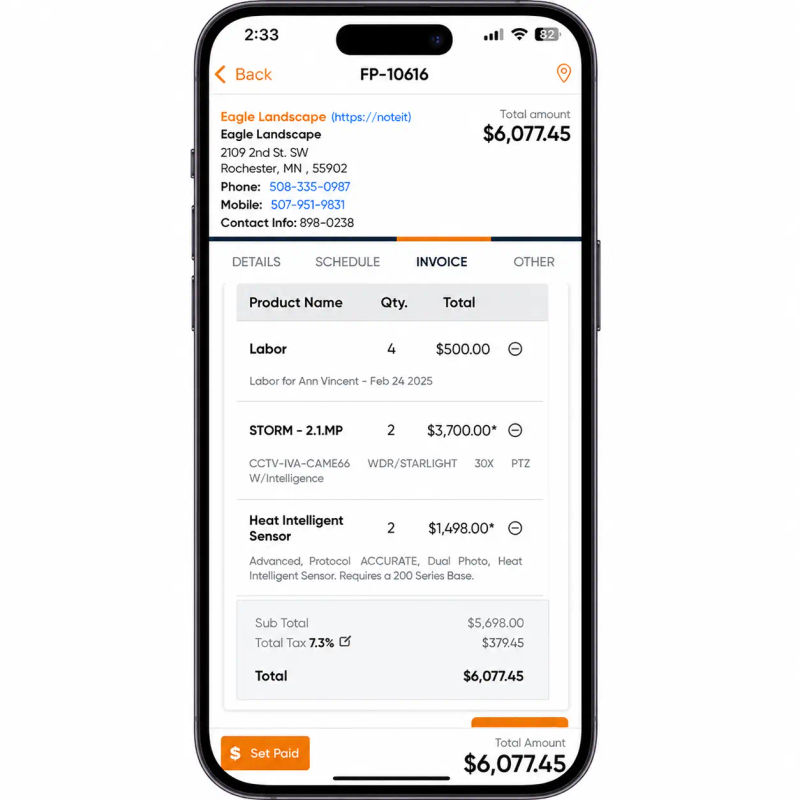
Step 1: Does DRC apply here?
Run the four-condition test. If any condition fails, charge VAT normally.
Step 2: State DRC on the invoice
Insert: "Reverse charge: VAT Act 1994 Section 55A applies. Customer to account for VAT to HMRC." Put it near the top of the line-item block and again near the total.
Step 3: Include buyer and seller details
Both parties' legal name, address, and VAT registration number. A wrong or missing VAT number is the easiest way to fail an HMRC check.
Step 4: Describe the services clearly
Specific enough that an HMRC inspector can match it to a CIS construction operation. "Plumbing work" is too vague. "Installation of central heating system, ground floor, 24 Bridge Road" is fine.
Step 5: Show the amount, but not as VAT collected
Show the net amount and the VAT that would have applied (20% or 5%). Make it clear the VAT figure is for the customer's accounting, not for payment to you. The total payable is the net only.
Step 6: Verify both VAT numbers
Use the HMRC online VAT number checker. Save a screenshot or note the check date in the customer record.
Step 7: Record the DRC transaction
Tag the transaction as DRC so it maps to Box 6 (not Box 1). Most accounting platforms support this natively if configured.
Step 8: Configure the invoicing system
Fix the configuration once rather than working around it on every invoice. The QuickBooks integration supports DRC tagging natively, so the flag carries through from dispatch to VAT return.
Step 9: Add the compliance language line
Restate, near the total, that the customer is responsible for VAT reporting and remittance. Redundancy survives forwarded emails, screenshots, and partial OCR scans.
How do you report DRC on your VAT return?
Per HMRC Notice 735, sections 7.7 and 8.5:
As the supplier (subcontractor):
- Box 1: leave blank for DRC supplies.
- Box 6: include the net value of DRC supplies.
- Box 4 and Box 7 unaffected.
As the customer (main contractor receiving DRC supplies):
- Box 1: include the VAT amount you would have been charged.
- Box 4: include the same VAT amount (subject to normal recovery rules).
- Box 7: include the net value.
- Box 6 unaffected.
Worked example. A plumbing subcontractor invoices £8,400 net for a heating install; VAT would have been £1,680.
- Subcontractor's return: Box 6 = £8,400, Box 1 unchanged.
- Main contractor's return: Box 1 = £1,680, Box 4 = £1,680, Box 7 = £8,400.
The most common mistake: shops putting the DRC sale value in both Box 1 and Box 6 because the invoice "looks like" it has VAT on it. It doesn't. The VAT line is disclosure, not collection.
Where field service software fits in
A field service tool that handles DRC well flags customer VAT/CIS status on the customer record, carries that flag from estimate to invoice automatically, inserts the Section 55A wording without retyping, and maps the right VAT return boxes through to accounting. Field Promax does this for construction software, HVAC, electrical, and other CIS-affected trades.
DRC removed the working-capital cushion VAT used to provide. The only way to defend cash flow now is faster, cleaner invoicing. Shops that flip to on-site mobile invoicing get the invoice in front of the customer within 10 minutes of wrap-up and report getting paid roughly 2x faster.
For more information, contact Field Promax
We're here to help you get started
Conclusion
DRC is overhead, not opportunity. Handle the mechanics cleanly inside your dispatch-to-invoice workflow and the rest of the business gets to keep doing the work.
Frequently Asked Questions

Content Creator
Bhargavi Halthore is a content writer at Field Promax, a field service management platform serving trades businesses across the USA and Canada. With over a decade of experience writing for business owners, she brings detailed, ground-level insight to every topic she covers. Her research goes beyond search results - she digs into LinkedIn groups, Facebook communities, and Reddit forums to understand what field service business owners are actually dealing with on the ground. She speaks directly with industry professionals, understands their day-to-day challenges, and translates that into content that is practical and actionable. What you read in her articles reflects real industry patterns, not theory.