Free Estimates for Field Service: When to Charge, When to Absorb the Cost

It’s Tuesday afternoon. The owner is caught between an emergency call and a demolition bid that needs to be submitted. A homeowner from yesterday has already sent two text messages asking where the quote is. The numbers? They are still sitting on a yellow pad in the dispatcher’s truck. The proposal gets written that evening. It arrives in the customer’s inbox three days later, by which time two competitors have already submitted their quotes.
This gap between walking the job and sending the proposal is where many “free” estimates end up costing you money. Industry data suggests that the average contractor quote-to-job conversion rate is around 74%. Every day a quote sits in a drafts folder can reduce the likelihood of closing the job. For a typical 5-20 tech shop, moving from a 3-day turnaround to same-day digital estimates can significantly improve win rates. That's the real economics of the free-estimate question, not whether to charge $50 at the door.
On Quora and contractor subreddits, the same gripe shows up over and over: how do you price a job when the scope and labor hours are not fully known during the site visit, without guessing low and bleeding margin or padding the price and losing the bid? This piece walks through what a free estimate actually costs, when an estimate charge makes sense, how shop prices work across HVAC, plumbing, electrical, landscaping, and roofing, and the on-site workflow that turns a walkthrough into a signed proposal before the technician leaves the driveway.
What a free estimate actually means, and what it costs to produce
Let’s start with what "free estimate" actually means, because that is what most homeowners have in mind when they think about hiring a contractor. A free estimate is typically a ballpark quote prepared after sizing up the project over the phone, through photos, or during a brief site visit. It usually includes the visible scope of work, a labor estimate, and a parts list. It does not include engineering drawings, Manual J load calculations, diagnostic teardowns, or any evaluation that takes more than 30 to 45 minutes beyond the initial visit.
The problem is that it can get messy. Customers often read an estimate as a fixed price. Operators, on the other hand, may view it as a best estimate based on what is visible before the work begins. Once a wall is opened or hidden conditions are discovered, the scope can change. This is one of the most common issues we see. That is why the language used in your documents - whether you call it an estimate, quote, proposal, or contract - is more important than most companies realize.
What a free estimate means to the customer and what it means to the contractor are often two very different things. Get clear on that free estimates meaning gap early, and you can prevent most disputes before they start. And the “free” part may be the biggest misconception in the room. Here’s what actually goes into producing one:
- Scope check at the site: 30-90 minutes of a technician’s or owner’s time.
- Drive time and fuel: The estimate often takes longer to prepare than the site visit itself.
- Number crunching: Material costs, labor hours, margins, and contingencies.
- Template overhead: Follow-up calls, proposal preparation, disclaimers, and administrative work.
A free estimate for a residential installation typically costs $150–$300 in labor, administrative time, and overhead before a customer signs anything. Commercial projects can cost substantially more.
The math gets more complicated from there. Industry research suggests that roughly 40% of contractors underestimate labor requirements by 10% or more when relying on manual estimating methods. This is where margins begin to leak. A 5% labor shortfall combined with a 7% material overrun can easily push a project 15% or more above the original estimate. The "free" estimate isn't free at all. It's a margin leak with a polite cover letter.
Industry norms across HVAC, plumbing, electrical, landscaping, and roofing
Every trade plays by its own rules. And those rules matter when you're deciding where to land. So do estimates cost money in your trade? Depends which one you're in.
- HVAC. Residential install bids and tune-up quotes are almost always free. Commercial work with Manual J load calculations or rooftop unit assessments often carries a $150 to $500 diagnostic fee, credited to the install if you win it. Shops on HVAC estimating software tend to bake that fee into the proposal price instead of billing it separately.
- Plumbing. Service-call diagnostic fees ($79 to $149) are standard, with the repair estimate rolled in. For repipes or sewer-line jobs, the visit is free; the engineered scope is where the money lives. Across plumbing business software setups we see, dispatchers lose the most time when the diagnostic write-up never makes it cleanly to the quote.
- Electrical. Free estimates are common for residential panel replacements and other small projects. Commercial work involving NEC code compliance, service upgrades, or load calculations typically requires a paid assessment because the customer receives a detailed report and professional analysis.
- Landscaping and lawn care. Estimates for seasonal contracts are usually free. Design-driven work, such as hardscape and irrigation projects, typically carries a consultation fee of $50–$300, which is credited back if the client signs the agreement.
- Roofing. Replacement estimates are typically all-inclusive because the trade is built around high-volume bidding. In this segment, free estimate offers are essentially table stakes. Insurance claim work is a separate category, often tied to Xactimate pricing and documentation requirements.
Region matters as well. In larger metropolitan markets, customers are often more accustomed to paying for estimates and consultations. In smaller markets, many customers still expect the initial estimate to be free. A shop that charges $75 for a walkthrough in a town of 30,000 people could see call volume decline significantly within a single quarter. Read the room before you read your rate sheet.

How to price an estimate, including the ones that don't close
The math comes down to three factors: what it costs you to produce an estimate, your estimate-to-job conversion rate, and how much of that cost you want closed jobs to absorb. Whatever estimating model you choose, the cost of producing estimates must ultimately be covered by the jobs you win. Estimates that do not convert still carry a cost. That is simply part of the economics of the business.
1. Fixed vs flexible pricing
Fixed pricing is easy to explain. The downside is that it can lose money on large or complex scopes. Flexible pricing aligns the cost of estimating with the amount of work involved, but it can be harder to justify when a customer sees a competitor charging less. Most multi-trade shops we work with use a hybrid approach: free walkthroughs below a certain dollar threshold and paid assessments for larger or more complex projects.
2. Five pricing models for the estimate itself
- Hourly assessment fee at your shop rate.
- Flat consultation fee credited to the final invoice.
- Cost-plus on the diagnostic.
- Retainer for property managers and commercial accounts.
- Value-based pricing for design-driven work.
3. Counting the overhead
Drive time, fuel, vehicle wear, software, dispatcher time. All of it belongs in the cost stack. Most shops badly lowball the soft cost. Tracking it for one month is the single most useful exercise you can do this quarter. The job costing module is where that tracking has to live, continuously, not in a one-off spreadsheet.
4. Setting profit margin
Include your direct costs. Factor in your estimate-to-job conversion rate so that the jobs you win cover the cost of the estimates that do not convert. Then add the margin you want to achieve. If your close rate is 30 percent and you need a 20 percent net margin, the math becomes difficult. At a 60 percent close rate, you can afford to provide many more estimates for free. The real question behind “How do I calculate my estimate cost?” is “What is my close rate?”
When charging for estimates makes sense, and when it backfires
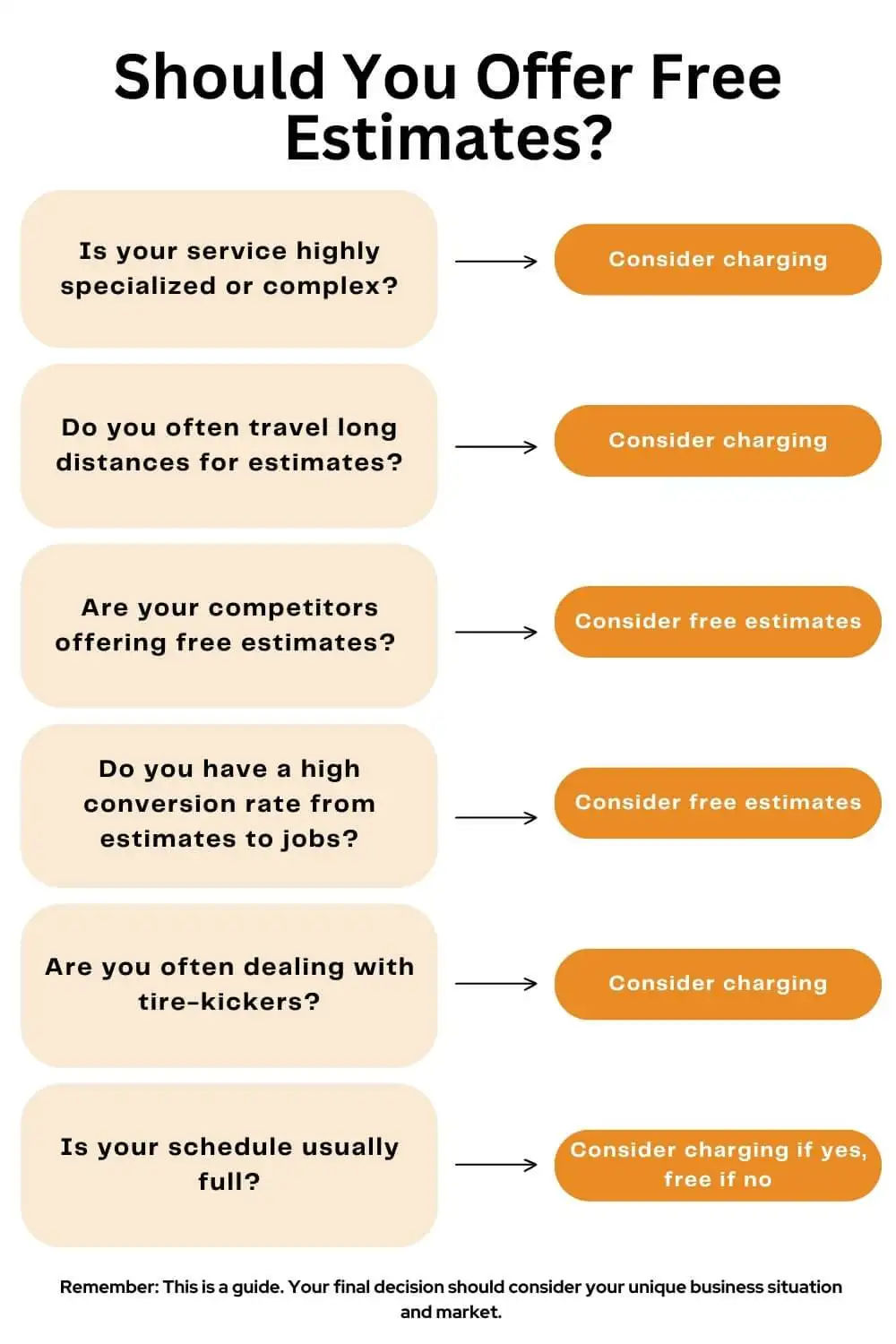
An estimate charge filters tire-kickers and signals expertise. It also costs you in call volume. Which way the trade-off tips depends on your current close rate.
1. When charging tends to work
- Commercial scopes require actual engineering work.
- Diagnostic work where the value lies in the evaluation itself (such as refrigerant leak detection, intermittent electrical fault diagnosis, or sewer camera inspections).
- Design-driven trades where the outcome is a written plan.
- Long-distance jobs where travel time outweighs the probability of winning the work.
- When you're booked for the year and have to decide on a priority.
2. When charging tends to backfire
- Residential service work in price-sensitive suburban markets.
- New customer acquisition for younger shops that are still building reviews.
- Trades where the regional norm is to provide estimates at no cost, such as residential roofing.
- Jobs where competitors charge for the estimate as a marketing line item. If everyone in your zip code runs a free estimate offer, charging puts you on the back foot.
So how much should I charge if I go the paid route? Paid estimates range from $50 to $750, depending on the trade and the complexity of the work, with some commercial estimates reaching the low tens of thousands of dollars. A credit-toward-the-final-invoice structure keeps the "free if you hire us" perception while protecting your time. It is often the best arrangement for both parties.
This is the part that nobody talks about. Switching to paid estimates after years of offering them for free often causes a 6 to 10 week decline in call volume, followed by a recovery that produces a higher-quality lead mix. The shops that gave up in week 4 are the ones that didn't survive the switch.
Scripts for talking money without losing the customer
If you charge, disclose before the visit, never on the invoice. The single biggest predictor of disputes? Fee language that shows up after the work is done. Surprise fees don't read as professional. They read as a trap.
This is upfront pricing done right: tell them the number before the truck rolls. Where to disclose it:
- On the services page of your website.
- In the booking confirmation email or via text.
- During the scheduling call, state the fee clearly.
- In the estimate document itself.
A scheduling script that works well is: "Our visit fee is $95, which includes diagnostics and a written estimate. If you choose to move forward with us, the $95 will be deducted from the final cost. Does that work?" Customers who object typically raise their concerns during the call. That is exactly where you want the objection to occur, not after the tech has driven 40 minutes.
Document language is also important. Discussions about contractor-client disputes tend to reveal the same pattern repeatedly: the client interprets the estimate as a fixed binding price, while the contractor views it as a scope-dependent projection. The solution is straightforward. Clearly identify the document type at the top ("Estimate, Subject to Discovery" vs "Fixed-Price Quote") and include the assumptions that, if wrong, could affect pricing.
For customers pushing back on the fee, the best comeback isn't a discount. It's specificity. Walk them through what the $95 buys: diagnostic report, part numbers, photos. That kind of transparency builds trust before the work even starts. The ones who still object weren't going to hire you anyway.
Six steps to an estimate that closes
Free visit or paid, the estimate itself is the close. A repeatable process moves a 5-20 tech shop from median 74% conversion into the top-quartile 80%+ band. Here's the play:
- Listen first, measure second. Ten minutes of customer-related questions before the tape measure comes out.
- Photograph everything. Existing conditions, access constraints, all of it. Photos have ended more disputes than any disclaimer language we know of.
- Use a checklist by trade. Reusable templates close the gap between Newbie Nick and Expert Emma.
- Triple-check the math. Labor hours, in particular. The 40% underestimation pattern shows up right here.
- Present in person if you can, same-day if you can't. A walkthrough with the homeowner sitting beside you can be completed much faster than sending a PDF three days later.
- Build in the obvious upsell. One stated optional line item the customer can either accept or decline. The option is often priced at nearly half the cost of the standard scope, but requires virtually no additional selling effort.
Reusable templates and e-signatures are two of the mechanisms that help shops move into the top quartile bands. Neither requires a complete overhaul of existing processes. Both require techs to work from a mobile app. That's the key difference.
The on-site estimate workflow that closes before the tech leaves the driveway
A free on-site estimate only pays off if you produce it fast enough that speed becomes the close. Here's the on-site workflow we see working:
- Customers can request a quote online or over the phone.
- Dispatcher uses scheduling and dispatch to assign the closest qualified tech, with route and ETA pushed to the customer's phone.
- Tech arrives with customer history, prior service notes, and reusable templates pre-loaded on the field service mobile app.
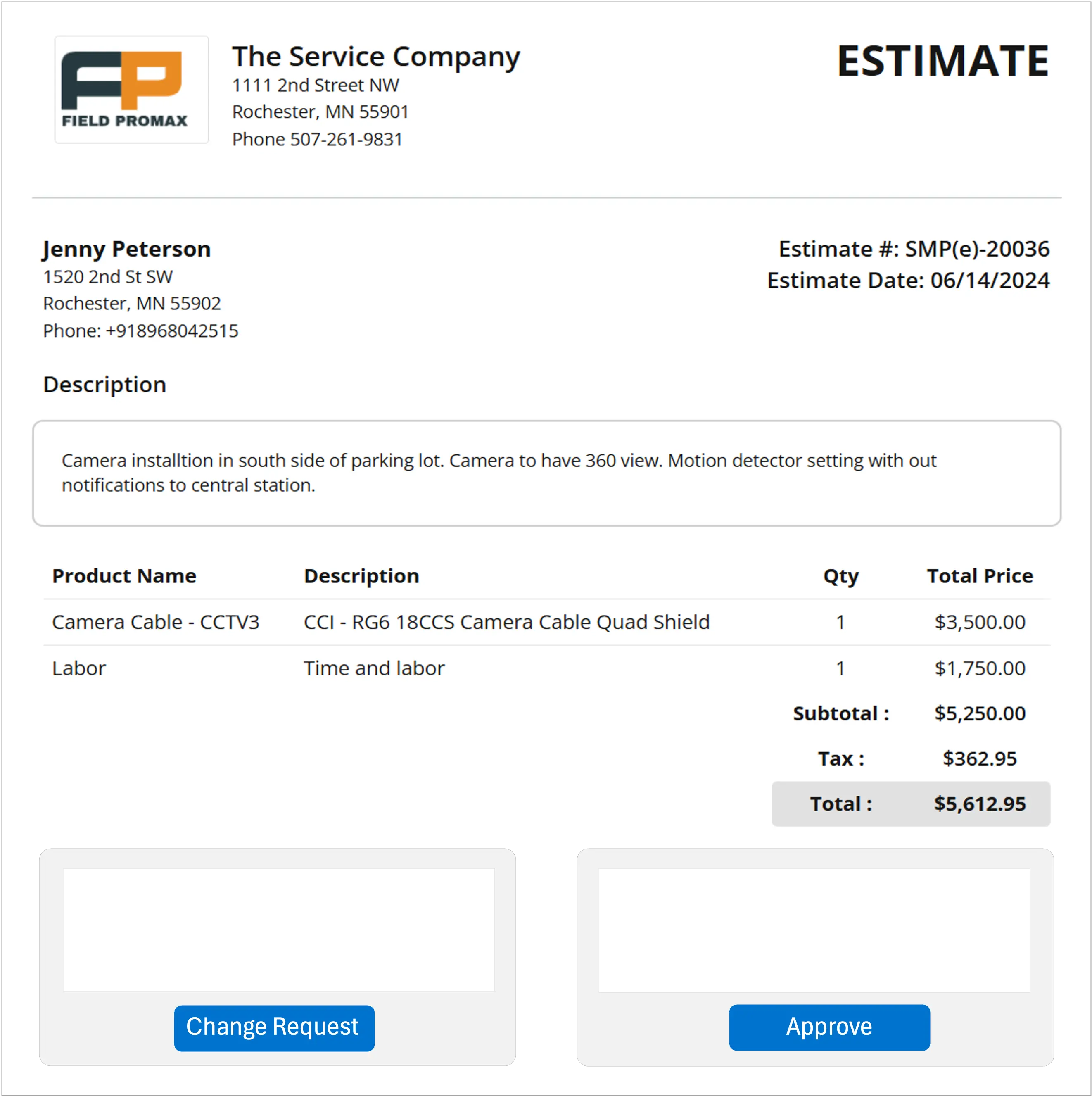
- During the on-site visit, the technician captures the job details, creates the line-item estimate in the app, and walks the customer through it using the same device.
- Customer e-signs on the device before the technician leaves. The signed estimate is then synced with the office in real time.
- Approved estimates convert to scheduled work and, on completion, to invoices in one click through invoicing software and QuickBooks integration.
Steps 4 and 5 happening at the customer's address, not back at the office, is the move that matters. The data backs it up hard: paper subcontracts in construction services take an average of 30 days to come back signed, versus about 2 days for e-signed documents. The estimate that closes at the kitchen table doesn't sit in anyone's drafts folder. That's the whole point of a free on-site estimate built right.
The thing I push back on with owners who ask whether to charge for estimates is that they're asking the wrong question. The real question is how fast can you get a signed estimate back into the office. Every day a quote sits unsent costs roughly 7% of the close rate. From 14 years of customer conversations, the shops that win aren't the ones charging a $75 diagnostic fee.
They're the ones whose techs build a line-item estimate on the tablet at the customer's address, get a signature before they leave the driveway, and have it sync to the dispatch board by the time they're back in the truck. Charge or don't charge is a marketing decision. The operational decision is turnaround speed, and that's where most shops we talk to are still losing money on free estimates.
- Joy, Founder, Field Promax
Tools that move estimate to invoice in one workflow
The pieces that actually matter:
- Estimates and quotes with reusable templates per job type and trade.
- Mobile app for on-site build, photo capture, and e-signature.
- Scheduling and dispatch tied to the same customer record.
- Invoicing with one-click conversion from an approved estimate.
- QuickBooks integration so the office never re-keys.
- Reports and dashboards tracking conversion by tech and job type.
- Job costing feeding real margin numbers back into your next estimate template.
An early Field Promax adopter on the QuickBooks App Store described the platform as flexible with estimates and work-ticket flow, and especially easy for QuickBooks Online users moving off spreadsheet-and-paper. This is the typical starting place. Most shops adopting digital free-estimate workflows are coming from spreadsheets, paper, or QuickBooks-only setups, not from other field-service platforms.
Calculators close the gap between back-of-envelope guessing and a defensible proposal: a salary-to-hourly calculator and a profit margin calculator. For owners already running QuickBooks, estimate templates inside QuickBooks are a workable starting point, right up until the workflow outgrows them and demands a dedicated field-service layer.

A pattern across multi-trade operators we've worked with
Across multi-trade operators since 2018, the recurring failure isn't the software. It's the dispatcher running an HVAC board in one tool and a plumbing board in another, then eyeballing the overlap. Take an owner running HVAC and plumbing crews with a dispatcher and roughly two dozen technicians in a mid-sized Midwest metro area. What you'll notice on a Tuesday morning is that technicians are assigned to a tune-up while the same address is already on the plumbing board for a rough-in, and the estimating terminology between both trades isn't compatible when the scope overlaps.
In the spring, this shop had double-booked techs whose licenses covered both trades, because the dispatcher maintained two separate calendars and then reconciled them from memory. Estimate disclaimers made it worse. HVAC estimates carried weather and equipment availability language. Plumbing estimates carried material-assumption language. When a scope involved both trades, such as a repipe near an air handling unit, customers pointed to whichever disclaimer favored their position. By midweek, there was no trust in either calendar.
The owner then collapsed both boards into a single shared calendar, which the dispatcher operated exclusively from, and required every booking to be entered there, even when techs tried to push back. Additionally, he revised the disclaimer template to cover exclusions for both trades: scope of work, material assumptions, weather conditions and access contingencies.
The double bookings stopped completely after a rough first month, during which the unified calendar exposed issues that had been buried for a long time. The disclaimer required two revisions following a customer complaint that a water damage exclusion appeared overly broad. The plumbing foreman held out on calendar adoption for most of the first quarter, while the rest of the team adapted more quickly. The new tool didn't fix the shop. Making everyone use one surface did.
This is a composite anchored to the most common version of the pattern. Specifics vary. The structural failure with " , split boards feeding mismatched estimated language, does not.
What this means for your shop
The free-vs-paid call matters less than it looks. The decisions that actually move close rate:
- If the estimate is sent to the customer the same day.
- If the document clearly identifies what type it is and outlines the assumptions that, if changed, could affect the cost.
- If your tech has templates, photos, or signature capture in the mobile app, it helps close the communication gap.
- If conversions are tracked by per tech and per job type, you'll know which services or scopes are leaking revenue.
- If accepted estimates flow directly into scheduling, invoicing, and QuickBooks without re-entering data, administrative efficiency improves significantly.
If you're charging before the visit, credit that amount to the invoice when the customer signs, and use the fee to deliver a higher-quality experience. If you don't charge, the math only works when your turnaround speed and estimate accuracy are good enough to offset the cost of estimates that never convert into paying jobs.
Sources consulted: Capital One Shopping's online-reviews research, Help Scout's customer-service statistics, our service project proposal guide, and 14 years of customer conversations with shop owners across HVAC, plumbing, electrical, landscaping, and roofing.
What real operators say, and the numbers behind it
It's not necessary to take our word for it. Tradespeople have been debating this issue for a long time, and their honest voices are more valuable than any benchmark.
One electrician on a trade forum shared his first experience charging $30 for a trip instead of offering a free consultation. He called it 'free estimate withdrawal,' heart pounding as he fought the urge to redial and take it back. He stuck with the charge. Only after losing money the old way did he finally change how he ran his business. Another contractor put it plainly: for price-shoppers who never intend to buy, you're paying for estimates one way or another. The customer always covers the cost, whether it's a separate line item or buried in your pricing.
The benchmarks line up with what those operators learned the hard way:
These figures come from industry data on contractor conversion rates, estimated production costs, and e-signature turnaround in construction services.
The pattern is hard to miss. The shops that track these numbers stop guessing whether free estimates pay off. They know.
| Estimate KPI | What it tells you | Benchmark |
| Quote-to-job conversion | Share of estimates that close | Median ~74%; top quartile 80%+ |
| Cost per residential estimate | Time + direct expense to produce one | $150-$300 |
| Daily delay penalty | Close-rate lost per day a quote sits | ~7% per day |
| Labor underestimation | Contractors lowballing labor 10%+ | ~40% of contractors |
| E-sign vs paper turnaround | Days to a signed document | ~2 days vs ~30 days |
Conclusion
Whether you charge is mostly a pricing call. What actually moves the needle is how fast you turn a walkthrough into a signed estimate. Shops that win the free-estimate game treat that walkthrough as a sales close, not a research project.
Field Promax gives small trade businesses one place to create estimates quickly, get them signed at the kitchen table , track which ones close, and convert winning estimates into invoices without having to re-enter the entire job. Plans start at $99 per month for a single user and scale as your crew grows.
Frequently Asked Questions

Content Creator
Bhargavi Halthore is a content writer at Field Promax, a field service management platform serving trades businesses across the USA and Canada. With over a decade of experience writing for business owners, she brings detailed, ground-level insight to every topic she covers. Her research goes beyond search results - she digs into LinkedIn groups, Facebook communities, and Reddit forums to understand what field service business owners are actually dealing with on the ground. She speaks directly with industry professionals, understands their day-to-day challenges, and translates that into content that is practical and actionable. What you read in her articles reflects real industry patterns, not theory.
Reviewed by

Founder and CEO
Joy Gomez is an engineer, process automation expert, and the Founder of Field Promax. Known for his technical expertise and commitment to field service innovation, Joy writes about transforming traditional business models into paperless, efficient operations. He is a Lean Six Sigma Black Belt based in Rochester, MN, dedicated to helping field professionals work smarter through better technology.