How to Prevent Property Damage in Field Service Jobs
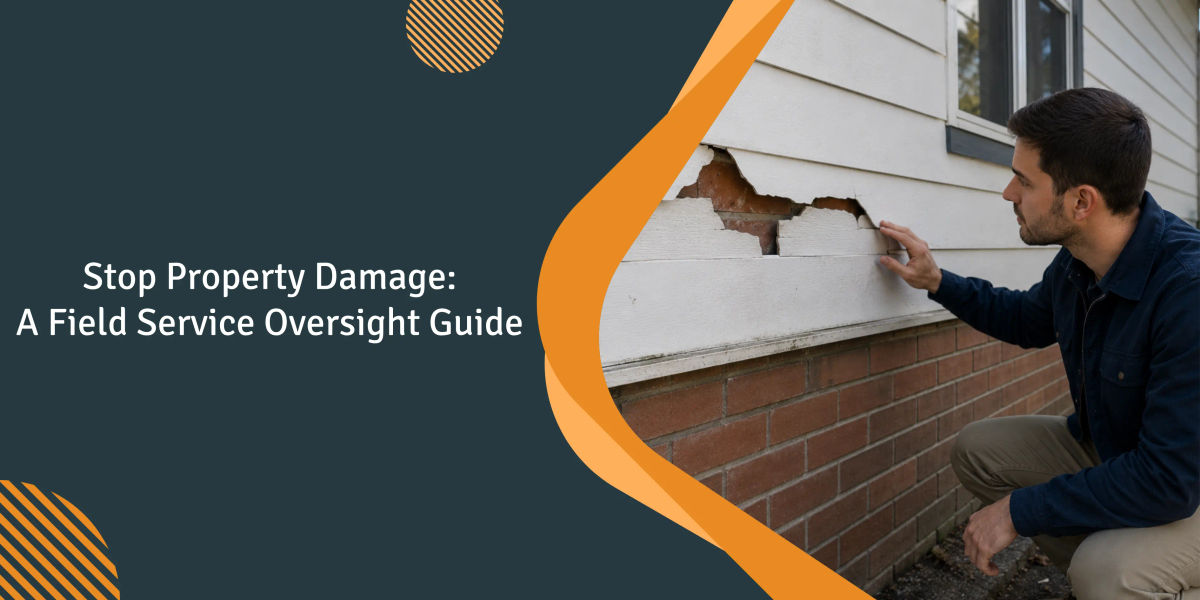
Where property damage actually happens on service calls
According to the Insurance Information Institute, 97.3% of U.S. homeowners insurance claims in 2023 were property damage related. When a technician cracks a tile or drops a compressor on a hardwood floor, the claim that follows almost never gets settled on the tech's word. It gets settled on the paper trail: the pre-task JSA, the before-photos, the timestamped work order, the signed customer walkthrough.
The paper trail is often the first thing to break under pressure. Contractor discussions online over the past year reveal the same issue: Job Safety Analyses (JSAs) are created ad hoc on paper, repeated with every new hire, and never stored in an organized system that anyone can retrieve six months later. When an OSHA compliance officer arrives or an insurance adjuster requests the pre-task documentation for a five-figure property damage claim, the binder in the truck is missing the required records.
This article explains where property damage occurs in field service work, the OSHA-referenced practices that help reduce those risks, and how small to mid-sized businesses can build the oversight system and audit trail before an audit ever happens.
A pattern across multi-trade contractors in Texas
Across roughly 30 to 40 mid-sized multi-trade firms we work with in Texas with field workers who are subject to OSHA safety rules, we've been watching the same story unfold through audits or serious complaints.
The shop is staffed by between 20 and 40 technicians in plumbing, HVAC, and electrical. Safety training is conducted regularly: toolbox talks every day, JSAs on-site, and PPE checked before crews leave the yard. The issue is the documentation. Paper JSA sheets are packed into binders in trucks. Sign-in sheets are kept in a file in the operations manager's office. Certification renewals are recorded in a spreadsheet that is regularly updated by the person responsible for tracking them.
Then, the audit comes. In one case, an OSHA compliance officer arrived at the workplace and requested training records for the employees working on commercial jobs. The contractor was able to prove that the training had been conducted. Supervisors were able to identify the dates, topics, and participants. The only thing they were unable to do was locate the signed documents in the format required by the inspector. This gap in the recorded documentation, not a gap in the actual training, a penalty of thousands of dollars.
The solution that worked was structural. The leadership team moved JSAs, training records, and certification tracking records out of bound books and into a central digital system that recorded signatures, completion dates, and certification renewals for each technician and made them retrievable on demand. The audits that followed were successful, and records were retrieved in minutes rather than days. Crew members initially resisted the additional sign-off step, and office personnel spent months entering historical data until the system was fully up to date.
The 5 damage categories that generate the most claims
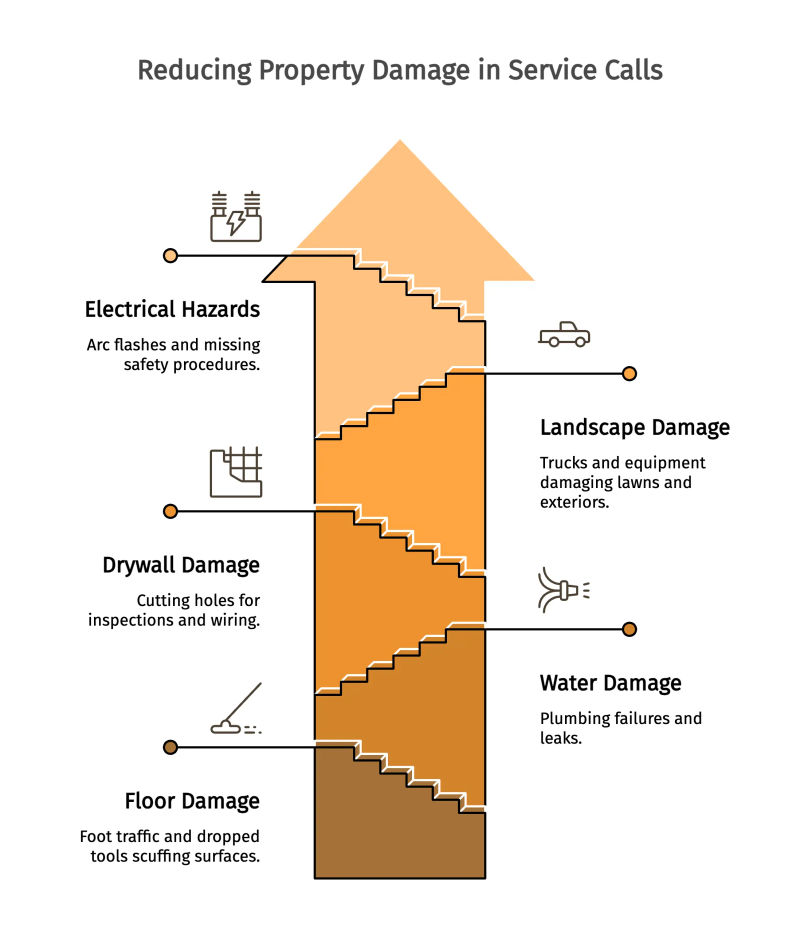
In 14 years of conversations with customers, the events that eventually become insurance claims or OSHA citation clusters generally fall into five categories, roughly in this order of frequency:
- Floor and carpet damage from foot traffic, boot scuffs, dropped tools, or equipment dragged across finished surfaces. Carpet cleaning, HVAC, and plumbing shops report this as the top informal-complaint driver even on jobs that went well.
- Water damage from plumbing work: a supply-line failure during replacement, a dropped SharkBite fitting, or a valve check skipped on a Friday afternoon. Industry-focused contractor analyses put a single pipe failure at $40,000 to $200,000 in exposure.
- Drywall and access damage caused by cutting holes for inspections, running new line sets, and fishing wire. Most of the time, it is recoverable through patch billing; however, it can lead to disputes if the pre-work walkthrough did not document the existing conditions.
- Landscape and Exterior Damage caused by trucks parking on lawns, stepping on flower beds, or placing equipment against gutters and fascia.
- Electrical and fire hazards such as arc flash exposure during panel work, missing lockout/tagout procedures, and PPE that is not properly rated. This is the highest-risk category in terms of financial impact and regulatory exposure.
What quality control looks like in a service business
Controlling quality in a factory means measuring Six Sigma defect rates on identical products. In an HVAC or plumbing shop, every job is a one-time event in a customer's kitchen or mechanical room. The controlling factor is the people, not process yield.
Four field-service-specific KPIs predict property damage risk better than any single-point checklist:
- First-time fix rate. Industry benchmarks place median first-time fix rates at around 72%, with the highest quintile averaging 76% and the lowest 55%.
- Callback rate. HVAC callback rates range between 2% and 2.75% of service calls, with each callback costing $150 to $300.
- Damage incidents per 100 completed jobs. Nearly no shop monitors this, which is why very few know its true extent.
- JSA completion rate before work-order close. The main indicator that links the system to completed work orders.
What field service can learn from professional movers
Moving crews work in confined homes and offices, carrying awkward, heavy objects through tight spaces, where one dropped cabinet can cause a five-figure expense.
Before work: the crew identifies the room layout, delicate items, and the moving sequence before the truck is parked. During work: one employee watches how items are wrapped and moved out of the room, not just loaded into the truck. After work: conduct a walkthrough with the customer before the truck leaves.
In an HVAC or plumbing shop, supervision begins when the technician rings the doorbell. Assess surface protection, tool lists, existing conditions, and customer expectations. If a supervisor participates through a mobile app, property protection is verified before work begins, not after a wall has been damaged.
How JSA turns OSHA compliance from a binder into a workflow
OSHA does not require a specific JSA form. What it requires, under the General Duty Clause and 29 CFR 1926.21(b)(2) for construction, is that employers provide a workplace free from recognized hazards and train employees to spot them. OSHA Publication 3071 is the agency's primary guidance on the Job Hazard Analysis technique.
Five steps of the JSA workflow are directly linked to a field-service job:
- Prioritize and select tasks that have the highest risk of injury (panel work, roof access, chemical exposure, confined spaces, and live-line work).
- Break each task down into sequential steps.
- Identify the risks at every step: electrical shock, falls from height, chemical burns, and struck-by hazards.
- Choose controls using the hierarchy of controls: elimination, substitution, engineering controls, administrative controls, and PPE.
- Review the plan with the team before implementation, and update it whenever the job or crew changes.
In an 8-tech operation, every tech spends about five hours a week on safety and compliance documentation when JSAs, toolbox talks, incident logs, and certification renewals are managed on paper. Businesses that move these forms into an automated compliance workflow reduce that time to less than one hour per tech each week because the system fills in known information, timestamps the form, and files it with the work order the moment the tech presses Submit. The document becomes the audit trail.
The dispatch pressure that produces most damage
Damage incidents concentrate under time pressure. When work orders stack up and a tech is running an hour behind, the same steps get skipped: the pre-task walkthrough, the drop cloth, the tool verification, the pre-existing damage photo. Not because the tech doesn't know better, but because the next customer waiting is real and the drywall crack hasn't happened yet.
Better dispatch loads help. Monitoring milestones (arrival, diagnosis, customer sign-off, and cleanup completed) instead of just raw minutes helps. Requiring a walkthrough at the start of every job as a mandatory step that cannot be skipped helps the most. The time it takes to lay down a drop cloth is the difference between a $9 protective sheet and a $2,000 hardwood floor refinishing job.
Why feedback loops fail without structural change
The post-incident review that ends with "talk to the technician" does not produce lasting results. If a technician has damaged an item, the question is not whether they were negligent. The question is whether they were assigned to work alone when the task required two people to lift. Whether the pre-task JSA identified the fragile surface. Whether the required tool was present on the truck.
Constructive feedback closes a loop only when it changes a dispatch rule, training module, tool spec, or JSA template. A scuffed door frame is a signal for better planning, not a reason to shame someone.
Clear ownership and concrete expectations
Owners on Quora discuss the same issue: no one actually owns compliance in a small field service business. Department heads assume that the ops manager is responsible for the information. The ops manager presumes the owner has it. Nothing gets done until a situation forces someone to ask. The answer is to place responsibility clearly. Managers set the policies and give tools (software, trucks, PPE budget). Supervisors watch the work, make sure technicians follow the rules, and escalate issues they cannot manage.
"Be careful" is not a strategy. Expectations that stick are written into the JSA template, shown as photos in the mobile app, and reinforced in a two-minute toolbox talk before the crew leaves the yard. If a tech cannot explain the safety plan back to the supervisor, they do not understand it, and that gap is easier to catch at the yard than at the client's front door.
The accountability data every shop should track
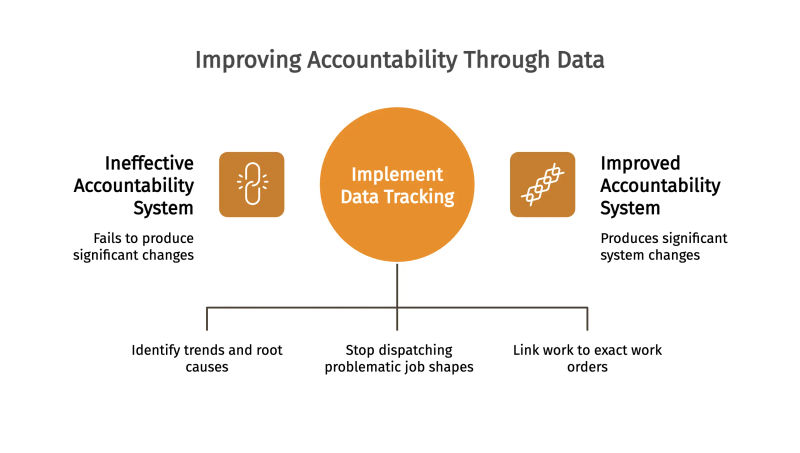
The accountability system fails when it stops producing real change. The information the oversight system records (incidents, close misses, and corrective actions) only applies when it is compiled into patterns.
When a shop reviewed damage incidents in the reports dashboard and found roughly two-thirds landed on Friday afternoons on jobs routed after 3 pm, the answer was not to yell at Friday-shift techs. It was to stop dispatching that shape of job in that window. When crews see reports lead to smarter dispatch instead of criticism, trust compounds.
An HVAC contractor who reviewed Field Promax on the QuickBooks App Store, with timecards enabled, said the tracking was simple and precise. Timecard-linked work ties each job to an exact work order and job site, which makes resolving a damage claim easy when the customer contacts the shop three weeks later.
Safety is a KPI, not a poster
According to BLS 2024 injury and illness data, plumbing, heating, and air-conditioning contractors run a nonfatal recordable rate of 3.0 per 100 full-time workers, above the 2.3 private-industry average; electrical contractors sit at 1.8. Fall protection under 29 CFR 1926.501 has been OSHA's #1 cited violation for 14 consecutive years, with 6,307 citations in FY 2024. Shops with the lowest recordable rates are the ones where the pre-task JSA is a required work-order step, not an optional one.
The National Safety Council pegs the average cost of a medically consulted work injury at roughly $43,000 in 2023, and a single recordable in a 20-40 tech operation can wipe out a quarter of the annual safety-program budget once indirect costs stack at the typical 3-5x multiplier.
Data and inspections without the clipboard
It is impossible to test anything if the information is stored on a coffee-stained clipboard at the rear of the van.
For a typical shop with 5-20 employees that runs paper JSAs, only about 60% of the pre-task safety forms are fully filled out and legible by the end of the week. Shops that convert to the digital JSA module with mandatory fields and missed form alerts increase completion rates to 95% because the tech is unable to close the order without submitting the form.
Create a site walkthrough checklist that reflects the actual work. Take note of flooring protection, equipment location, and clearances. Feed the findings into training. A supervisor who stops for thirty seconds to show a safe lift is more valuable than an hour of safety training a month later.
Training and technology that reinforce the JSA habit
New-hire orientation is heavily based on shadowing and apprenticeship, and workers operate without standardized reports, so supervisors can't easily determine who is trained on what. Skilled trades can see high turnover, while mechanical contractors with formal safety-first programs see about 20% less turnover than their peers. Shops that have JSAs documented as well as toolbox talks and continuing safety training are the ones that have the senior techs stay with them beyond the three-year mark.
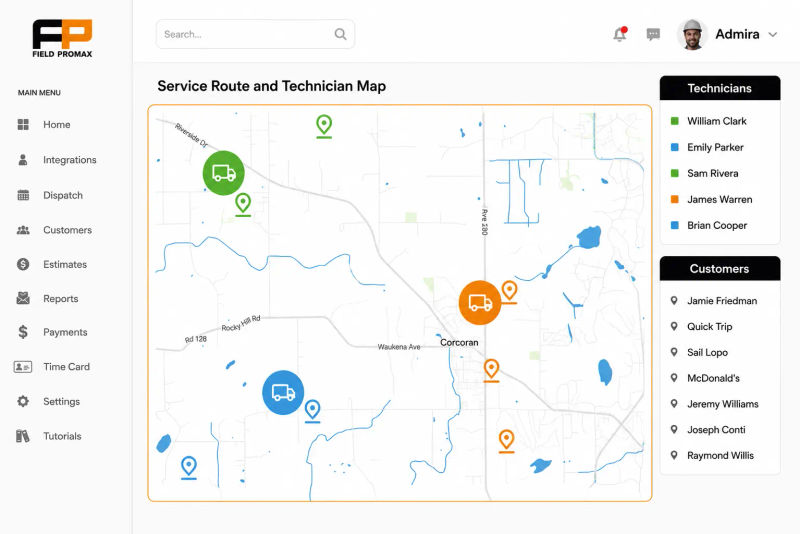
Technology makes that documentation live. Mobile forms replace paper. Photo documentation before and after each job produces the defense against disputed claims. GPS tracking turns "the tech says he was there" into a timestamped route log. Real-time flags let a supervisor coach mid-job instead of reviewing damage after.
I read every support ticket that comes through Field Promax, and the ones about JSA and compliance features tell you exactly what the enterprise FSM tier misses. Most shops adopting a mobile compliance workflow are not switching from a competing platform. They are coming off paper binders, spreadsheets, and QuickBooks-only setups.
The question is not which enterprise system logs OSHA-aligned forms best. It is whether the tech on job number six of the day will actually complete the pre-task JSA when the customer is standing in the driveway. What we hear from HVAC and plumbing owners is that mobile-app adoption predicts oversight success more than any feature checkbox. If the tech does not open the app at the truck, the JSA does not happen and the audit trail does not exist. Every product decision on the compliance side runs through that filter.
- Joy Gomez, Founder of Field Promax
Customer communication as the final oversight layer
Oversight extends past the crew. When clients know what is happening before it happens, misunderstanding-driven claims drop. Pre-work: explain access needs and protection steps in plain English. During: brief updates when equipment moves or the water goes off. Post-job: walk it with the customer before the truck leaves, so any concern surfaces while the tech is on-site. This is where before-and-after photo documentation earns its keep.
Scaling oversight from 5 techs to 30 without breaking it
What is effective for two truck crews fails when you reach twenty. Informal systems become a tax on growth if you don't standardize before hiring your third employee. Shops that scale efficiently agree to three key elements before the third hire: uniform JSA and inspection checklists for all trade lines, shared reporting formats that let the ops manager review incidents across teams, and repeatable training routines that do not rely on the senior tech.
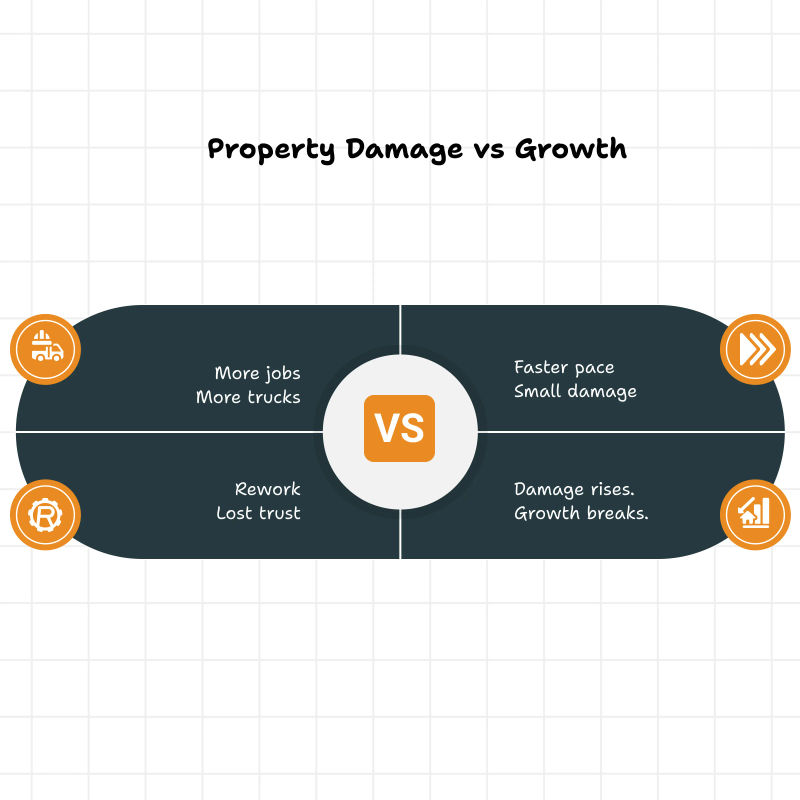
Clear standards let teams self-correct even if the supervisor isn't present. When training, software, and culture are aligned, damage claims, callbacks, and OSHA exposure all trend down.
Conclusion
Better oversight does not mean more surveillance. It's about making the right pre-task steps the default route in the software along with the training process and the overall culture. When these are aligned, damage claims, callback rates, and OSHA exposure all move in the same direction: down.
Frequently Asked Questions

Content Creator
Bhargavi Halthore is a content writer at Field Promax, a field service management platform serving trades businesses across the USA and Canada. With over a decade of experience writing for business owners, she brings detailed, ground-level insight to every topic she covers. Her research goes beyond search results - she digs into LinkedIn groups, Facebook communities, and Reddit forums to understand what field service business owners are actually dealing with on the ground. She speaks directly with industry professionals, understands their day-to-day challenges, and translates that into content that is practical and actionable. What you read in her articles reflects real industry patterns, not theory.
Reviewed by

Founder and CEO
Joy Gomez is an engineer, process automation expert, and the Founder of Field Promax. Known for his technical expertise and commitment to field service innovation, Joy writes about transforming traditional business models into paperless, efficient operations. He is a Lean Six Sigma Black Belt based in Rochester, MN, dedicated to helping field professionals work smarter through better technology.