Labor Burden: What an Hour of Field Labor Actually Costs You

What labor burden is, and what it is not
The labor burden is the amount you pay to hire a person over and above their salary. It includes employer payroll taxes, unemployment insurance premiums, workers' compensation, health and pension contributions, paid time off, licensing and training, as well as, in field services, the truck and tools that the person carries.
Keep the buckets separate. The burden is attached to the person. Rent, dispatcher salaries, software, office phone bills, and marketing are all overhead costs that the company has to pay. Profit and markup are added on top and are not included in the cost. Burden is part of your job cost. The rate structure recovers overhead. Profit is what remains after the first two honest steps.
BLS provides a helpful floor. In March 2026, the average employer compensation cost for private-sector workers was $46.60 an hour, divided into $32.59 in wages and salaries and $14.01 in benefits. This means benefits accounted for about 30.1% of total compensation. This figure does not include fuel, tools, or windshield time. It is the starting point for a field worker.
What sits on top of a field tech's wage
Split the list into what you must pay and what you chose to pay.
Mandatory
Voluntary, plus the part nobody prices
The second table is the point where office-worker articles cease to be useful. The laptop is the equipment of a software company. You have a car that costs more each month than many benefit packages.
| Item | Notes |
|---|---|
| Employer Social Security | 6.2% of wages, statutory |
| Employer Medicare | 1.45% of wages, statutory |
| FUTA and SUTA | State experience rate varies |
| Workers' compensation | Trade class codes run far above office class codes |
| General liability, state disability | Varies by state and carrier |
| Item | Notes |
|---|---|
| Health, retirement, PTO, sick | Your benefits election, per tier |
| Truck payment or lease | Assigned per tech, monthly fixed |
| Fuel and commercial auto insurance | Monthly, tracks with route density |
| GPS or telematics, phone and data | Monthly per unit |
| Tools, replacement, uniforms | Annualized, then divided by hours |
| License and certification renewals | Annual, plus the paid hours to sit for them |
The denominator most owners get wrong
Nearly every burden calculator divides the annual cost by 2,080. This number is a fiction for a field services company and is the most expensive assumption you can make. Start at 2,080. Take out holidays, PTO, and sick time. Now take out what only field work has: drive time between calls, shop and warehouse time, parts runs, callbacks, warranty rework, and the dead gaps when a cancellation leaves a tech sitting. None of that bills. All of it is paid. If you want the arithmetic on paid hours by month before you subtract anything, we walked through it in How Many Work Hours in a Month.
This is what I have seen owners regret the most and discover last in 14 years of conversations with customers. They are aware that their techs waste time, but they've never accounted for it. Your bids should be based on the same annual labor cost divided by a smaller number of productive hours.
Also, unbilled labor can leak through gaps in the scope. Contractors have described change orders that arrive after the project is completed and projects starting without written deliverables, resulting in crews performing work that does not make it onto an invoice. This is a burden that has no billable hours to cover it.

Worked example: what a $28 an hour tech really costs
Use your own rates in place of the illustrative ones. The structure is what matters.
The burden on wages before the vehicle is $16,279, or roughly 28%. This falls within the range of 25% to 50% that contractor calculators provide and is close to their cluster of 30% to 45%. These are vendor estimates, not primary research. Use them to check your calculations.
Now, the denominator.
- Divided by 2,080 paid hours: $48.52 an hour
- Divided by 1,470 hours of billable time after PTO, holidays, and drive time (including callbacks): $68.65 an hour.
Same technician. That is roughly a $20 gap for every hour. The real multiplier for a $28 hourly wage is 2.45x, not the 1.3x that most owners think.
| Line | Annual |
|---|---|
| Base wage, $28.00 x 2,080 | $58,240 |
| Employer FICA at 7.65% | $4,455 |
| FUTA and SUTA at an illustrative 2% | $1,165 |
| Workers' comp at an illustrative 8% | $4,659 |
| Health and retirement contribution | $6,000 |
| Employment cost | $74,519 |
| Truck, fuel, commercial auto, telematics, phone, tools at $2,200/month | $26,400 |
| Total annual cost | $100,919 |
| Line | Annual |
|---|---|
| Base wage, $28.00 x 2,080 | $58,240 |
| Employer FICA at 7.65% | $4,455 |
| FUTA and SUTA at an illustrative 2% | $1,165 |
| Workers' comp at an illustrative 8% | $4,659 |
| Health and retirement contribution | $6,000 |
| **Employment cost | $74,519 (subtotal) ** |
| Truck, fuel, commercial auto, telematics, phone, tools at $2,200/month | $26,400 |
| Total annual cost | $100,919 |
Turning burdened cost into a bill rate without double counting
The order is important: cost per billable hour, including the labor burden; overhead recovery; target margin; and finally, the bill rate.
The problem is that you can end up counting the same cost twice. If the cost of trucks, fuel, and tool replacements is already sitting in your overhead pool and you then load those costs into the hourly rate, your estimate is effectively doubled, and you may miss bids you could otherwise have won. You need to decide where each cost belongs and make sure your markup and estimate are aligned with that decision. Make a note of which pool each cost belongs to before you prepare the bid.
The effect compounds over time. A bill rate calculated against an unburdened salary can appear profitable on the estimate and even when you receive the payment. But the rate is wrong for every hour and every job throughout the year. A 10% labor overrun on a $120,000 labor budget can quietly remove a significant portion of a small industrial job's margin, potentially reducing a $45,000 margin to $33,000 before anyone notices. A wrong burden rate does this quietly, starting from day one. --- END OF SECTION ---
Why one blanket rate across the crew loses money
A journeyman, an apprentice, and a senior technician don't have the same responsibilities. They differ in compensation class or benefits eligibility, in whether trucks are assigned or shared, and in what percentage of their weekly hours can be billed. A senior technician who handles calls independently might bill up to 80% of the time they work. An apprentice who is still learning on the job may be billable for almost none of their time, which is acceptable as long as the employer is aware of it.
Overtime is an integral part of this field, not an exception. After-hours calls and emergency dispatches change the wage base for those hours, and the burden shifts along with it.
Run a rate for each tier. Also, run a margin column for each technician on every job. Let it show red when a person's cost is higher than the amount being charged. This is one of the most cost-effective diagnostics available in the business. It reveals the blanket-rate issue within a week, rather than when the books are closed.

Track burden on the job, not in a spreadsheet
Most advice treats burden as a quarterly spreadsheet exercise. This is why it gets outdated. The rate must be linked to time entry whenever the technician logs in, then flow into the estimated cost of the job and sync with the payroll and accounting systems without requiring a manual reset.
That means field time capture that reflects reality: clock in at arrival, drive time logged separately from wrench time, notes and parts attached to the work order. Techs will do this if it takes seconds on their phone, which is most of the argument in 7 Reasons You Need to Give Your Technicians a Mobile Field Service Management App. It also means the work order is the cost container, so every hour and part has a home. We covered how to structure that in our guide to work order management, and for crews you rarely see in person, the supervision side is in 9 Best Practices for Managing Remote Field Teams.
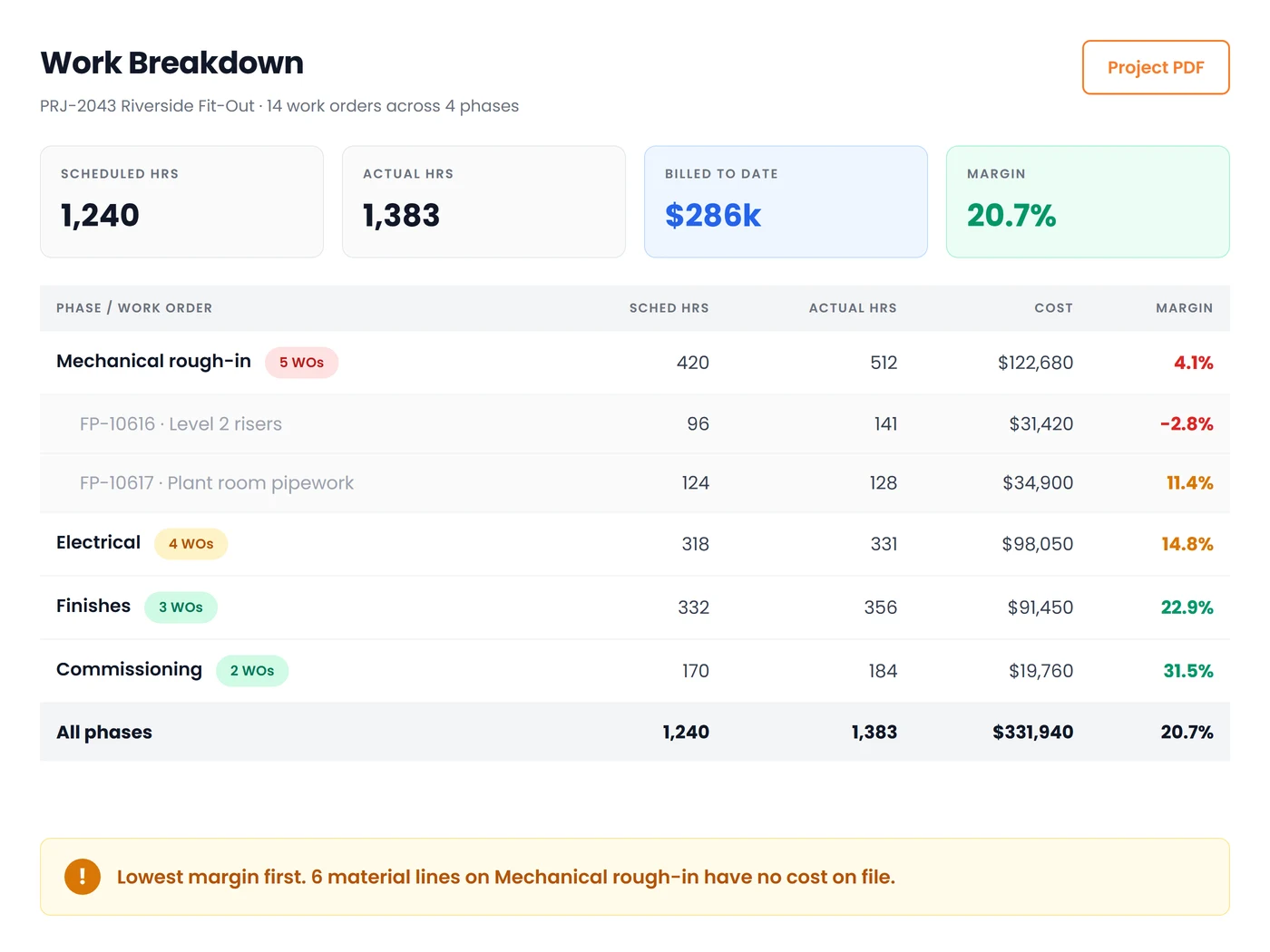
Our construction clients explained it clearly in a report, noting that multi-phase construction projects used to be managed through spreadsheets and paper logs, whereas PMs now manage every project and dispatch crews from a single screen. That's the shift. The rate ceases to be an item in a document and instead becomes a field in the time entry.
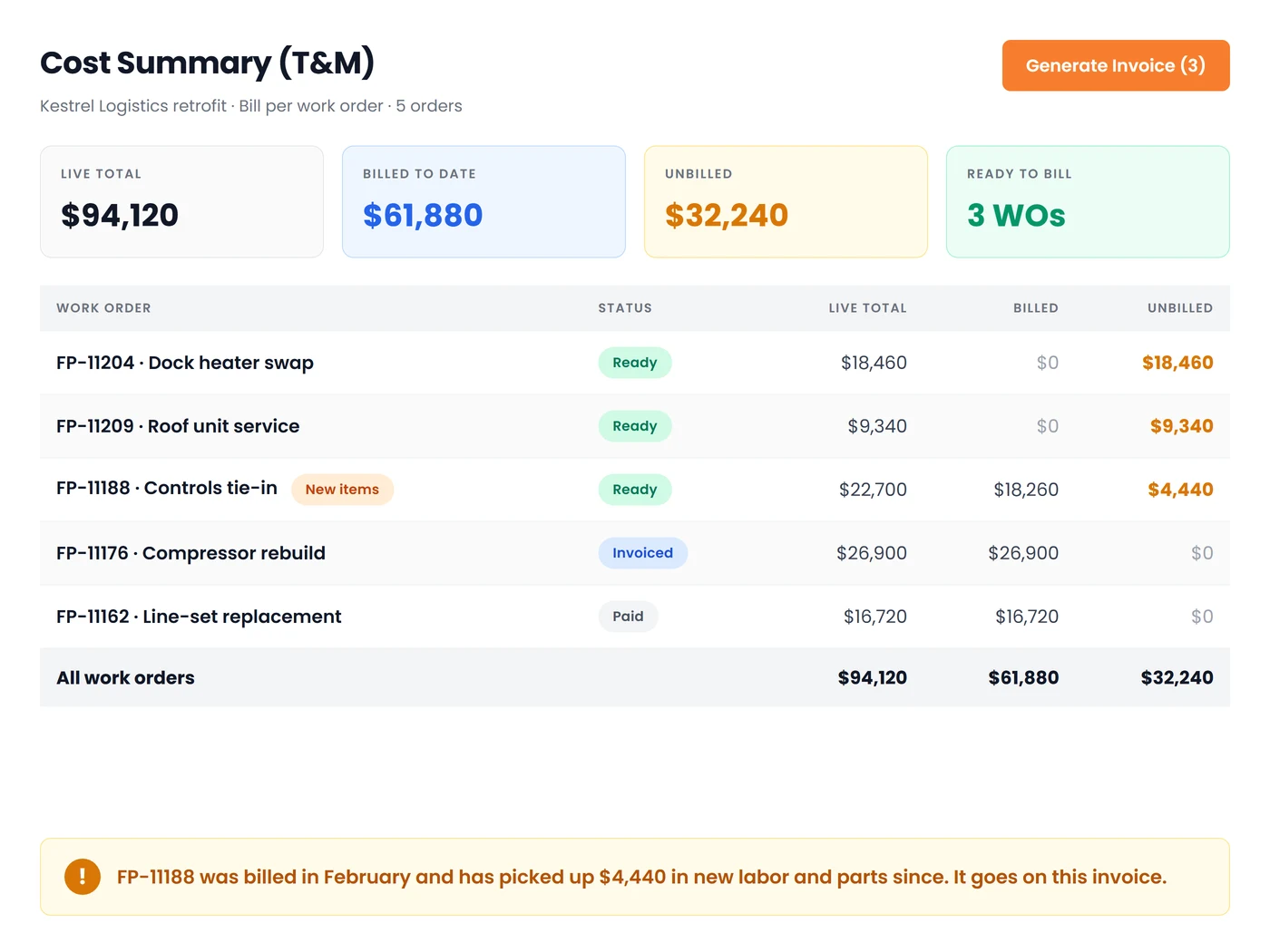
A discipline I am very passionate about is this: if the cost coverage is insufficient, keep the margin number blank rather than displaying it. A seemingly reliable margin based on a half-priced labor cost is more damaging than a blank line because owners will act on it.
When to recalculate, and the four errors to hunt
Review the rate every six months, or annually at a minimum, and immediately after any of these events: a workers' compensation renewal, a health insurance premium change, a wage adjustment, a hiring wave, or when a brand-new truck goes on the road.
Four errors do most of the damage:
-
Stale rate. Premiums paid last year versus this year's payroll.
-
Blanket rate. Using one number for apprentices, journeymen, senior technicians, and technicians.
-
Double-counted overhead. The truck's cost is included in the labor rate and again in the overhead pool.
-
Paid-hours denominator. Dividing by 2,080 when the technician can bill only 1,470 hours.
I would rather have an owner use rough burden rates that are updated twice a year than rely on a precise rate created in 2023. Precision applied to outdated inputs is simply a more confident form of error.
More on job costing
Continue with:
- Job Costing for Small Commercial Contractors: Phases and Margin — the pillar guide: phase structure, committed cost, scheduled vs actual, and honest margin.
- The Ultimate Guide to Job Cost Sheets: How to Track Job Costs and Improve Profitability — the per-job document where burdened labor, material, and overhead actually land.
Conclusion
The amount shown on your check represents only the smallest portion of what an hour of fieldwork will cost you. Calculate it correctly: start with the wage, then add mandatory costs and taxes, followed by benefits, and finally the tool and truck costs. Then divide the total by the number of hours you can actually sell. Run the calculation by technician level, refresh it twice a year, and store all costs in one pool. I've seen too many good operators calculate an entire season using a figure that was 40% too low. They only discover the problem at closeout, when the work is finished and the money is gone. Make the calculation this week, then build it into your system so it is applied on the day each entry is made. That way, you won't have to rely on your memory again.
Frequently Asked Questions

Founder and CEO
Joy Gomez is an engineer, process automation expert, and the Founder of Field Promax. Known for his technical expertise and commitment to field service innovation, Joy writes about transforming traditional business models into paperless, efficient operations. He is a Lean Six Sigma Black Belt based in Rochester, MN, dedicated to helping field professionals work smarter through better technology.
Reviewed by

Content Creator
Bhargavi Halthore is a content writer at Field Promax, a field service management platform serving trades businesses across the USA and Canada. With over a decade of experience writing for business owners, she brings detailed, ground-level insight to every topic she covers. Her research goes beyond search results - she digs into LinkedIn groups, Facebook communities, and Reddit forums to understand what field service business owners are actually dealing with on the ground. She speaks directly with industry professionals, understands their day-to-day challenges, and translates that into content that is practical and actionable. What you read in her articles reflects real industry patterns, not theory.