How to Do Time and Material Invoicing in Field Service (With a Template You Can Copy)

It's 4:40 in the afternoon on a Thursday, and your technician has completed a compressor repair that took three hours, consisting of two parts removed from the truck and one rental line, plus forty minutes of diagnostic time before he identified the issue. He records the hours on a carbon invoice and heads home. The ticket is sent to your admin on Monday. The invoice will be sent out Wednesday. Payment is made in the second half of the next month, provided that the customer doesn't first call to dispute the time billed.
This is the main issue with materials-and-time billing. It has little to do with the pricing you are charging.
On Quora, contractor questions regarding receivables are grouped around the identical two complaints. Net-30 is viewed by customers as a suggestion. Likewise, the owner is wasting hours each month trying to collect cash for work that was completed and billed correctly.
Then there's the actual invoice. Based on 14 years of customer interactions, approximately 10% of manually entered T&M invoices from typical 5-20 tech shops are returned for dispute or correction because of a wrong part number, an unresolved line item, or hours written on a ticket that is smudged. Each triggers a phone call or a resend and adds another week to the payment clock.
Ready to get started with Field Promax?
Sign Up Free
The T&M formula is easy. The record-keeping, the backup documents, and the payment mechanics are what decide whether the invoice clears in ten days or sixty. Below: the line items a defensible T&M invoice needs, a template structure you can copy, and the configuration steps inside field service invoicing software.
Fixed price or time and materials: which should you bill on?
With a fixed-price contract, you are bound to a certain amount. The client is assured of the price; however, you run the risk of a surprise in the background. The billing process tracks the percentage of completion, and paperwork is minimal because the amount was determined before anyone picked up a piece of equipment.
Time and Materials bills the actual hours worked at the agreed rates, including equipment and parts usage or subcontractor markup. The project is invoiced in stages, and each invoice includes a record of what was used.
Our recommendation: for diagnostic and repair work, T&M should be your preferred method, and a flat price for an unknown fault is a risk you'll have to pay for during your second busy year. If you are replacing a known-scope part, such as a water heater or a panel with the permit already pulled, flat pricing is better, and clients prefer it. Run both. Make sure you don't use flat-priced work that you aren't able to see.
Ready to get started with Field Promax?
Sign Up FreeWhat do you actually gain by billing time and materials?
T&M is often referred to as transparent, which is true, but it's a bit vague. The real benefit is that the invoice reflects the total cost of the work, without adding a margin to protect against risk that you've priced blindly.
This cuts both ways. It stops you from eating four unbilled hours of work that turned out to be an unclean return line. It also stops you from quietly overcharging customers for simple jobs, which is what a blended flat rate can do to your most loyal customers, whether you intended to or not. Accuracy in billing mainly comes from exactness in recording: hours against a particular task, the quantity of parts used for the specific task, and receipts attached to the task they relate to.
What happens when the scope changes mid-visit?
You deal with the issue in the present instead of negotiating the terms of a contract. The technician finds the capacitor that failed in the second place, calls the customer to confirm the repair, adds the part and labor to the order, and then continues working. There are no change orders and no tense call three days later to ask for additional money for a job that's already been completed. In the case of remodels, commercial service, or anything involving old equipment, that flexibility is the primary reason why the model exists.
Does a line-item breakdown really cut customer pushback?
Yes, if the breakdown is able to answer the question the customer was planning to ask. "Labor: 6 hrs" is a reason to argue. "Diagnostic: 0.75 hr, evaporator coil access: 1.5 hr, brazing and pressure test: 2.25 hr" is not. Owners who list items by task report fewer callbacks on invoices and shorter approval times on commercial accounts, as someone in accounts payable must justify the expenditure internally before cutting a check.
Which jobs are too unpredictable to quote flat?
Everything in which the cost driver is concealed until you open it up: leaks in the slab, knob-and-tube wiring discovered during a 1940s-era remodel, rooftop units that haven't been maintained in six years, and multi-phase installations where the customer is still debating the finishes. For those projects, T&M will be the one option that will pay you for the work you actually perform and allow you to stop with a clear end instead of dumping unpaid hours into a set amount you agreed to while standing in the driveway.
How does hourly billing change the way your crew works?
The billable hours are easily evident, and the truck is properly stocked. The second trip to the store becomes an expense that is noticed by someone else, and the process of diagnosing becomes more precise. This is a true productivity boost, but it also creates the danger of overestimating hours. Hours that appear to be overinflated on paper could be questioned, regardless of whether they actually were.

That's why details are the main defense. Owners who are comparing tools for field service on Capterra explain the same issue we are hearing about all the time: the work was completed correctly, and the battle is over the paperwork. A T&M invoice with timestamps, part numbers, and receipt photos eliminates the majority of that argument before it even begins.
A pattern across small residential contractors
In small companies we've dealt with since the beginning of 2019, one variant is frequent enough to be dependable. One example is an owner-operator at a small residential service provider with six technicians who manages estimates and bookkeeping himself, with a part-time administrative assistant working on QuickBooks and all other software. Estimates are rebuilt each time, line by line, as no one has stored the first one as an example. The referral-source field is empty for two out of three customers who have new records.
In the second half of a busy spring, he was spending two nights every week creating estimates that were close to those he'd sent out earlier in the month. The most costly issue came to light when he attempted to determine whether Google Ads spend was worth renewing. He was unable to separate ad-driven jobs from word-of-mouth referrals in his own client list.
Over the course of a weekend, he created six estimate templates according to job type. He stored them as regular estimate templates in QuickBooks. Then, he added referral-source tagging as an absolute rule: no estimate is released until the customer's record includes a source, regardless of whether it's "unknown." The initial dropdown contained fifteen options, but he reduced it to seven options after two months.
Estimated turnaround was reduced to around half by the second month. This was mainly for repeat jobs. The tagging rules slipped for eight weeks, with the administration team waving rush jobs through without tagging them until the owner began sending incomplete records back instead of fixing them himself. The backfilling of legacy customers has never occurred.
The case is a composite, and the details are linked to the most common variant of this design across the small companies we've worked with.
How do you build a T&M invoice that survives review?
The template-and-discipline problem in that story is the same one T&M invoicing has, one step later. Capture is where accuracy can be determined or not, and no amount of invoice formatting can fix the issue. Create it according to this procedure.
What records do you need before you can bill anything?
All items purchased, rented, or used to perform a particular job were recorded against the job. The hours of labor were logged by task and technician. Parts taken from stock in the truck were recorded with part numbers and quantities. Pickups from the supply house were recorded with receipt photos taken at the time of pickup. Equipment rentals were recorded with start and stop dates. Subcontractor invoices were recorded with your markup.
The practical test: if a customer calls six weeks later asking why the invoice says 6.5 hours, can you produce the answer in under two minutes? Shops using timecard and GPS tracking can, because clock-in and clock-out are timestamped against a work order rather than reconstructed Thursday night from memory.
Which backup documents should ride along with the invoice?
Government and commercial customers typically specify their needs in the agreement. The standard set of T&M billing requirements is:
- A summary invoice that shows all billable hours, the labor rate, material costs, and the markup
- A list of transactions describing the time and charges incurred, since the majority of commercial accounts require it to approve payments internally
- Copies of receipts and invoices for purchases made from third parties and rental charges
- Timesheets or payroll reports certified by a certified accountant when the contract calls for them
- Photos of the component that failed, as well as the replacement component that was installed and any site issues that extended the work time
If any of the work is federal construction, alteration, or repair covered by Davis-Bacon, the Department of Labor's certified payroll requirements apply: weekly payrolls with a signed Statement of Compliance, due within 7 calendar days after the regular pay date. A not-to-exceed cap doesn't get you out of it. The shops that stay clean here capture worker classification and hours at the timecard, not in a spreadsheet rebuilt at week's end.
What line items belong on a T&M invoice?
The document should clearly outline:
- The purpose of the task or phase
- Estimated completion dates for the activities within it
- The labor cost, derived from overhead, wages, administration, general expenses, and a profit margin (commonly 15% to 30%)
- The quantity, type, and price of materials, together with the part number, if available
- A time-and-materials not-to-exceed clause (T&M NTE), as well as the agreed cap
- Payment milestones for long-running or recurring work
Then the arithmetic:
(Total Labor Hours X Fixed Hourly Rate) + Material Cost + Markup = Final T&M Invoice)
<!-- CEO commentary -->I read every support ticket that comes in, and the T&M ones follow a pattern. The dispute is almost never about the hourly rate. It's about a line item the customer says nobody mentioned, usually a rental fee or a part swapped mid-job that pushed the total past the not-to-exceed number they agreed to. Conventional advice says put the NTE cap in the contract and you're protected. The truth is the cap only protects you if the tech knows the number while he's still standing in the basement, which means it has to sit on the work order in his hand, not in a signed PDF in the office. The most requested feature across our customer base is better dispatch-to-invoice automation, and this is exactly why: the handoff is where billable detail goes missing.
A time and material invoice template you can copy

Three blocks are stacked, consisting of labor (technician, task, hours, and rates), materials (part, quantity, unit cost, and markup), and pass-through costs (rentals, permits, and subcontractors). The totals are at the bottom, with the NTE cap stated above the signature line. Make a copy of it in a spreadsheet if you're still billing manually. However, be aware that this spreadsheet is the version that needs to be retyped by someone else.
Can software take this paperwork off your desk?
For more information, contact Field Promax
We're here to help you get started
Check how many of the items above are handled by humans twice: the receipt is written in the field and then typed into the office; the check is photographed, later attached by hand; and the time is totaled by the tech and then re-totaled by the person who processes the payment. Every time something is handled twice, it's an opportunity for the numbers to change. This is where the majority of the 10% correction rate comes from.
A technician who had used a variety of service applications noted in the QuickBooks App Store that Field Promax was the most user-friendly one he'd used for basic invoice entry. He also found it flexible enough to support sales and tracking functions, with access to the team that built it. The standard should be that the person doing the work enters the information once, while it is still in the form in which it is available.
How do you pick software that actually handles T&M?
Small-scale operators asking questions about invoicing tools on Quora continue to discuss the same problem: the majority of solutions are either too basic to support real-time invoicing, with no parts catalog, labor tiers, NTE field, or invoice attachments, or too heavy for a shop with eight techs to configure and maintain.
What you need is time tracking tied to work orders, a parts catalog with cost and markup, invoicing that pulls from both, and accounting sync. Field Promax is priced for the shop that can't justify an enterprise tier, and it covers roughly 24 trade verticals, from HVAC to plumbing and electrical service work.
What do you configure before the first invoice goes out?
Rates first, set by role instead of one blended number. The BLS Occupational Employment and Wage Statistics for 2024 put median hourly wages at $28.75 for HVAC mechanics and installers, $30.67 for plumbers and pipefitters, and $30.38 for electricians. We see shops billing a single rate for a helper and a senior tech alike, which underprices senior hours and overprices the apprentice's on the same invoice. Build separate rates for apprentice, journeyman, and after-hours, and carry overtime and emergency multipliers as their own line types.
Materials next. Load part descriptions, cost, markup, and stock levels so the tech picks from a list rather than typing a description. That list is also what makes job costing mean anything later, since you can't compare quoted to actual if the parts were free text.
How do hours and parts get captured without re-entry?
The technician clocks in to the task, not against the calendar. The time is based on a specific project, and an hour-long visit that covers two repairs as well as a diagnostic is reported as three lines rather than one line that nobody can defend.
Parts function similarly. If inventory is within the exact same system, the technology subtracts the item from the inventory on the truck and then displays it on the invoice with the price and markup already in place. Separate systems mean that someone has to reconcile two lists, and the gap between what was used in the field and what is stated on the invoice is precisely where write-offs are hidden.
Does dispatch data belong on the invoice?
It does. Arrival and departure timestamps from scheduling and dispatch are the cheapest proof of billable hours you'll ever get, generated whether anyone remembers to log them or not.
Dispatch can also trigger recurring work. Owners of maintenance agreements describe the recurring billing process as more difficult than they anticipated due to expired cards, faulty auto-charges, and service revenue that essentially ceases for a month or two each quarter. If work under the agreement is scheduled on a regular basis and includes an invoice, both the invoice and payment method should be scheduled at the same frequency, with a failure alert sent to a designated individual.
What makes a generated invoice hard to argue with?
Attachments matter, too. When parts and hours are auto-populated as line items, the amount of evidence needed to support them is minimal, including an image of the broken heat exchanger, the supply-house receipt, and the technician's note explaining why access took an additional hour. An invoice that can answer the client's questions before they are asked doesn't result in calls or callbacks, which can mean a week of float that you can't recover.
Why collect the signature before the truck leaves the driveway?
The easiest way to get approval is by contacting the individual who observed the work being completed. E-signatures on the completed work order, recorded by phone while the customer is still on-site, can close the inquiry permanently.
Owners have a point to make, too. Paper invoices and bank transfers allow customers to delay payment, and when there is no single-click method to pay the invoice, the delay remains. Signature and payment should happen together within 30 seconds at the front desk instead of requiring two follow-ups later in the week.
Why is mobile adoption the whole ballgame?
Our customer base is diverse. Mobile app use by field techs is the largest indicator of whether a rollout will improve invoicing speed and accuracy. It's not the configuration or the training plan. A shop where half of the staff still writes tickets has simply added a data-entry step without removing the manual work.
A plumbing company that shifted away from a fleet-tracking system noted in the same marketplace that Field Promax was far better for field technicians and significantly faster for invoicing, with fewer steps required for each invoice. That's the measure to keep an eye on during onboarding: the number of steps per invoice from the tech's perspective. If that number rises, it's a sign that adoption is not happening, no matter what you say in Monday's meetings.
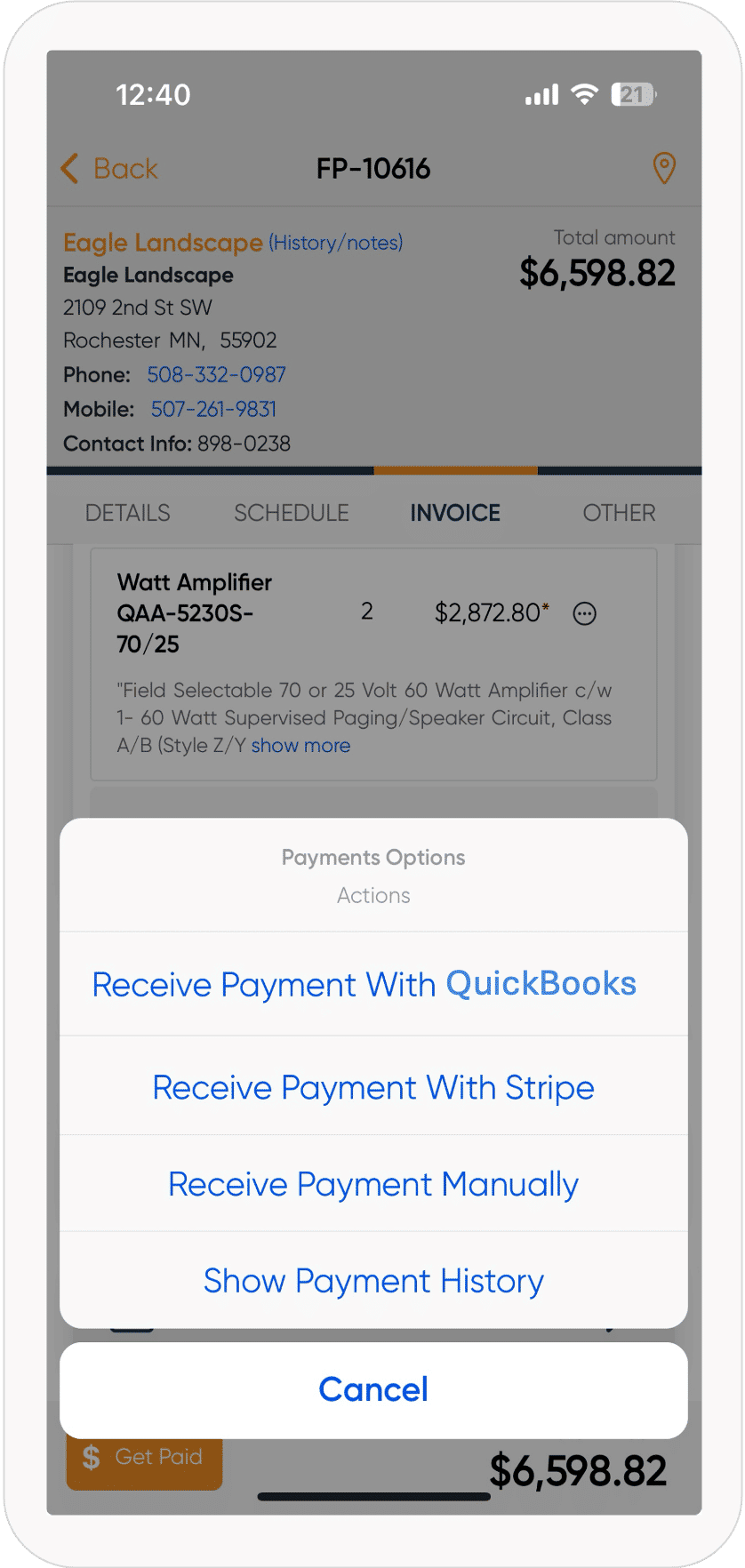
Why do clean invoices still get paid late?
Because accuracy and speed are different problems. QuickBooks' small-business late payments reporting found 47% of U.S. small businesses had invoices more than 30 days overdue, and trade-level benchmarks compiled by LevelCFO put days-sales-outstanding near 39 days for plumbing, 44 for HVAC and mechanical, and 48 for electrical contractors. Shops still mailing paper invoices run worse than those benchmarks.
Two levers move it. First, time-to-invoice. For an average 5 to 20-tech shop, back-office batch invoices mean there will be a gap of 2-3 days between job completion and the invoice being issued. Shops that use on-site mobile invoicing get the same invoice to their customers within just 10 minutes of wrapping up and are paid approximately twice as fast.
Second, the chase. Set automated reminders at 7, 14, and 30 days past terms through notifications, accept card and ACH on the invoice itself, and state your late-fee terms (1.5% per month is a common clause) before the first job, not after the first problem.
How does the invoice get back into your books?
Most businesses that adopt Field Promax for T&M work rely on paper sheets or a QuickBooks-only setup. The biggest benefit is removing the retyping process between the ledger and the field.
With QuickBooks integration, the invoice created on the job site posts as a customer invoice with line items intact, mapped to the income accounts and items you already use. Decide three things before you turn the sync on: which system owns the customer record, how parts map to your chart of accounts, and whether payments post from the processor or from the field app. Get those wrong and you'll spend a month un-duplicating customers.
What should you review after the first 90 days?
Learn the tech's workflow rather than the administration console. Five taps between arrival and clocking in will determine how much time on the truck is better than a two-hour class.
Then check four numbers at 90 days: average hours from job completion to invoice sent, percentage of invoices corrected or disputed, DSO, and the share of invoices paid on site. Pull them from reports and dashboards rather than impressions. If time-to-invoice hasn't dropped, the problem is almost always capture in the field, not the invoice template.
Conclusion
Time-and-materials billing isn't complicated arithmetic. It's a record-keeping problem that has an impact on cash flow. Businesses that charge T&M effectively record time and parts as they are used in the field, then put the not-to-exceed amount in the hands of the tech and attach photos and receipts before any questions are asked. They also offer the customer an option to pay at the point of sale. If you're billing from paper tickets, spreadsheets, or QuickBooks alone, start by capturing the data, as that's where delays and mistakes begin. Field Promax handles the work order, timecard, components, invoice, payment, and work order on one platform and syncs the outcome to QuickBooks. Take a tour of Field Promax and get help creating a T&M workflow.
Frequently Asked Questions

Content Creator
Bhargavi Halthore is a content writer at Field Promax, a field service management platform serving trades businesses across the USA and Canada. With over a decade of experience writing for business owners, she brings detailed, ground-level insight to every topic she covers. Her research goes beyond search results - she digs into LinkedIn groups, Facebook communities, and Reddit forums to understand what field service business owners are actually dealing with on the ground. She speaks directly with industry professionals, understands their day-to-day challenges, and translates that into content that is practical and actionable. What you read in her articles reflects real industry patterns, not theory.