Field Service Asset Management: A Working Guide for Small Trade Shops

Across the small and mid-sized trade shops we work with, field service asset management rarely looks like the brochure. It looks like a dispatcher walking out to the lot at 6:47 a.m. because the recovery machine the second-shift HVAC tech needs is in a different truck than the work order shows. Or a plumbing apprentice driving 22 miles back to the shop for a manifold set sitting in a job-site lockbox the foreman forgot to log.
The failure isn't that owners don't believe in asset tracking. It's that paper logs and stale spreadsheets can't keep up with how fast assets move between trucks, techs, and job sites. Good field service asset tracking means the record travels with the job - not with the memory of whoever last touched the equipment. The shops that fix it are the ones where the mobile workflow on the truck matches the office workflow at the desk. The software is just where those two finally meet.
1. What field service asset management actually is.
Field service asset management tracks, maintains, and routes the physical things your shop needs to deliver work: This includes trucks, tools, fixed equipment, customer-owned units under contract, and the components associated with them. This layer of data is a record of assets - one record per asset that includes location, condition, service history, ownership, and associated work orders. Billing, dispatch, and compliance are all tied to that record.
In a 5-20 tech shop, the difference between a functioning asset management system and a broken one comes down to two things: whether technicians can edit records directly from their trucks, and whether each record automatically links to every work order that touches the asset. If either link fails, the business is back to using spreadsheets in less than a quarter. This is why evaluating asset tracking software by feature count alone misses the point. The real question is whether the software updates records in real time without requiring a call to the office.
2. Why asset visibility is a margin problem, not an inventory problem.
Our customer base includes owners who still use paper work orders and typically estimate that the majority of tickets are lost, duplicated, or never make it back to the office in an invoiceable form. Digital work orders reduce that leak to near zero because the ticket is stored in the cloud from the moment the technician starts the job.
The second number is on the maintenance side. The U.S. Department of Energy's FEMP Operations & Maintenance Best Practices Guide puts a working preventive maintenance program at 12-18% cheaper than reactive across building systems, with a referenced JLL study showing preventive programs delivering an average 545% ROI. In our customer base, the smaller-shop version shows up as fewer emergency callouts and tighter route density.
This ROI does not come from more advanced dashboards. It comes from PM schedules that operate on real data instead of an unreliable wall calendar that has not been updated since March. Asset tracking software that links maintenance triggers to runtime cycles and actual usage history - not just fixed dates - delivers far better results. In shops that still rely on manual PM planning, the shift from fixed calendars to usage-based triggers often pays for itself within the first quarter.
3. From paper and spreadsheets to a single asset record.
Most shops adopting digital asset management are not migrating from another platform. They are moving from spreadsheets, paper records, or even a QuickBooks-only setup. There is no clean CSV file ready to import. The first few weeks are devoted to data collection: technicians in the field use mobile devices to capture serial numbers and tag trucks, while the office team reconciles spreadsheets with actual asset counts. Owners often underestimate the effort required. Treat it as a project with deadlines, not as a feature you can simply switch on.
When thinking through which asset management software is best for field services operations at your scale, the real question isn't just which features are listed - it's how the best field service asset management tools connect your asset records to the rest of your workflow. The platforms that deliver the fastest return on investment are those in which mobile work orders, GPS-equipped trucks, preventive maintenance triggers, and invoicing all operate from the same data layer.
The features that actually move the needle
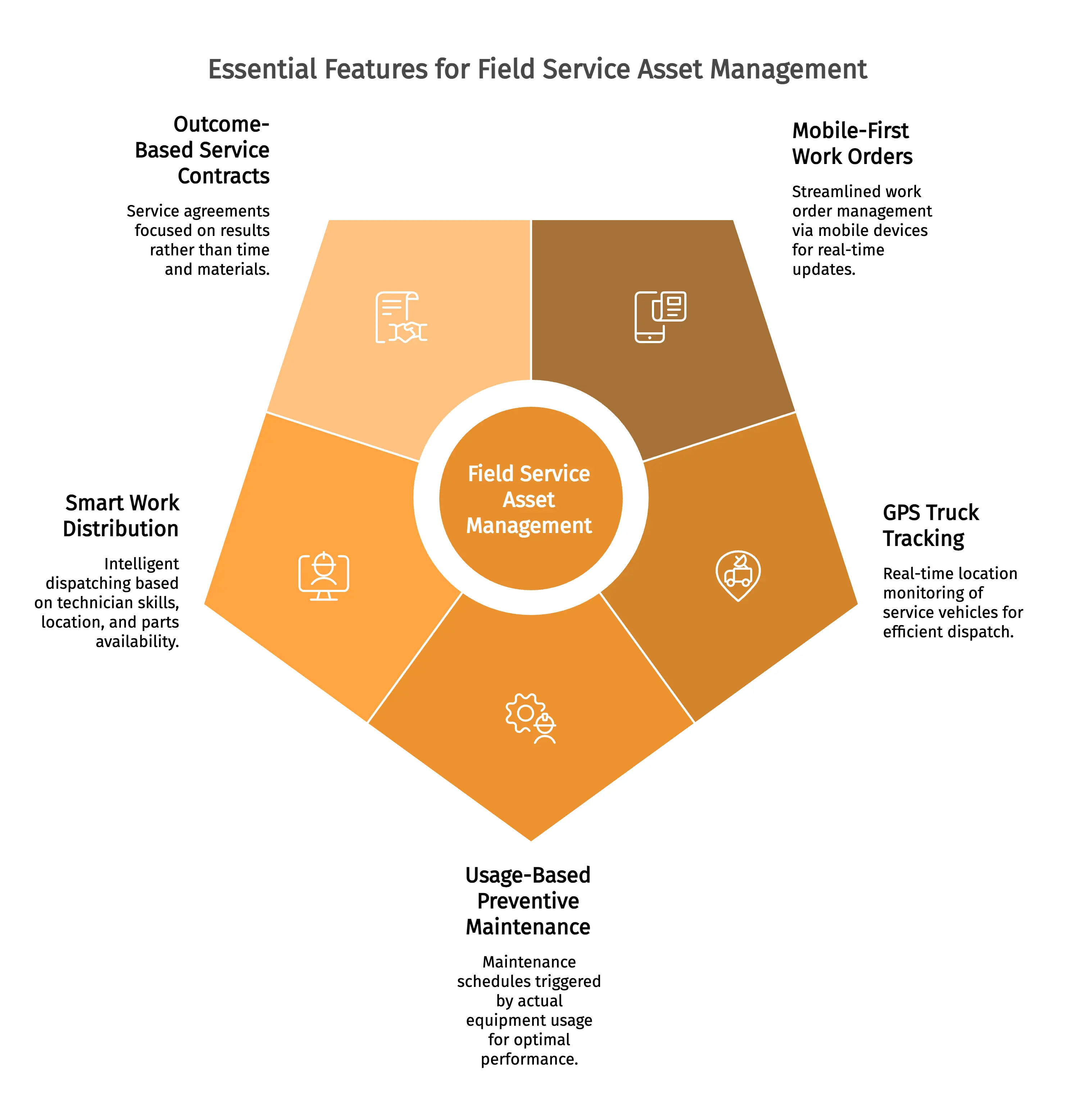
The features that deliver the fastest return are mobile-first work orders linked directly to an asset record, GPS tracking for trucks, preventive maintenance triggered by actual usage rather than a fixed calendar, and a streamlined dispatch-to-invoice workflow. Prioritize these capabilities before evaluating any advanced features.
.webp?updatedAt=1747733768906)
1. Outcome-based service contracts
Outcome-based contracts pay for results: such as uptime hours, leak-free quarters, or first-visit repair rates - rather than time and materials. They are only effective when asset records accurately reflect the outcomes being billed. A business that guarantees 99% uptime on commercial chillers must be able to immediately verify downtime tickets, runtime data, and service event logs against the chiller’s asset record. Without that documentation, you are relying on the customer’s memory, which may seem acceptable until you have to resolve the first dispute.
2. Usage-based preventive maintenance
Calendar-based PM ignores how hard equipment actually worked. Usage-based PM triggers on runtime hours, cycles, or sensor data. McKinsey's predictive maintenance research, summarized by IIoT World, found maintenance costs falling 18-25% and availability rising 5-15% when shops moved from time-based to condition-based scheduling. In our customer base, even a usage column populated by tech entries beats a fixed calendar within a quarter - the gain isn't the dashboard, it's the trigger firing off real work instead of a memory of when PM was last done.
3. Smart work distribution by skill, location, and parts on the truck
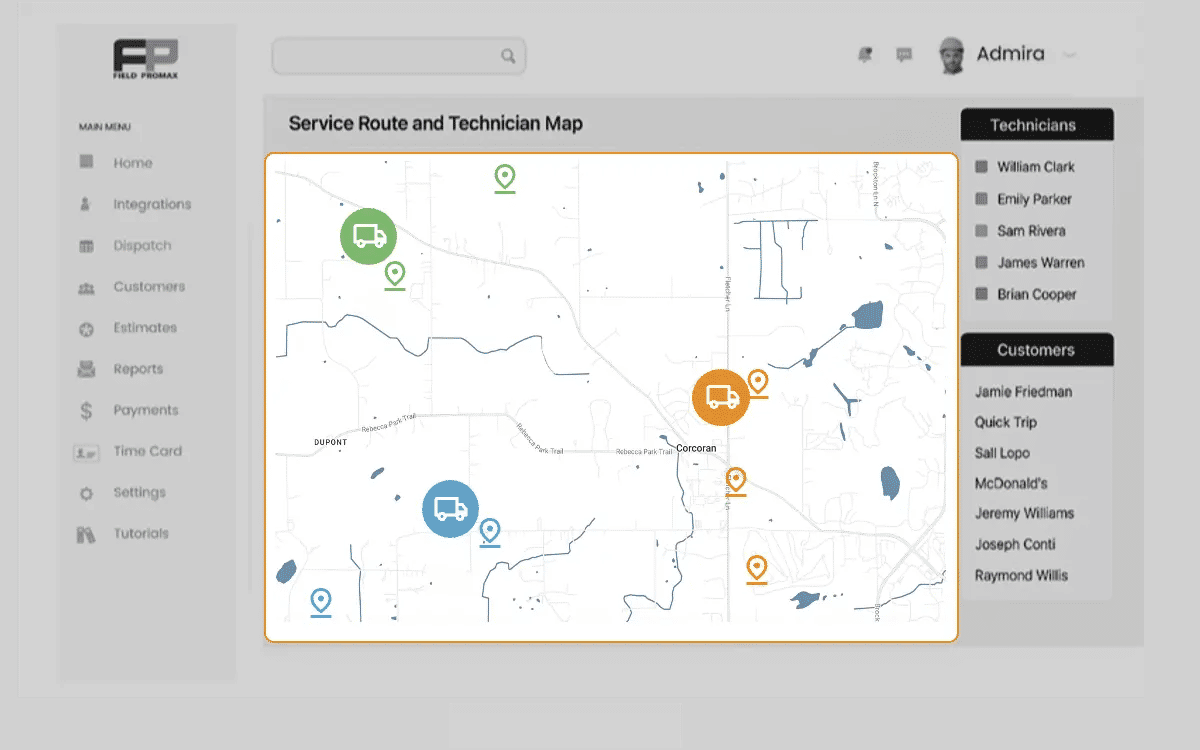
Across owner conversations on Reddit and Quora over the last 12 months, the single most-described dispatch pain is the dispatcher losing visibility into who's where: a chunk of every morning lost reconciling routes techs actually drove against routes the schedule assigned. The fix is one field service scheduling and dispatch surface showing truck location, current job status, and skill tags on a single screen, with drag-and-drop reassignment that pushes to the tech's mobile app in real time.
4. Change history and an audit trail you don't have to reconstruct
Every asset record should log who changed what and when. For HVAC shops, EPA Section 608 requires three-year retention of records for any service event on appliances with 50 lb or more of refrigerant. The HVAC shops that don't sweat a Section 608 audit are the ones whose techs log refrigerant added on the invoice at the moment of service, not from notes the next day.
For fire alarm and sprinkler contractors, NFPA 72 and NFPA 25 require inspection records retained at least one year past the next ITM event - a window that keeps sliding. Shops that pass AHJ reviews cleanly are those whose mobile app forces ITM data entry on-site. For OSHA-recordable injuries, 29 CFR Part 1904 keeps the 300 log on a five-year retention; shops with a digital incident workflow tie the 300 entry to the asset and the job, so the audit trail compiles itself instead of being reconstructed the week of an inspection.
5. Accurate asset pricing without rounding
If your asset record carries decimal precision on cost, your invoices carry it too. In our experience, shops that switch off QuickBooks-only setups consistently recover meaningful gross margin from fixing rounding on line-item asset costs - without raising a single customer price. Job costing software tied to the asset record is where this lives. And for a 12-tech shop running hundreds of line items a month, the recovered margin adds up before the end of the first quarter.
6. Predictive maintenance from sensor and runtime data
Predictive maintenance uses sensors and runtime data to identify problems before they occur. For our customer base, the small-shop version is far simpler than the manufacturing-plant version. Shops that move equipment service histories out of glove-box folders and into a centralized database can identify failing units before customers call. The data does not need to come from sophisticated sensors to be useful. It simply needs to be collected consistently and stored in a database for at least two seasons before meaningful patterns begin to emerge.
7. AI-assisted maintenance recommendations (with a caveat)
AI suggestion engines can be helpful when the data they rely on is accurate, and misleading when it is not. If your asset records still have blank service-history columns from 2022, an AI recommendation will be a guess in confident language. Get the asset record straight first; the model gets useful second. This is not an attack on AI. It is a matter of sequence. Accurate outputs depend on accurate inputs.
8. Centralized notes, files, and mobile checklists
The asset record should include photos, signed checklists, installation instructions, warranty documentation, and customer notes such as gate codes, pet warnings, panel locations, and preferred billing contacts. One issue frequently mentioned by operators is that technicians want job checklists they can access on their phones while on site, rather than paper forms stored in the vehicle. Without mobile checklists, repeat tasks are often performed differently from one visit to the next because each technician follows a slightly different mental model of the process.
9. Maintenance work rules over rigid frequency fields
Fixed-frequency schedules (such as “every 90 days”) rarely hold up during busy seasons. Usage-based rules - such as “trigger preventive maintenance at 1,200 runtime hours or six months, whichever comes first” - adapt to actual operating conditions. Start by identifying how often each asset type fails today, then build maintenance rules around real-world data rather than optimistic manufacturer guidelines. Software asset tracking that supports usage-based maintenance rules consistently outperforms fixed-calendar scheduling for assets whose utilization varies by season or team size.
4. The real challenges of asset tracking in service businesses.
Operating a service shop without functioning asset software tracking is costly in ways most owners have not considered. The next section examines the failure scenarios we encounter most often.
The pain points operators describe most
Across discussions among business owners on Reddit and Quora over the past 12 months, the most common complaints have fallen into four distinct categories:
- Managing large volumes of repair orders without a single view of job status, parts availability, or customer commitments.
- Lost paper work orders during handoffs between the field and the office.
- Inconsistent execution of repeat jobs because every technician follows a different mental checklist.
- Difficulty locating critical equipment or verifying its last service date and assigned technician in less than 10 minutes.
Within our customer base, dispatchers who rely on paper work orders often spend hours each week chasing missing tickets and reconciling paperwork with invoices. Shops that transition to electronic work orders typically cut that time to less than an hour per week.
OUR STANCE: Most field service shops don't have an asset problem. They have a visibility problem. The assets exist - they're just on the wrong truck, in the wrong lockbox, or sitting in someone's mental checklist instead of a system that survives a bad Tuesday. You can solve visibility without replacing every tool you own. You can't solve it with a spreadsheet with no dispatcher updates in real time.
5. The cost of poor asset tracking, priced out.
The real costs appear in four areas: lost productive hours spent searching for tools or retrieving parts, delayed job completion caused by equipment being assigned to the wrong trucks, unexpected downtime when a critical asset fails without warning, and reputational damage when “we’ll be there by 2” turns into “we’ll be there by 5” because a technician spends 30 minutes locating equipment that was not properly documented.
Siemens' True Cost of Downtime 2024 report puts average unplanned downtime cost across large facilities at roughly $320,000 per hour. In our customer base, the trade-shop number is smaller, but the ratio to revenue is often worse: a single missed commercial appointment can blow a week of dispatch ratios for a 12-tech shop. Good asset software tracking doesn't eliminate downtime. It converts unplanned downtime into scheduled maintenance - which costs 12-18% less before you count the reputation hit that comes with every emergency callback you could have prevented.
6. Why manual systems break around 8-12 techs.
Spreadsheets may work for a five-truck operation, but they often begin to break down as a business grows beyond 15 trucks. There is no real-time synchronization between the office and the field, no revision control when two people edit the same record, no audit trail when data is deleted, and no practical mobile workflow for technicians. The tipping point typically occurs when a shop reaches 8-12 techs. At that stage, the person in charge can no longer keep a mental inventory of assets, and the spreadsheet is no longer capable of serving as a reliable system of record.
This is the point at which software asset tracking stops being an upgrade and becomes a necessity. Not because the business has become more sophisticated, but because the error rate of manual systems has risen to the point where it is more affordable to solve the root problem than to keep paying for the resulting damage every week.
7. A pattern across multi-trade operators we've worked with.
Imagine an owner-operator running a multi-trade shop with HVAC and plumbing teams, a dispatcher, and about two dozen technicians in a mid-sized Midwest metro. The most obvious problem appears on a Tuesday morning, when a tech is assigned to an HVAC tune-up while the same address already has a plumbing rough-in scheduled on another board.
In the middle of a busy spring season, the shop was double-booking technicians licensed in both trades because dispatchers maintained two separate calendars and synchronized them from memory. Estimate disclaimers compounded the problem: HVAC carried weather- and equipment-availability language, while plumbing carried material-assumption language. If a scope involved both trades, customers tended to favor whichever disclaimer benefited them more.
The owner merged both boards into a single calendar, which forced dispatchers to work from one system and route all bookings through that one surface. The disclaimer was rewritten into a single template covering exclusions for both trades. The first version was published before legal review, the second version was issued after disputes emerged.
Double-bookings largely ended after a rough start to the month, when the unified calendar exposed issues that had previously remained hidden. Plumbing foremen were the ones most resistant to adopting the new scheduling system.
Composite case, anchored to the most common version of this pattern across multi-trade operators we've worked with.
8. What digital asset tracking actually changes.
Five things, in order of impact:
- Real-time location tracking for trucks and high-value tools
- Work assignments based on technician skills, truck inventory, and proximity, instead of relying on phone calls
- Preventive maintenance schedules that trigger based on runtime, rather than depending on memory
- Inventory levels that automatically decrease as items are consumed, rather than being adjusted during quarterly stock counts
- Audit-grade documentation automatically generated from the workflows used daily
Our customer base shows that the difference between high and low first-time fix rates often comes down to one factor: mobile tech access to service history, asset records, and standardized checklists at the moment the work is being performed. Shops where techs carry that data directly in the field consistently close more jobs on the first visit than shops where technicians need to call the office to access historical service records. That's what field service asset tracking actually changes - not the number of features on a dashboard, but the information the tech has in their hand when they're standing in front of a customer's equipment.
OUR STANCE: We see shops add GPS tags to every truck and tool and then wonder why nothing changed. The hardware alone isn't the fix. The fix is a dispatch-to-invoice path where the asset record updates automatically - without anyone remembering to update it. A GPS tracker is a location sensor. What makes it useful is whether it's tied to a work order, a tech assignment, and a PM schedule in the same system. Otherwise you have an expensive dot on a map.
9. HVAC maintenance teams.
An HVAC field service shop running digital asset tracking knows where each refrigerant gauge, recovery machine, and manifold set lives, which truck it's on, and when it last logged a service event. PM fires from runtime and refrigerant-charge events tied to EPA Section 608 documentation. BLS projects 8% employment growth for HVAC mechanics through 2034. In our customer base, shops that automate dispatch and asset tracking absorb that demand growth without hiring extra coordinators.
Among the best field service asset management tools for HVAC operation, the essential characteristic is the service history that is tied to specific units installed by customers that are not limited to equipment owned by companies. If a commercial client asks the reason why their rooftop unit required emergency assistance in two seasons, the shops with a clean asset record will answer without hesitation. The shop that doesn't have one deflects.
Landscaping and grounds crews
A landscaping team running asset tracking knows which trailers carry which mowers, which mowers are overdue for blade swaps, and which irrigation tools went out with which crew. The shop that started the season with maintenance done runs through April without an emergency repair. The shop that didn't loses three days to a head gasket and spends a Saturday calling rental yards.
Electrical service shops
An electrical service shop tracks calibrated test instruments per ANSI/NETA ATS. BLS reports the median annual wage for electricians at $62,350 in May 2024, with 9% projected growth through 2034. Shops that document calibration in the mobile app at the moment of test pass audits without rebuilding records the night before.
Alarm and fire system installers
Tracking installation kits and NFPA 72 compliance documentation gets workable when every panel install logs its inspection record against the asset record. NFPA 72 retention runs one year past the next ITM event, so the window keeps moving. Manual binders break this. A mobile-driven record with timestamped entries doesn't.
10. How Field Promax pulls work orders, assets, and dispatch onto one source of truth.
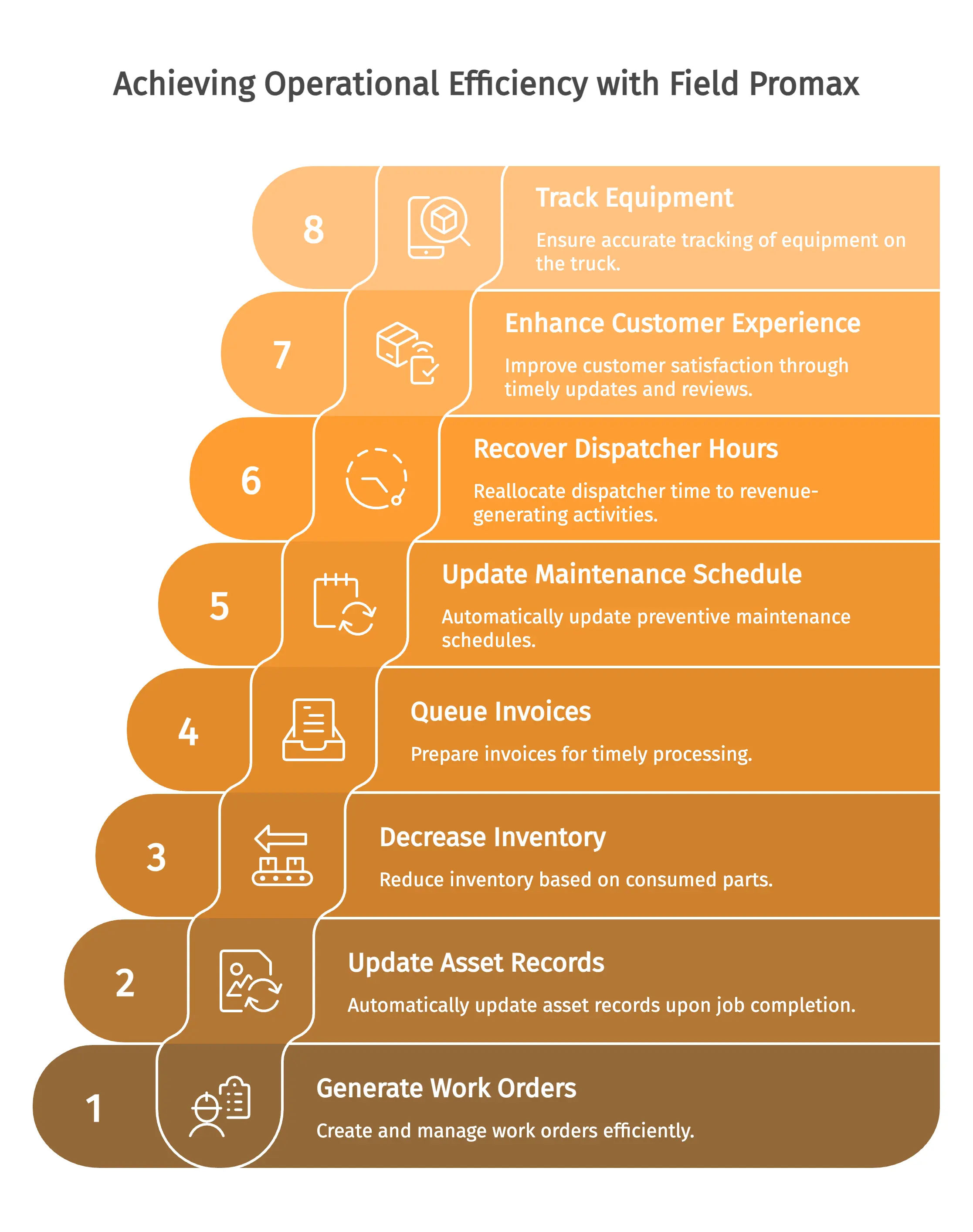
The main function of field service software is to generate your work orders, asset records, and a dispatch board that all read the same data. When a tech marks a job as complete, the asset record is updated, inventory decreases based on consumed parts, invoices are queued, and the preventive maintenance event schedule updates itself. No separate person needs to enter the same data twice. That's what field service management software with best asset tracking integration actually delivers - not more dashboards, but fewer manual steps between work done and money collected.
Among the options shops evaluate when asking which asset management software is best for field services, the distinction that matters is whether the platform was built from the start for trade businesses running under 25 techs, or whether it's an enterprise system with a lighter tier bolted on. The best asset management software for field service industry use - at this scale - is the one that works the way your shop actually runs, not the way the demo shows it running when everything goes smoothly.
A truck repair business reviewing Field Promax on the QuickBooks App Store described the platform as making accurate work orders and fast invoicing actually possible. Another long-time user who had cycled through several work-order apps called the interface easier to live with day to day than what they had been on. Both reviews point at the same thing: field service management software with best asset tracking built in should reduce friction on the daily workflow, not add a new category of administrative overhead.
Dispatcher hours, recovered
The cleanest single measure of ROI is dispatcher hours saved per week. Time recovery from digital ticket flow shows up within the first 60 days. The dispatcher reallocates that time to revenue work - customer follow-ups, quote conversion, payment chases - not going home early. Team management software tied to the work order is where this shows up on the timesheet.
Customer experience, in the gap between window and arrival
A customers’ experience with your shop is shaped by the gap between the appointment window and the time when the truck arrives. Automated arrival notifications, precise GPS-driven ETAs, and post-service reviews help close that gap. Pest control customers who receive a photo of the bait stations are less likely to call back. The HVAC customer who receives a 12-minute arrival warning is less likely to change their schedule because they know you’re on the way.
Equipment and asset tracking, on the truck
For cleaning and multi-trade shops with high-value equipment moving between sites, the asset record on the mobile app is the difference between knowing and guessing. Equipment tracking tied to the work order, with the field service mobile app as the field entry point, makes asset visibility a daily reality instead of a quarterly clean-up. The best asset management software for field service industry operations makes this entry point fast enough that techs actually use it - on every job, before they close the work order.
The piece that decides whether a rollout works isn't on any feature checklist: it's mobile-app adoption by the techs. Mobile-app usage is the single biggest predictor of a successful field service asset management rollout, not the integration list, not the dashboard depth. When techs update the asset record from the truck in real time, the office gets clean data and the system compounds week over week. When they don't, the office spends Friday reconstructing the week from memory.
Conventional advice says pick the tool with the most features. I'd argue the opposite: pick the tool your senior tech will actually open on Monday morning. Feature depth only matters once.
- Joy, Founder, Field Promax
11. Emerging trends worth tracking (and which ones to ignore).
AI tools analyze service history, weather patterns, and runtime data to identify which assets are most likely to fail within the next 90 days. The risk is that shops adopt AI before ensuring their asset records are clean and accurate. Clean up the asset records first, and the model becomes practical later.
IoT sensors and condition monitoring
Temperature, vibration, and current-draw sensors add condition data directly into the asset record. The economics work well for fixed equipment and larger mobile assets. This is usually not the case for hand tools, where the installation cost is often greater than the average replacement or loss cost. For most shops with fewer than 20-tech, this is more of a future consideration than a budget purchase for the next 12 months.
Blockchain for chain-of-custody
Blockchain is useful for high-value assets where chain of custody is legally required. That market is relatively small for most trade shops. If a customer or insurer does not specifically require it, there is usually no reason to invest in it.
Cloud-based asset systems
Cloud is now the default choice for new deployments. The real question is not whether to use cloud services, but whether the offline user experience works properly during situations such as a basement service call with no signal, and whether data syncs correctly once the technician regains connectivity. Test this thoroughly during the demo, not during the first actual job.
Hybrid GPS and software tracking
GPS tracking on trucks plus barcode or QR on assets covers most under-15-truck fleets. RFID earns its cost above that scale, or for specific high-loss tool categories where the recovery rate justifies tag cost. The decision is straightforward: if the asset moves between jobs and costs more than $1,000 to replace, GPS is worth it. Below that threshold, QR plus a checkout habit covers the use case.
AR for field technicians
AR-assisted repair overlays are available for more complex installations such as commercial chillers, industrial controls, and large life-safety systems. However, the economics are not yet practical for most residential service businesses. Watch the category, but do not budget for it yet.
Big data and predictive insights
A clean asset record with two years of service history and reliable reporting is more valuable than any analytics dashboard when the underlying data is inaccurate. Start with strong data discipline first; analytics only become useful when the data inputs are reliable enough to trust.
Mobile-first as the actual workflow
Every trend above depends on a working mobile workflow underneath it. If techs can't update the asset record from the truck in roughly 10 seconds, none of the dashboards, AI predictions, or chain-of-custody features will save the rollout. Any field service management software with best asset tracking capabilities runs or fails on this single constraint. A field service mobile app means the asset record lives where the work happens - not on a desk three hours after the job closes.
Asset management benchmarks for trade shops.
The numbers consistently show the operational benefits that well-managed asset tracking creates, and how much poor tracking can cost businesses across the different trade industries that Field Promax serves.
| KPI | Industry Avg Without Digital Tracking | Target With Digital Asset System | Source |
| Annual tool loss rate | 5-10% of portable inventory | <2% with QR checkout + accountability | National Equipment Register, 2024 |
| Equipment utilization rate | ~60% (40% idle at any time) | 80% with active location visibility | McKinsey Construction Productivity, 2023 |
| Reactive vs. planned maintenance split | ~50% of shops still primarily reactive | <20% reactive, 80%+ planned | US DOE FEMP, 2023 |
| Tech time searching for tools daily | ~15% of workday (6 hrs/week per tech) | <1% with checkout habit enforced | Trackunit, 2023 |
| Audit time reduction | Full-day manual audit per quarter | 60-75% reduction with digital tracking | MapTrack, 2024 |
| Maintenance cost savings | Reactive maintenance baseline | 12-18% savings (preventive), up to 40% (predictive) | US DOE FEMP 2023 / Siemens Senseye, 2024 |
| First-time fix rate | ~77% industry average | 90% with full asset history at job site | Aberdeen Group, 2024 |
| Year | Market Size (USD Billion) | Key Growth Driver |
| 2022 | $4.43B (Grand View Research) | Post-pandemic trade digitization push |
| 2023 | ~$4.85B (estimated) | Cloud adoption, mobile-first dispatch growth |
| 2024 | $5.10B (MarketsandMarkets) | SMB platform accessibility, AI scheduling entering mid-market |
| 2025 | $5.66B (Mordor Intelligence) | IoT integration, predictive maintenance demand at scale |
| 2026 | $6.26B (Mordor Intelligence) | Asset tracking integration, mobile workforce growth |
| 2028 | ~$7.3B (Verdantix) | AI-driven asset lifecycle management reaching SMB tier |
| 2030 | $9.17B (MarketsandMarkets) | Full IoT monitoring at SMB scale, predictive maintenance as standard |
Ready to run your shop on clean asset data?
Field Promax connects work orders, asset records, dispatch, and invoicing on a single platform designed for trade shops with fewer than 25 techs. Plans start at $99/month for the Light plan (1 user), $159/month for Standard (5 users), and $239/month for Premium (12 users). No separate asset modules, no spreadsheet to maintain alongside it.
Conclusion
Field service asset management doesn’t win on the number of features. It wins because of mobile app adoption, clean asset records, and a dispatch-to-invoice flow that doesn’t break down even on bad days. The shops that do this right tend to look the same: technicians update their trucks in real time, the office can review clean and accurate data by Friday, and asset records reconcile automatically. If your dispatcher is still reconstructing Friday afternoon’s activity from memory, that’s the first problem you should assign value to solving.
Frequently Asked Questions

Content Creator
Bhargavi Halthore is a content writer at Field Promax, a field service management platform serving trades businesses across the USA and Canada. With over a decade of experience writing for business owners, she brings detailed, ground-level insight to every topic she covers. Her research goes beyond search results - she digs into LinkedIn groups, Facebook communities, and Reddit forums to understand what field service business owners are actually dealing with on the ground. She speaks directly with industry professionals, understands their day-to-day challenges, and translates that into content that is practical and actionable. What you read in her articles reflects real industry patterns, not theory.