Vehicle Branding for Field Service Businesses: Wraps, Signs, and Magnets That Generate Real Leads

The homeowner notices the wrapped van at a neighbor's house, snaps a photo of the phone number, and calls while driving home, only to reach voicemail. By the time the dispatcher returns the call on Wednesday afternoon, the homeowner has already scheduled another contractor. The truck wrap did its job. The intake process did not.
Owners on Quora who run shops with 5-20 techs often describe the same break in the funnel. The truck generates awareness, but the path between the first impression and the booked call leaks in ways they cannot measure. Across 14 years of customer interactions, we have seen that truck wraps generate leads - but those inquiries often end up buried in notebooks or voicemail. This guide explains the branding choices that create impressions and the intake decisions that turn those impressions into invoiced jobs.
Who is this guide for?
Field service owners operating anywhere from one vehicle to a fleet of 20 who want to increase local calls without increasing their advertising costs. When your vehicles are parked in driveways every day, your brand is advertising itself. The real question is whether you're capturing the leads that visibility creates.
- HVAC contractors wanting top-of-mind when an AC dies in July, supported by HVAC field service software.
- Plumbers needing credibility at midnight floods, paired with plumbing business software.
- Electrical contractors building trust through safety-forward branding and electrical service software.
- Landscapers turning curb-appeal jobs into mobile billboards with landscape business management.
- Pest control operators standing out with pest control software behind the brand.
- Traffic control and mobile repair crews using reflective branding with traffic control software.
What is vehicle branding?
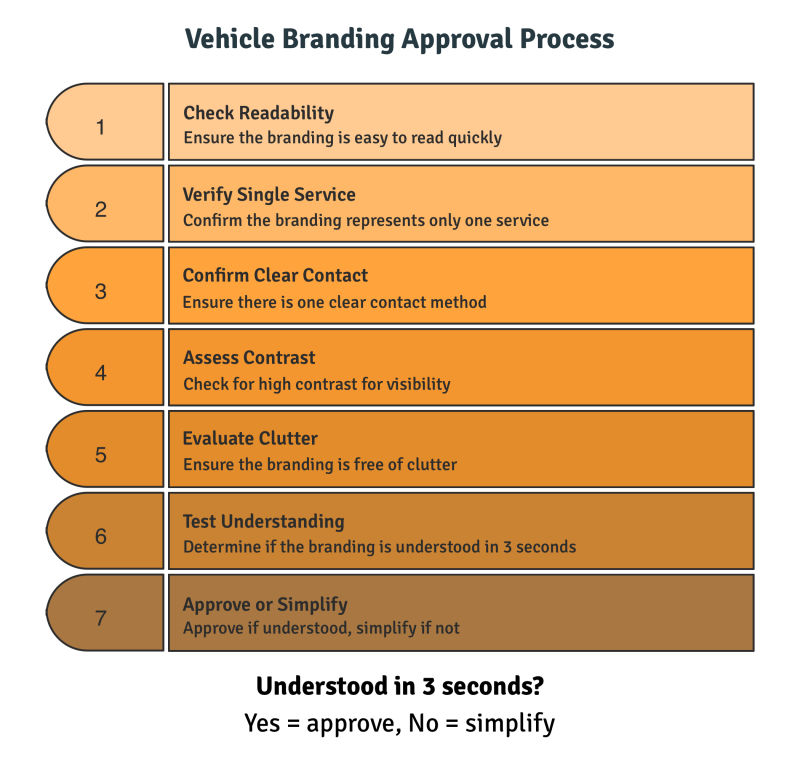
Anything graphic on a truck, van, or car to promote your business: magnets, vinyl decals, partial or full wraps, and signs. The objective is the same. Prospects glance at the vehicle and, within three seconds, are aware of who you are, what you do, and the best way to contact you. Unlike a digital ad campaign, the cost stops once the installer leaves. The impressions aren't.
What is car branding (and how does it differ from van branding)?
Car branding typically refers to an automobile, usually driven by a single contractor, inspector, or service manager. These vehicles also serve as personal vehicles, which is why removable magnets and small vinyl decals are the most popular. They can be swapped out when the vehicle is traded or used for an off-work weekend.
What is car signage and car sign writing?
Graphics or vinyl lettering are applied to a company or personal car. More durable than a magnet and more discreet than a complete wrap, they are designed for cars that do not have the size of the Sprinter.
What is van sign writing?
Cut vinyl lettering applied directly to a van's body panels. The middle ground between magnets and a full wrap: professional, reasonably priced, readable from a stoplight. Automotive Fleet's wrap analysis of OAAA figures puts vehicle wrap CPM at roughly $0.77, lower than any other ad format.
What is a vehicle or van wrap?
Full or partial vinyl covers that are printed with your logo. Highest visual impact, highest production cost. In a typical 5-20 tech shop, the most important problem is rarely "wrap or no wrap." It's "wrap a flagship truck and apply cut-vinyl decals to the remainder."
How does vehicle branding compare to traditional advertising?
| Feature | Vehicle Branding | Traditional Advertising |
|---|---|---|
| Ongoing cost | One install fee, minimal upkeep | Recurring monthly or per-campaign spend |
| Competition | No bidding for placement | Auction or media-buy pressure |
| Visibility | Active while driving and parked | Only when delivered or displayed |
| Control | You set the design and placement | Platform rules and rotations apply |
| Longevity | Five to seven years once installed | Stops when budget ends |
| Ad avoidance | Low: vehicles aren't blocked or skipped | High: ignored, skipped, blocked, tossed |
| Best for | Local service areas and neighborhood recall | Short-term promos and broad awareness |
Why does vehicle branding work so well for field service businesses?
Field service is based on local trust. The homeowner who is about to let a stranger into the home wants four signals: licensed, insured, reputable, and recognized. A branded vehicle gives all four signals at one time. The shops that increase referrals most quickly are those that have the same look across three different neighborhoods and three streets.
How many people see a branded service vehicle daily?
Industry estimates place an individual branded vehicle at around 30,000-70,000 visual impressions per day. This is based on the route taken and traffic, according to research cited by the OAAA. A branded truck parked on a driveway for three hours can produce an entire window of impressions.
How does branding compare to Google Ads and flyers?
Referral leads from industry benchmarks average around 45% for home services contractors, while pay-per-click Google Ads leads close at around 18%, and shared marketplace leads (Angi/HomeAdvisor) close at 11%. A wrapped truck that is parked on a driveway for three hours generates the highest-converting leads for businesses, as neighbors consider it an indirect recommendation.
Pair vehicle branding with field service scheduling and dispatch so the calls don't die at intake.
How does vehicle branding build local trust and recall?
Your van is seen by a neighbor three times over the span of two weeks, and a name they did not know turns into the name they recall when a pipe explodes. The companies that have the best recall match the vehicle with a comprehensive Google Business Profile and recent reviews. The wrap powers the results. The profile closes the call.
%20(4).webp?tr=f-auto,q-80,w-800,pr-true)
What does the wrap-to-intake gap look like across operators we've worked with?
In the roughly 30 multi-trade and HVAC contractors from our small-business tier that we've watched transition from paper to digital paperwork during the last two years, a similar pattern has emerged. This case combines the most common version: a mid-sized multi-trade business in Texas with field workers who are subject to OSHA rules. Vehicle branding was an integral part of their lead engine for many years, with 14 wrapped service vehicles generating constant inbound calls.
The branding wasn't the problem. The company's documentation was. During an OSHA review, the contractor was unable to produce safety training records for several technicians, leading to a penalty that could reach tens of thousands of dollars. The same paper-binder workflow that lost training records also resulted in lost leads generated by the wraps. Dispatchers put callback codes on Post-its and then lost them under invoices.
Leadership shifted both functions onto an integrated digital system in one go. Training records are recorded per technician. Inbound calls coming from wraps, the site, and the Google Business Profile were routed through an intake queue linked to the dispatch board.
Later audits were easy, and records were retrieved in a matter of minutes. Jobs assigned to wraps, measured using the tracking number of each truck, were placed into dispatch the next day instead of three days later. Crews initially were not happy with the additional sign-off procedures, and office personnel spent weeks backfilling old training records. Wrap-call attribution took around a quarter to settle. However, the gap between street impressions and booked jobs narrowed measurably.
It is a common pattern seen across a variety of operators within this vertical. The details are linked to the most common version.
When do car magnets actually make sense for a field service shop?
Car magnets are often the first step in branding for shops that are new. Install them in about 30 seconds, change them as you move vehicles, then remove them completely after a contract van is handed over to your leasing firm. Great for testing, but only for a limited time.
What are car magnet signs?
Magnetic panels with your logo can be removed. A vinyl topcoat holds the design, and the magnetic backing attaches the panel to doors and rear quarter panels. The quality varies based on the thickness of the magnet and the quality of the adhesive, which is where most cheap magnets fall short.
Magnetic signs or permanent signage: which wins for your fleet?
Magnets detach, fade, and curl. Sign writing doesn't. If a homeowner sees a magnetic sign that is lifting at the corner, they will perceive it differently than clear vinyl lettering. Magnets are a good choice for fleets in transition, but not for the flagship truck.
Why does magnet thickness matter?
A 30-mil magnet stays flat at highway speeds and in all weather. A bargain 15-mil magnet can lift around the edges. The difference in price per panel is typically $20. The cost of a sign flapping in someone's rearview mirror is more.
How should custom car magnets be sized and designed?
Make a single promise on each panel: who you are, what you do, and how to contact you. Do not list your services. Skip the URL. Magnets that generate calls all have the same elements: a phone number visible from 40 feet away, one dominant service promise, and a logo that stands out at a glance.
What are the real pros and cons of car magnets?
Magnets score well on cost and flexibility but fall short on perceived professionalism and longevity. Good stage-one choice, bad stage-three choice. If magnets are still on your only service vehicle a year later, your wrap discussion is past due.
Where do car magnets fit best?
Solo contractors with private vehicles, businesses swapping rental vans in the summer, supervisors who visit sites in their own vehicles, and short-run promotional graphics. It's not the long-term face of a six-vehicle fleet.
Why van signs are the field service standard
Van signs cost less than a wrap, look more permanent than a magnet, and survive five-plus years with normal cleaning. For most 5-20 tech shops across the trades we serve, a clean cut-vinyl sign-writing job is the most cost-efficient branding decision they ever make.
What is van sign writing, exactly?
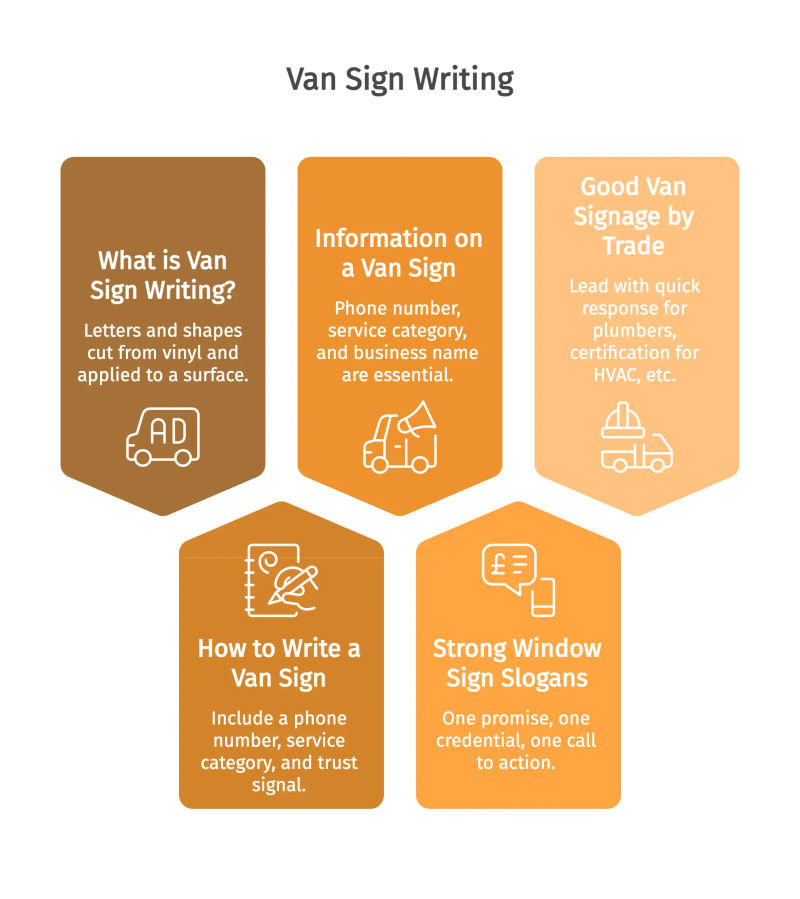
Letters and shapes cut from sheets of vinyl using a CNC plotter, then weeded and applied to a prepared surface. Clean, painted-on appearance. The lack of a full-color image keeps costs low and design discipline high.
How do you write a van sign that generates leads?
Keep it simple. A phone number big enough to be read from a stoplight. One service category (Heating + Cooling, not HVAC + Refrigeration + Maintenance Plans + IAQ). One short trust signal (Licensed and Insured). Keep the URL small. The most frequent error is treating a van's signage as a mobile website.
What information has to be on a van sign?
Three things, ranked: phone number, service category, business name. OAAA-cited research in Automotive Fleet shows passersby register vehicle ads in under three seconds. Enough to memorize a phone number. Not enough for a service menu.
What are some examples of strong window sign slogans?
- Emergency Plumbing. 24/7. Call Now.
- Heating + Cooling. Same-Day Service.
- Licensed. Insured. Local Since 2008.
- Landscaping. Curb Appeal Guaranteed.
- Pest Control. Family + Pet Safe.
One promise. One credential. One call to action.
What does good van signage look like by trade?
Lead with quick response for plumbers (24/7 emergency). Lead with certification for HVAC (NATE-certified, EPA 608). Lead with safety for electrical (Licensed and Insured, Bonded). Landscapers show the work. Traffic control uses reflective sheeting since half of its visibility is at night. Choose the signal your potential customer is searching for, and place it where they will read it first.
Van wraps explained
Wraps replace the visible surface with an image-based surface. If done correctly, a wrap costs more and can earn more. If done wrong, it looks like a cheap billboard that's impossible to remove.
What is a commercial van wrap?
The printed vinyl skin is formed to body panels using heat and pressure, then sealed around glass and trim. Topcoated to protect against UV. Cast vinyl is shaped to conform to compound curves and withstand shrinkage. Calendered vinyl is less expensive and more rigid, making it ideal for smaller runs and flat panels.
Full van wrap or partial van wrap: which one?
A full wrap covers every visible surface and runs roughly $2,500 to $6,500 for a service van in 2024-2025, per industry pricing summarized by AlphaGraphics. A partial wrap typically lands $1,000 to $2,500. For most 5-20 tech shops, partial wraps on the bulk of the fleet plus one full-wrap flagship is the smart budget choice.
What does a commercial van wrap actually cost?
Costs vary based on the size of the van, the design, its complexity, the vinyl grade, and the installer's experience. High-end cast vinyl (3M IJ180, Avery 1105) is more expensive upfront but lasts longer. The cheapest quote will usually be the one with the highest cost over five years.
How long do van wraps actually last?
3M's published warranty matrix for Wrap Film Series 2080 gives vertical-surface coverage of 6 to 8 years depending on climate zone, with horizontal surfaces much shorter. In practice, high-quality professionally installed wraps land at 5 to 7 years. Sun-belt fleets cap closer to 3 years. Garage-kept vehicles in mild climates can stretch to 9.
Are van wraps tax deductible?
Vehicle wrap and signage costs are generally deductible as advertising expenses, separate from the vehicle itself. IRS guidance on Section 179 and ordinary advertising costs covers wraps, decals, and magnetic signs. Putting your business name on a personal car does not convert all vehicle miles into deductible business miles. The wrap itself: deductible. The lunch run in a wrapped vehicle: still personal. Book wrap spend against the right expense category using QuickBooks integration.
What about wraps on leased vehicles?
It's generally accepted, but you should make sure you read the lease agreement first. Most leases require that the vehicle be returned in its original state. Professional removal is the safest option. Partial wraps using clean-removal cast vinyl minimize the risk of paint damage at the end of the lease. Magnetic signs do not leave any markings.
Creative van wrap ideas that actually work
Wraps that generate calls are characterized by three things: a phone number readable from up to 40 feet, a single predominant service promise, and a URL brief enough to remember at an intersection. All else is decorative.
Do minimalist van wrap designs actually convert?
One accent color, one font family, and one logo lockup that can be maintained regardless of size. If done well, it reads confidently. Poorly done, it looks unfinished.
Why do high-contrast wraps read at speed?
Black on white. Navy on yellow. White on dark green. Contrast ratios of more than 12:1 can be read at speed, in low lighting, and through a windshield. If a sign passes the squint test when viewed from the opposite parking lot, it will remain readable at 35 mph.
How do you make a unique wrap still look professional?
A clever copy or a catchy tagline can work as long as the primary elements remain the focus. The error is letting the joke become more prominent than the phone number.
What separates a wrap that looks expensive from one that looks cheap?
Cheap wraps are not effective because of low-resolution graphics, crowded layouts, or bargain vinyl. Professional installations use high-DPI source files, white space, and cast vinyl rated for vertical exposure. The difference in cost between basic and professional is 15 to 25 percent. The apparent difference over five years is significantly greater.
Work van wrap ideas by industry
Trade-recognizable cues let prospects self-qualify. HVAC showcases a house exterior and a comfort claim. Plumbing shows a wrench and a 24-hour guarantee. Landscaping showcases completed work. Pest control uses pet-safe language.
What business truck wrap ideas convert?
Effective truck wraps use the bed for the most prominent message, the cab doors for contact information, and the tailgate as a call-to-action. Treating a truck like a van is a common design error in truck wraps.
Custom truck wrap ideas for fleets
Five identical trucks read as one shop with five trucks. Use equipment tracking software and team management software to maintain visual consistency at the asset level, and the local recall lift is measurable inside two quarters.
Car sign writing and car signage best practices
A strong vehicle branding strategy is a visual problem first and a design issue second. The tough part isn't deciding on the right colors. It's getting a promise read in just three seconds.
Car sign writing or car magnets: which is right for your stage?
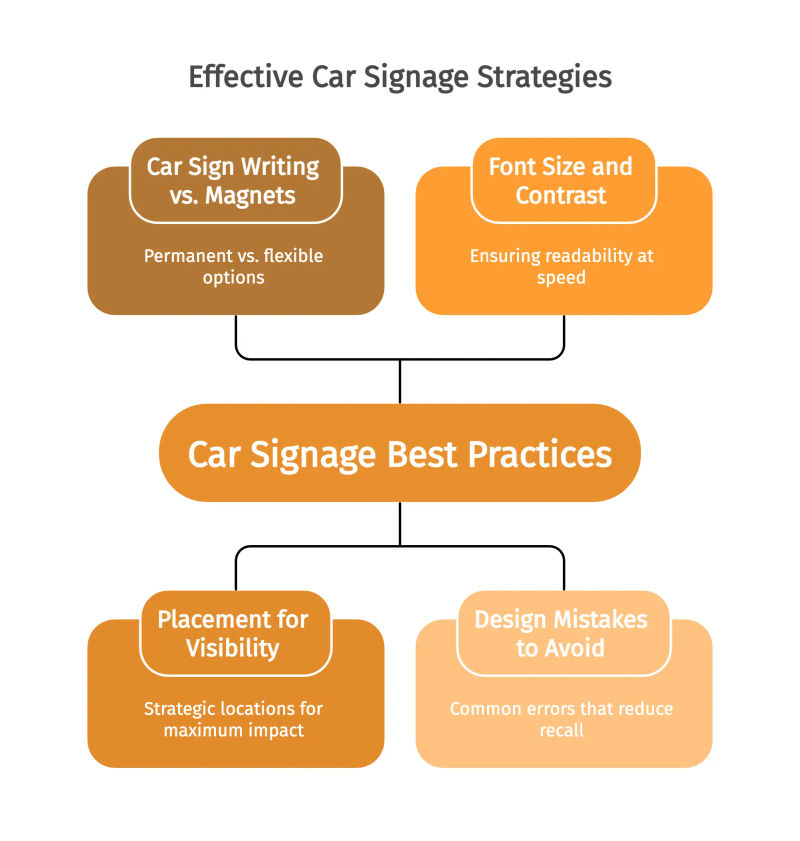
Sign writing indicates permanence. Magnets signify flexibility. A six-truck shop with magnets on each vehicle communicates impermanence to anyone who is paying attention.
Where should you place car signage for maximum visibility?
Door panels (eye level for drivers in front), the rear panel (visible to following cars), and the back window, if the law allows. Roof graphics and hoods get less exposure than the companies selling them claim.
What font sizes, contrast, and layout rules matter most?
The phone number on van panels should be readable from 40 feet. Six-inch character height is the minimum for body-side positioning. Heavier typefaces (Futura Heavy, Helvetica Bold, Montserrat Black) can be read at speed. Avoid script fonts. Two type families maximum.
What design mistakes kill recall?
Too much copy, contact information smaller than the logo, poor color contrast, inconsistent type weights, and stock photos that age badly. Treat the wrap as something you'll see 1,000 times.
The psychology of vehicle branding
Repetition, familiarity, and consistency in the signal create the kind of memory that transforms the impression of a wrap into a phone call if something goes wrong at 11 p.m.
What color psychology works for service vehicles?
Green and blue are interpreted as trustworthy, which is why plumbing and HVAC often default to these colors. Red signals the urgency of emergency services, but in moderation. Black and yellow is the highest-contrast combination available and dominates traffic control branding. Two colors are readable. Three blur. Four look unprofessional.
Which fonts hold up at 30 to 50 mph?
Heavy sans-serif typefaces (Futura, Helvetica Neue, Montserrat, Gotham Bold) are able to stay readable at speed. Small strokes, complicated serifs, or ornamental flourishes lose readability. Check the design from 6 feet away on an LCD screen. If it fails to hold there, it will not hold at high speeds.
How should logo, phone number, and visual hierarchy be ordered?
The logo or service promise should be read first, followed by the phone number, with supporting copy third. Inverting that order is the most common hierarchy mistake.
Why simple beats clever, every time
Clever copy ages fast. Clear copy can last for about a decade. The shop wrapped with "Premier IMS Group" loses out to the shop wrapped with "Heating and Cooling."
Real vehicle branding examples by trade
Plumbing vehicle branding
Side panel: '24/7 Emergency Plumbing' with the phone number larger than the business name. Rear: a single guarantee. The neighbor with a flooding basement isn't reading a service menu; they're memorizing a number. Pair with plumbing business software so calls hit dispatch the same minute they ring.
HVAC van branding
NATE-certified and EPA 608 belong on the panel because they validate technician quality. Pair the HVAC software workflow with the branding so wrap-generated calls reach a dispatcher who can quote same-day.
Electrical contractor branding
Licensed, insured, and bonded language is homeowners' risk insurance. A neat and restrained style also indicates security. Sprinter van wraps are suitable for larger electrical fleets operating commercial jobs, and a uniformly branded fleet on the job site can double as a credential display.
Traffic control service branding
Reflective sheeting (DOT-grade Class III, if required) is the most practical anchor. Anything that's not visible at 3 a.m. in the headlights doesn't merit a spot on the panels.
Landscaping and outdoor services branding
A photo of a clean lawn or finished hardscape on the side panel sells the outcome better than any slogan. Pair with landscape business management software to capture the leads the photo generates.
Car magnets vs van sign writing vs van wraps: how do they compare?
Each format works best at a different stage. It is a mistake to force one format across the entire fleet when the economics favor an array of formats.
Why focused, clear designs win every comparison
Whether it's a magnet that costs $50 or a wrap that costs $5,000, the principle is the same. Design concepts that attempt to do multiple things on a single panel will accomplish only one. The branding incorporated into the design is usually the most straightforward version.
How do you choose the right vehicle branding for your stage?
Choose for stage, not for ambition.
What works if you're a solo contractor?
Magnets are the best place to start. Upgrade to vinyl sign writing once the second truck arrives and becomes the primary service vehicle.
What works for a 2-to-5-vehicle fleet?
Use cut-to-size vinyl sign writing across the fleet, maintaining a similar design on every truck, with the option of a fully wrapped flagship vehicle for jobs that require high visibility or for trade shows.
What works for 6 or more vehicles?
Create document specification templates that lock in logo usage: define the fonts, Pantone colors, and placement guidelines. Without a design framework, each installer may end up reinventing the logo.
What if your vehicle is leased?
Select formats that are removable: Partial wraps using clean-removal cast vinyl or strong magnetic signs. Make sure lease conditions are documented in writing. Budget for professional removal at the end of the lease.
What if you swap vehicles often?
Use premium 30 mil magnets with strong adhesion. The transfer time between vehicles should take only a few minutes.
Vehicle branding do's and don'ts
- Use contrast ratios above 12:1.
- Keep one clear message or promise for each panel.
- Make the phone number the most legible element after the logo.
- Avoid stock clipart for vans and generic city skyline graphics.
- Design for both the parking lot squint test and visibility at traffic speed.
- Clean the wrap every month.
Cost, ROI, and lead generation
Branding spend is less important than the number of calls it generates. Small shop owners on Quora mention this problem - they see visitors coming to their website and trucks passing potential customers, but only a few convert because the path between the initial visit and form submission is broken due to weak trust signals or unclear messaging. The website and the vehicle wrap serve the same job, and both fail in similar ways without a disciplined intake process.
What does professional branding actually cost?
Partial wrap: $1,000 to $2,500. Full wrap: $2,500 to $6,500. Sign writing packages start at roughly $500 for a clean cut-vinyl job, per SpeedPro's published 2024 pricing. Magnetic signs sit under $100 per panel. Pair the spend with job costing to track per-truck branding investment against booked-job revenue.
Does branding deliver better ROI than digital ads?
According to OAAA data reported by Automotive Fleet, vehicle wrap CPM is around $0.77, which is lower than many comparable advertising formats. When you combine that with referral close-rate math (roughly 45% for referrals compared to 18% for paid search), the long-term ROI of branding becomes much stronger. Branded trucks continue generating visibility even when the advertising budget is reduced.
How do you actually track wrap-generated leads?
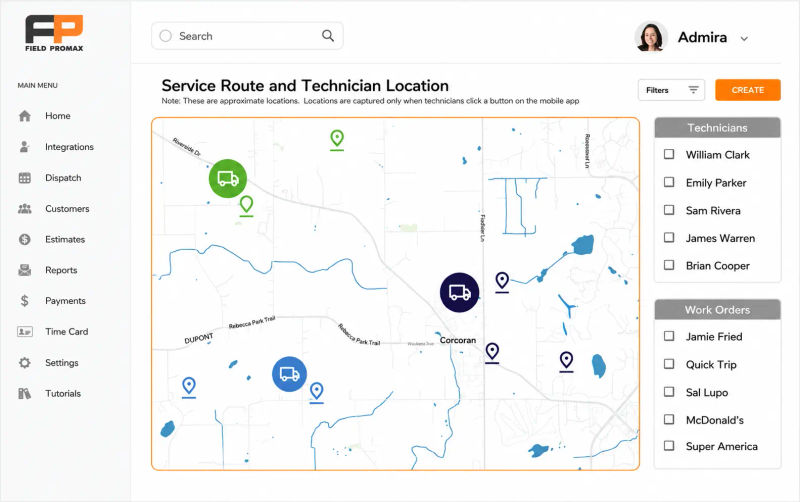
Assign a unique tracking phone number per truck or per region. Route those numbers through a customer management system tied to dispatch. Add a QR code on the rear panel dropping prospects into a measured landing page with a single CTA.
An HVAC contractor reviewing Field Promax on the QuickBooks App Store explained that lead capture forms now integrate directly with the dispatch board. This allows technicians to be assigned on the same day a homeowner calls to inquire about an installation, resulting in roughly 30% more work scheduled without adding office staff.
Small business owners on Quora discussing lead capture systems often mention the same issue - too many disconnected tools and no clear solution that fits within a small shop’s budget. One tracking number for each truck, one intake queue, and one dispatcher is often enough. The issue is not the stack itself. The real problem is losing the lead that the vehicle wrap originally created.
A note from our CEO
I read every support ticket that comes into Field Promax, and the wrap conversation surfaces more than people expect. What we hear from HVAC and plumbing owners is the same complaint: 'We just spent $4,500 on a wrap. Where are the calls?' The calls are there.
Most shops just can't see them. They route through three phone lines, one notebook, and a Wednesday-afternoon voicemail check that misses the prospect by 48 hours.
- Joy Gomez, Founder of Field Promax
The choice of branding is only one part of the process. The larger factor is whether calls from the wrapped vehicle reach an operator and whether the booking system is up and running within 90 seconds. Our customer base is diverse, and those who overcome that gap recover the cost of the wrap in about one quarter. Those who do not continue to blame the wrap.
Vehicle branding trends for 2026 to 2027
- QR codes on the rear panel. Track impressions to scans, scans to calls. Pair with practical QR code workflow guidance.
- Reflective materials. DOT Class III sheeting is moving from traffic control crews to general HVAC and plumbing fleets, especially those handling emergency calls after dark.
- Minimalist, single-promise designs. One service. One number. One color story.
- Hybrid and electric vans. Sleeker body lines reward simpler, cleaner designs.
- SMS and email capture in the wrap. Litmus and DMA benchmarks estimate the ROI of email marketing at around $36 for every dollar invested, and smaller plumbing and HVAC shops consistently tell us that regular reminders sent to their list are the cheapest repeat revenue channel.
How does vehicle branding support local SEO?
- It changes search behavior. People who come across your truck search for your business name directly. Branded searches are the cheapest traffic source and typically deliver the highest conversion rates you can track.
- It strengthens Google Business Profile performance. Real photos of wrapped vans on job sites far outperform stock photos. Research conducted by SOCi suggests that consumers are 2.7x more likely to judge an organization as trustworthy when it has a complete profile.
- Use Google review management to keep that profile fresh.
- It closes the trust loop. When the van, website, and business profile are visually aligned, the business is perceived as professional.
Google's local 3-pack pulls a click-through rate above 48% on local service searches, meaning nearly half of nearby intent traffic routes straight to the three competitors who claimed their GBP. BrightLocal's 2024 Local Consumer Review Survey found 92% of consumers read reviews of local businesses before their first visit. The wrap drives the search. The reviews close the call.
Common branding mistakes to avoid
- Busy backgrounds. Text competes with the photo, and neither wins.
- A tiny contact number. A phone number that is visible on the vehicle may not be visible from the next car.
- Inconsistent branding across the fleet. Five different logos eliminate the benefits of brand recall.
- Cheap materials. Low-quality vinyl fades within two years.
- Lack of a tracking system. A wrap that does not include a tracked phone number is simply advertising without analytics.
Vehicle branding cheat sheet: quick answers at a glance
- Magnets - The lowest-cost option with minimal commitment. Use high-quality adhesive materials for durability. Ideal for solo contractors as well as businesses with rotating fleets.
- Van Sign Writing - The standard option for field service businesses, offering a solid balance between visibility and cost.
- Partial or Full Van Wraps - Deliver the highest visual impact, longest lifespan, and highest upfront cost. Best suited for established fleets or frequently used service vehicles.
A plumbing business reviewing Field Promax on G2 noted that automated follow-up SMS sent after each service call led to repeat bookings within minutes, with customers responding immediately to schedule their next appointment. The branded truck encouraged customers to contact them the first time, while the system ensured they kept booking again in the future.
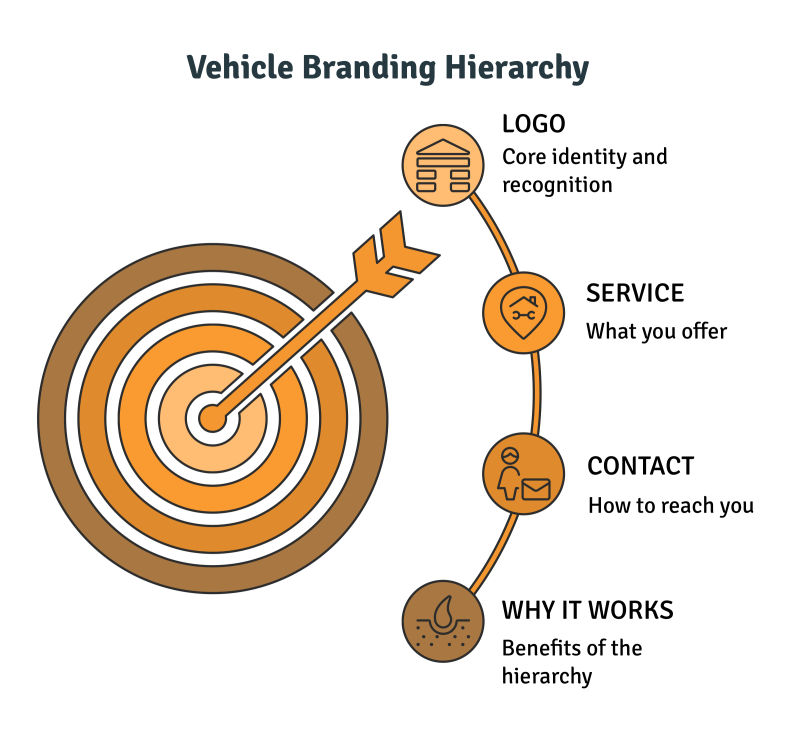
Final recommendation for field service businesses
There is no need for a branding agency or a $1,000 design retainer. What matters most is having a phone number that is readable from 40 feet away, a clear, single service promise, contact information arranged in the right order, and high-quality materials.
Use the field service mobile app so techs capture customer details, photos, and review prompts on the spot. Mobile-app adoption among technicians is the single biggest predictor of whether a branding investment compounds, because the wrap drives the call but the tech in the truck has to capture the customer, the photo, and the review for the next referral cycle to start.
What turns a wrap into actual booked revenue?
A wrapped fleet plus a tracking number plus same-day dispatch plus an automated review request equals measurable wrap-to-job ROI. Pair quality branding with GPS tracking so dispatchers see which truck is where and customers get ETAs matching the professional impression the wrap already made, and automated customer notifications turn first calls into repeat bookings.
Conclusion
Branding vehicles is one of the least expensive long-term advertising methods available for field service businesses, but it only works effectively when incoming calls are routed to a dispatcher with the job board open. The branding itself is only a small part of the equation - having an efficient intake process matters even more.
Frequently Asked Questions

Content Creator
Bhargavi Halthore is a content writer at Field Promax, a field service management platform serving trades businesses across the USA and Canada. With over a decade of experience writing for business owners, she brings detailed, ground-level insight to every topic she covers. Her research goes beyond search results - she digs into LinkedIn groups, Facebook communities, and Reddit forums to understand what field service business owners are actually dealing with on the ground. She speaks directly with industry professionals, understands their day-to-day challenges, and translates that into content that is practical and actionable. What you read in her articles reflects real industry patterns, not theory.
Reviewed by

Founder and CEO
Joy Gomez is an engineer, process automation expert, and the Founder of Field Promax. Known for his technical expertise and commitment to field service innovation, Joy writes about transforming traditional business models into paperless, efficient operations. He is a Lean Six Sigma Black Belt based in Rochester, MN, dedicated to helping field professionals work smarter through better technology.