Field Team Performance Runs on Safety, Compliance, and Documentation

The OSHA compliance officer arrives at the yard of a mechanical contractor with 25 techs on a Tuesday and requests the past 12 months of Job Safety Analysis records for the team conducting the retrofit across the road. The office manager opens the binder. Half of the JSAs don't have signatures. Three are in the wrong place. Two are dated after the work had been completed. The conversation about penalties begins before lunch.
This scene is repeated across the trade shops we work with. It is rarely the result of workers who aren't concerned about safety. It's the result of a paper-and-binder documentation system that can't keep up with the work being done in the field.
Over the past 14 years, our interactions with HVAC, electrical, plumbing, and multi-trade shops have shown that improving field team performance requires more than a few efficiency hacks. It is about bridging the gap between the work technicians perform on-site and what is documented for OSHA, insurance, and the customer's audit records.
This pillar includes Job Safety Analysis (JSA) as the operational backbone, OSHA-aligned PPE and hazard assessment requirements, BYOD data security, worker classification in accordance with California AB 5 and AB 2257, and reporting procedures designed to prevent audits from turning into penalties.
Why safety and compliance drive field team performance
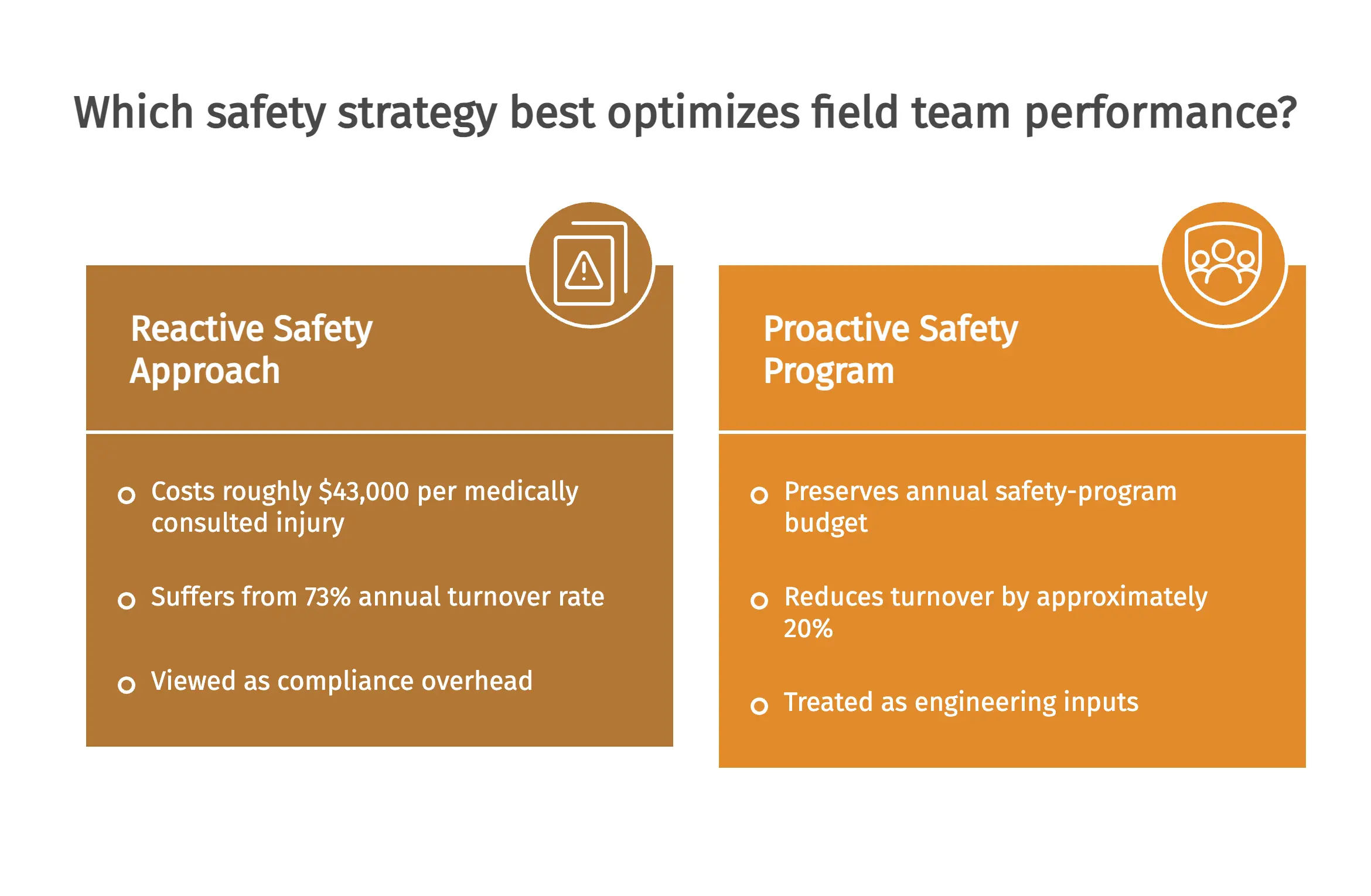
The National Safety Council estimates the average cost of a medically consulted work injury at roughly $43,000 in 2023 once wage losses, medical bills, and administrative costs are tallied. In a 20-40 tech operation, owners consistently tell us a single recordable wipes out a quarter of the annual safety-program budget once indirect costs stack on at the typical 3-5x multiplier.
Retention reinforces it. Skilled trades sit at a 73% annual technician turnover rate per 2026 Bridgit workforce benchmarks, while mechanical contractors with formal safety-first training programs run roughly 20% lower turnover. In our customer base, the shops with documented JSAs, toolbox talks, and ongoing safety training are the ones whose senior techs stick past the 3-year mark. That is the actual performance lever.
BLS 2024 fatality data shows electrical contractors recorded 59 fatalities, 17 from falls; plumbing, heating, and air-conditioning contractors recorded 75, 23 from falls and 22 from harmful exposures. Your trades have specific hazard profiles. Building a program that treats those as engineering inputs (not compliance overhead) is how safety turns into performance.
The four operational areas of a working field safety program
Safety and compliance are distributed across four areas of operation that share ownership:
- Pre-task planning: JSA, JHA, PPE assessments, lockout/tagout plans, and energy source identification.
- On-Site Execution: Toolbox talks, hazard awareness, safe work practices, and real-time hazard escalation.
- Documentation: Training certificates, incident logs, signed acknowledgements, JSA archives, and audit trails.
- Governance: Written policies covering HR classification (AB 5/AB 2257), wage-and-hour compliance, BYOD data security, insurance, and workers' compensation compliance.
Splitting these documents across different systems (a paper JSA binder, a training spreadsheet, HR documents stored on shared drives, and a BYOD policy that nobody has read since 2019) is the kind of setup that breaks during an audit.
Section 1: Setting safety and compliance goals techs can actually hit
Generic SMART goals are useful for improving revenue metrics. For safety, behavior-change goals should be concrete and tied to specific guidelines:
- Complete and submit a JSA before every task involving work at height, electrical work, or confined-space exposure. Target 100% completion. Measure it every week.
- Zero PPE non-conformance findings on supervisor spot-checks, baselined against a documented PPE hazard assessment under 29 CFR 1910.132(d), which requires written certification.
- Toolbox talk attendance and acknowledgement each week, tracked per technician.
- Refresher training on OSHA-related standards at regular intervals (NFPA 70E for electrical work, 29 CFR 1910.134 for respirators, and so on).
Aquant's 2024 field-service benchmark report puts median first-time-fix rate at 76%, top quintile at 87%. The shops that reach top quintile almost always have the safety-and-compliance backbone locked down first. The same discipline that produces a clean, timestamped JSA produces a fully documented, first-visit-complete job.
Section 2: Prioritize by hazard exposure, not just task urgency
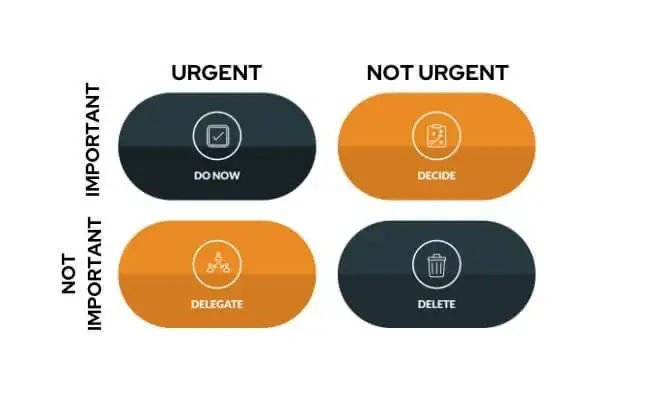
The most-cited OSHA violation in fiscal 2024 was Fall Protection - General Requirements (1926.501) at 6,307 violations, the 14th consecutive year at #1. Hazard Communication, Ladders, Respiratory Protection, and Lockout/Tagout round out the top five. If you run HVAC, electrical, plumbing, or roofing, those touch your crews daily.
- Sort jobs by hazard class before revenue. A rooftop RTU changeout, a service call to a live 480V panel, and a filter change aren't identical jobs.
- Match techs to jobs based on their certifications and hazard experience. Assigning a new apprentice to work near arc flash exposure (a sudden electrical explosion) is an OSHA finding waiting to happen.
- Build the JSA into dispatch. If the job type involves hazardous exposure, the JSA workflow is triggered before the tech can clock in on-site.
OSHA's 2024 civil penalty schedule sets the maximum for serious violations at $16,550 per violation, with willful and repeat violations reaching $165,514. Every citation traces back to whether the pre-task workflow was completed and documented. The shops that avoid these findings make the JSA a gate on the work order, not a form the tech fills out at day's end.
For landscaping, pest control, and pressure washing, the hazards shift to chemical exposure, ergonomics, and power equipment. However, the same pattern remains: the pre-task workflow needs to align with your goals, not a generic template.
A pattern across multi-trade operators we've worked with
In the many small and mid-sized multi-trade contractors we've watched go through an OSHA review, one failure pattern recurs: field practices are generally good, but the documentation can't prove it.
Consider a mid-sized multi-trade contractor operating across Texas with around 30 technicians covering electrical, HVAC, and light construction. Safety training was conducted. New hires went through JSAs with their supervisors. Toolbox talks were held every Monday morning. The records were kept in three locations: a paper binder containing JSA reports, an Excel spreadsheet tracking training completion, and a shared-drive folder for certificates. Different people maintained different sections on different schedules.
During an OSHA compliance inspection, the contractor was unable to provide safety training records for the workers on a particular job. There was no issue with the certifications; they simply weren't properly organized. The training had been completed, but the paper trail couldn't be reconstructed while the officer was on-site. The documentation gap triggered an administrative penalty of thousands of dollars, along with a corrective action plan that the office manager spent two months preparing.
The action: safety training records were transferred from paper binders into a central digital system, where completion dates, signatures, and certificates could be retrieved on demand. JSAs were moved to a mobile format, with crews completing their forms in the truck before starting work, and required fields pulled from the work order.
Subsequent audits were smooth, with records retrieved in a matter of minutes. The transition was hard. Crews initially opposed the new sign-off step, while office personnel spent weeks filling in old training data. Adoption improved after week eight.
This pattern appears across multiple operators; the details reflect the most commonly observed version.
3. Making compliance ownership explicit
Owners researching compliance management systems often report the same confusion: who is actually responsible for compliance? For shops with fewer than 40 techs, ownership has to be clear and divided.
- The designated owner (operations supervisor or safety lead) is responsible for the program's performance, including what is monitored, documented, the level of accountability, and what is escalated.
- Every tech is accountable for their own JSA compliance, PPE completion, and training acknowledgement.
- Dispatch is responsible for ensuring that a tech is not assigned to a job without current certification. This is the most neglected link, yet catching it prevents the majority of audit issues.
When everyone is responsible, no one is responsible. The result is that a JSA is skipped, and nobody notices for weeks because everyone assumes someone else is checking.
Section 2: Training records and skill documentation
OSHA's Job Hazard Analysis publication identifies JHA/JSA as a core method for hazard recognition, control, and training. OSHA doesn't mandate a specific form. It requires documented hazard identification and training. PPE hazard assessment specifically requires written certification under 29 CFR 1910.132(d).
Owner discussions on Reddit and Quora often describe new hire orientation based on informal shadowing and apprenticeships, with workers entering the field without standardized training documentation. Supervisors cannot verify who has been trained on what without going on a scavenger hunt.
OSHA-aligned training documentation in a small trade shop:
- One record for each technician, based on the requirements for their area of responsibility (NFPA 70E for electrical work, respiratory protection for refrigerant-related work, and fall protection for all work over six feet).
- Completion dates, refresher intervals, and signatures.
- Records retrievable within minutes.
Businesses that pass audits maintain training records in the same system as PPE assessments and JSAs, all linked to the technician's profile. If the auditor asks, "Show me the training records for the team that performed this retrofit," the answer should be simple.
5. Pushing safety information to multi-site crews
Owners of multi-site businesses report the same issue: safety information is communicated through daily toolbox talks, written notices, and verbal briefings, without a reliable method to ensure that every tech has been informed before starting work. If something changes, the update is sent through five different channels, and many staff members miss it.
What works:
- Toolbox talks are delivered through the same mobile application the tech uses to record job details and require a tap-to-acknowledge confirmation before the first task can begin.
- JSA revisions are pushed as notifications, not email attachments.
- One record system tracks who acknowledged the information and when.
Field Promax notifications fold safety comms into the same channel as job updates.
6. JSAs are the operational backbone
Owners on Quora discuss the JSA as the core of the new hire orientation process, requiring the supervisor, worker, and safety leader to review each job step by step. The problem is that JSAs are created on paper and must be revised with each new hire.
An OSHA-aligned JSA sequence:
- Select the job, prioritizing work with a high risk of injury, severe consequences, or new procedures.
- Break the work down into separate steps in the order it is performed.
- Identify the hazards for each step. For mechanical or electrical work, identify all energy sources at every stage.
- Evaluate the risk (probability + severity).
- Determine controls following the hierarchy of controls: elimination, substitution, engineering controls, administrative controls, and PPE.
- Train and inform affected employees.
- Review and update the JSA after near misses, incidents, or process changes.
In an average 5-20 tech shop using paper JSAs, owners estimate that only 60% of completed forms are complete and legible by the end of the week. Shops that switch to a digital JSA module with mandatory fields and missed-form alerts increase completion to 95% because techs can't close a work order without an associated JSA.
7. Hazard-observation and near-miss reporting
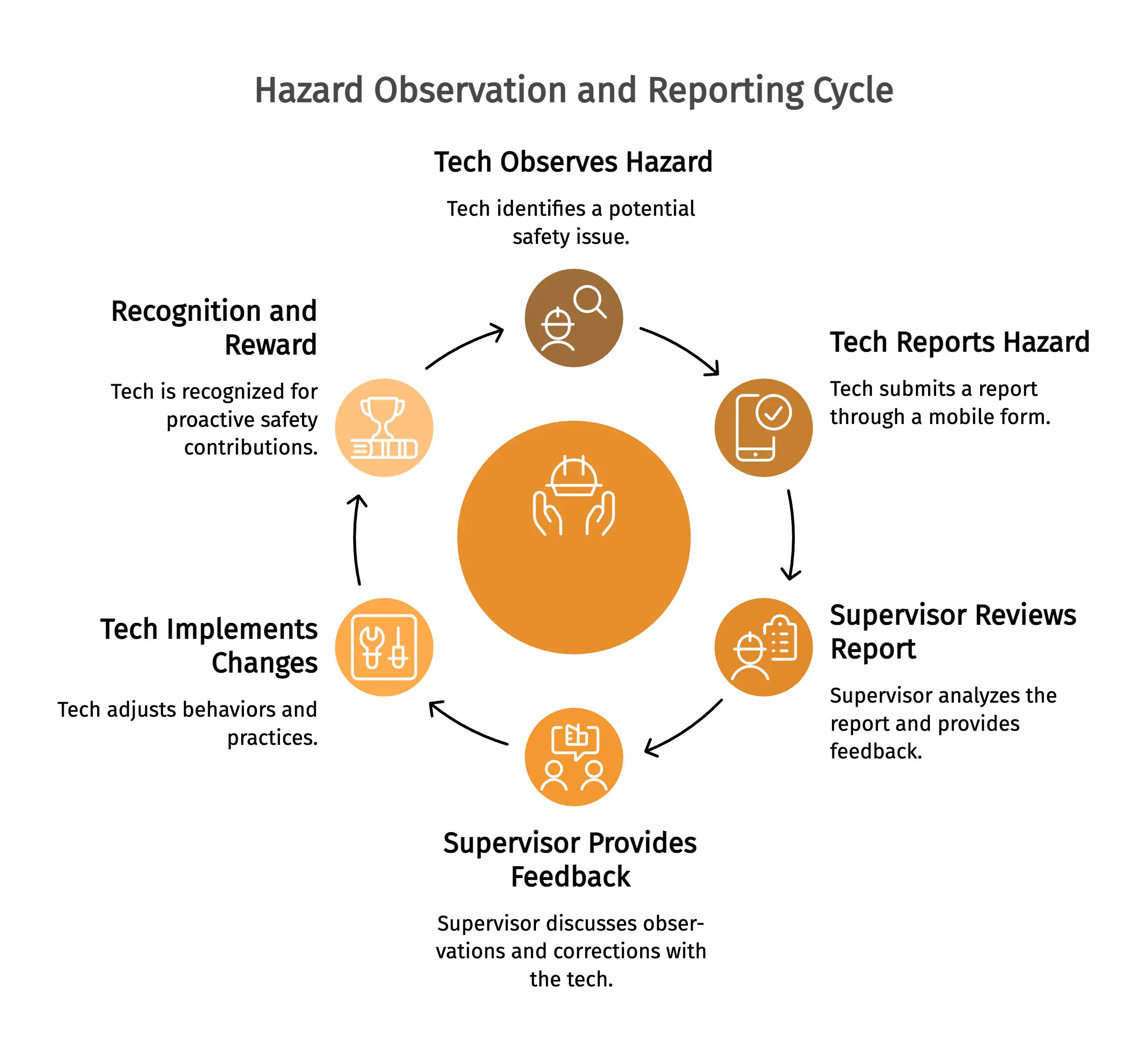
The program must receive feedback that flows both ways: from techs to supervisors regarding hazards they observe, and from supervisors to techs regarding behaviors that require correction. Businesses that create a true safety culture treat near-miss reports like incident reports, making it psychologically safe to raise an issue without fear of discipline.
In the real world: anonymous hazard reporting through a mobile form, one-on-one meetings that incorporate safety and productivity observations, and recognition through the same performance system for techs who identify or report near misses.
Section 3: FSM software as the compliance workflow layer
The real value of field service management software for a compliance-serious shop is that it becomes the single system of record for pre-task planning, on-site execution, documentation, and audit response.
- JSAs are available as configurable digital forms linked to job types. When the job is dispatched, a JSA is required, the tech completes the form on-site, the form is automatically timestamped, and the records are linked to the work order.
- PPE assessments use a checklist for each job type, along with the written certification required under 29 CFR 1910.132(d), which can be generated digitally.
- Training records are linked to each tech's profile. Dispatch cannot assign a tech to work that requires a certification they do not have.
- Toolbox talks can be delivered through the app, requiring acknowledgement before the workday begins.
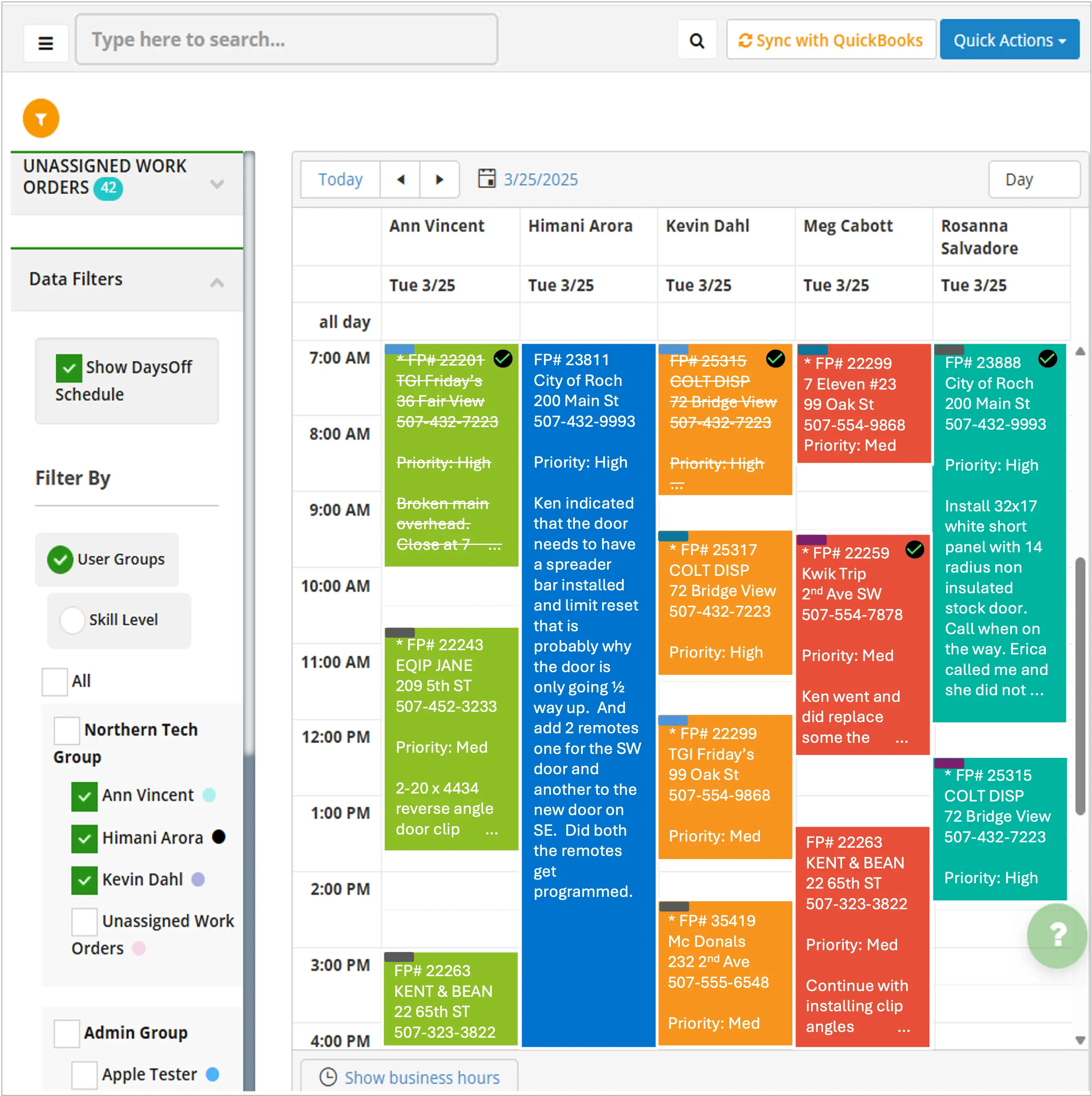
A large enterprise Field Promax customer running the platform across four different businesses noted in a QuickBooks App Store review that the customer service and configurability were superior to those of niche, out-of-the-box products. This reflects the reality that a pest control company has different pre-task requirements than an HVAC team working on rooftops.
9. Automating safety forms
In an 8-tech operation, owners have reported that each tech spends about five hours per week on compliance and safety paperwork. That's 40 hours of billable capacity spent on forms each week (8 techs × 5 hours). Businesses that integrate these forms into a mobile, automated compliance workflow can reduce that to less than one hour per tech per week, because the system auto-fills known information and saves the form when the tech presses Submit.

What automation does:
- Auto-fill all known fields (job, tech, customer, date, GPS, and timestamp).
- Enforce mandatory fields so incomplete forms can't close the work order.
- Send missed-form alerts to an administrator.
- File the completed form with the employee's record.
10. Mobile technology and BYOD data security
The majority of trade shops use BYOD, which is fine. However, it has real implications for how customer PII, employee records, and job data are handled.
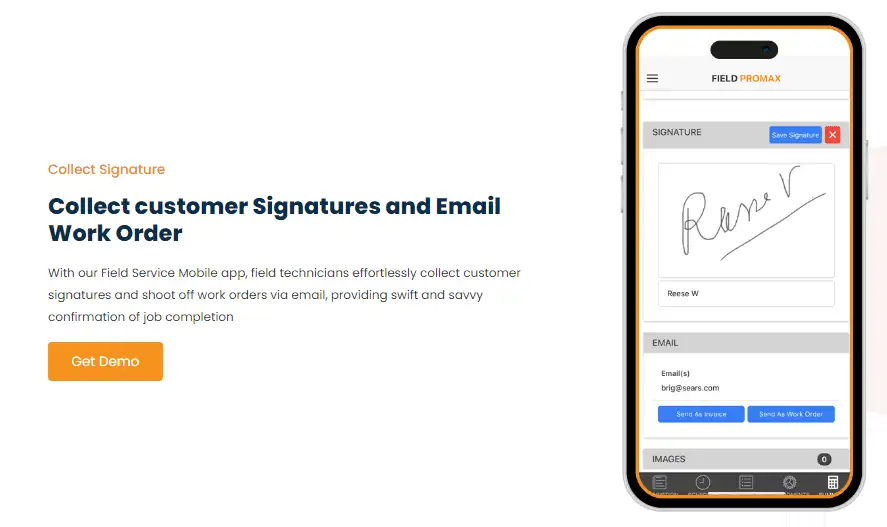
Practices that last:
- Enforce application-level authentication, not just device locks.
- Limit data cached on devices to work-related tasks. Historical records should remain in the cloud.
- Allow app data to be remotely wiped through the FSM platform without affecting the user's personal device.
- Maintain a written BYOD policy signed by every tech that covers acceptable use, remote wipe rights, and the handling of customer private information.
For California operators, the CCPA applies to customer PII regardless of device ownership, and BYOD policy documentation is often where shops are flagged during privacy audits.
11. Standardizing pre-task walks by job type
Batching similar safety pre-checks is a compliance and productivity move:
- Standardize the JSA template by job type, not by customer. A rooftop RTU changeout carries the same fire risk regardless of who owns the building.
- Pre-populate site-specific hazards from previous visits.
- Check PPE and equipment on the truck before walking the site.
If the JSA is 80% pre-populated, the tech only needs to provide the remaining 20% of information that can't be pre-filled (weather, current site conditions, and difficult equipment access). Those are exactly the areas where hazard exposure changes.
Section 4: Worker classification: AB 5, AB 2257, and the ABC test
For any trade shop with California field crews, worker classification is the compliance area with the sharpest penalty edge. Under California Labor Code as implemented by AB 5 and clarified by AB 2257, a worker is presumed an employee unless the hiring entity proves all three prongs of the ABC test:
- A: The worker is free from the hiring company's control and direction in performing the work.
- B: The work performed is outside the usual course of the hiring company's business.
- C: The worker is customarily engaged in an independently established business performing the same type of work.
For a field service company whose primary business is dispatching technicians to perform plumbing, HVAC, or electrical work, a 1099 tech generally cannot satisfy Prong B. The default classification is employee.
The penalties for willful misclassification under California Labor Code § 226.8 range from $5,000 to $15,000 per violation for initial offenses and up to $25,000 per violation for a pattern or practice of willful misclassification. PAGA also imposes civil penalties of $100 per employee per pay period for initial violations and $200 for subsequent violations. A genuine business-to-business contractor with its own license, insurance, and other clients may qualify for the AB 2257 business-to-business exemption, but the standard is high.
13. Toolbox talks that change behavior
Toolbox talks work best when they are targeted (one hazard, one behavior, or one job type), brief (five to seven minutes), delivered through the same channel the tech uses to receive job details, and acknowledged with a recorded tap that becomes part of the tech's training record.
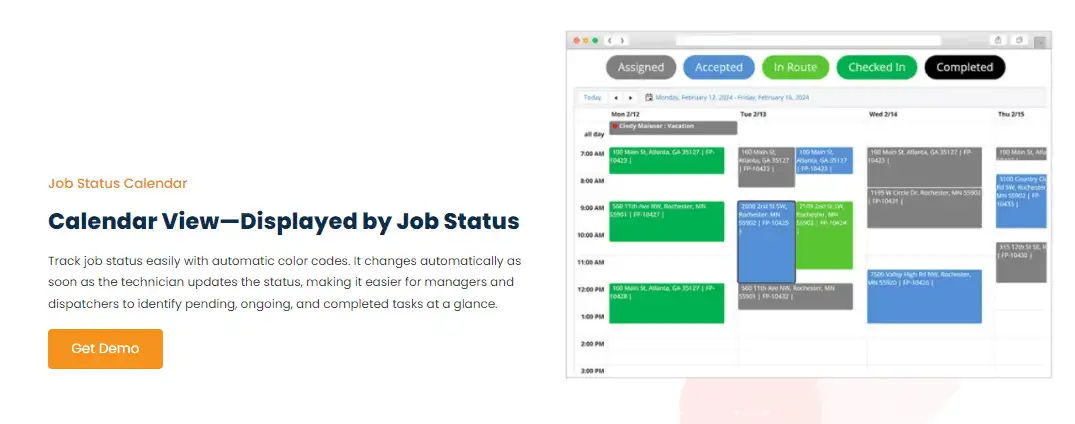
The failure mode is the monthly all-hands meeting where 30 techs sit through a slideshow covering PPE they already know. Attendance is recorded. Behavior doesn't change.
Section 5: Tracking safety KPIs
Lagging indicators (TRIR, DART, and EMR) don't change quickly enough to provide meaningful week-over-week guidance for a small trade shop.
The most important leading indicators to monitor are:
- JSA completion rate per tech, per week.
- PPE compliance rate from spot checks.
- Near-miss reporting frequency (higher is generally healthier).
- Toolbox talk acknowledgement rate.
- On-time training refresher completion rate.
Lagging indicators should be monitored for insurance, EMR, and audit purposes:
- TRIR (Total Recordable Incident Rate).
- DART rate.
- Days since the last recordable incident.
Field Promax reports and dashboards surface these against job data, so KPI review isn't a separate spreadsheet exercise.
15. Pricing safety into tech performance reviews
Two techs with identical jobs and revenue are not operating at the same level if one has an impeccable JSA record and no PPE findings, while the other has skipped JSAs and repeated near misses. The safety-focused tech delivers higher overall value.
Include safety in the performance review alongside work quality, productivity, and customer satisfaction. Weight it appropriately so that a serious safety issue cannot be offset by strong profitability. Shops that take this approach to safety tend to have lower turnover among senior techs.
An HVAC contractor reviewing Field Promax with the timecard feature enabled on the QuickBooks App Store called it software no service company should be without. That labor-capture accuracy is what makes the review conversation possible. If the tech's hours, jobs, and safety history live on the same record, the review runs on data.
.webp?updatedAt=1747733769120)
How Field Promax's JSA and compliance workflow fits your shop
Consolidating spreadsheets, paper records, and shared-drive folders into a single mobile-first compliance workflow is what separates companies that pass audits from those that end up in penalty discussions.
What a compliance platform should provide to a business owner:
- Configurable JSA templates by job type, linked to dispatch and required before a work order can be closed.
- PPE assessment checklists with written certification output in accordance with 29 CFR 1910.132(d).
- Training records linked to each tech's profile, with certification checks at dispatch.
- Toolbox talks and safety alerts delivered through the same mobile application.
- Timecard and GPS tracking tying labor and location to safety-relevant work.
- Reports and dashboards surfacing JSA completion, PPE conformance, and safety KPIs alongside operational metrics.
Whether you run HVAC field service, plumbing, electrical service, pest control, or a multi-trade operation, the compliance backbone looks the same. What varies is which standards you cite on the JSA.
I read every support ticket that comes through Field Promax, and the JSA-related ones follow a specific pattern. It's rare that the form is broken. Owners tell us they bought the software for scheduling, and now that they can see our compliance workflow on a screen instead of in a binder, they need help configuring the JSA templates for their scope of work. That's the moment the compliance question turns real for most owners. Safety documentation isn't a software problem; it's a workflow-visibility problem.
Once an owner can actually see whether the JSAs got done this week, they usually already know what to fix. What we hear from HVAC and electrical shops in particular: mobile-app adoption by techs is the difference between a program that exists on paper and one that exists in practice.
- Joy Gomez, Founder of Field Promax
Conclusion
Field team performance is a strong indicator of an effective compliance process. The businesses we work with that consistently pass audits, retain top technicians beyond the three-year mark, and reach top-quintile first-time fix rates are those that use mobile-first JSA, PPE, and training record workflows integrated with dispatch.
Frequently Asked Questions

Content Creator
Bhargavi Halthore is a content writer at Field Promax, a field service management platform serving trades businesses across the USA and Canada. With over a decade of experience writing for business owners, she brings detailed, ground-level insight to every topic she covers. Her research goes beyond search results - she digs into LinkedIn groups, Facebook communities, and Reddit forums to understand what field service business owners are actually dealing with on the ground. She speaks directly with industry professionals, understands their day-to-day challenges, and translates that into content that is practical and actionable. What you read in her articles reflects real industry patterns, not theory.