Remote Team Scheduling for Field Service: What Actually Works
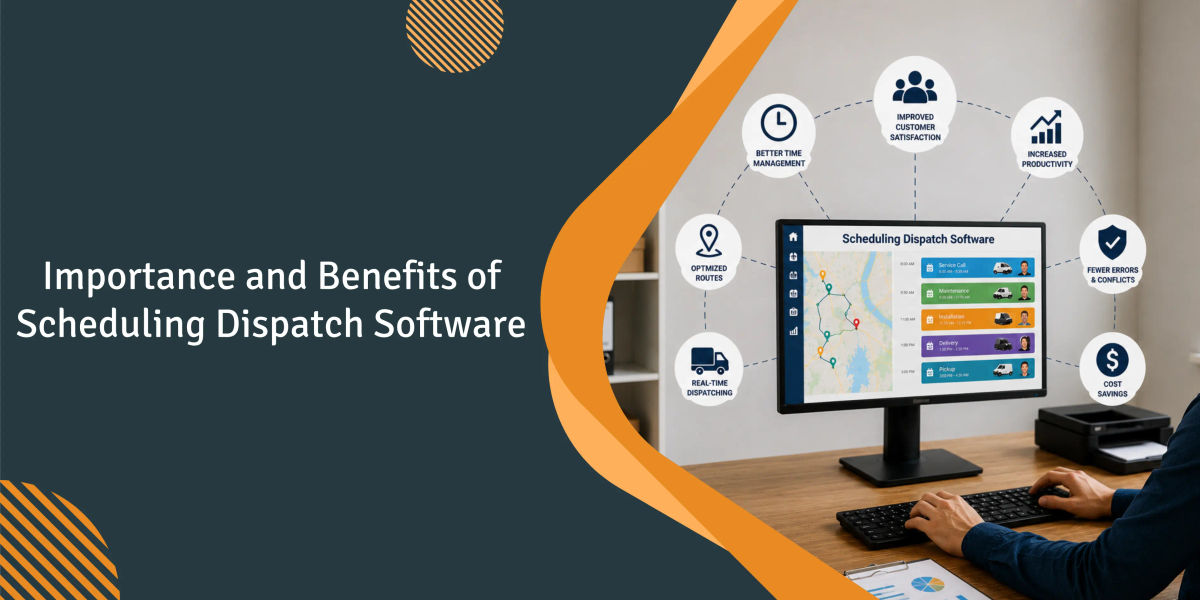
The standard advice for scheduling remote teams, the kind you see on SaaS review sites and software comparison pages, is to buy the platform with the best-looking calendar and the highest review scores - was written for SaaS sales teams scheduling Zoom calls, not for dispatchers trying to fit a furnace replacement between an apartment service call with limited access and a technician stranded on the interstate with a broken serpentine belt.
Across the operators we have worked with over the years, one pattern has remained consistent: the scheduling software rarely fails. The workflow built around it does.
1. A pattern across remote field operators
Across the operators we have worked with since 2019, one failure mode keeps surfacing on commercial-adjacent routes: gated complexes, property-manager-coordinated sites, and after-hours retail stops. Dispatchers often do not discover the problem until the technician arrives on site and calls the office, which can waste 30 to 50 minutes, plus the return drive. The example is a composite based on an operations manager at a mid-sized company running about 20 technicians across residential and light commercial routes.
During the second quarter of a busy summer, the operator observed a steady stream of no-access incidents: locked gates, off-site property managers, and tenants who had not received arrival notifications. The booking script captured the address and the technician availability window, but it did not record site access instructions. The calendar looked organized, yet nearly one-quarter of the day's time was being lost before a single job could begin.
The solution was not new software. It was simply rewriting the intake script so the CSR could not end the call without completing an access note field and verifying a mobile number, which was paired with a one-hour confirmation message. The initial version did not last. CSRs skipped the access field for long-time customers, so by the second month it became a mandatory field. Every Monday, the team held a huddle to review the previous week's missed opportunities.
The number of no-access incidents dropped by about half within the quarter. The unexpected challenge was that confirmation messages triggered a wave of rescheduling requests. The calendar became more congested for about three weeks before the process stabilized. The newest CSRs adopted the script immediately. The only people who resisted were two senior dispatchers who continued booking jobs from memory.
This is a composite case based on the most common version of this pattern. The numbers are representative, even though no single shop's story matches every detail.
2. The conventional advice on remote scheduling is mostly wrong
The most common buying advice is to choose the platform with the most capabilities, features, integrations, and the highest-rated mobile app. For an HVAC, plumbing, electrical, or other field service business with 5-20 technicians, that is often the wrong filter.
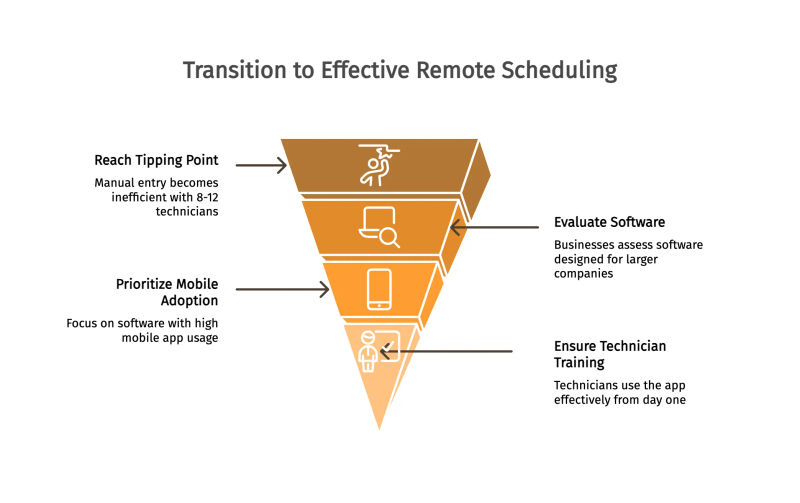
The most reliable indicator of whether scheduling software delivers ROI for our customers is whether field technicians open the mobile application every Monday morning. Mobile app adoption is a stronger predictor of success than any other metric, and it is the one variable that cannot be seen during a sales demonstration.
The second reason is that most businesses are not switching from another FSM platform. They are moving from paper, spreadsheets, or QuickBooks-only workflows. Transitioning from paper does not require a sophisticated data import wizard. It requires a technician who can use the mobile app effectively from day one without needing to learn from a PDF.
In owner discussions on Quora over the past 12 months, operators running five- to 15-technician businesses repeatedly describe the same progression: they start with Google Forms, Google Calendar, and spreadsheets. They reach a tipping point at around eight to 12 technicians, when manual entry begins to break down, and then spend six weeks evaluating software designed for companies three times their size.
3. Where remote field scheduling actually breaks
Five failure points appear again and again. None of them have anything to do with the calendar view.
Dispatcher minute drain. Our experience has shown that dispatchers in an 8-tech shop are forced to spend a large portion of every workweek building schedules manually through phone calls and back-and-forth text messages. Shops that use drag-and-drop dispatch boards recover most of that time because the schedule updates automatically as jobs change.
Windshield time. Across the HVAC and plumbing companies we serve, we have consistently observed that windshield time consumes a large portion of the workday before routing rules are implemented. Well-planned operations can reduce that figure to less than 20%. In an 8-technician shop, the difference is equivalent to recovering a significant amount of billable time each week.
The after-hours leak. Roughly 35% of service requests come in outside business hours. Calls that hit voicemail quietly walk to the next contractor. The Housecall Pro home service customer trends report notes 80% of homeowners now factor online booking into hiring decisions. In our customer base, the shops that publish a widget on their website and Google Business Profile fill the Monday-morning board before the phone even rings, while the holdouts spend the first two hours of Monday returning weekend voicemails.
Visibility blind spot. Owners on Quora often mention the need to know the exact location of each technician, not just where the schedule says they should be. Without live GPS visibility, the office cannot accurately track a technician between dispatch and job completion.
The dispatcher-driver disconnect. If dispatchers do not understand the realities of a route - such as site access times, vehicle restrictions, and live-load wait times - they assign jobs that can't be done on time, and the back-and-forth throws off everyone's schedule.

4. What mobile-first dispatch really requires
"Mobile-first" is one of the most commonly used terms in field service software marketing. For trade businesses, it has a specific meaning: technicians should be able to complete their work in the field without having to call the office.
The features that actually predict adoption:
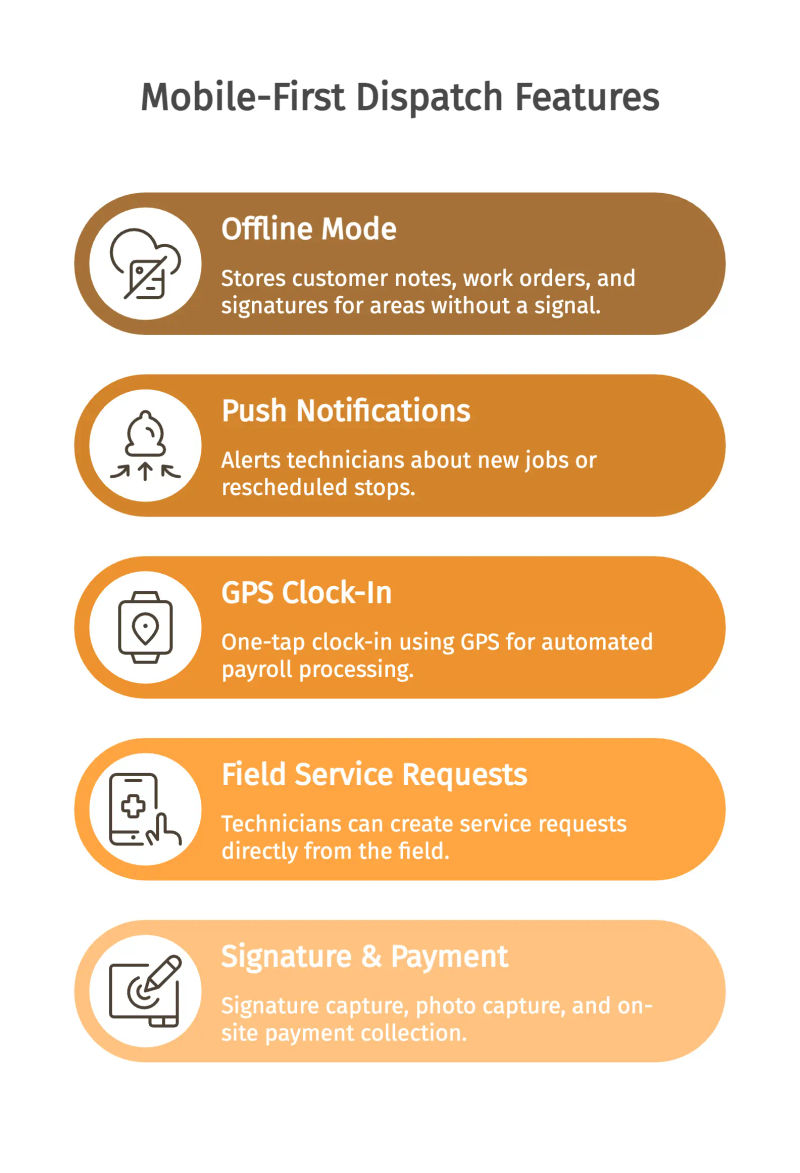
- Offline mode that stores customer notes, work orders, and signatures, allowing technicians to work in basements or mechanical rooms without a signal.
- Push notifications when a new job is assigned or an existing stop is rescheduled.
- One-tap GPS-enabled clock-in, allowing payroll to be processed without manual timesheets.
- The ability for technicians to create service requests directly from the field instead of calling the office.
- Signature capture, photo capture, and on-site payment collection.
A small business reviewing Field Promax on the QuickBooks App Store highlighted two features that mattered most: the color-coded calendar and the ability for technicians to create service requests themselves. Shops where technicians can create their own service requests are the ones where the scheduling workload for office staff actually decreases rather than simply shifting elsewhere.
The point of mobile is not the app-store rating. It is whether the tech can mark a job complete from the driveway and roll to the next stop without a phone call. Look at the field service mobile app and GPS tracking as the two features that drive that outcome.
5. How to compare remote scheduling tools without buying the wrong tier
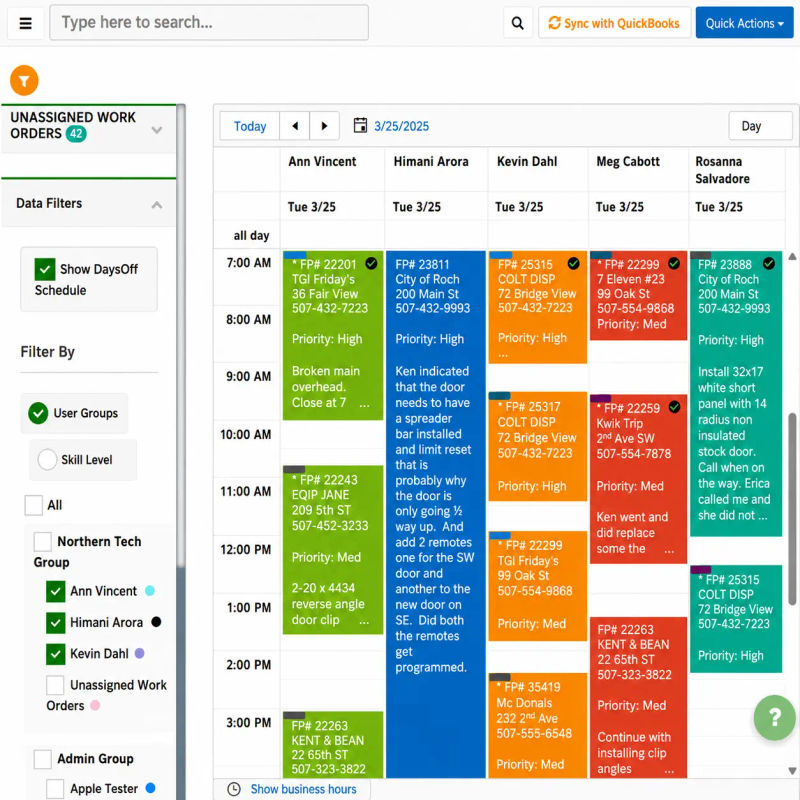
[https://ik.imagekit.io/d1cslxmlo/Blogs/09-2022/best-digital-tools-to-manage-remote-teams/Field%20Promax%20dispatch.webp | Alt: Field Promax dispatch by date showing assigned jobs across the week | Caption: Field Promax dispatch by date: a multi-day view of assigned jobs so owners can spot capacity gaps and overbooked days before they become same-day fires.]
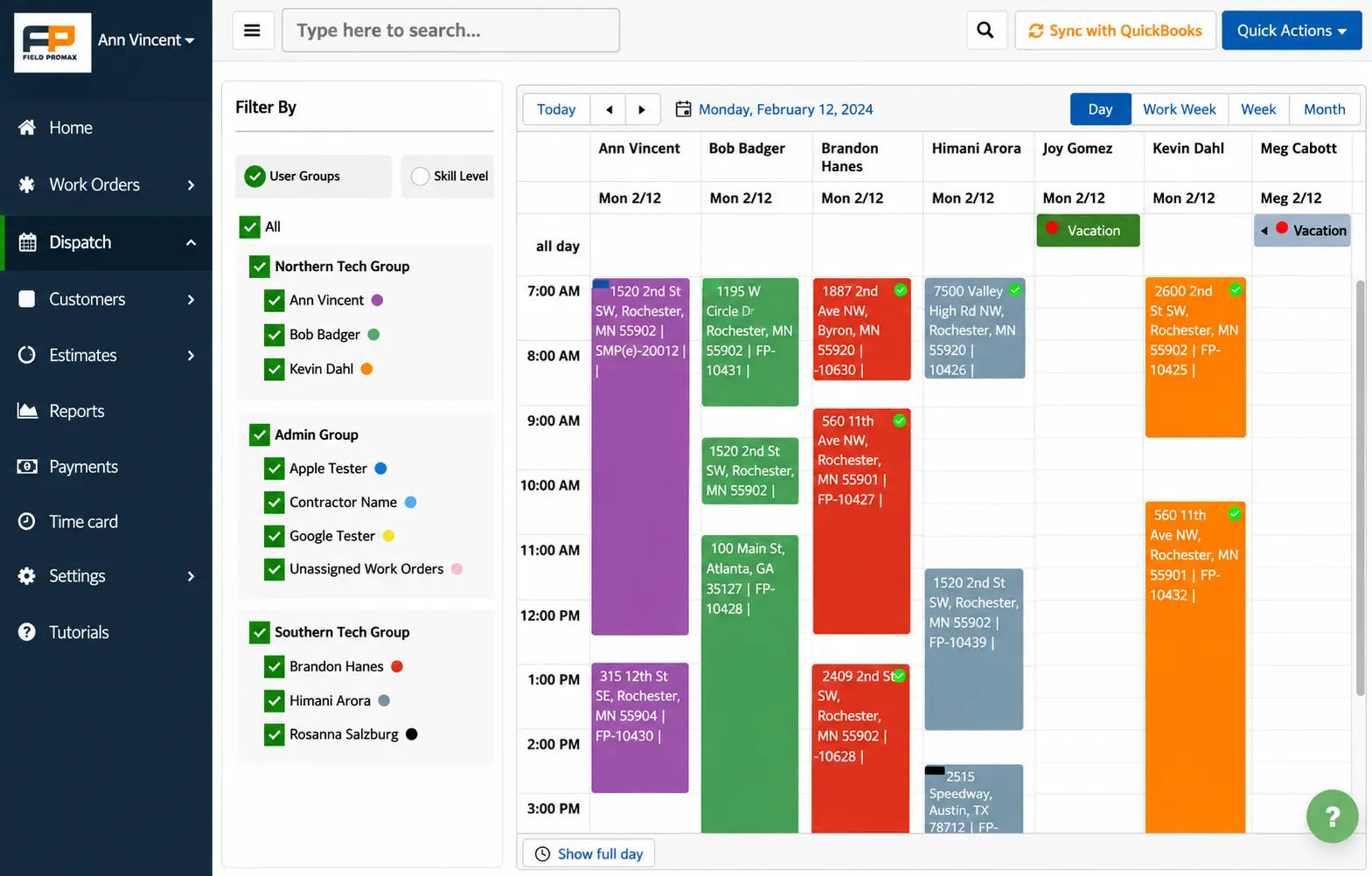
Most comparison articles list 10 apps and rank them by review scores. That structure is designed for affiliate revenue. A more useful framework for trade businesses with five to 50 technicians divides software into three categories.
Enterprise-tier FSM platforms. Platforms designed for 50+ tech operations and priced accordingly. Onboarding is measured in months. They are highly scalable, but the cost per technician can consume the margins a 12-technician shop is trying to protect.
Generic horizontal schedulers. Tools built for scheduling meetings that dominate SaaS comparison roundups. They are ideal for client meetings but are not designed for skill-based dispatch, route sequencing, GPS-enabled timecards, or QuickBooks-integrated invoicing.
Trade-focused FSM in the sub-enterprise tier. Platforms built for trade businesses with roughly 5-30 techs that do not have a VP of Operations or a six-figure software budget. Field Promax fits into this category.
The criteria worth scoring, in rough order of weight:
- Mobile app adoption rates among technicians. Vendors that cannot provide adoption figures are often those whose technicians are not actively using the application.
- QuickBooks sync depth should go beyond basic integration. Verify that line-item descriptions, parts, and labor codes can make the round trip accurately.
- A drag-and-drop dispatch board with clear visibility into capacity gaps and fully booked days.
- GPS tracking is linked to timecards so payroll does not require an additional reconciliation step.
- An online booking tool that sends new requests directly to the dispatch board rather than into a separate queue.
- Route optimization that updates automatically whenever a job is added, cancelled, or rescheduled during the day.
- An onboarding process designed for businesses transitioning from paper, spreadsheets, or QuickBooks-only workflows.
The wage math matters. Per the BLS May 2023 OEWS data, median hourly wage for plumbers is $29.59 and HVAC techs run roughly $27.55. Across our shops, the pattern is consistent: an extra hour of windshield time per tech per day on a 10-tech crew quietly burns the equivalent of a part-time CSR every month. Independent studies including Timefold's field service modeling show drive time falling 15-30% and mileage cuts around 23% once dispatch is sequenced rather than scheduled in order of phone call. In our customer base, the shops that land on the upper end of that range are the ones whose dispatchers stop overriding the optimizer after week two.

6. Remote scheduling best practices that move real numbers
Four common practices are seen in shops where customer retention curves remain stable.
Tight arrival windows backed by live ETA texts. We have observed that most complaints about missed appointments result from overly broad arrival windows rather than actual tech tardiness. Our team has seen that even one missed window can cost not only a rebooking but also referrals from family members that the customer may have provided later. Two-hour arrival windows supported by live ETA texts help differentiate shops and prevent the loss of referrals.
Skill-tagged work orders. If the dispatch board knows which technician is a journeyman versus an apprentice, whether they specialize in residential or commercial work, and how the schedule is routed, assignments become far more accurate. A boiler diagnostic that takes two hours but is assigned to a residential service technician without commercial experience is exactly the kind of mistake that skill tagging can prevent.
Anchor on local time, surface the offset. For shops with crews operating across two metropolitan areas, schedule work according to each technician's local time and display the time-zone offset next to every technician's name for the dispatcher. Morning time-zone calculations are when dispatching mistakes multiply.
Treat the booking widget as the front door. Shops that use an online booking widget can capture the additional 35% of service requests that are scheduled outside normal business hours before Monday morning, instead of relying on voicemail callbacks. The widget can be the difference between starting the day with a full schedule and starting it with a long list of callbacks.
7. Why founder-led FSM matters for shops the enterprise tier ignores
The fundamental difference between enterprise-tier FSM and trade-focused FSM is not the feature count. It’s about who decides what gets built next.
Field Promax is priced for shops that cannot afford enterprise-level solutions and is specifically designed for small to mid-sized trade shops, a segment often overlooked by enterprise vendors. Our customer base is diverse, but the most frequently requested feature by a significant margin is better dispatch-to-invoice automation. This is the workflow that converts a scheduled job into cash without the need to re-enter data. Enterprise vendors cannot structurally meet that feedback loop. Their product roadmap is determined by corporate purchasing committees, not by a 14-tech HVAC business owner explaining why the QuickBooks sync removes line-item descriptions for parts.

From the founder
The thing nobody tells you about scheduling software is that the office configuration is the easy part. We can stand a dispatch board up for a 12-tech shop in an afternoon. What predicts whether the rollout sticks, every single time, is whether the field techs open the mobile app on the first Monday.
If three of your 12 techs are still texting the dispatcher their status, you do not have a scheduling system. You have a database the office types into. We hear the same story on support tickets: an owner moved off a spreadsheet, paid for the seats, and the techs reverted to phone calls because nobody walked them through the app at the truck. Train at the tailgate, not in the conference room.
- Joy Gomez, Founder of Field Promax
8. What this looks like inside Field Promax
At Field Promax, we designed a workflow that connects dispatch to invoicing without requiring duplicate data entry. The drag-and-drop dispatch board gives visibility into the week’s schedule, capacity gaps, and overbooked days. The mobile app holds work orders offline, captures signatures and payments, and then pushes the invoice directly into QuickBooks. The online booking widget connects directly to the dispatcher. A field service customer on the QuickBooks App Store described how they quickly moved from paper-based processes to a paperless workflow while dispatching crews to multiple job sites without a hitch. This is the part of implementation we care most about because it is where paper-and-spreadsheet-based shops typically stall.
If you are a shop with 5 to 30 technicians currently relying on spreadsheets, paper processes, and QuickBooks alone, the transition path is relatively simple. The owner continues handling support requests, while the first areas most shops tend to focus on are:
- Scheduling and dispatch
- Field service mobile app
- GPS tracking and timecard GPS
- QuickBooks integration
- Team management for remote crew oversight
- Industry pages for HVAC, plumbing, electrical, pest control, and landscaping
Sources consulted
- Housecall Pro, Home Service Customer Service Report. In our customer base, the 80% online-booking finding matches what we see week over week: shops without a public widget cede after-hours requests to whoever the homeowner clicks next.
- U.S. Bureau of Labor Statistics, May 2023 OEWS, Plumbers, Pipefitters, and Steamfitters. Across our shops, the wage data anchors the ROI math: every billable hour a tech loses to dispatch friction is a direct margin hit at the $29+/hr median.
- U.S. Bureau of Labor Statistics, Electricians OOH.
- Timefold, field service route optimization modeling and case data.
- Field Promax customer reviews on the QuickBooks App Store and aggregated operator conversations on Reddit and Quora over the last 12 months.
Conclusion
Remote dispatch is primarily an adoption issue, not a software issue. The shops that succeed focus on tracking mobile app usage by the end of day three rather than measuring feature adoption on day one.
Frequently Asked Questions

Content Creator
Bhargavi Halthore is a content writer at Field Promax, a field service management platform serving trades businesses across the USA and Canada. With over a decade of experience writing for business owners, she brings detailed, ground-level insight to every topic she covers. Her research goes beyond search results - she digs into LinkedIn groups, Facebook communities, and Reddit forums to understand what field service business owners are actually dealing with on the ground. She speaks directly with industry professionals, understands their day-to-day challenges, and translates that into content that is practical and actionable. What you read in her articles reflects real industry patterns, not theory.