AIA Pay Applications and the Schedule of Values Explained

A pay application is a document package, not a line-item invoice
Progress billing for commercial work is done using three sheets of paper that have to be reconciled to the penny: the schedule of values, the G703 continuation sheet, and the G702 summary certificate. If one of these is off, the check will not move. I've watched for 14 years as small commercial businesses learn this lesson the hard way, and the patterns are always identical. The process is viewed as a formality in accounting, but these documents are, in fact, the operating discipline that determines whether payroll will be paid by the 15th of each month.
An invoice informs the customer of the work you performed and the amount they have to pay. A pay application is an official document that informs an owner, an architect, and, often, a construction lender that a certain amount of the contracted work was physically completed on a certain date, that the materials are located on site or in a bonded warehouse, and that retainage was calculated at the rate specified in the contract. The check doesn't follow the wording of your contract. It is issued based on the architect's certification on the G702's certificate for payment block.
This is why the accounting software itself cannot create a valid pay application. QuickBooks is able to create invoices. It does not have the ability to certify them. For AIA contracts, the chain of certification is embedded in A201-2017 §9.2. The G702/G703 pair is there to ensure that the certification is mechanical rather than an argument.
The G702, G703, and SOV triangle
The three documents feed into each other in a single direction. A Schedule of Values (SOV) can be signed at the start of the project and is the basis of the whole contract sum. The G703 continuation sheet is the work document that you can update each period. Each SOV item has a line that lists what was completed in the past, what was completed during this period, the materials that are currently stored, the percentage of completion, and the balance to complete. The G702 is the summary document that adds all the G703 totals, adds retainage, subtracts previous payments, and calculates the amount due on this application.
When the G703 line totals don't exactly match the G702 summary claims, the packet is returned. The reconciliation has to be exact, with no rounding allowed.
Building the schedule of values (and the frontloading trap)
The SOV is written by the architect and owner before the first pay application is filed. Standard columns include item numbers (usually CSI MasterFormat), description of work, scheduled value, work completed using previous and current subcolumns, materials currently stored, total stored materials, completed to date, percentage completed, balance to finish, and retainage. After the schedule has been accepted, the values are fixed. Each subsequent pay application is drawn against those line numbers.
The most common failure method is frontloading, which involves adding extra money to initial line items (mobilization, demolition, submittals, etc.) in order to collect more cash prior to the end of the project. The owner's representatives look for this in the initial submission. If they find it, they redline the schedule and return it to the contractor, delay the next draw, and can sour the relationship throughout the remainder of the process.
Owners on r/Construction consistently describe another version of the same problem: two GCs will look at the same contract and produce completely different SOV breakdowns because there is no shared convention on granularity, so each contractor invents one and then has to defend it against an owner who wants it split differently. If you tie each SOV line item back to the underlying estimate, the frontloading concern is easier to answer and the owner's rep has less to argue with.
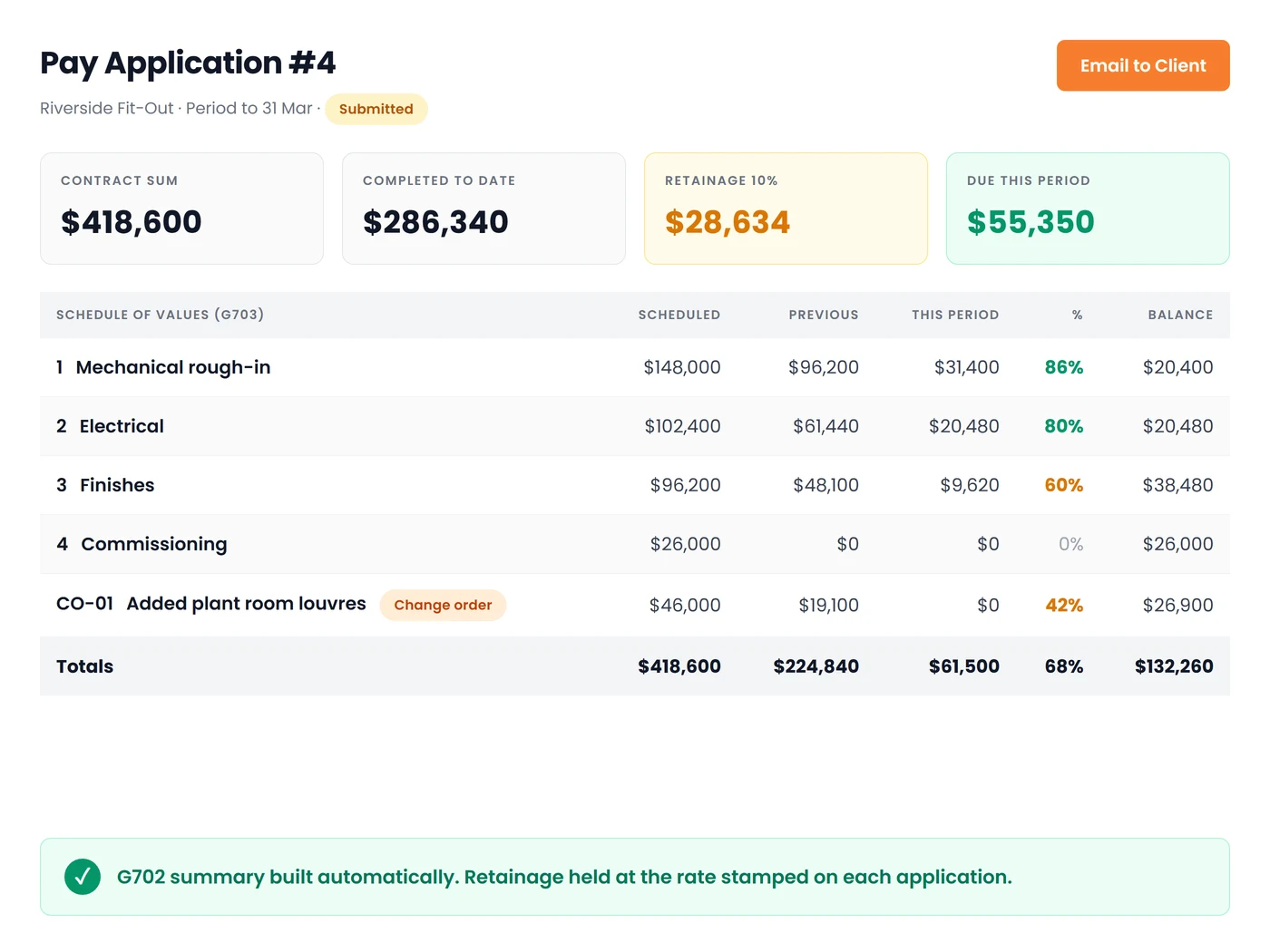
The G703 continuation sheet, column by column
The G703 has nine functional columns, labeled A through I.
- Column A: Item number. Matches the SOV.
- Column B: Description of work. Matches the SOV.
- Column C: Scheduled value. Locked from the SOV.
- Column D: Work completed from previous applications. Equals last period's Column G total.
- Column E: Work completed this period. The only column that requires field judgment each cycle.
- Column F: Materials presently stored (not already reflected in D or E). Photo proof and, on some contracts, off-site insurance certificates are required.
- Column G: Total completed and stored to date (D + E + F), with a subcolumn showing percent complete (G ÷ C).
- Column H: Balance to finish (C minus G).
- Column I: Retainage. Held at the rate stamped on the application. On variable-retainage contracts (10% early, 5% after 50% complete), Column I is the audit trail that shows the reviewer you calculated correctly.
G703 column totals become G702 summary lines. There is no forgiveness in the arithmetic.
The G702 summary, line by line
The G702 has nine numbered lines:
-
Original contract sum. Locked from the contract.
-
Net change by change orders. Fed by the Change Order Summary in the lower left, which lists every approved CO with its number and value.
-
Contract sum to date (1 + 2).
-
Total completed and stored to date. Equals G703 Column G grand total.
-
Retainage. Sum of 5a (retainage on completed work) and 5b (retainage on stored materials), reconciled against G703 Column I.
-
Total earned less retainage (4 minus 5).
-
Less previous certificates for payment. Prior draws collected.
-
Current payment due (6 minus 7).
-
Balance to finish, including retainage (3 minus 6).
Below the numbers are the contractor's signature, the notary's block, and the Architect's Certificate of Payment. The architect's stamp is what actually releases the funds. Note that Lines 1 and 2 stay separate for the duration of the work. The contract's original sum and the value of the change orders never merge into a single number. This distinction is important when you close out the project and the client asks you how the contract's value actually changed.
Change orders, stored materials, and lien waivers
An approved change order becomes a separate contract line that has its own unique number. It doesn't get included in another SOV line. In the Change Order Summary in the G702, list CO-001, CO-002, and others, each with a dollar value, and it feeds the line sum 2. The G703 also includes the COs as new lines, with their own scheduled value as well as their own percentage complete. This is the reason why the G702 subtotals the original contract separately from change orders. The owner is looking to see at a glance how far the contract has changed since the initial number.
The storage of materials is in G703 Column F, but only with dates for photos and, in many contracts, insurance riders that are off-site. If you don't use either, Column F gets zeroed on review.
Lien waivers are a part of the pay app. They include conditional waivers for the current month (they become effective once the check has cleared), in addition to unconditional waivers that are valid for the previous period (proof that the previous draw was accepted as well as released). Owners on r/Construction repeatedly describe change orders arriving weeks or months after the work, or clients refusing to pay for unforeseen conditions, and that scope-changing-faster-than-paperwork gap is the single most avoidable reason a G702 fails certification.

Why pay apps get rejected (and what a rejection actually costs)
After 14 years of conversations with customers, approximately 14% of manually created G702/G703 applications for payment in an average small-sized commercial business are rejected for formatting or arithmetic mistakes, such as total mismatches between G702 Line 4 and the G703 gross total, incorrect retainage calculations, unapproved change orders in Line 2 that do not have lien waivers, or a signature block that was flagged by a notary. Each rejection adds 30 or even more days to the already lengthy payment process.
Retainage is another category with high friction. Owners on r/Construction and Quora frequently discuss firms that are holding the wrong amount, clients holding beyond the point of practical completion, and subs who are chasing payments that are months behind. The most frequent issue in these threads is that no one has an official record of what's being held and the date it's scheduled to be released.
One reviewer from Capterra stated it in plain language: the G702/G703 progress billing feature can be a lifesaver for their electrical department when they are working on bigger commercial projects, as they can use AIA-formatted pay applications without having to rebuild the entire system each month. That word, "rebuilding," is the point.* That is exactly what manual preparation involves. *
Progress billing cadence and the cash flow reality
It is a monthly process on nearly every commercial contract that is tied to a draw schedule established by the GC with the lender or owner before the work begins. The process is cut off on the 25th, with submission by the 30th, the architect's certification takes place within two weeks, and the owner will pay within two to four weeks. The GC will pay the contractor under pay-when-paid conditions.
The industry number worth looking at is CFMA data and 10-K filings for specialty contractors, which put commercial subcontractor DSO at an average of 83 days, significantly higher than the 60-day benchmark for all industries. Based on 14 years of discussions with small commercial business owners, they tell us that 83 days is the reality because of retainage as well as multi-tier approvals for applications. The lever that actually transfers cash is in the middle of the process: clear G702s, faster lien waivers, and immediate submissions after a reviewer has redlined an application.
Retainage itself is held once at the rate stamped on each application and released once, usually at final completion after the punch list closes. A reviewer on Capterra told us that managing multi-phase commercial builds used to mean juggling spreadsheets and paper logs, and that consolidating everything to one screen cut hours off the weekly admin grind. Any system that can handle scheduling, dispatch, and invoicing from one screen collapses the cycle time between work completed and pay app filed.

Where software helps (and where AIA licensing still matters)
AIA G702 and G703 forms aren't free. A single-use license costs $49.99, and an annually billed AIA Documents Online subscription is $2,199.99. ConsensusDocs 292, 293, and 710 are popular contract-family options and are favored by many owners. Certain GCs are willing to accept an aesthetically designed version of the contract created using billing software if the retainage math, columns, and certification block conform precisely to the AIA layout.
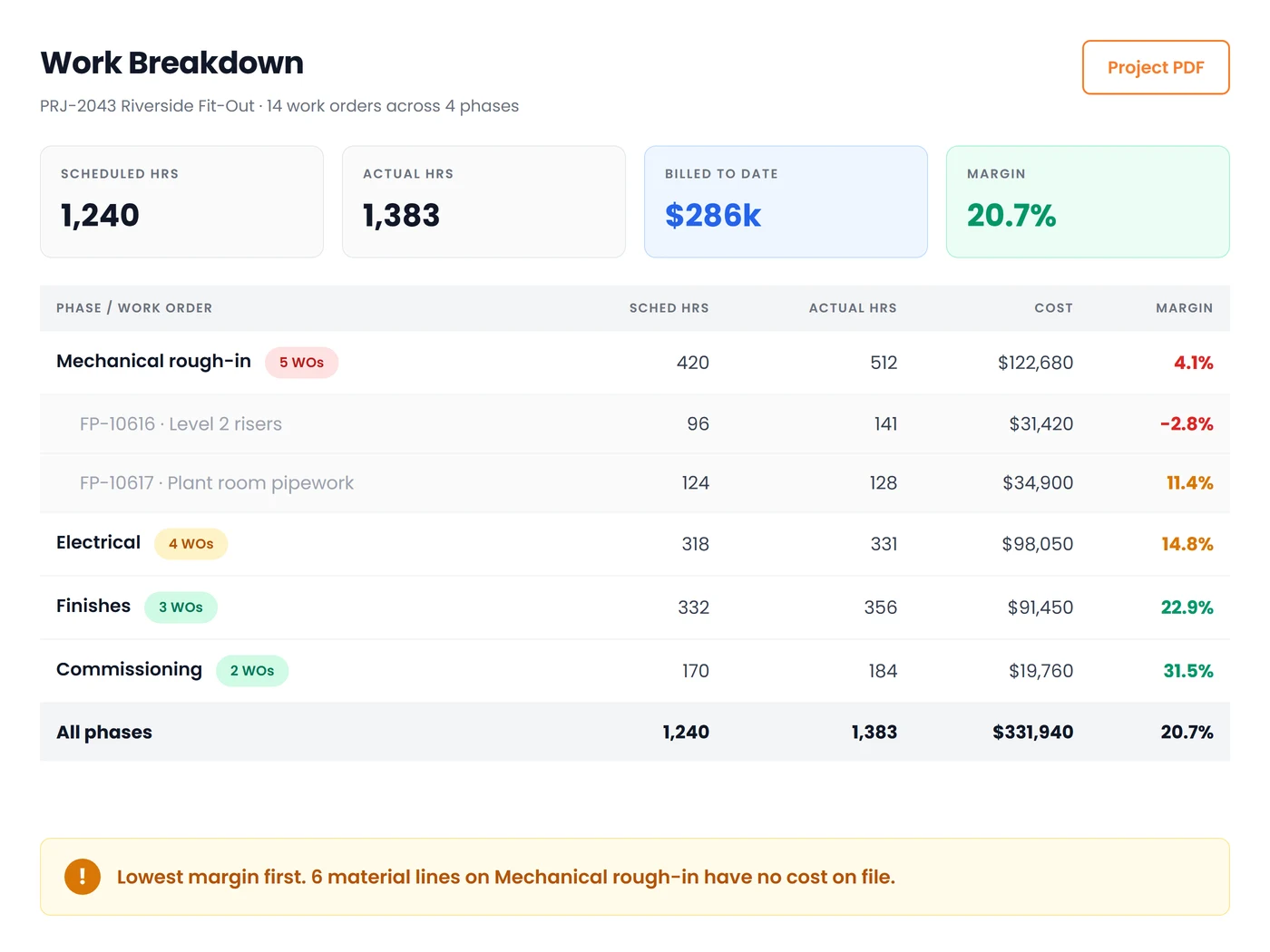
Where software actually earns its keep is upstream of the form: tying every work order under a project back to its phase, so the percent complete on each G703 line has an audit trail in field data rather than a project manager's memory. When Column E is defensible, the reviewer has nothing to redline.
Part of our small commercial project series
Continue with:
- Project Management for Small Commercial Construction: G702/G703, Progress Billing, and POs Without the Overhead — how the SOV, purchase orders, burdened labor, and pay apps hang off one phase structure
- Retainage in Construction: How Much Is Held and How to Get It Back — release triggers, state caps, step-downs, and the seven-step collection playbook
Conclusion
This AIA pay application process rewards those who view the SOV as an agreement. The G703 is an open ledger, and the G702 is a certificate that must be reviewed by three different sets of eyes. The process is not difficult. The process is not difficult. The steps are to lock the SOV, then modify the G703 with acceptable field numbers, compare the G702 math to the cent, add the appropriate lien waivers, and then resubmit the form after a reviewer redlines it. Repeat this for four billing cycles in a row, and your DSO begins to shift. This is how you win.
Frequently Asked Questions

Founder and CEO
Joy Gomez is an engineer, process automation expert, and the Founder of Field Promax. Known for his technical expertise and commitment to field service innovation, Joy writes about transforming traditional business models into paperless, efficient operations. He is a Lean Six Sigma Black Belt based in Rochester, MN, dedicated to helping field professionals work smarter through better technology.
Reviewed by

Content Creator
Bhargavi Halthore is a content writer at Field Promax, a field service management platform serving trades businesses across the USA and Canada. With over a decade of experience writing for business owners, she brings detailed, ground-level insight to every topic she covers. Her research goes beyond search results - she digs into LinkedIn groups, Facebook communities, and Reddit forums to understand what field service business owners are actually dealing with on the ground. She speaks directly with industry professionals, understands their day-to-day challenges, and translates that into content that is practical and actionable. What you read in her articles reflects real industry patterns, not theory.