Plumbing Marketing and Lead Generation: The 2026 Playbook for 5-20 Tech Shops

Imagine the article was written for an owner-operator of an emergency plumbing business with six technicians serving a Sun Belt metro from a single location. The phone rings at 1:00 a.m. and again at 5:00 a.m. Google Ads clears the account every month. However, the business doesn't appear in the local results for the two ZIP codes it serves, and national franchises are winning the late-night calls that used to come here.
This is the kind of business modern plumbing marketing was designed for: a 5-20 tech shop that has grown beyond word-of-mouth and now must manage lead generation, reviews, referrals, and its web presence in one integrated system.
Why plumbing marketing works differently in 2026
Plumbing is a local, emergency-purchase service. The customer makes a decision within ten minutes of a pipe bursting and someone answering the phone. What matters during that window is a claimed Google Business Profile, a fast mobile website, recent reviews, and a dispatcher who answers the call.
On Quora, contractor-related discussions about plumbing website conversions follow a similar pattern: owners can see the traffic but can't tell which part of the funnel is breaking. The issue isn't the traffic itself. It's what happens after the click.
A working plumbing business marketing plan does five things: puts you in front of high-intent local search, converts the visit into a booked appointment, gets a review after the job, feeds the customer into a future-work list, and closes the loop with the dispatch board so nothing gets lost between the marketing tab and the schedule.

Build a website that books work, not just describes it
If your site takes four seconds to load on a mid-range Android, the leak-in-progress caller has already dialed the next listing. Google's Core Web Vitals target LCP under 2.5s, INP under 200ms, and CLS under 0.1 at the 75th percentile. Across our customer base, shops hitting those targets on mobile see materially higher form-fill rates than ones running a five-year-old WordPress theme with unoptimized hero images.
A plumbing website that converts features a headline that names the city and service, a phone number on every page, lists of service areas and services, three to five recent reviews with real first names, photos of your technicians and trucks (not stock plumbers), and a booking form that goes directly to the scheduler. If the form is sent to a Gmail inbox that someone checks only twice a day, it's not a booking form. It's a delay.
Quora discussions about website designs that actually generate inquiries follow the same pattern. The website looks professional, but it doesn't generate booked calls because the trust signals and form design don't align with homeowners' actual intentions.
Get the directory listings right, then stop touching them
Directories carry weight because Google treats them as signals of consistency. Focus on the directories that are worth your time:
- Google Business Profile
- Yelp
- Angi
- HomeAdvisor
- Thumbtack
- Bing Places
- Better Business Bureau
- Local Chamber of Commerce
Each listing should have the same basic information: business name, address or service-area radius, phone number, website, business hours, category, three to five photos, and a list of services. Create a quarterly reminder to audit them. That's all there is to it.
Claim the Google Business Profile and treat it like inventory
In our experience, the local 3-pack receives most of the clicks from "plumber near me" search results. If a business doesn't have reviews or a claimed Google Business Profile, most nearby intent traffic goes to the three competitors that do.
Whitespark's 2026 Local Search Ranking Factors data puts GBP signals at ~32% of Local Pack weight, review signals at ~20%, and on-page website signals at ~15%. From working with dozens of home-services shops on local visibility, the profile is consistently the biggest single lever we see, ahead of the website itself. Fill every field. The primary category should be "Plumber," not "contractor." Add services with descriptions, service-area ZIP codes, high-res truck and job photos, hours with holiday overrides, and messaging turned on. Post monthly.
Paid ads work, but only if the dispatch board can absorb them
PPC gets you to the top in an afternoon, not six months. LocalIQ's 2025 home services benchmark puts plumbing search cost per lead around $129, against a home-services average closer to $91. A 2026 plumbing-specific benchmark from SearchLight Digital, based on $14.6M in non-branded spend across 524 contractors, shows $183 average CPL for non-branded search and $82 CPL for Performance Max. Across our shops, the ones that get PPC to pay back inside a quarter share one habit: they respond to every lead within five minutes, from the mobile app, before the caller fills out three other quote forms.
Google Local Services Ads appear above regular search ads and are charged per lead. The typical cost ranges from $25 to $162 per lead, and the leads are exclusive to your business, with an average lead-to-customer conversion rate of 31%. If your shop is just getting started with paid customer acquisition, LSAs are a strong option because the leads aren't shared with five contractors, as they are on Angi.
SEO is the bet you make in year one to eat lunch in year two
SEO won't help this month. It changes unit economics 18 months from now. Organic leads cost almost nothing after rankings are achieved, and organic traffic doesn't disappear when an ad account is suspended.
Target service-plus-city keywords, one page per pair
Make a list of keywords people search for, such as "emergency plumber [city]," "water heater replacement [city]," and "sewer line repair." Then layer those keywords into titles, meta descriptions, H1s, alt text, and body content. City-and-service keyword pairs are the most valuable in the map pack. Generic keywords aren't.
If you serve three or four ZIP code areas, create a dedicated landing page for each metro and its top five to eight most requested services. Create 10 to 20 pages, not 200. Each page should have unique content, a local phone number, an embedded map, and reviews from that service area. Cookie-cutter city pages get flagged.
Ship a fast, mobile-first site with clear title tags
If your homepage title reads "Home | Smith Plumbing LLC," you've lost the click to a competitor whose title is "Emergency Plumber Tucson | Smith Plumbing | 24/7 Service." Rewrite each title to reflect the service intent and the location.
Around 72.7% of Google users are on mobile, according to StatCounter traffic data. If your desktop website is beautiful but your mobile site is cluttered with duplicate tap targets, you're losing a significant number of visitors.
Across four Quora threads about website traffic not turning into leads, plumbers describe seeing users arrive on service pages but not complete a form. Our customer base suggests that the remedy is typically page speed and rewritten title tags, not more content.
Build local backlinks the slow, boring way
Sponsor a Little League team and get a link from the league's website, write a guest blog for a local home improvement website, earn editorial mentions from the electrician and roofer you already work with, and get featured in the local newspaper's homeowner tips column. Link farms and $99 SEO packages are penalized. Don't buy them.

Reviews are the second-biggest local ranking lever after the profile itself
BrightLocal's 2024 Local Consumer Review Survey found that 75% of consumers always or regularly read online reviews when researching local businesses, with only 3% saying they never read them. In our customer base, shops that automate the post-job review ask consistently report a lift in booked calls within a quarter.
Whitespark estimates review signals account for around 20% of Local Pack ranking factors. What drives the needle includes average star rating (aim for 4.5+), total review count, review velocity, review text that includes the city and service, and professional responses from business owners.
Ask every customer, not just the happy ones. As soon as the invoice is paid, an automated text goes out with a one-tap link to your Google review page. An owner reviewing Field Promax on Capterra described the same setup applied to plumbing follow-ups: automated post-service SMS drove repeat-work conversations within minutes and freed the dispatcher from hours of manual outreach. Tools like Field Promax's Google Review Management handle the request timing.
Use social media as proof, not as a broadcast channel
Choose two platforms: Facebook for neighborhood groups and older homeowners, and Instagram or TikTok for short-form videos.
What should you post:
- Before-and-after photos of real jobs (with permission and blurred addresses)
- 30-second video clips of common repairs
- A monthly technician introduction post
- Review screenshots (with permission)
- Tips on common homeowner issues
Local Facebook groups can be worth half an hour per week. If someone asks, "Does anyone know a reliable plumber?" and you can help, it can generate more work than a paid advertisement.
.webp?updatedAt=1764822742157&tr=f-auto,q-80,w-800,pr-true)
A pattern across emergency plumbing operators we've worked with
Over the 40-50 plumbing operators we've worked with since 2018, the same pattern appears in shops with fewer than ten technicians. The habit of giving quotes over the phone after hours continues until it no longer works because the person answering a 1:00 a.m. call wants to secure the job before the customer calls the next company. This pattern is similar to code-mandated additions (expansion tanks or drain pans) that aren't mentioned during the phone call.
One shop ranked outside the local pack for after-hours searches in three of the ZIP codes it served. Emergency calls were going to national franchises. When calls did come in, the verbal estimate often differed from the written estimate prepared on-site after code-required items were added. Technicians either absorbed the difference or explained it at the door, and no one could tell which happened more often.
The owner rebuilt the intake process around a single-page emergency-rate template that included diagnostic fees, call-out charges, Good-Better-Best ranges, and a line identifying likely code-required additions. The text was sent before the truck rolled. GBP posts and the after-hours landing page were revised to reflect weekend and nighttime wording. The initial version was too bloated and required two revisions before the layout was no longer confusing at 2:00 a.m.
By the second summer, the volume of after-hours calls had increased, and disputes over on-site quotes had virtually disappeared. The cost was that price-sensitive callers often dropped off once the message was delivered, particularly during overnight weekend calls. The owner also added a callback option for callers who didn't respond within ten minutes. The two senior technicians adopted the process immediately. The newest hire continued to revert to phone quotations until the pay structure was changed to support written quote conversions.
Composite case; details are tied to the most common variant of this pattern among the emergency plumbing operators we've worked with.
Smart marketing habits that actually increase plumbing sales
The above strategies provide the basic structure. The following are the day-to-day routines that work.
Most plumbing owners we've talked to aren't fighting a marketing problem. They're fighting a marketing-to-dispatch handoff problem. A shop can spend $2,000 a month on Google Ads and still lose the job because the after-hours call rolls to voicemail, or the tech shows up with a phone quote that doesn't line up with what code actually requires (expansion tank, drain pan, PRV).
What we hear from shops running four to fifteen techs is consistent: the leads exist, the ads work, but a slow reply or a mismatched quote at the door burns the conversion. The shops that grow booked-call volume in a single quarter aren't spending more on ads. They're routing every inbound lead onto a single dispatch board and texting a written estimate before the truck rolls.
- Joy Gomez, Founder of Field Promax
Talk about outcomes, not tools
Homeowners don't want technical terminology. Instead of emphasizing tools and technical steps, focus on what customers value: same-day service, transparent pricing, licensed technicians, clean worksites, and a written guarantee that outlines the terms of service.
Post the actual work, not stock photos
Share short videos and photos of real jobs, such as burst pipe repairs before and after, water heater replacement time-lapses, and slab leak walkthroughs. This increases the credibility of an image-based website.
Run seasonal promotions the way HVAC shops do
Frozen pipes are the main driver of winter service calls. Slab leaks and outdoor spigot repairs are more common during summer. Create offers that match the calls you're actually receiving, such as pre-winter shut-off valve checks, spring water heater flushes, and autumn drain cleaning packages. Seasonal ads perform better because they align with what people are already searching for.
Show up in local Facebook groups and Nextdoor
Neighborhood Facebook groups and Nextdoor are where conversations like "Who is a reliable plumber?" happen in real time. Answer homeowners' questions with helpful advice, not a sales pitch. When you help three or four people publicly, the algorithm is more likely to show your profile to more people.
Respond in five minutes or lose the job
Response time is the most important marketing factor for field service businesses. Within our customer base, plumbing shops that send lead capture forms directly to the dispatch board - so technicians are assigned the same day a homeowner calls - consistently schedule more same-day work without adding office staff. After years of observing this across customers, we've found the same pattern in plumbing: companies that route every inquiry to a single scheduling board consistently book more jobs than those that send calls to voicemail after 6:00 p.m.
The tools that close the gap: scheduling and dispatch that auto-routes to the closest tech, a field service mobile app that puts the assignment on the tech's phone before they've finished the previous job, and automated customer notifications that text an arrival window.
Build the email list and actually use it
Litmus and DMA benchmarks put email marketing ROI in the range of $36 per $1 spent. Small plumbing and HVAC shops that send seasonal reminders and post-service follow-ups to their existing list consistently tell us email is the cheapest repeat-revenue channel they run.
Send an email after every completed job, label it by the type of service, and send four to six emails annually, including two seasonal reminders, a homeowner tips newsletter, one promotional email, and one "We're Still Here" email from the owner. Plumbing customers don't need weekly emails. They just want to recognize your company when their garbage disposal stops working or a pipe bursts next winter.
Post short videos that show the work, not just the person
Reels, Shorts, and TikTok provide access to thousands of local homeowners for less than the cost of the smartphone in a technician's pocket. Content that performs well includes quick plumbing fixes in under one minute, debunking common plumbing myths, highlighting homeowner mistakes, and sharing pre-hurricane plumbing safety tips. Educational content consistently outperforms promotional content across every platform.
Give every piece of content one clear action
Use a single, clear call to action, such as "Call us now for same-day service" or "Book a diagnostic or text us for an estimate." Only one action should appear in each piece of content. Giving people multiple choices often reduces clicks and conversions.
Trade referrals with the trades next door
A 2024 ServiceTitan Pulse Report summary puts referral lead-to-job conversion at 30-40% for HVAC contractors, with top-quartile operators exceeding 50%, versus 15-25% for cold leads. In our customer base, plumbing shops see the same delta: a warm referral closes at roughly twice the rate of a shared marketplace lead from Angi or HomeAdvisor, and books faster.
Set up structured referrals with adjacent trades: the HVAC company across town, the electrician you already sub to, property managers who own older buildings in your area. Offer a defined per-job referral fee or a mutual first-call agreement. Track every referred lead in your customer management system.
Measure the six numbers that actually matter
Monitor key metrics weekly rather than monthly, including cost per lead by channel, booking rate, close rate, customer acquisition cost (CAC), average job value, and revenue per lead. If any of these metrics change by 15% or more within a month, investigate the cause before the trend becomes a larger issue.
The simplest starting point is Field Promax reports and dashboards that pull the six numbers off your job data automatically, plus Google Business Insights and call-tracking on any PPC number. Impressions and followers don't put trucks on driveways.
Marketing templates worth downloading
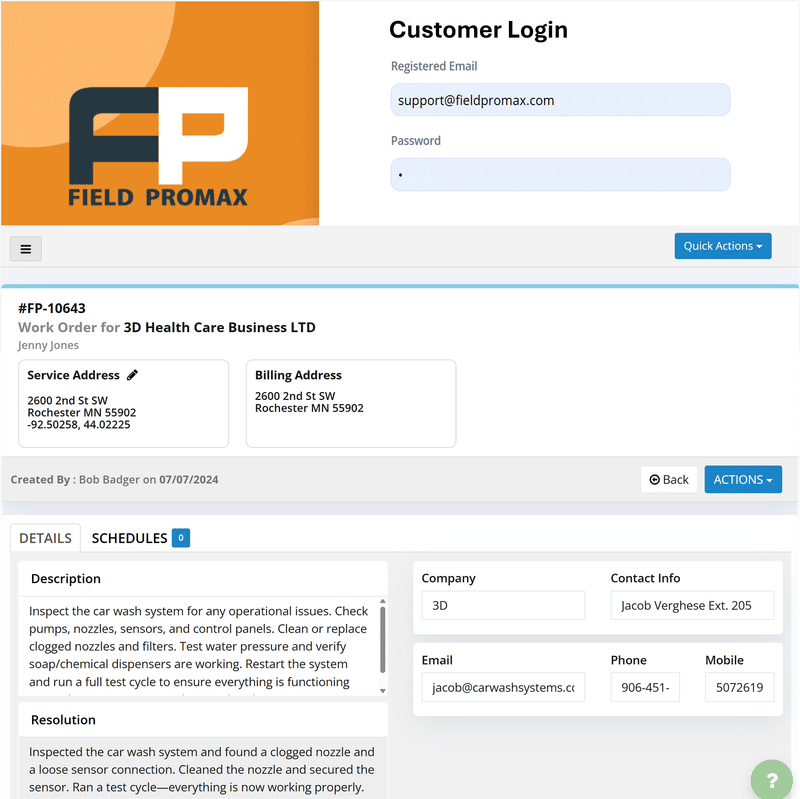
A CRM template helps organize customer information, track job history, and manage follow-ups in one place, ensuring that no lead is missed. Shops that use tools such as Field Promax find it easier to manage job information, assign technicians, and track leads throughout the sales process.

Email marketing template
An email template also helps maintain a seasonal calendar for service reminders, promotions, and customer updates. A well-designed email template typically includes a subject line, personalized greeting, message body, service reminders or promotional offers, company information, and a strong call to action (CTA).
Social media planner template
It organizes content for Facebook, Instagram, LinkedIn, and YouTube posting dates, as well as captions, content type, and hashtags. It also includes visuals, hashtags, and CTA notes. Set up a weekly or monthly schedule and monitor what is generating calls and comments instead of just likes.
How to sequence this over the next 90 days
A sequence that works for a 5-20 tech shop:
- Weeks 1-2: claim the GBP and fully optimize it, review directory listings, and install call tracking.
- Weeks 3-4: redesign the top five pages on the website with a focus on location and service intent, fix mobile Core Web Vitals.
- Weeks 5-6: switch on automatic review requests following every invoice paid.
- Weeks 7-8: launch LSAs and a non-branded Google Ads test.
- Weeks 9-10: establish structured referral partnerships that include two related trades.
- Weeks 11-12: begin building your email list and launch the first seasonal campaign.
Skip social media for general networking until this pipeline is up and running. If the intake team isn't able to respond within five minutes, none of the strategies above can be paid back. Make sure you have the handoff in place first.
.webp?updatedAt=1764822742726&tr=f-auto,q-80,w-800,pr-true)
Keep building the plumbing marketing system
Conclusion
Marketing that doesn't consider the dispatch board is just noise. The shops that increase the volume of booked calls within a quarter route every inbound lead onto a single board, respond within minutes, provide a written quote, and request a review once the invoice has been paid.
Frequently Asked Questions

Content Creator
Bhargavi Halthore is a content writer at Field Promax, a field service management platform serving trades businesses across the USA and Canada. With over a decade of experience writing for business owners, she brings detailed, ground-level insight to every topic she covers. Her research goes beyond search results - she digs into LinkedIn groups, Facebook communities, and Reddit forums to understand what field service business owners are actually dealing with on the ground. She speaks directly with industry professionals, understands their day-to-day challenges, and translates that into content that is practical and actionable. What you read in her articles reflects real industry patterns, not theory.