Electrician Job Description: Duties, Roles, and What Small Shops Get Wrong

Why is writing an electrician job description harder than owners expect?
As per the U.S. Bureau of Labor Statistics Occupational Outlook Handbook, the median electrician wage was $62,350 in May 2024, with 9% employment growth projected through 2034 and roughly 81,000 openings per year. The electrical shops that struggle most with hiring aren't fighting demand. They're fighting their own job descriptions.
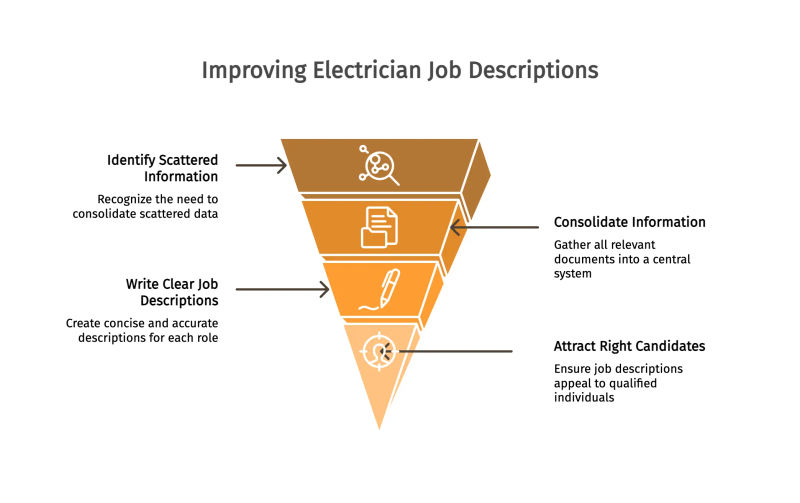
Owners in trade forums describe the same issue: training records, JSA sign-offs, and certification tracking are required, but they are scattered across paper binders, spreadsheets, and emails. The problem first appears in the job description, which often reads like three old job postings stitched together. It also attracts the wrong candidates.
This guide explains how to write electrician job descriptions for helper, technician, journeyman, and master electrician roles in a small to mid-sized trade shop.
What does an electrician actually do day-to-day?
A professional electrician installs, maintains, repairs, and troubleshoots electrical systems for residential, commercial, and industrial projects. In a small trade shop, the role extends beyond what most templates describe. For example, in an eight-tech shop, an electrician is typically expected to pull wire, read blueprints, follow the NEC, troubleshoot electrical systems, and close work orders in a mobile app with photos and the customer's signature before leaving the job site.
Split the responsibilities into two categories:
- Daily tasks: Installation, maintenance, testing, troubleshooting, service diagnostics, and load calculations.
- Professional responsibilities: NEC compliance, safety documentation, accurate time tracking by job code, customer communication, and ownership of the dispatch-to-invoice workflow.
Which electrician role are you actually hiring?
Determine which of the four roles the job description is intended for before you begin writing it. Owners often blur these role definitions, and that is one of the main reasons applicants and job requirements fail to align.

Using master-level NEC design language in a helper job posting discourages entry-level candidates from applying. Likewise, using entry-level labor language in a licensed electrician job posting turns away experienced professionals. Choose the appropriate role first, then write the responsibilities to match it.
| Helper | Pre-apprenticeship | ~$15–$20/hr | No |
|---|---|---|---|
| Apprentice | Working toward ~8,000 supervised hours | $16–$27/hr scaling by year | No (registered) |
| Journeyman | Passed state exam after ~8,000 hours | Median $62,350/yr (BLS) | Yes |
| Master | 10,000–12,000+ hours plus supervisory exam | $80K–$110K+ | Yes; pulls permits |
What belongs in an electrician helper job description?
A helper is an entry-level assistant who supports licensed electricians. No license is required. Owners often write this role as a watered-down electrician job description, which is why it fails to attract the right candidates.
A helper job description should include:
- Moving materials, preparing worksites, and cleaning up after installations.
- Assisting with wire pulls, conduit runs, and equipment staging.
- Loading trucks and staging inventory at job sites.
- Operating basic power tools under supervision.
- Learning NEC fundamentals as preparation for a registered apprenticeship.
- A high school diploma or GED and reliable transportation.
Typical pay ranges from $15 to $20 per hour. The role should not require blueprint reading, memorizing electrical codes, or independent troubleshooting. Clearly separating the helper position from the licensed electrician role is often enough to significantly increase the number of qualified applicants within 30 days.
What belongs in an electrician technician job description?
An electrical technician is not an electrician. Electrical technicians assemble, test, maintain, and repair electrical equipment based on established designs and typically hold a technical or electrical degree. They do not design complete electrical systems or pull permits.
Typical responsibilities include:
- Assembling, testing, and repairing electrical equipment and control systems.
- Performing diagnostic tests, calibrating instruments, and recording results.
- Troubleshooting equipment using manufacturer schematics.
- Performing preventive maintenance on installed systems, including motor controls, PLCs, and low-voltage equipment.
- Working alongside licensed electricians without independently performing or approving electrical installations.
If the role requires a state-issued journeyman electrician's license, it is an electrician job description - not an electrical technician job description. Choose one and write the posting accordingly.
What belongs in a journeyman or master electrician job description?
A journeyman electrician is a licensed professional who works independently and has completed approximately 8,000 hours of supervised experience and passed the required state licensing exam. A master electrician adds supervisory responsibilities, can pull permits, and typically serves as the company's master of record.
Journeyman responsibilities:
- Install, maintain, and repair electrical systems in accordance with the currently adopted NEC (for example, Texas adopted the 2023 NEC on September 1, 2023; verify the edition used in your state).
- Interpret blueprints and one-line diagrams.
- Troubleshoot electrical issues and find the root cause.
- Complete work orders on-site with photos, materials used, and customer signatures.
- Maintain accurate job documentation, including time, materials, and work order details.
Master electrician responsibilities:
- Pull permits and serve as the master of record.
- Supervise apprentices and journeymen and sign off on training requirements.
- Design system layouts for new construction and major retrofit projects.
- Provide final approval for NEC compliance where required.
Three ready-to-use job description templates are provided below. Customize each one with your company name, service area, and pay range before publishing.
A pattern across multi-trade operators we've seen in the field
A pattern observed across roughly 20-to-40-tech multi-trade contractors in Texas highlights what belongs in the safety and compliance section of a modern electrician job description.
One mid-sized multi-trade company underwent an OSHA review but was unable to produce safety training records for its HVAC and electrical personnel. Certifications were stored in paper files across three branches. JSAs from the previous 12 months were kept as carbon-copy paper forms, some of which had been water damaged. Toolbox talk sign-off sheets were stored in a binder that had not been audited in over a year.
The documentation gap wasn't one missing form. It was a systemic absence of a defined process for where records lived, who owned them, and how a supervisor could pull a tech's training history on demand. The National Safety Council pegs the average cost of a medically consulted work injury at roughly $43,000 in 2023. This contractor's OSHA penalty landed in the tens of thousands, before the two-week effort to rebuild the records.
The leadership team migrated all training records to a centralized digital system where completion dates, signatures, and certifications were stored for each technician. JSAs were converted into mandatory mobile forms that had to be completed before a work order could be closed. Toolbox talks moved to a broadcast-and-acknowledge workflow.
During subsequent audits, records were retrieved within minutes. Field personnel initially resisted the additional sign-off requirements, and office staff spent about six weeks entering historical records into the new system. This pattern has been observed across multiple multi-trade companies.
How should safety and compliance duties be written into the JD?
Owners in trade discussions often describe Job Safety Analysis (JSA) as the foundation of new hire orientation. A common complaint is that JSAs are created ad hoc on paper and then repeated separately with each new hire.
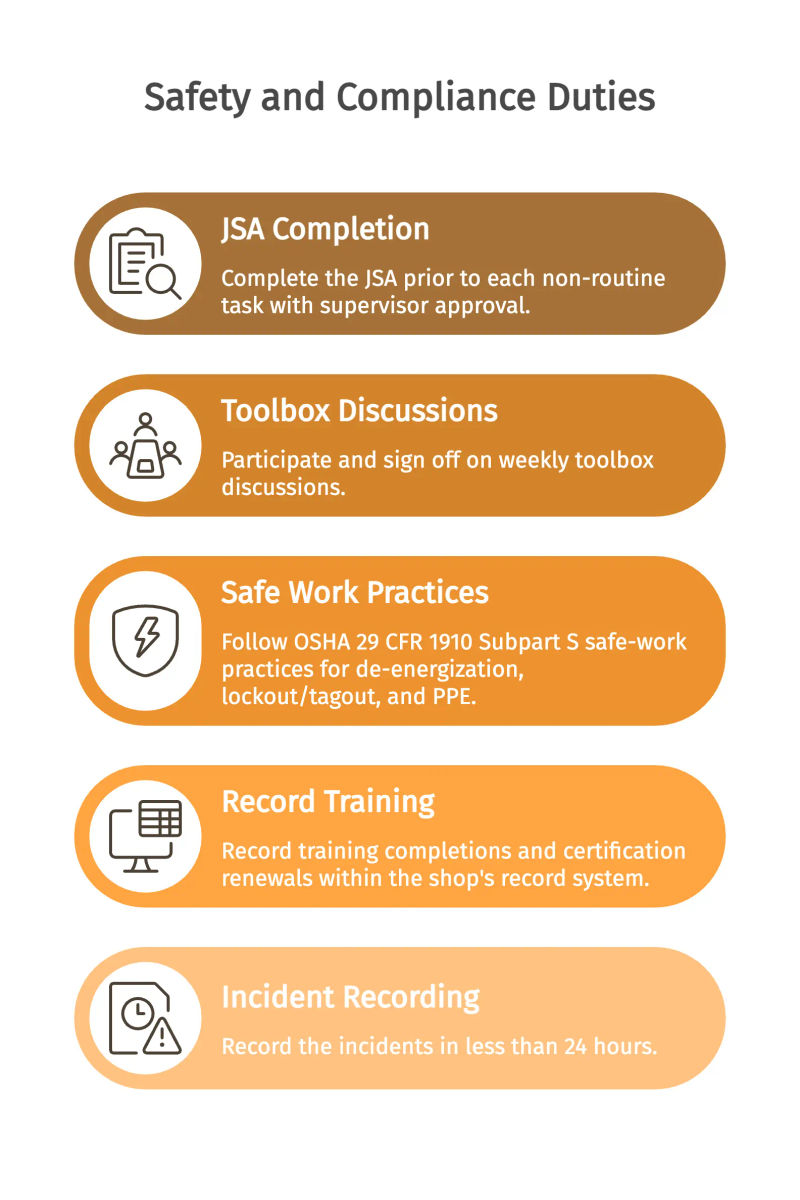
Write these duties in explicitly:
- Complete the JSA before each non-routine task with supervisor approval.
- Participate in and sign off on weekly toolbox talks.
- Follow OSHA 29 CFR 1910 Subpart S safe-work practices for de-energization, lockout/tagout, and PPE.
- Record training completions and certification renewals within the shop's record system.
- Record incidents within 24 hours.
In an 8-tech company, owners report that each technician spends about five hours per week on compliance and safety paperwork. Shops that move these forms into a mobile compliance workflow can reduce that time to about one hour per technician each week. This is why "comfortable working with a smartphone-based work order and safety-form app daily" is a reasonable requirement.
What are the 2024 salary benchmarks by role?
As per the BLS Occupational Outlook Handbook May 2024 data:
- Median electrician wage: $62,350/yr, $29.98/hr
- 2024 employment: 818,700
- Projected 2024-2034 growth: 9%
- Projected annual openings: ~81,000
Role-specific ranges from IEC Oregon Area IV (July 2024) and NECA/IBEW schedules:
- Helper / first-year apprentice: ~$15.82/hr (40% of local journeyman scale)
- Final-year apprentice in high-wage union markets: $35-$40+/hr
- Journeyman (Oregon Area IV inside): $39.54/hr average
- Master electrician: $80,000-$110,000+ depending on the state
Post the range in the JD. Insight Global's 2024–2025 analysis found 61% of applicants rank salary range as a top decision factor.
How do you write a JD that actually gets applications?
Five patterns are consistent across job descriptions (JDs) that convert:
-
Keep the posting under 300 words. Job descriptions under 300 words receive 8.4% more responses, according to Insight Global. Job seekers spend an average of about 14 seconds reviewing the requirements before deciding whether to continue reading.
-
Break company overview, job description, responsibilities, and benefits into distinct sections. A well-structured, scannable format performs better than dense blocks of text.
-
Post the pay range. 61% of candidates consider it the most important part.
-
Use neutral, non-gendered language. Insight Global's research shows that gender-neutral language can generate 42% more responses.
-
Review the JD quarterly. If the role has changed, update the job description before the next hiring cycle.
Notes from the founder on what to write into the JD
Here's what I keep seeing in electrical-shop hiring conversations. Most owners writing their first W-2 electrician JD are coming off spreadsheets, paper, or QuickBooks-only setups. The instinct is to copy an enterprise JD off a big job board, which assumes a dispatcher, safety officer, and billing clerk that the shop doesn't have. The result is a posting that promises a role the operation cannot support on day one. My push-back on the standard advice of hiding pay range to preserve negotiating room: in a market with 9% growth and 81,000 annual openings, hiding pay costs you the applicant, not the negotiation. Post the range.
If the electrician you're hiring will touch invoicing at the point of work, close out work orders on a phone, and own JSA sign-off for their own tasks, name each of those duties. The JD is a retention document as much as a hiring document, because the tech reads it again at the 90-day mark.
- Joy Gomez, Founder of Field Promax
Where do most electrician job descriptions go wrong?
Four mistakes are common across small to mid-sized electrical shops:
- Conflating helper duties with journeyman duties. Create separate job descriptions for each role.
- Requiring "own truck and tools" on a helper JD. This unnecessarily filters out many qualified candidates you're trying to attract.
- Silence on compliance ownership. If electricians are responsible for completing JSAs, inspecting PPE, or submitting incident reports, state those expectations clearly. When ownership is unclear, these tasks often fall through the cracks until an audit exposes the issue.
- No mobile-app expectation. Mobile app adoption is one of the strongest predictors of a successful field software rollout. Include a requirement such as: "Comfortable using a smartphone-based time tracking and work order app every day."
How does field service software fit into electrician onboarding?
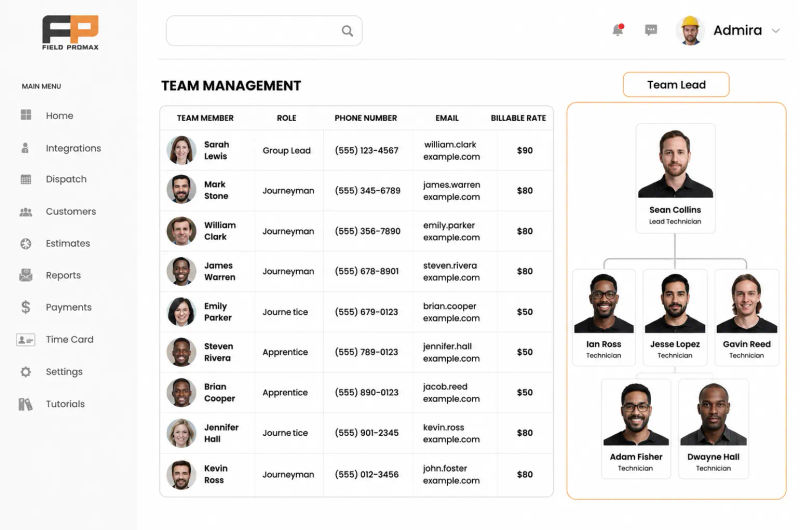
Once the JD matches how your business actually operates, new hires know what to do. For a shop with 8 technicians, that means dispatching, work order management, time tracking, and job costing all happen within a single mobile app that every new employee uses from day one.
For the typical shop with 5-20 technicians that still relies on paper JSAs, owners estimate that only about 60% of safety forms are complete and legible by the end of the week. Shops that switch to digital JSA modules with mandatory fields typically increase completion rates to 95%. That difference can determine whether you pass an OSHA audit or spend valuable time reconstructing records under pressure.
If the electrician hired cannot enter job codes using their phone, dispatch-to-invoice accuracy typically begins to break down by the third week.
Pieces that plug into an electrician's daily workflow:
Conclusion
The JD sets clear expectations for the role before you begin hiring. Then, match it with how the work is carried out within your shop. The right candidates will show up faster.
Frequently Asked Questions

Content Creator
Bhargavi Halthore is a content writer at Field Promax, a field service management platform serving trades businesses across the USA and Canada. With over a decade of experience writing for business owners, she brings detailed, ground-level insight to every topic she covers. Her research goes beyond search results - she digs into LinkedIn groups, Facebook communities, and Reddit forums to understand what field service business owners are actually dealing with on the ground. She speaks directly with industry professionals, understands their day-to-day challenges, and translates that into content that is practical and actionable. What you read in her articles reflects real industry patterns, not theory.