Locksmith Marketing: How to Get More Locksmith Leads in 2026
What we've watched across small locksmith shops
In the small locksmith shops we've worked with, typically operating with 3-8 techs across automotive, residential, and light commercial services, one issue occurs more often than any other. An emergency call comes in at 6:47 p.m. The on-call technician is just minutes away from a townhouse lockout. Dispatch is managing a burner phone and a shared inbox. By the time someone types the address into a text message, the customer has already called the next locksmith listed in Google's search results. The lead came from a real advertising expense but was lost within four minutes.
Field service shops lose leads at three operational chokepoints: dispatch-to-dispatch, dispatch-to-technician, and technician-to-invoice. Locksmith businesses are especially affected because nearly 70% of demand is urgent, and the next provider is only one tap away.
This article explains what works in locksmith marketing for a 3-20 tech shop, including channel economics, close-rate math, and the operational system that prevents paid leads from disappearing between the phone ringing and the truck pulling away.
Why locksmith lead gen breaks the standard service-business playbook
Owners on Reddit and Quora regularly raise the same issue: most marketing advice assumes a carefully considered purchase, but locksmith services are usually an emergency purchase. Traditional lead capture tools are built around contact forms that people don't have time to complete during an emergency, while phone-first lead management tools are often priced for large service chains rather than small locksmith businesses.
IBISWorld puts the U.S. locksmith services market at roughly $3.0 billion with slight contraction over five years. It's mature and price-sensitive, where local visibility decides who eats. Google spent years cleaning up fake locksmith listings and now requires advanced verification, including background check, license upload, and insurance proof. That verification wall is both a barrier and moat.
How to size your lead target before buying a single ad
The number of locksmith leads a business needs is a requirement, not a goal. Divide your monthly revenue target by the average job value to calculate the number of booked jobs required. Then divide that number by your close rate to determine how many leads you need.
A five-tech shop targeting $85,000 in monthly revenue with an average ticket of $180 would need approximately 472 completed jobs. With a 40% close rate, that translates to about 1,180 leads per month, or roughly 40 leads per day. The number of leads required depends on your revenue goals, specialization, close rate, and staffing level. Setting this target before investing in advertising helps align your marketing budget with your business goals instead of creating a gap in your P&L.
The two numbers that control locksmith lead economics
Two numbers drive the economics of a locksmith business: the close rate and the answer rate. The close rate gets most of the attention, but the answer rate quietly drains your marketing budget when calls go unanswered.
Owners who track both find missed calls drag close rates more than pricing does. A shared marketplace lead converting at 34% in a competitor's shop and 12% in yours usually isn't a sales-skill gap. It's a 'phone rang for 90 seconds and nobody picked up' gap. BLS OEWS data puts locksmith employment at 15,550 nationally at a mean hourly wage of $26.54, the cost floor for a night dispatcher. ROI on that hire shows up when paid-lead volume crosses roughly 25 calls a day.
Repeat business and channel evaluation
Locksmith customer retention is generally lower than in HVAC or plumbing. Homeowners may only need a locksmith once every few years. Commercial accounts - such as property managers, dealerships, and real estate brokerages are where retention becomes much more important. Think of these accounts as a recurring revenue pipeline.
Evaluate each marketing channel based on its cost per lead and cost per booked job, not just lead volume. Based on 14 years of customer conversations, businesses that send periodic reminders and post-service follow-ups to existing customers consistently tell us that email is their most cost-effective repeat-revenue channel, outperforming paid search. Locksmiths can use email to send commercial re-key reminders, access control upgrade recommendations, and residential post-emergency follow-ups.
Seasonality, competition, and growth timing
Demand for locksmith services follows predictable seasonal patterns. The moving season (May-September) increases residential re-key jobs, the back-to-school season drives dorm and rental property turnover, and winter brings more calls for frozen locks. Your advertising budget should align with these seasonal demand cycles.
SOCi's 2024 Consumer Behavior Index via BrightLocal reports 80% of U.S. consumers search for local businesses weekly and 32% daily. The locksmith shops still ranking after Google's verification cleanup are actually licensed, insured, and reviewed. Match that bar, then differentiate on response time.
If you're planning to grow, don't increase lead volume before increasing your capacity to answer calls. Owners who invested in more advertising before expanding dispatch coverage often regretted it within a single quarter.
What makes locksmith lead generation different from other trades
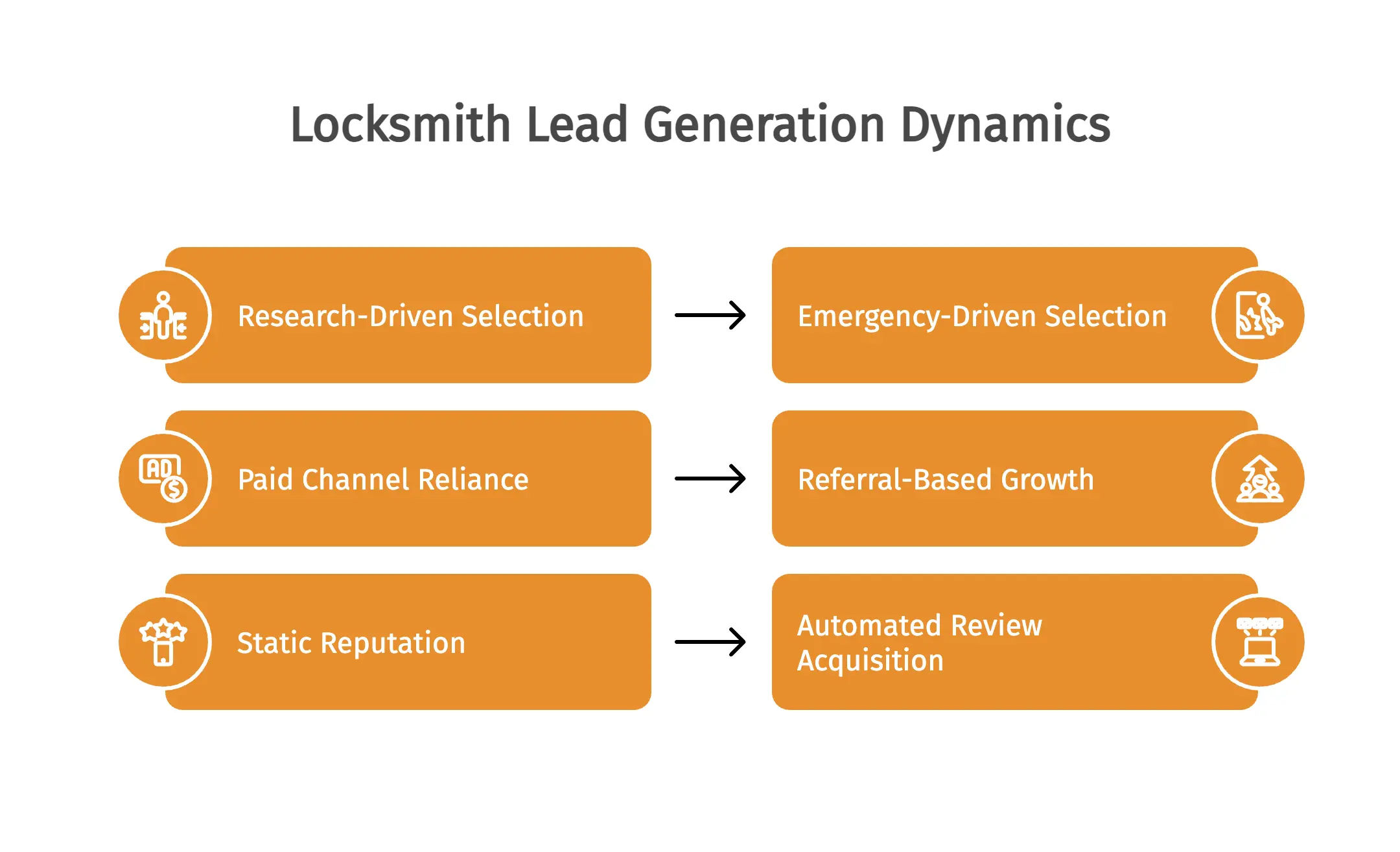
Locksmith demand is driven by emergencies. People often call at 11:00 p.m. from a parking garage using a cellphone with only 12% battery remaining. They're not reading reviews or collecting three quotes. They're calling the first Google result with a clearly visible phone number.
Trust signals still matter earlier in the funnel. BrightLocal's 2024 Local Consumer Review Survey found 92% of consumers read reviews before their first visit, so a shop relying on stale 4-star ratings is compared in real time against competitors collecting fresh reviews after every job. Shops that automate the post-job review ask to report a steady lift in booked calls within a quarter.
Referrals consistently outperform paid channels. Industry benchmarks place referral close rates at around 45% for home service contractors, compared with approximately 18% for Google Ads and 12% for shared lead marketplaces such as Angi and HomeAdvisor. In other words, a referral is about three times more likely to become a booked job.
A pattern across small trade operators, and what one shop did about it
In the small multi-trade shops we've worked with, one issue consistently falls into an ownership gap: responding to customer reviews. Imagine an owner-operator managing a modest multi-trade business with 10 technicians covering plumbing, HVAC, and light electrical work across a mid-sized metro area. The HVAC team assumes the plumbing team is responsible for responding to reviews. The plumbing team assumes the office handles them. Review notifications are sent to a shared inbox that is buried beneath dispatch-related emails for days.
By the second half of the cooling season, this business had accumulated more than a dozen unanswered one- and two-star reviews, several of which mentioned repeated callback issues involving the same furnace installation crew. No one believed responding to those reviews was their responsibility.
The solution was simple. One team member set aside 30 minutes each week to respond to every review from the previous week and tagged complaint-related jobs for discussion during the Monday team meeting. The first attempt didn't work because Fridays were consistently consumed by emergency calls. In the second month, the review session was moved to Monday at 7:00 a.m., before the weekly meeting, and the process became consistent.
Over the next two years, the tone of customer reviews improved, and some previously unhappy customers booked another service after receiving a personal phone call. One even signed up for a maintenance plan. The lead HVAC technician felt some complaints lacked context, so the manager began reviewing those jobs one-on-one instead of discussing them in a group setting.
The same approach applies to locksmith businesses. Because locksmith services are highly emergency-driven, negative reviews can accumulate quickly, and someone must be responsible for responding before they sit unanswered until Monday. This is a composite example based on the most common version of this pattern among the smaller multi-trade businesses we've worked with.
Nine channels that actually generate locksmith leads
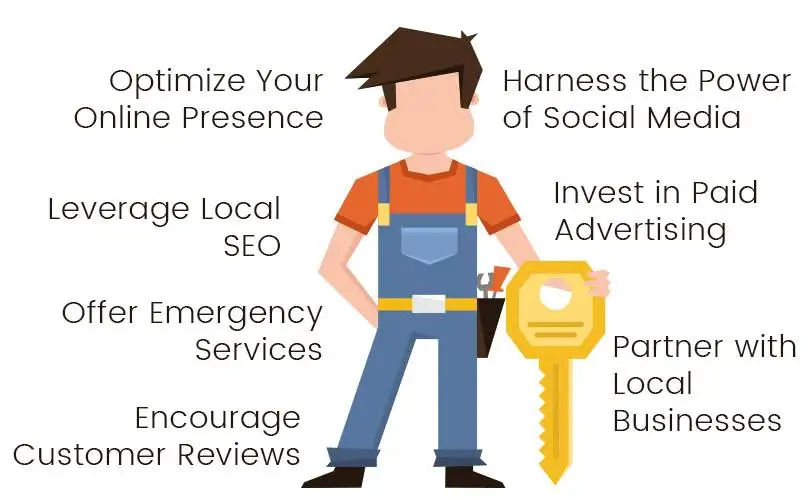
Nine marketing channels do most of the work. They are ranked by cost and by how quickly they generate the first booked job.
1. A locksmith website built to convert, not just exist
Your website is the anchor of your credibility. Commercial clients inquiring about master key rekeying and homeowners planning to upgrade their smart locks often decide whether to contact you based on your website. Make sure your website:
- Loads in less than 3 seconds on mobile devices.
- Displays your phone number in the top-right corner with a sticky header while scrolling.
- Clearly lists your service area, including your city and nearby suburbs.
- Provides a list of services along with pricing ranges wherever possible.
- Showcases your technicians' credentials, license number, and proof of insurance.
- Feeds web-form leads directly into your scheduling and dispatch so leads don't sit in an inbox
2. Claim and complete your Google Business Profile first
Claim your Google Business Profile before any ads. The local 3-pack pulls a click-through rate above 48% on local service searches, so a shop without a claimed, review-rich GBP is handing nearly half of nearby intent to competitors who did claim theirs. Shops close that gap fastest by pairing a complete GBP with automated post-job review asks through a Google review management workflow.
3. Local SEO and content after GBP is dialed in
Once your Google Business Profile (GBP) is fully optimized, focus on local search optimization. This includes using location-specific keywords in page titles, creating service area pages for every ZIP code or city you serve, and building backlinks from local directories and news or press websites. Publishing locally relevant content ("What to Do When You're Locked Out of Your Vehicle in [City]") may take time to deliver results, but it can become a strong driver of long-term organic growth. Most shops begin to see significant organic improvements within six to nine months.
4. Social media is a trust builder, not a lead engine
Facebook and Nextdoor are the two social media platforms that are most relevant for local marketing. Post before-and-after photos of completed jobs (with the customer's permission), community sponsorships, and technician spotlights. Don't expect them to generate emergency calls on the same day. Instead, expect them to influence the Google search results and build trust when someone searches for your business.
5. Paid search and Google Local Services Ads
Pay-per-click (PPC) ads and Local Services Ads (LSAs) can put you on the top right away. LSAs require category-specific verification for locksmiths, including a background check, license verification, and proof of insurance. Verified shops often see their cost per lead decrease significantly within the first 60 days as Google's algorithm gains confidence in their lead acceptance rate. Standard Google Ads also perform well for informational-intent searches, such as smart lock installation and safe cracking, especially in areas where LSA inventory is already oversubscribed.
6. Partnerships with property managers, dealerships, and adjacent trades
Property management firms, dealerships, brokerages, apartment operators, and local hardware stores send steady referral flow if you make it easy. Wharton research shows referred customers have 16% higher lifetime value and 37% higher retention than non-referred. Shops that formalize referral programs (small kickback, priority scheduling for partner-referred jobs) see partner accounts quietly outperform Google Ads on cost per booked job.
7. Emergency and 24/7 positioning, honest version
It's a game of wits, and you shouldn't advertise 24/7 service if you aren't able to staff it. Owners who advertise 24/7 but don't answer a 2:00 AM call won't convert leads and often end up with negative one-star reviews. You can advertise the extended hours you actually maintain, but not aspirational hours you can't support.
8. Reviews are the compounding asset
Harvard Business School research by Michael Luca found a one-star rating increase drives 5-9% revenue lift for independent local businesses on Yelp, and simply being listed lifts sales 5-10%. Shops that automate the post-job review ask (a text sent 30 minutes after completion with a one-tap link) collect 3-5x more reviews than shops relying on techs to remember. Automation matters because emergency customers are already gone by the time a manual ask happens.
9. SMS and email follow-up as a repeat-revenue engine
Litmus and DMA benchmarks put email marketing ROI at $36 per $1 spent. A plumbing customer reviewing Field Promax on G2 described automated SMS follow-ups prompting customers to reply within minutes to schedule the next job, saving their dispatcher hours a week. For locksmiths, the practical mix is quarterly commercial re-key reminders by email and same-week satisfaction checks by SMS.
The response-time gap that kills paid locksmith leads
Industry benchmarks for SMS show that 90-95% of text messages are read within 3 minutes or less, while email responses typically take 90 minutes or more. This response window often determines whether a lead becomes a booked job. Locksmiths who route web-form leads directly to their dispatch boards can assign a technician immediately instead of waiting until the next day. Shops that shorten this response loop book 30% more booked jobs without hiring additional office staff. The issue isn't sales skills - it's the time between when a lead arrives and when someone at the shop becomes aware of it.
Automation closes the lead-to-invoice loop
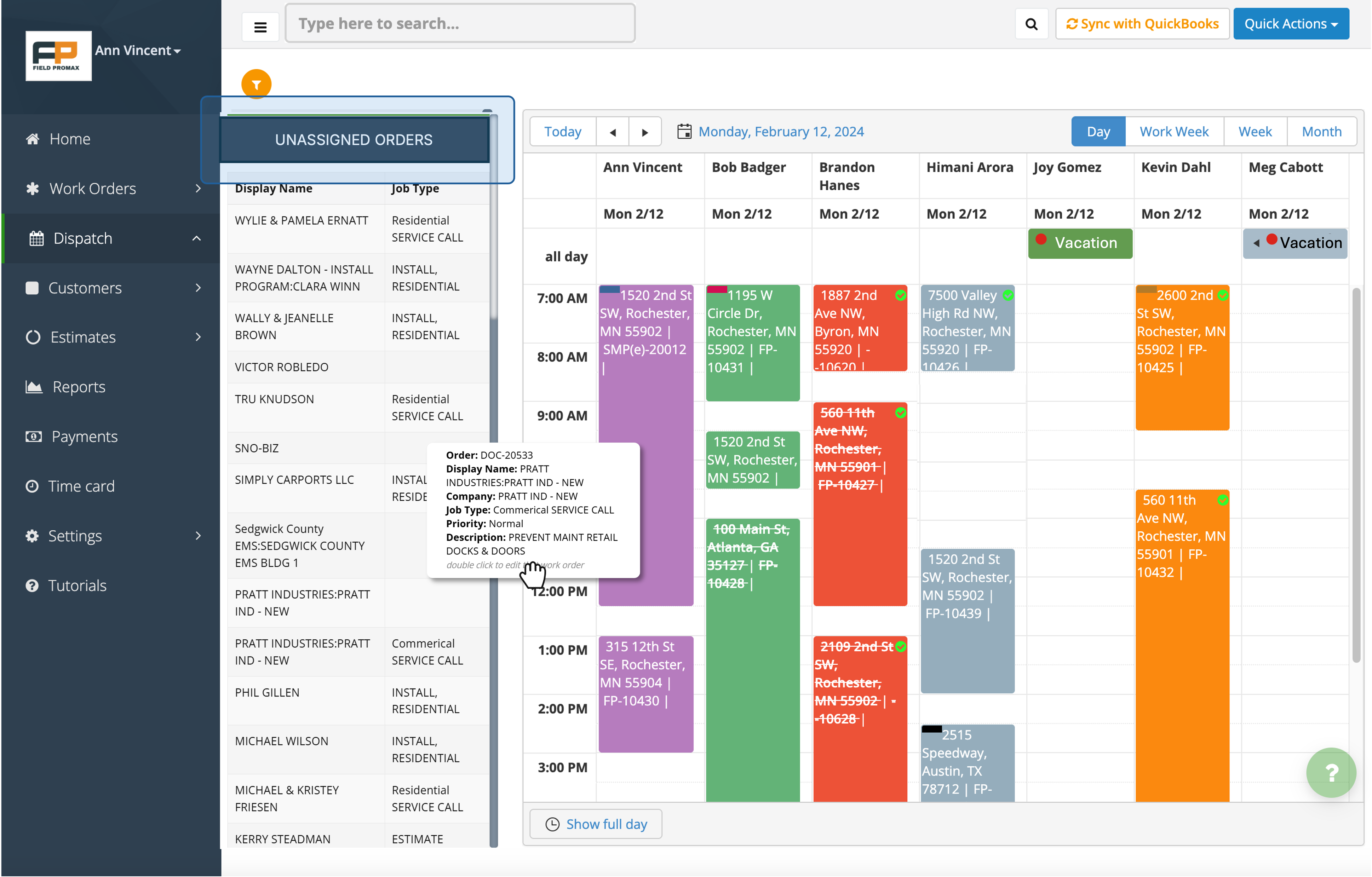
You can generate leads and still lose them if the plumbing between the phone ring and truck rolling is broken. A work order comes in, an estimate goes out, a nearby tech gets assigned, a route lands on the mobile app, and the invoice fires from the job site. Owners consistently report the dispatch-to-invoice workflow as the single biggest lever on close rate.
The field service mobile app lets techs pull job details, customer history, and parts info at the truck, and order parts on the spot. Mobile-app adoption by technicians is the strongest predictor of whether a rollout sticks.
The truth about locksmith lead generation, from 14 years of customer conversations, is that most small shops don't have a lead volume problem. They have a lead answer problem. When we sit with a locksmith owner and look at the last 30 days, the pattern is almost always the same: paid ads and GBP are generating enough calls to hit revenue, but 20-30% hit voicemail because the on-call tech is on a job, the second phone is dead, or dispatch is a spreadsheet nobody has open.
Locksmiths get told they need more marketing. What they usually need is the boring plumbing between the phone ring and the truck rolling. Fix the answer rate, then buy leads.
- Joy Gomez, Founder of Field Promax
The playbook for a small locksmith shop
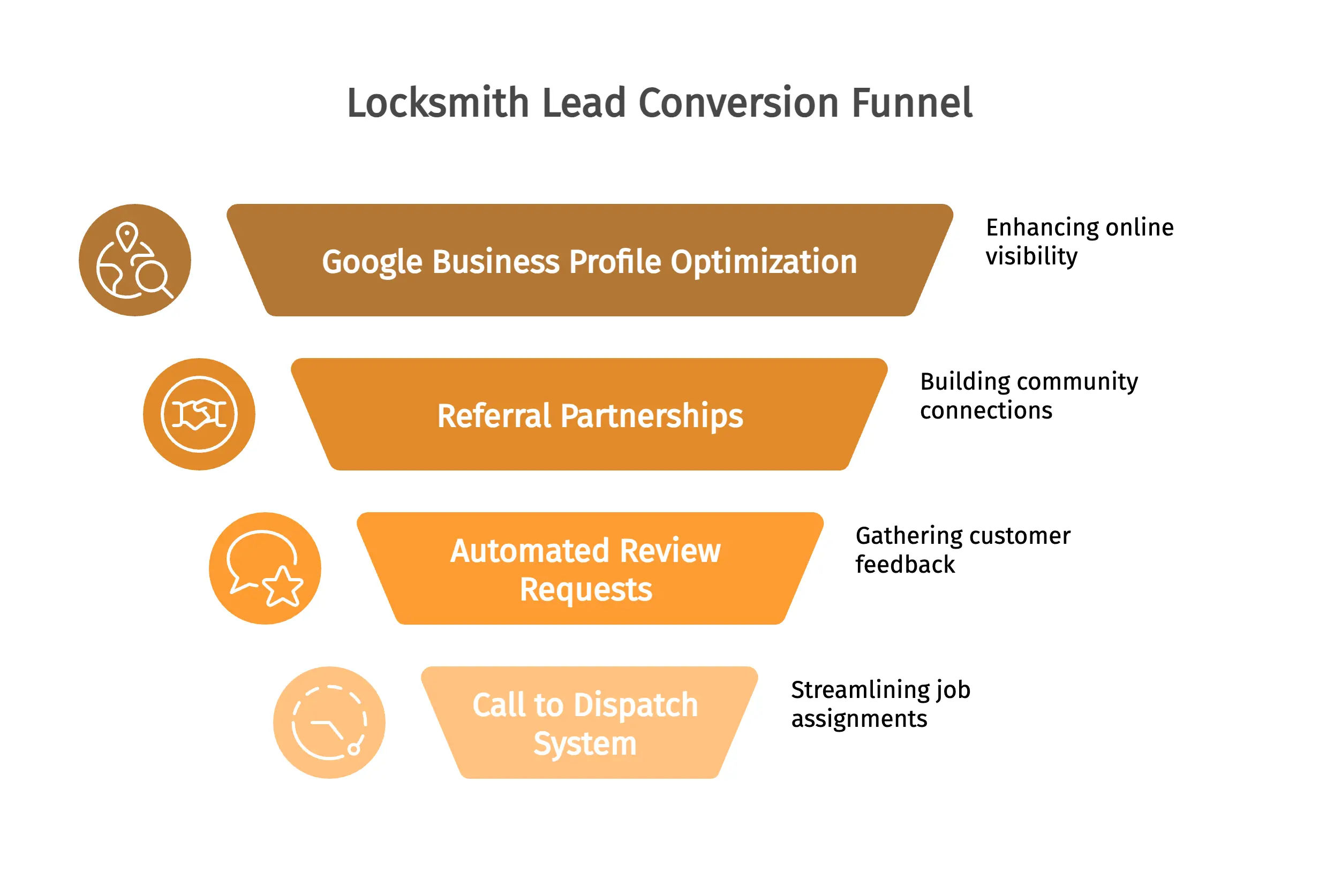
Locksmith marketing in 2026 will be about trust and fast response, not a volume-based game. The channels that work best are local, cost-effective, and supported by smart automation, including a fully optimized Google Business Profile (GBP), active referral partnerships, automated review requests, and a system that turns inbound calls into dispatched jobs. Shops that grow steadily aren't necessarily spending more money - they're answering more calls, responding to reviews more consistently, and keeping their phones staffed after 6 PM.
Locksmith field service software closes the loop between a lead and paid revenue. Get the plumbing right, then buy leads.
Frequently Asked Questions

Content Creator
Bhargavi Halthore is a content writer at Field Promax, a field service management platform serving trades businesses across the USA and Canada. With over a decade of experience writing for business owners, she brings detailed, ground-level insight to every topic she covers. Her research goes beyond search results - she digs into LinkedIn groups, Facebook communities, and Reddit forums to understand what field service business owners are actually dealing with on the ground. She speaks directly with industry professionals, understands their day-to-day challenges, and translates that into content that is practical and actionable. What you read in her articles reflects real industry patterns, not theory.
Reviewed by

Founder and CEO
Joy Gomez is an engineer, process automation expert, and the Founder of Field Promax. Known for his technical expertise and commitment to field service innovation, Joy writes about transforming traditional business models into paperless, efficient operations. He is a Lean Six Sigma Black Belt based in Rochester, MN, dedicated to helping field professionals work smarter through better technology.